Chapter 10- Cell reproduction
 Call Kai
 Learn
Learn Practice Test
 Spaced Repetition
 Match
Match Flashcards
 Knowt Play
1/58

Earn XP
Description and Tags
Chapter 10.1 The cell cycle, 10.2 producing gametes, 10.3 variation in daughter cells (meiosis), 10.4 Cancer
Name | Mastery | Learn | Test | Matching | Spaced | Call with Kai |
|---|
No analytics yet
Send a link to your students to track their progress
59 Terms
List the 5 phases of the cell cycle and describe briefly what occurs in each.
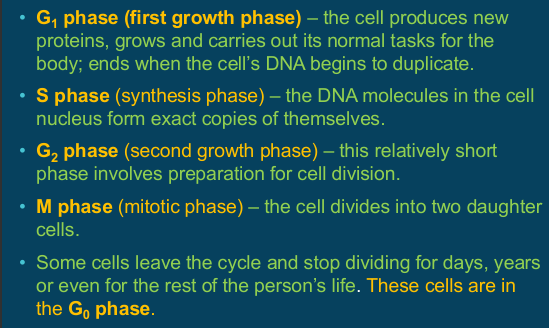
What does mitosis ensure?
It ensures that each body cell receives the exact same hereditary material (DNA) as that possessed by its parent cell.
What are the 4 stages of mitosis (excluding interphase)?
For convenience, biologists describe mitosis in four stages: prophase, metaphase, anaphase, and telophase.
What is interphase and what phases of the cell cycle does it occur in?
The period between nuclear divisions. The cell goes through the G1, S and G2 phases of the cell cycle.
What happens in the S phase, and what does this mean in the period between one cell division and the next?
In the S phase, the DNA molecules in the nucleus form exact copies of themselves—DNA REPLICATION OCCURS. Therefore, in the period between one cell division and the next, the quantity of DNA in the nucleus doubles.
What four steps occur in prophase?
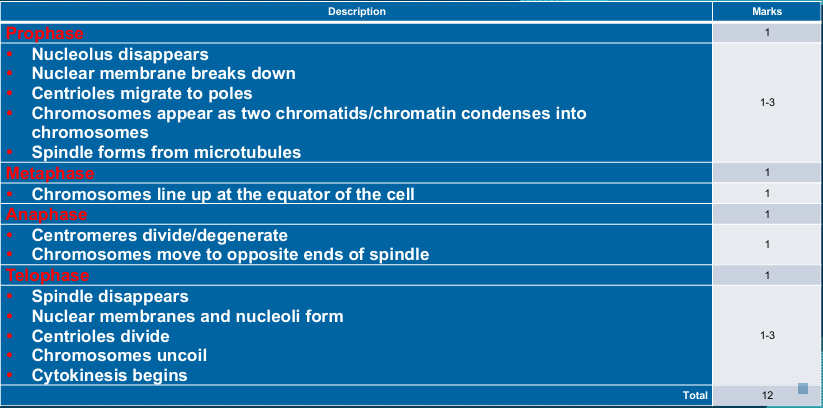
1. Two pairs of centrioles become visible early in prophase.
2. They move to opposite ends (poles) of the cell, and microtubules begin to radiate (form) from them.
3. At the same time, the nucleolus disappears, and the nuclear membrane begins to break down.
4. The chromatin threads of DNA become tightly coiled and can be seen as chromosomes.
What does each chromosome consist of?
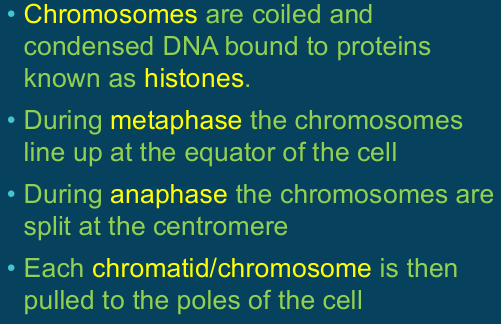
Each chromosome consists of two chromatids, which are joined at a point called the centromere.
What has happened by the end of prophase?
By the end of prophase, the centrioles have reached opposite poles of the cell, and some of the microtubules radiating from them join to form a framework of fibers called a spindle.
What happens in metaphase?
During metaphase, the chromatid pairs line up on the equator of the cell. The centromere of each pair is attached to a spindle fiber.
What occurs in anaphase?
In anaphase, each pair of chromatids separates at the centromere.
What happens to the new chromosomes in anaphase?
The new chromosomes are then pulled away from one another towards opposite poles of the cell.
Structure of Chromosomes and what occurs to them during Metaphase and Anaphase
(past exam question)
What happens in telophase?
During telophase, the two sets of chromosomes form tight groups at each pole of the cell.
A nuclear membrane forms around each group, and a nucleolus appears in each new nucleus.
The spindle fibers disappear, and the chromosomes gradually uncoil to become chromatin threads once more.
Cytokinesis is the division of the cell, and during this process a furrow develops. Where does it develop and what happens to it during cytokinesis?
A furrow develops in the cytoplasm between the two nuclei. The furrow gradually deepens until it cuts the cytoplasm into two parts, each with its own nucleus.
What do mitosis and cytokinesis form?
Mitosis and cytokinesis result in the formation of two daughter cells, which are now in interphase.
mitosis extended response
(past exam question)
What is differentiation?
The process by which cells become specialized.
What are stem cells?
The cells that can undergo differentiation are called stem cells.
What do stem cells differentiate into?
Specialized cells.
What are the different types of stem cells?
Stem cells can be classified based on where they originate (embryonic, adult, or cord blood) or the type of 20 cells that they can form.
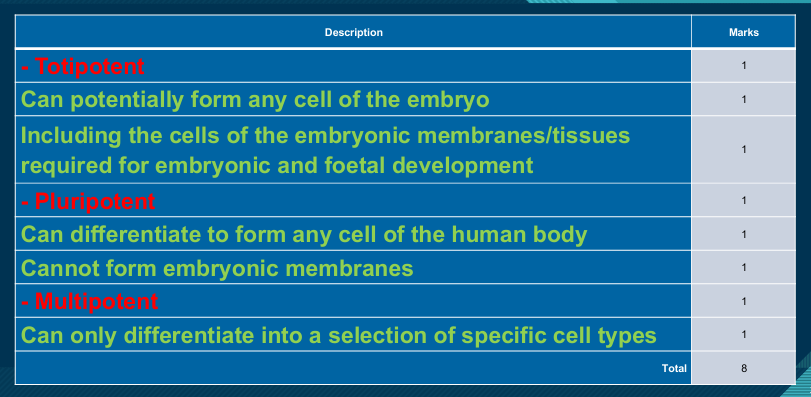
What do totipotent stem cells create?
Create any type of cell necessary for embryonic development, including the embryo itself and all the membranes associated with embryonic development.
Give an example of totipotent stem cells.
cells of the embryo
What type of cells to pluripotent cells give use to? Give an example.
They give rise to any of the cells in the body. Embryonic cells are pluripotent as they differentiate to form all cells of the individual.
What do multipotent stem cells have the potential to become?
Multipotent Stem cells have the potential to form a number of different types of cells.
Summary of 3 cell types
(past exam question)
What does meiosis produce and where?
The gametes, sperm and ova that are produced in the ovaries and testes.
What does meiosis result in?
Meiosis results in daughter cells with half the number of chromosomes that were present in the original cell, known as the haploid number.
What number of chromosomes in our body cells is described as what?
The number of chromosomes in body cells is the diploid number.
Why are our diploid cells described as homologous chromosomes?
Because the chromosomes in diploid cells actually exist in pairs that are identical in shape and carry genetic information that influences the same characteristics.
Describe diploid chromosome number and how many chromosomes are in diploid cells in humans?
Diploid cells are designated 2n, where n stands for the number of different types of chromosomes. The diploid number for humans is 46.
Describe haploid chromosome number and how many chromosomes are in haploid cells in humans?
In gametes, only one of each type of chromosome is present, or n, and therefore they are described as haploid. The haploid number for humans is therefore 23.
What does the process of meiosis involve?
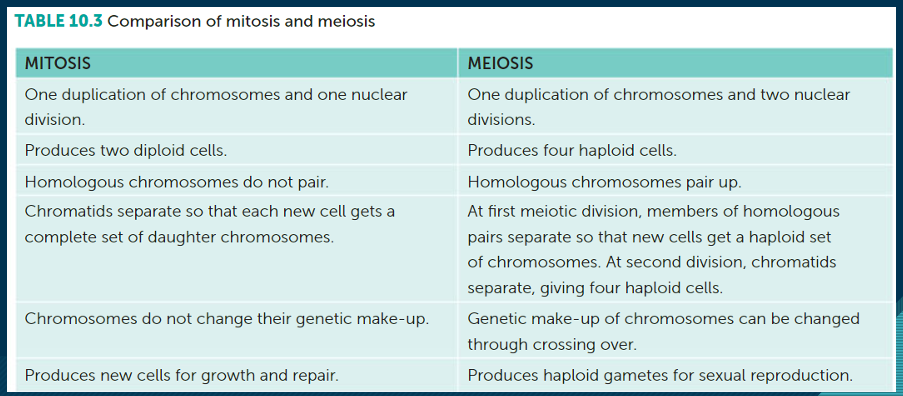
The process of meiosis involves two nuclear divisions, but the chromosomes only duplicate once.
After interphase occurs describe the first and second division that chromosomes go through in meiosis.
First division: The homologous pairs separate, and two daughter cells form with 23 chromosomes, each with two chromatids.
Second division: The chromatids separate, resulting in four daughter cells with 23 chromosomes, each with one chromatid.
When does crossing over occur and what does it ensure?
Occurs in prophase I before the chromosomes line up on the equator in metaphase I. This crossing over is what creates genetically ‘different/unique’ cells.
Comparison of mitosis and meiosis:
Mitosis and Meiosis Comparison - Similarities:
important
• both are types of cell division.
• both start with a diploid cell
• both have same/similar substages or prophase, metaphase, anaphase, telophase
• DNA replication occurs before mitosis/meiosis starts/during interphase
• sister chromatids separate (to different poles) in mitosis and meiosis II
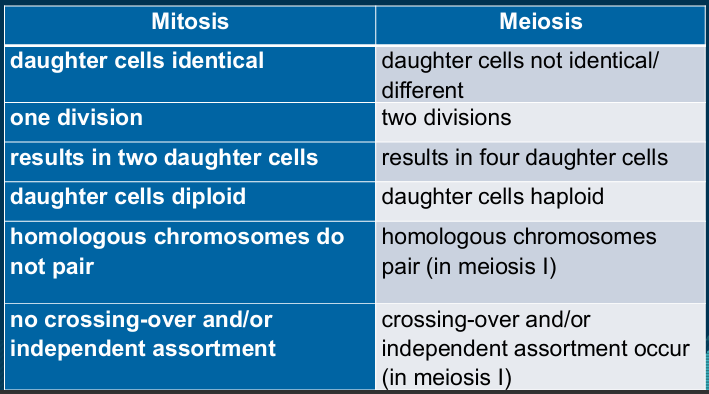
Mitosis and Meiosis Comparison - Differences:
Important
Importance of Mitosis and Meiosis:
Mitosis:
• Helps to repair old/damaged cells/ maintenance
• Needed for growth of organisms
Meiosis:
• Produces sex cells
• Required for sexual reproduction to occur
What is variation of daughter cells a result of?
Variation in daughter cells is a result of crossing over, non-disjunction and random (or independent) assortment.
What is crossing over?
When the homologous chromosomes are paired, the chromatids may cross, break, and exchange segments.
What is the point called where chromatids cross over?
Chiasma
What is the new combination of alleles called when crossing over occurs?
Recombination
How does non-disjunction occur after the first division?
During the first division of meiosis, the homologous chromosomes pair and then separate. Sometimes one or more of the chromosome pairs may fail to separate when the cell divides.
How does non-disjunction occur after the second meiotic division?
In the second meiotic division, one or more of the chromatids may fail to separate.
What does non-disjunction result in?
results in one of the daughter cells receiving an extra chromosome and the other daughter cell lacking that chromosome—(in humans, 45 or 47 chromosomes).
Non-disjunction results in trisomy and monosomy, describe these conditions.
Trisomy is a condition in which an individual inherits an extra copy of a chromosome, 3 copies instead of the normal two.
Monosomy is where an individual is missing a chromosome, they have only one copy instead of the normal two.
What other 2 conditions can also occur?
Partial monosomy and partial trisomy
During the first meiotic division, how are homologous pairs of chromosomes separated and when they do move apart how do they do so?
During the first meiotic division, the homologous pairs of chromosomes separate at random. They do so independently (the way one pair of chromosomes separates is unaffected by the way any of the other pairs separate).
What is the total number of possible chromosome combinations?
The total number of possible chromosome combinations is 223, which is approximately 8.4 million.
What does cancer result from?
Cancer is the uncontrolled/excessive division of cells.
What is the mass of the uncontrolled growth of abnormal cells called?
Tumour.
Tumors can be malignant, what does this result in?
The tumor cells are able to spread to other parts of the body, a process known as metastasis.
These cancer cells use up nutrients/take up the space occupied by non-cancerous cells and inhibit their normal functioning. In this way, secondary tumors may develop in parts of the body well away from the original tumor.
What are benign tumors?
Tumors that are unable to invade normal tissues.
What do benign tumors do, and why can they be dangerous?
grow and press on surrounding tissues and can be dangerous if they exert pressure on vital organs such as the brain.
How come they can be easily removed?
Because a capsule often surrounds them.
What are environmental factors that can trigger malignant tumors called?
carcinogens
List the different causes of cancer:
UV radiation - produces cancer in the skin.
X-rays are known to cause cancer (in Australia, exposure is limited and controlled).
Ionising radiation (such as that produced by radium and ores of uranium) can cause cancer.
Viruses can cause some cancers (the human papilloma virus causes cancer of the cervix in women).
Chemical carcinogens, including alcohol, asbestos, and tobacco tar, can cause cancer with excessive exposure.
List the different methods used to detect cancer early, also mentioning the type of cancer they detect:
Cervical Screening Test + Pap Smear (cervical cancer)
Mammography (breast cancer)
Faecal occult blood test (bowel cancer)
Digital rectal examination, prostate-specific antigen blood test, and biopsy (prostate cancer).
Early Detection of Cancer – Breast Screening and Blood Tests:
(past exam question)
Breast screening allows for the detection of tumors through the use of X-ray/production of a mammogram before they are noticeable by touch or feel.
Blood tests can check for the presence of certain proteins/cells associated with cancer.