Moder Biology: Chapter 44 The Circulatory System
 Call Kai
 Learn
Learn Practice Test
 Spaced Repetition
 Match
Match Flashcards
 Knowt Play
1/79

There's no tags or description
Looks like no tags are added yet.
Name | Mastery | Learn | Test | Matching | Spaced | Call with Kai |
|---|
No analytics yet
Send a link to your students to track their progress
80 Terms
The Circulatory System of the Heart will consists of the?
Heart
Vessels
Fluids
The lymphatic system is an accessory system of?
Vessels and Organs that helps balance the fluid content of blood and surrounding tissues, and participates in the body’s defense against invading disease organisms
The cells of all organisms take in _____________ and ___ from the?
This will eliminate wastes such as?
CO2 in the environment
For very small or very thin animals, movement of these molecules occur primarily by?
Diffusion
For larger animals, the circulatory system will?
Bring fluids close to the cells so that gases and nutrients can be exchanged
Fluid is a?
Specialized medium that carries cells, o2, nutrients, CO2, and wastes
Fluid will play a major role in?
Homeostasis
The heart is the muscle that?
Pumps fluid through the circulatory system
Tubular Vessels will?
Distribute the fluid pumped by the heart
For simple animals like sponges, cnidarians, and flatworms they have no?
Distinct circulatory system
Substances will diffuse between cells and external environment through a?
Internal or external surfaces
In sponges, water will be pumped through the? and exit through?
Pores in body wall
Exit through internal or external surfaces
Cnidarians will have a?
Central gastrovascular cavity with a mouth through which water enters and laves
In an open circulatory system, what will occur?
Vessels leaving the heart release blood like fluid called hemolymph, directly into body spaces (sinuses) that surrounds organs
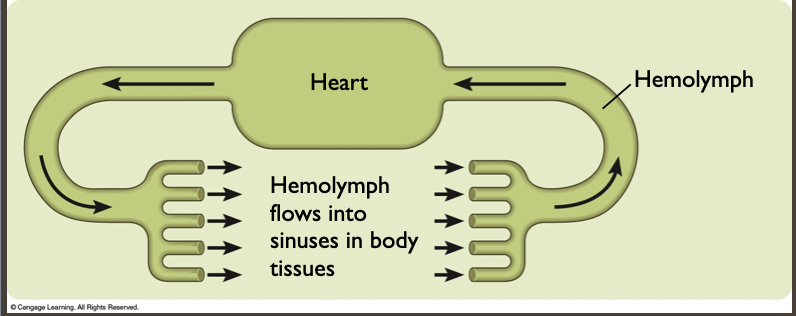
Hemolymph will do what?
Reenter the heart through valves in heart wall
In a closed loop system
The fluid (Blood) is confined to blood vessels and is distinct from the interstitial fluid
In closed loop, substances are exchanged between
Blood and interstitial fluid, then between interstitial fluid and cells
Invertebrates have Open Circulatory System
Arthropods and most mollusks have an?
Open-Circulatory System with one or more muscular hearts
Most of the fluid pressure generated by the heart will do what?
Dissipate when hemolymph is released into sinuses
Most of these open loop animals are relatively sedentary meaning?
Their tissue does not require large amount’s of O2 and nutrients
Annelids, Cephalopod mollusks, and all Vertebrates will have a?
Closed Circulatory System
Arteries will do what?
Conduct blood away from heart at a relatively high pressure
Nutrients and wastes are exchanged between?
Blood and body tissue by diffusion across thin walls of capillaries
Blood will return to the heart through?
Veins- at relatively low pressure
Blood Circuits - 2
Depending on the vertebrate, the heart will consists of? (This is for Blood Circuits - 2)
One or two atria which receive blood returning to the heart
One or two ventricles, which pump blood from the heart
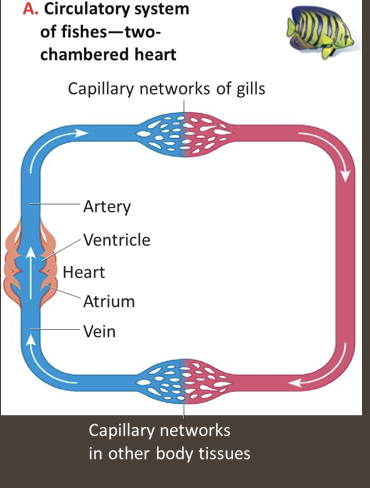
Sharks and bony fish have what?
One atrium and one ventricle
The ventricle will pump blood to?
Capillaries of the gills, where blood releases CO2 and picks up O2
Oxygenated blood is delivered to the capillary networks in other?
Body tissues, where it delivers O2 and picks up CO2
Deoxygenated blood will?
Return to the atrium in veins
Blood Circuits - 3
Turtles,Lizards, and Snakes also have?
2 Atria and 1 ventricle
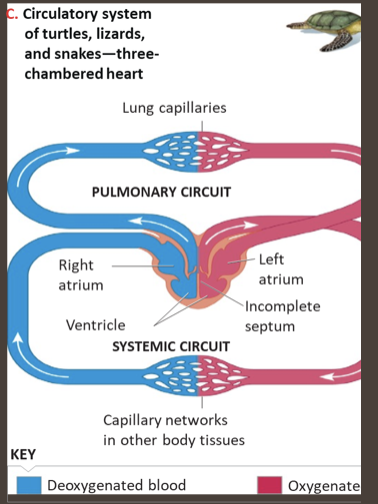
A flap of tissue in the ventricle (incomplete septum) will do what?
Keep oxygenated and deoxygenated blood almost completely sparate
The systemic circuit will?
Carry oxygenated blood to Body Tissue
The pulmonary circuit will carry?
Deoxygenated blood to the lungs
Blood Circuits - 4
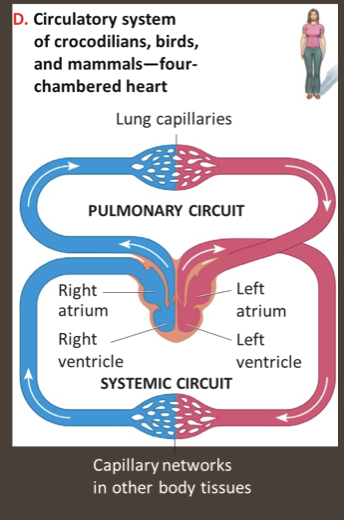
Crocodilians, birds, and mammals will have a?
Double heart consisting of two atria and two ventricles
Each half of the heart will opearate as a?
Separate pump, restricting blood circulation to completely separate pulmonary and systemic circuits
Blood is pumped by a ventricle in each circuit meaning?
Both operate at relatively high pressure
What are the Cellular Components of Blood?
Erythrocytes
Leukocytes
Platelets
What is the Liquid Component of Blood?
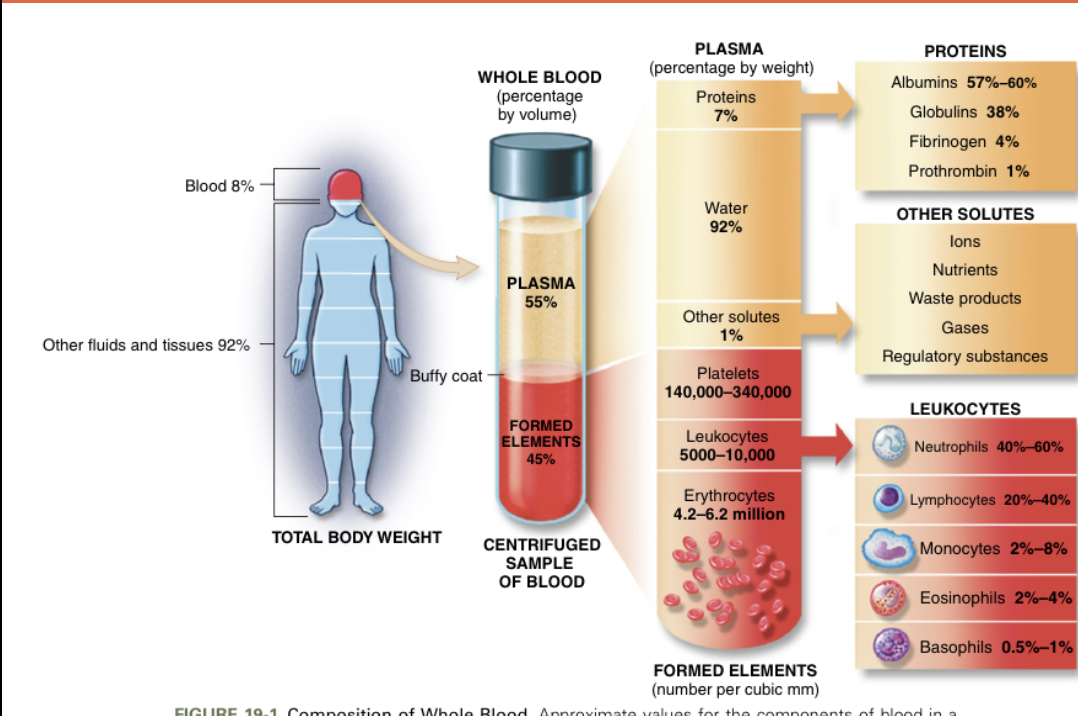
Cells suspended in Plasma (Clear liquid matrix)
What is the Volume and Ratio?
Average adult has 4 to 5 L of Blood
Liquid plasma makes up 55%-58%
The remaining solid components make up Hematocrit
Graph of Whole Blood Components
In Humans, blood cells will develop in the?
Red bone marrow, primarily in vertebrae,sternum, rubs, and pelvis
Blood cells originate from the?
Pluripotent stem cells, which retain the embryonic capacity to divide
Pluripotent stem cells will differentiate into two cells being?
Myeloid
Lymphoid
Myeloid stem cells give rise to?
Erythrocytes
Platelets
Neutrophils
Basophils
Eosinophils
Monocytes
Lymphoid Stem cells will give rise to the?
B lymphocytes and T lymphocytes
Blood distributed diagram

What are the 3 functions of blood?
Transport cell and molecules
Stabilize pH and salt composition
Regulate body temperature by transferring heat
What are the components of Blood Plasma?, their is a lot….
Water (91%–92%)
Glucose and other sugars
Amino acids
Plasma proteins
Albumins are important for osmotic balance and pH buffering
Globulins transport lipids and fat-soluble vitamins
Fibrinogen is essential in blood clotting
Most plasma proteins are synthesized in the liver
Dissolved gases mostly O2, CO2, and N2
Ions - Na+, K+, Ca2+, Cl–, and HCO3–
Some ions, particularly bicarbonate, help maintain pH, which in humans is slightly basic at pH 7.4
Lipids
Vitamins
Hormones and other signal molecules
Metabolic wastes, including urea and uric acid
Erythrocytes are disc-like cells containing large quantities of
O2-carrying protein hemoglobin
Mammalian erythrocytes will lose their? (Hint: Their are 3, THINK CELLS)
Nucleus
Cytoplasmic organelles
Ribosomes
(Limiting their life span)
What metabolic process occurs in erythrocyte cytoplasm, and what is most of the ATP used for?
Erythrocytes perform glycolysis in the cytoplasm, and most of the ATP produced powers active transport pumps that move ions in and out of the cell.
Hemoglobin has four __________, each attached to a heme group with a central __________ that binds O₂, releasing O₂ into the?
Polypeptides
Iron Atom
Releasing O₂ into the other body tissues
Hemoglobin also combines with Carbon Monoxide (CO), which can do what?
CO, can block hemoglobin’s ability to combine with O₂, quickly leading to death
What is the Mechanism of action for Hemoglobin Production?
O2 carrying capacity drops below normal levels in blood
Kidneys detect that, and secrete erythropoietin into the blood
Erythropoietin stimulates erythrocyte producing in bone marrow, where new enters bloodstream
Additional circulating erythrocytes increase O2 carrying capacity of blood
How much erythrocytes are produced in average human each second?
2 million to 3 million
The lifespan of an erythrocyte is about _____ ____, after which they will be?
120 days
Engulfed and destryed by macrophages in spleen, liver, and bone marrow
What mechanism controls the number of erythrocytes?
Negative feedback mechanism
(If blood O2 content drops, the kidneys release erythropoietin (EPO) which stimulates stem cells in bone marrow to increase erythrocyte production)
For Type A blood what is the Cells (donor), and Plasma (Recipient)
Surface Antigen A (donor)
Anti-B Antibodies (recipeint)
For Type B blood what is the Cells (donor), and Plasma (Recipient)
Surface Antigen B (D)
Anti-A antibodies (R)
For Type AB blood what is the Cells (donor), and Plasma (Recipient)
Surface antigens A and B
No Antibodies
For Type O blood what is the Cells (donor), and Plasma (Recipient)
No surface antigens
Anti-A and Anti-B Antibodies
What are the Genotypes for each Blood Type?
IA IA or IA i for A type
IB IB or IB i for B type
i i for O type
IA IB for AB
An Anemia is a disorder of the erythrocytes where there are?
Too few or malfunctioning erythrocytes, which prevent O2 from reach body tissue in sufficient amounts
Anemias can also be produced by? (Hint: Their are 3)
Blood loss from a wound
Certain Infections
Dietary insufficiencies
Leukocytes or White blood Cells will do what? (HintL Their are 3 things to note)
Eliminate dead and dying cells
Remove Cellular debris
Defend against invading organisms
What is something Leukocytes do, that Erythrocytes don’t
They can retain their nuclei, cytoplasmic organells, and ribosomes as they mature
Some leukocytes will continue to do what?
Divide in blood and tissue, and have specific functions in immune system
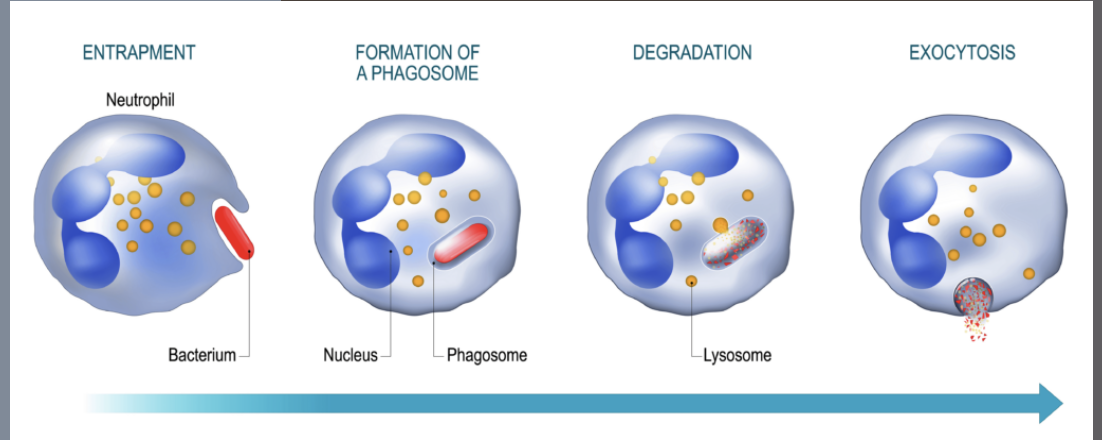
Process of Phagocytosis
Blood Platelets are small vesicles that contain?
Enzyme’s and other factors for blood clotting
When blood vessels are damaged, platelets in leaking blood will do what?
Stick to collagen fibers, then release signals that induce additional platelets to stick to them, forming a plug
Platelets will release ______ that converts soluble _______ into _____, which forms a blood clot
Thrombin
Fibrinogen
Fibrin
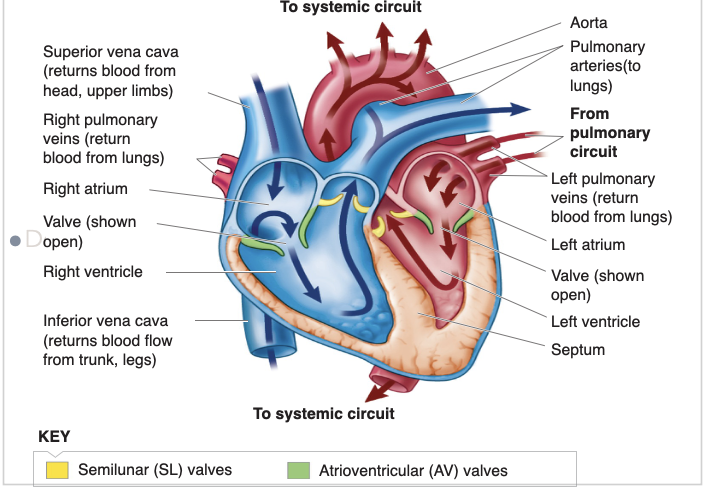
In mammals, the heart is a four-chambered pump with?
Two atria at the top pumping blood into two ventricles at the bottom
Ventricles will pump blood at a?
Relatively high pressure into arteries leaving the heart
What are the valves in the heart, that keep blood from moving backwards
Atrioventricular (AV) valves between atria and ventricles
Semilunar (SL) valves between ventricles and arteries leaving the heart (aorta and pulmonary arteries)
Human Heart diagram