24. Anesthesia and analgesia part 1
 Call Kai
 Learn
Learn Practice Test
 Spaced Repetition
 Match
Match Flashcards
 Knowt Play
1/95

There's no tags or description
Looks like no tags are added yet.
Name | Mastery | Learn | Test | Matching | Spaced | Call with Kai |
|---|
No analytics yet
Send a link to your students to track their progress
96 Terms
What are the requirements for an adequate veterinary Care program? (Hint: there are a total of 8 requirements see chapter 4 of the Guide)
Veterinary care program consists of mgmt of:
1.Animal procurement and transportation
2.preventive medicine (including quarantine, animal biosecurity, and surveillance)
3.clinical dz, disability, or related health issues, and assessment of animal well-being)
4.Protocol associated dz, disability and other sequelae
5.Surgery and perioperative care
6.Pain and distress
7.Anesthesia and analgesia
8.Euthanasia
How do bird react to opiods?
the effects of opioids are very unpredictable in birds
Recommended acclimation period
24 to 72 hr
According to the International Association of the Study of Pain (IASP), what is the definition of pain? What is the definition of chronic pain?
an unpleasant sensory and emotional experience associated with actual or potential tissue damage, or described in terms of such damage"
3 months of pain → chronic
What is the 1° excitatory neurotransmitter released by nociceptive terminals that is released in response to brief or low intensity noxious stimuli?
Glutamate
What are the different nerve fiber for conduction? conduction speed?
Aβ → fast conduction; touch and proprioception
Aδ → Intermediate conduction; thermal and mechanical; sharp, rapid pain
C → slow conduction; mechanical, thermal and chemical; dull, aching pain
What are the Inhibitory neurotransmitters?
GABA (GABAA and GABAB) & Glycine
Serotonin and norepinephrine
What are the 5 phases of Nociceptive pain occurrence?
1) Transduction, 2) Conduction, 3) Transmission, 4) Modulation, 5) Perception.
What is Analgesiometry?
quantitative sensory testing such as
Thermal assays
- Mechanical assays: dynamic (triggered by brushing), punctate (triggered by touch) and static (triggered by pressure)
- Chemical assays
What does Cold plate test do?
Determines behavioral responses to both noxious and innocuous cold temperatures in both mice and rats
Response time recorded (time to display nociceptive behavior- shaking, jumping, or licking)
Number of flinches over set period of time recorded
What does Acetone Evaporation Test do?
Measures aversive behaviors triggered by evaporative cooling and is typically considered as a measure of cold allodynia
What does Cold plantar assay do?
Animal is placed on a glass floor and a cold stimulus is delivered by applying a cut off syringe filled with dry ice or wet ice to the glass under the paws
What does Temperature preference assays do?
Rodents are allowed to freely move between a reference plate (neutral temperature) and test plate. The time spent on the test plate relative to the reference plate is measured over a set period of time.
(A) Two-temperature choice assay
(B) Continuous temperature gradient assay
What is used in Tail-Flick Test or Tail Withdrawal Test as heat source?
Tail-Flick Test (radiant heat)
Tail-Withdrawal Test (hot water, 46-52 C)
What does Hot-plate Test do?
measure latency to hindpaw licking and/or shaking, or jumping, then animal removed from hot plate
thermal sensitivity unconfounded by stress-induced analgesia associated with restraint
sensitive to repeated measurements, likely via learning
What does Radiant Heat Paw-Withdrawal (Hargreaves') Test do?
light beam focused onto hindpaw; when animal lifts/shakes/licks hindpaw, stimulus terminates
allows independent testing on both sides of body
What does Randall-Selitto test do?
withdrawal from pressure applied to paw; common in rat; not practical in mouse due to necessary restraint
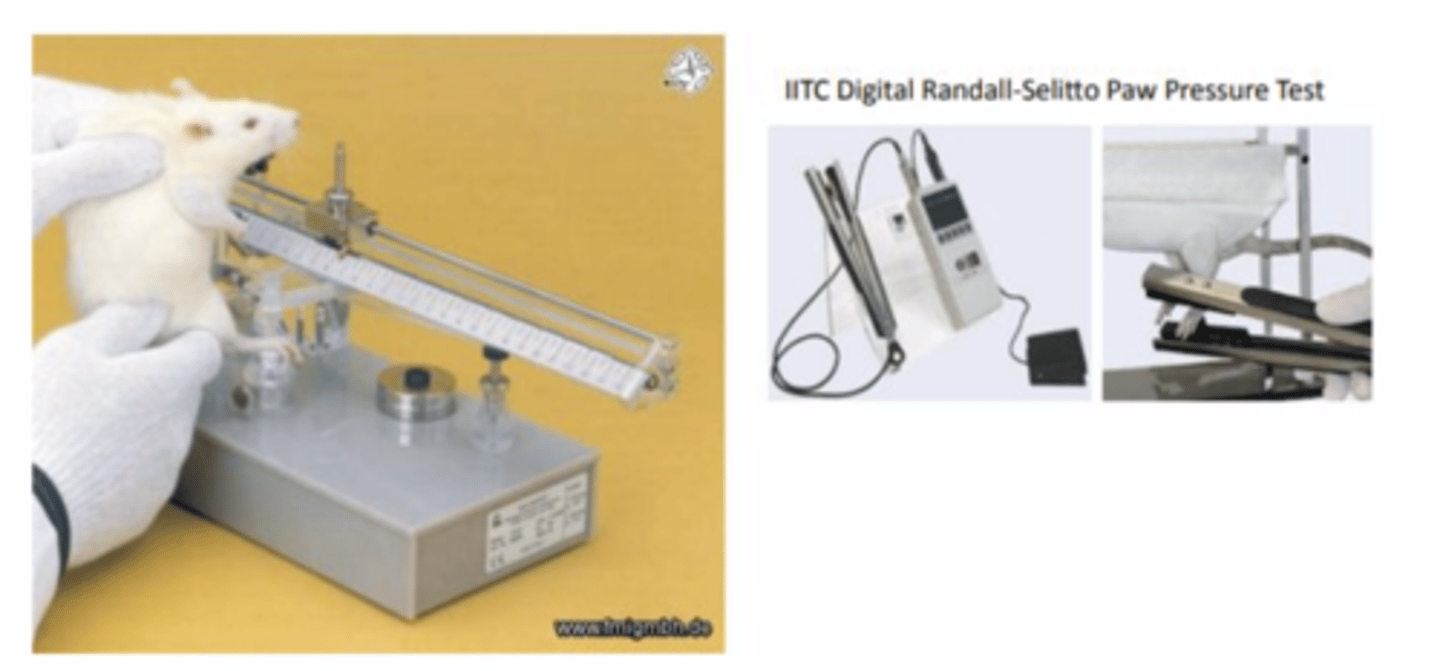
What does Tail-Clip Test do?
constant suprathreshold pressure stimulus is applied to tail; metal artery or binder clip applied to tail at base - latency to lick, bite, grab, or bring nose to w/in 1 cm of clip is recorded; extremely sensitive to repeated testing
What does Von Frey Filament Test do?
nylon fibers vary in diameter & are calibrated to exert a maximal vertical force at point of bending; positioned in plexiglas cubicle on wire mesh floor, fiber applied to plantar surface of hindpaw; rodents display significant variability (even within strain)
What does Formalin Test do?
SQ injection of 1-5% formalin in dorsal or plantar surface of hindpaw → licking & biting in hind paw, short lasting
What does Abdominal Constriction Test do?
experimental model of visceral pain; acetic acid most commonly used irritant - injected IP; animals scored for presence/absence of "writhing" for 30-40 mins post-injection
What are used to create Orofacial Pain Models?
Injection of inflammogens (mustard oil) into TMJ as model of orofacial pain
Transection of the trigeminal nerve used to model neuropathic pain of the face and mouth
What are used to create Muscle Pain Models?
Unilateral injection into gastrocnemius muscle of carrageenan or acidic saline produces acute inflammation with edema and produces mechanical and thermal hyperalgesia
What can be used to induce arthritis?
collagen, oil, pristane (induces autoimmune disease in rodents), streptococcal cell wall
Adjuvant-Induced Arthritis
A reactive arthritis, sometime called Reiter's Syndrome,
What is the mode of action of GABA?
Transmembrane chloride conductance increases when the GABA A receptor is activated, resulting in postsynaptic cell membrane hyperpolarization and postsynaptic neuron resistance to stimulation by excitatory transmitters.
GABA Receptor Agonists
Barbiturates and propofol- decrease the rate of dissociation of GABA from its receptor, thus increasing the duration of the GABA-activated opening of chloride channels
Barbiturates also can mimic the action of GABA by activating the chloride channels directly
Etomidate augments GABA-gated chloride currents (indirect modulation), and produces chloride currents in the absence of GABA at higher concentrations (direct modulation).
Characteristics of Barbiturates: route
High alkaline pH limit route to IV but also PO
Effect: good hypnotic, poor analgesic- better classified as a sedative hypnotic
Impact of Barbiturates on physiology
↓ cerebral blood flow (CBF), ↓ Intracranial Pressure (ICP), ↓ Cerebral metabolic rate of oxygen (CMRO2) = useful for brain surgery
↓ body temperature
↓ blood pressure
↓ renal blood flow
↓ Pack cell volume (PCV) in dogs, miniature swine and mice
What is the glucose effect when using barbiturate?
Reanesthetization ("Glucose effect"): glucose administration to animals recovering from barbiturate anesthesia can result in re-anesthetization
Barbiturates (Thiobutabarbital) is inactive and can be lethal to which species?
rabbit
Characteristics of Barbiturates (Pentobarbital)
Rapid onset, Non-irritating, Ease of IP injection
Generally impaired cardiovascular effects (less with IP)
Inconsistent analgesia in mice, rats and rabbits
Characteristics of Metomidate & Etomidate
No analgesic effect (both), strong muscle relaxant (metomidate)
Minimal cardiorespiratory effect (long term continuous infusion)
Metabolized in the liver, excreted in urine
It is an imidazole, so it inhibits adrenal steroidogenesis through inhibition of 11 beta hydroxylase
Side effects of etomidate
Pain on injection
Nausea/vomiting
Myoclonic movements at induction- follow with IV diazepam to reduce
Side effects of Propofol
Apnea is common in most species except rhesus
Hypotension- concern for use in patients with CV disease
Rapid recovery, little cumulative effect- use as continuous infusion agent
Poor analgesic
Metabolized by the liver, excreted by kidney
Greyhounds have slower clearance
Propofol is Less effective in which species?
rabbit
What does daily administration of propofol in cats cause?
Heinz body formation
Why isn't propofol CRI recommended for C-section anesthesia?
crosses the placenta in a sheep model and reaches the fetus within 2 minutes of administration
What does propofol have impact on the brain?
decreases cerebral oxygen consumption, reduces ICP, and has anticonvulsive activity
What are some of the advantages of Steroidal Anesthetics (Alphadolone/Alphaxalone) Alfaxalone?
Rapid induction with rapid recovery, wide safety margin
Anticonvulsant effects similar to pentobarbital in rats but high incidence of myoclonic jerks occur in mice.
Minimal cardiovascular and pulmonary effects
can be effectively delivered by the i.m. route
Sides effects of Alfaxalone?
hypothermia, apnea, hypotension, hypoxemia, vocalization, muscle tremors
What are some of the advantages of Benzodiazepines?
Sedative, anxiolytic, muscle relaxant, anticonvulsant, no analgesia
Minimal cardiovascular and respiratory effects
Differences between solubility of zolazepam, diazepam and midazolam?
Diazepam - insoluble in water
Midazolam - water soluble
Zolazepam - is water soluble
What is the Antagonists of Benzodiazepines?
Flumazenil
Which of the following is most commonly used in rat renal studies:
a. Ethylmalonyl urea (thiobutabarbital)
b. Alpha chloralose
c. Diazepam
d. xylazine
a. Ethylmalonyl urea (thiobutabarbital)
Which of the following GABA agonists have a narrow margin of safety and are not recommended for use in rabbits?
a. Alpha chloralose
b. tribromoethanol
c. thiopental
d. alphaxalone
c. thiopental
What is the mechanism of Ketamine (NMDA Antagonist) and its effect?
Blocks NMDA receptor (blocks glutamate an excitatory neurotransmitter)
Mild local anesthetic effect by Na+ channel inhibition
Analgesia: musculoskeletal > visceral
High lipid solubility
Rapid induction
Pain on injection, muscle necrosis due to pH (3.5)
Metabolized in liver by P450 pathway, excreted by kidney
What impact does ketamine have on physiology?
Cardiovascular → causes increased myocardial contractility in some species/ arrhythmogenic potential
Respiratory→ Bronchial muscle relaxation and decreased respiratory rate (sympathomimetic)
↑ CBF/ICP (not in rats)
Myoclonic and seizure like activity
What is the reaction Tiletamine (NMDA Antagonist) in rats/mice with low dose versus high dose? Which species doesn't it work?
Low dose: excitation rats/mice
Higher dose: anesthesia produced except rabbits/guinea pigs
IM -rabbits (renal tubular necrosis), ↑ BUN/creatinine
Mild nephrosis (histologically)
Which species are very sensitive to Xylazine (Alpha 2-Adrenoceptor Agonists)? Which species is resistant?
Horse and goat; pig
Side effects of Xylazine?
Dose dependent bradycardia
Dogs- 2nd degree AV block
Initial transient increase in MAP followed by decrease
Decreased CO - ↑ vascular resistance + ↓ HR, arrhythmias
Hypoxemia -sheep
↓ insulin release→ hyperglycemia
Diuresis, ↑glomerular filtration and polyuria
↓ GI motility
Hypothermia (in Rhesus)
Vomiting especially cats
Advantages of xylazine
Analgesia
Rapidly absorbed IM
Minimal respiratory depression
Antagonist of xylazine?
Yohimbine (prototypical reversal); atipamezole
Compared to Xylazine, Dexmedetomidine (Alpha 2-Adrenoceptor Agonists) is more?
More potent
Higher Alpha2-adrenoceptor selectivity
More lipophilic
Faster elimination
Analgesia - most species (inconsistent in rabbits, G pigs, pigs, hamsters)
Antagonist of Dexmedetomidine?
atipamezole
Detomidine can provide Sedation and analgesia in mice/rats but it does not lead to loss of _____?
righting reflex
Which of the following is not correct regarding dexmedetomidine?
a. Can be reversed by atipamezole
b. Analgesia is inconsistent in rodents
c. It rapidly crosses the blood brain barrier
d. It has higher alpha-2 receptor selectivity than xylazine
B (rabbits, gpigs, pigs, hamsters)
Consistent in most species including rodents- inconsistent in rabbits, gpigs, pigs, and hamsters
Acepromazine (Dopaminergic Receptor Antagonists)
Sedative phenothiazines
Tranquilizer effects
What is the mechanism of Dopaminergic Receptor Antagonists?
Sedative effect - antagonistic actions of H1 histamine receptors
Tolerance to sedation effect can occur
Calming effect- antagonism of D2 dopamine receptors in forebrain
What impacts does acepromazine have on physiology?
Cardiovascular- Hypotension with↓ CO, systemic vascular resistance not affected
Respiratory- ↓ RR, minimal effect on blood gas
Renal blood flow and glomerular filtration is maintained during hypotension - acepromazine
Hyperglycemia
↓ Hct (splenic sequestration)
↓ GI secretions
Antipyretic/antiemetic/antihistaminic
What is the mode of action of Eugenol (clove oil)?
through vanilloid receptor 1 (VR1) antagonism
Affinity toward GABA and NMDA receptor also demonstrated
Analgesia/anesthesia
Paralytic (nicotinic receptors)
Mainly used in fish and amphibians
Side effects of Eugenol (clove oil)?
Hypoxemia, hypercapnea, acidosis, hyperglycemia
What is the mechanisms of action of Local Anesthetics?
stop the inflow of sodium and nerve depolarization is prevented
What is in EMLA cream?
lidocaine 2.5% and prilocaine 2.5%
What can be used to buffer MS-222? what's the ratio?
2 parts sodium bicarb to 1 part MS-222
What is the side effect of Halothane in pigs?
Malignant hyperthermia in pigs
Duroc, Yorkshire, Poland China, Landrace, Pietrain
What can be used to treat Malignant hyperthermia?
Dantrolene sodium
Side effects of Isoflurane? effect on cerebral blood flow?
Myocardial depression/ decreased vascular resistance - dose dependent → decreased blood pressure
Respiratory depressant
Cerebral blood flow is also not increased if ventilation is maintained
Sevoflurane can cause renal and hepatic toxicity because it can produce _____?
Decomposes in soda lime producing a toxic compound olefin -compound A
What is the recommended flow rate for sevoflurane to prevent degradation?
flow rate in excess of 20 ml/kg/min
Order the onset time from the fastest to the slowest: Desflurane, isoflurane and sevoflurane
Desflurane > sevoflurane > isoflurane
Why should acetaminophen (P-Aminophenol Derivatives) be avoided in cats?
Cats lack the ability to metabolize through glucuronidation resulting in methemoglobin
Which COX inhibitor is Etodolac (Acetic Acid Derivatives)?
dual COX inhibitor with selectivity for COX-2
Which COX inhibitor are Ibuprofen, ketoprofen, naproxen, carprofen?
Ibuprofen, ketoprofen, naproxen, carprofen
Inhibit both COX-1 and COX-2
Carprofen is 1° COX-2
What is the side effects of COX inhibitor
GI effects- ALL
Alter platelet function ↑ bleeding time
Piroxicam (Oxicams) is Contraindicated in which species?
cats
What should be taken into consideration when using meloxicam in cats?
should only be used as a single dose for postoperative pain, because longer use will result in GI side effects, as would be expected from the higher COX-1 activity in this
What is the cox inhibiting selectivity of meloxicam?
Selective COX-2 dogs, not so selective in cats
What is the cox inhibiting selectivity of Flunixin (Nicotinic Acid Derivatives)?
COX-1 selectivity- dogs and horses
Examples of COX-2 inhibitors?
Celecoxib, deracoxib, firocoxib
Robenacoxib (for cats)
Carprofen
Meloxicam
What type of COX inhibitor is Tepoxalin (Zubrin®)? pros of this drug?
Dual COX and LOX inhibitors
COX inhibition: thromboxane, prostaglandin E2
LOX inhibition: leukotrienes in blood/stomach
almost exempt from gastric toxicity
does not cause neutrophil adhesion in blood vessels
Morphine agonist for which receptor? delta (δ), kappa (κ), mu (μ)
mu (μ)
Characteristics of morphine
drowsiness, respiratory depression, ↓ GI motility, nausea, vomiting, ↓ gastric motility and hydrochloric acid secretions in stomach
Produce vasodilation, ↓ peripheral resistance
May induce histamine release
Mania in cats
↓ NK cell activity, impair immunoglobulin production, suppress phagocytosis
Absorbed well from GI (subject to 1st pass removal by liver), SQ, IM also transdermal and epidural
Crosses BBB slower than other lipid soluble drugs
Which animal species doesn't morphine work?
does not appear to affect ruminant animals
Butorphanal agonist for which receptor? delta (δ), kappa (κ), mu (μ)
kappa (κ), more μ antagonist than agonist.
Fentanyl agonist for which receptor? delta (δ), kappa (κ), mu (μ)
mu (μ)
Characteristics of Fentanyl
80X more potent than morphine
Muscle rigidity, respiratory depression in dose-related manner
Buprenorphine agonist for which receptor? delta (δ), kappa (κ), mu (μ)
partial agonist of mu (μ), antagonist kappa (κ),
Characteristics of Buprenorphine
Schedule III
25X more potent than morphine given IM
Analgesia ceiling effect
Rats- excreted in bile, enterohepatic recirculation, Pica
Duration 3-5 hrs mice, 6-8 hrs rats, 6-7 hrs dogs
Characteristics of Gabapentin
structural analog of GABA, but actually has little interaction with GABA receptors
MOA unknown
Used to treat neuropathic pain and non-neuropathic pain.
Did not outperform buprenorphine
The neuroactive drug 3α-Hydroxy-5α-pregnane-11,20-dione works by acting on which receptor?
a) NMDA antagonist
b) GABA A agonist
c) GABA B agonist
d) α2 agonist
e) α2 antagonist
B. Alphaxalone; GABA A
Which of the following is true about the use of tricaine methanesulfonate in fish?
a) It has a large margin of safety and exhibits dose dependent sedation and anesthesia
b) It is equally efficacious between larvae and adult fish
c) Fish never show aversion if buffered properly
d)It can be stored at 4°C for up to 6 months in an amber bottle
D
In Xenopus laevis, this substance (MS-222) interferes with ______, resulting in general anesthesia.
A)Chloride channels
B) Potassium channels
C)Sodium channels
D)Uptake of GABA A
E)Uptake of GABA B
D
Which of the following best describes the action of alfaxalone?
A) Blocks nerve conduction by decreasing or preventing transient increase in permeability to Na
B) Produces a dopamine blockage with alpha-adrenergic antagonism
C) Provides sedation and analgesia by stimulation central alpha2-adrenoreceptors
D) Steroidal anesthetic that acts on GABA chloride channels
D
Which of the following is a COX-2 preferential inhibitor in rodents?
A)Meloxicam
B)Ketoprofen
C)Ibuprofen
D)Naproxen
A
Which one of the following statements IS NOT correct regarding the substance (gabapentin) pictured?
A)It is a structural analog of GABA (γ-aminobutyric acid)
B)It was originally developed as an antiepileptic drug
C)It preferentially inhibits cyclooxygenase 2 secondarily to prostaglandin synthesis
D)It has analgesic potential in neuropathic pain models
C
Which of the following species is very sensitive to the effects of xylazine and may require only one tenth or less of the xylazine dose used in other species?
A)Capra hircus
B)Cavia porcellus
C)Mustela putorius furo
D)Sus scrofa
E)Callithrix jacchus
A)Capra hircus