Fluid & Electrolytes
 Call Kai
 Learn
Learn Practice Test
 Spaced Repetition
 Match
Match Flashcards
 Knowt Play
1/34

There's no tags or description
Looks like no tags are added yet.
Name | Mastery | Learn | Test | Matching | Spaced | Call with Kai |
|---|
No analytics yet
Send a link to your students to track their progress
35 Terms
How much body water in infants?
73%
Adult Males?
60%
Adault females:
50%
What does this decrease to in old age?
45%
Total body water in an average person? (L) How is it divided?
40L
Intracellular fluid 40% 25L
Extracellular fluid 20% 15L
Interstitial fluid 80% of ECF 12L
Plasma 20% of ECF 3L
Water is a _____
Universal solvent, lots of things can dissolve in water and become solutes
What is classified as a nonelectrolyte? What do they form?
Does not dissociate in water: e.g., glucose, lipids, creatine, and urea
No charged particles created
What is an electrolyte? What do they form? What do they do better than nonelectrolytes?
Dissociates in water. E.g., NaCl dissociates into Na+ and Cl-.
Charged particles created
Inorganic salts, acids, bases, some proteins
Greater osmotic power than nonelectrolytes, causes fluid to shift more?
ICF, levels of Na+, Cl-, K+, and proteins (and HPO4 2-)
Low Na+ and Cl-
High amounts of K+
High amounts of HPO4 2-
More soluble proteins than in plasma
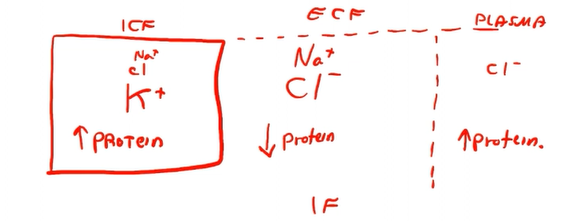
ECF, IF, levels of Na+, Cl-, K+, and proteins
High levels of Na+
High levels of Cl-
Low levels of protein
Negligible levels of K+
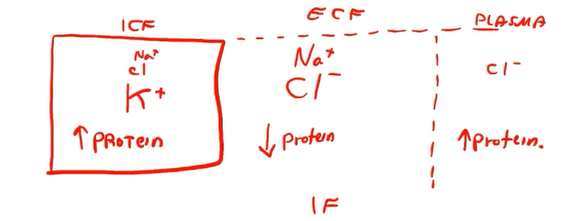
ECF, Plasma, levels of Na+, Cl-, K+, and proteins
Low levels of cl-
high levels of protein
negligible levels of Na+ and Cl-
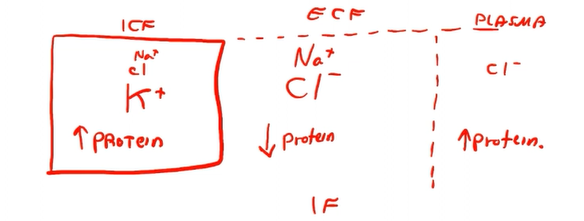
What forces actually move fluid between layers of the body?
Osmotic (oncotic) pressure
Hydrostatic pressure
The fluid moves along osmotic gradients, from areas of low solute concentration to areas of high solute concentration
If ECF osmolarity is high?
Water leaves the cell
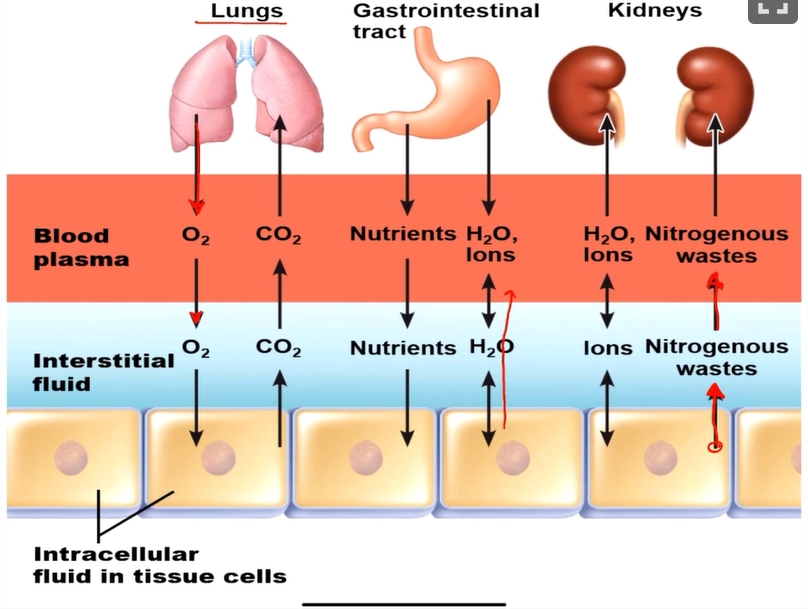
If ECF osmolarity is low?
Water enters the cell
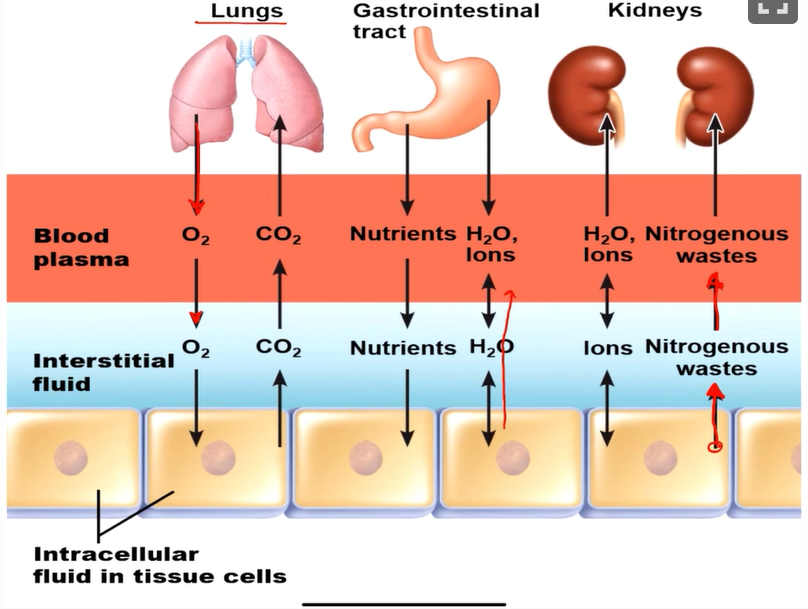
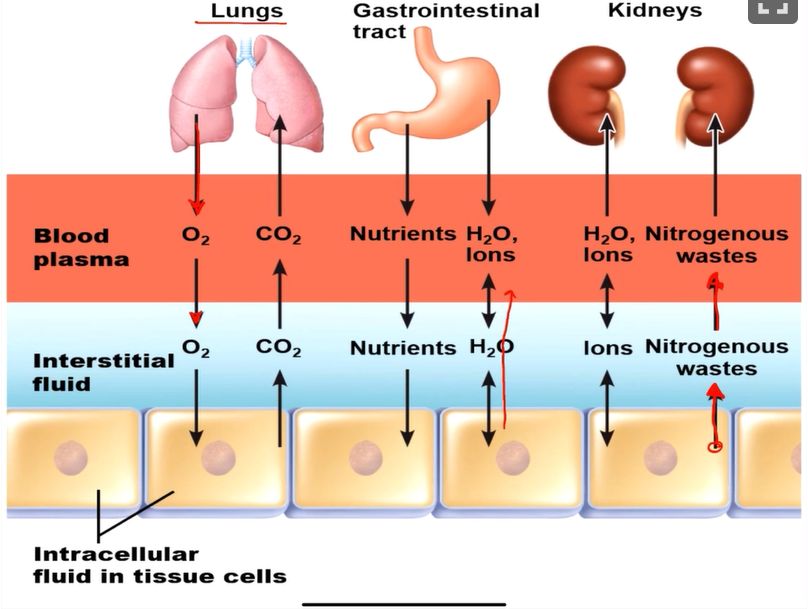
How does this movement pattern differ between the IF and ICF across the cell membrane?
Two-way osmotic flow of water
Ions move selectively; nutrients, wastes, gases, unidirectionally.
How much water should you drink a day, and why?
2.5L
This is the amount of water you lose on average per day
How much water is lost through fecees? %
4%
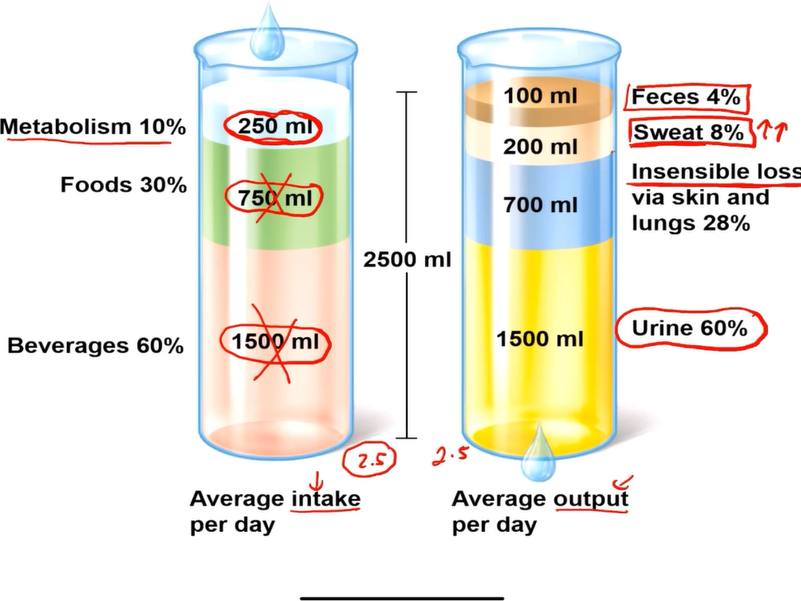
How much water is lost through sweat?
8%
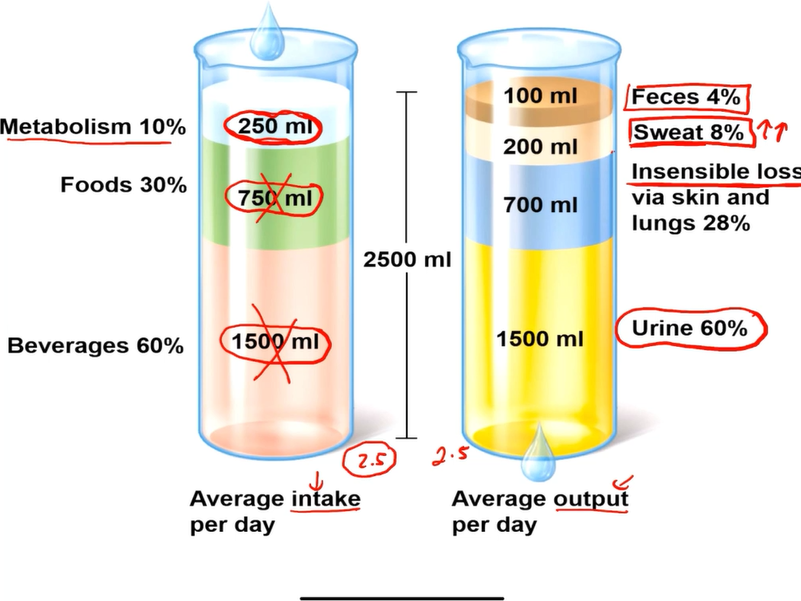
How much water is lost via insensible loss via skin and lungs?
28%
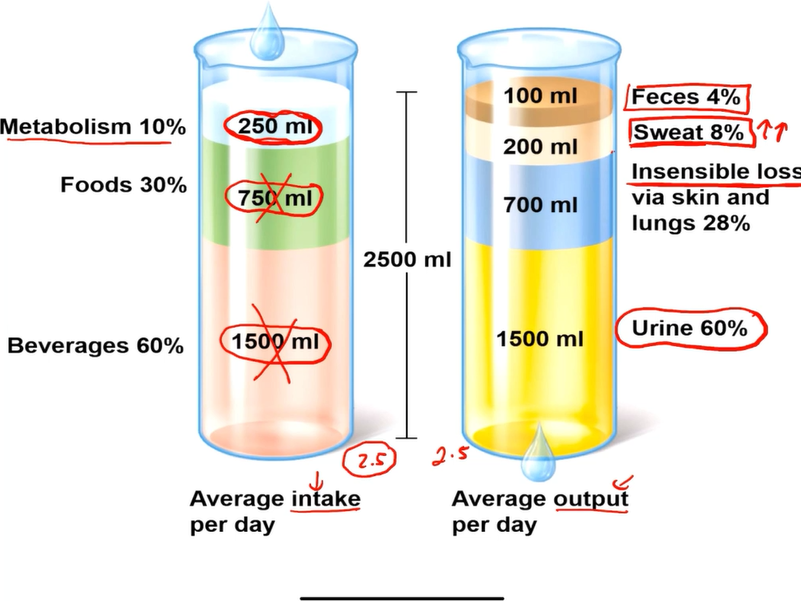
How much water is lost through the urine?
60%
What is normal osmolality in the body?
280-330 mOsm
What does a rise in osmolality cause?
Stimulate thurst
Release ADH
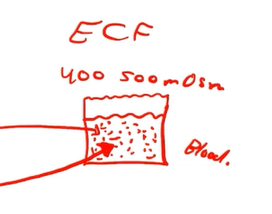
What does a decrease in osmolality cause?
Inhibit thrist
ADH inhibition
What governs the thirst mechanism?
The hypothalamus
What stimulates the hypothalamus thirst center?
Osmoreceptors detect ECF osmolality; activated by:
Plasma osmolality of 1-2%
Dry mouth
Decreased blood volume or pressure
Angiotensin 2 or baroreceptor input
Detailed pathway Plasma Volume —> Thirst
Blood plasma volume decreases.
Blood pressure drops
Granular cells in the kidney are no longer being stretched
Granular cells in the kidney release renin
Renin activates angiotensin 2
Angiotensin 2 activates our hypothalamic thirst center
We drink enough water to increase our plasma volume back to normal
Yay this pathway works :)
ECG osmolarity —> Thirst
ECF osmolarity increases
Osmoreceptors in the hypothalamus realizes we dont have enough fluid
Our mouth becomes dry as less saliva is produced to try and retain fluid
We drink water
However, once our mouth and throat are moistened, this reflex can stop early
This pathway sometimes doesn’t work fully :(
What does ADH do?
Antiduretic hormone leads to the reabsorption of water at the kidneys
This is good because our blood plasma volume will return to normal
However we will have scant (Concentrated) urine
What stimulates ADH release?
Large changes in blood volume or pressure
Renin stimulated ADH as well
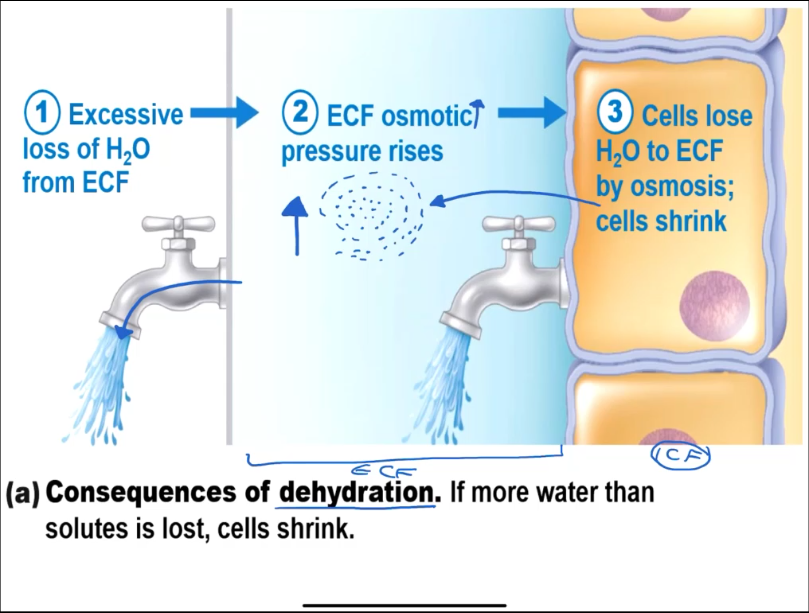
What is dehydration? What could cause it?
When we are losing more water than we are taking in
Could be caused by hemorrhage, severe burns, prolonged vomiting, profuse sweating, water deprivation, etc..
Symptoms of dehydration?
“Cottony” oral mucosa
Thirst
Dry flushed skin
oliguria
What is the internal consequence?
ECF osmotic pressure rises, so cells shrink
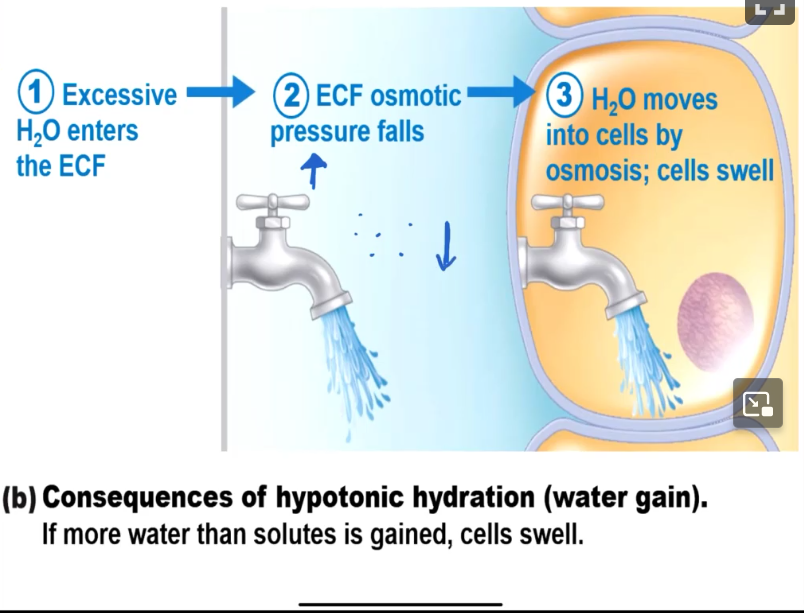
Hypotonic hydration
This is water intoxication
ECF osmolality goes waaaaaaaay down
Internal consequence?
ECF becomes less concentrated
Osmotic pressure falls
Cells swell
What are Edemas and what can cause them?
Accumulating fluid between the cells in the IF
Too much IF increases distance between BV and tissue, compresses BV and tissue which also hurts
Caused by capilaries leaking too much fluid into the interstitial space