Edexcel A level Physics - Materials
 Call Kai
 Learn
Learn Practice Test
 Spaced Repetition
 Match
Match Flashcards
 Knowt Play
1/50

There's no tags or description
Looks like no tags are added yet.
Name | Mastery | Learn | Test | Matching | Spaced | Call with Kai |
|---|
No analytics yet
Send a link to your students to track their progress
51 Terms
Density
p = m/v (mass per unit volume)
Upthrust
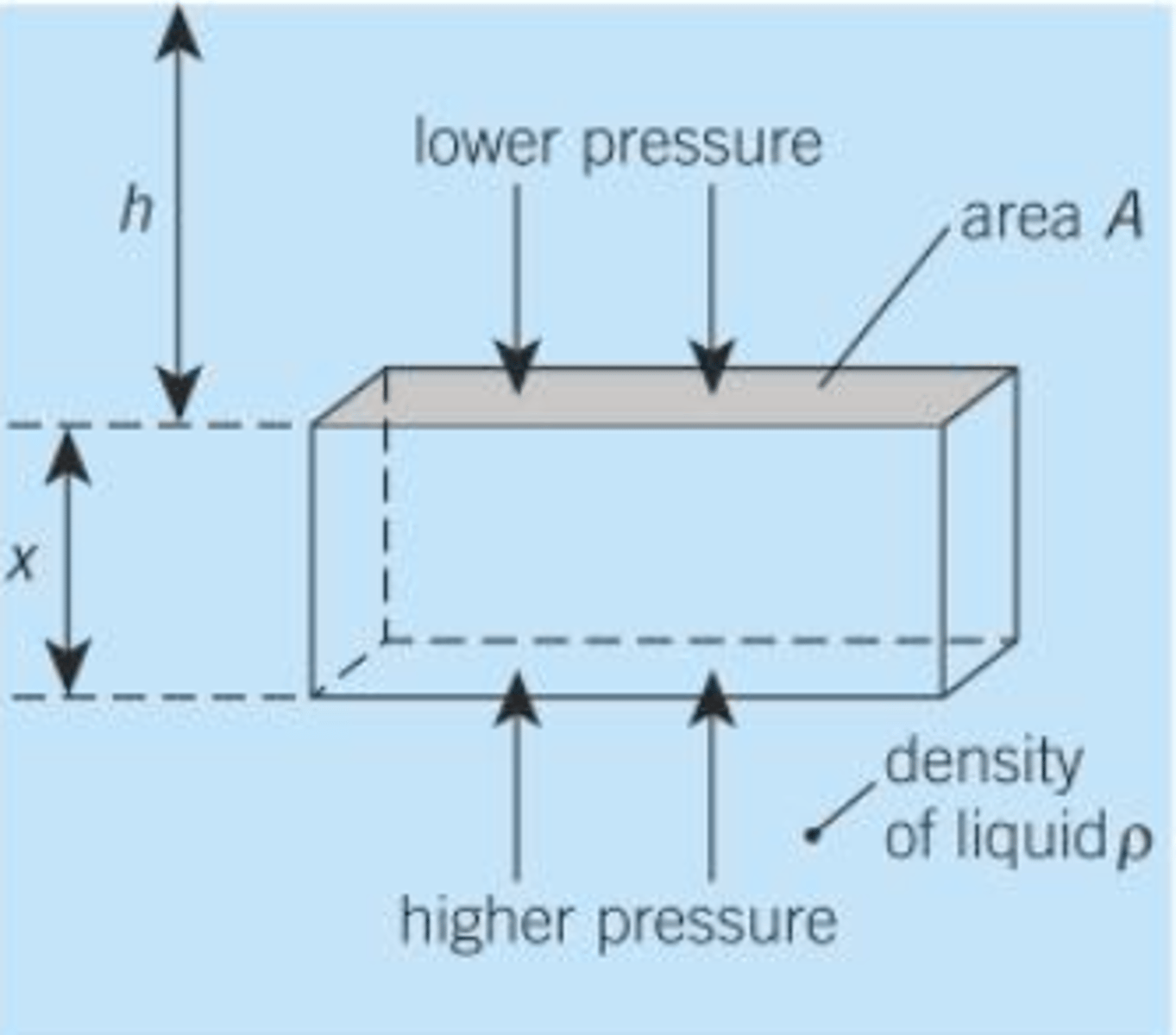
Upward force on an object immersed in fluid due to different pressures being exerted on the surface of the object - Higher pressure from the bottom side exerted upwards and lower pressure from the top side exerted downwards (P = pgh) P is pressure, p is density, g is gravitational field strength, h is depth
equal to the weight of the displaced fluid (Archimedes' principle where, U = pVg U is upthrust, V is vol (m^3)
If an object is fully submerged than the weight of the object is equal to all the volume of fluid displaced
What does Stokes Law describe?
The drag acting on an object as it moves through a fluid (viscous drag)
Why does viscous drag occur?
Due to collisions or friction with surrounding liquid particles
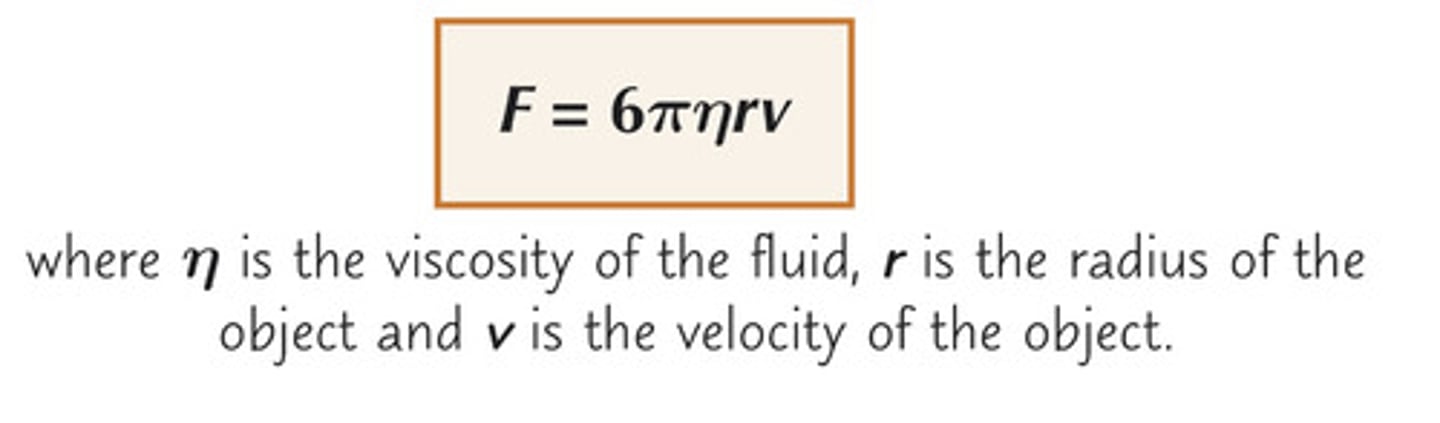
Equation and Conditions for stokes law
Equation only applies to Small, spherical objects moving at low speeds with laminar flow...(absence of turbulent flow)
Note v is the terminal velocity
Derivation Stokes Law
This is the completed form, but initially you want to set your equations for the forces of the ball moving at terminal velocity (if falling W = U + F, if rising U = W + F) and then go from there.
Make sure density is in (kgm^-3)
See (https://www.google.com/url?sa=i&url=https%3A%2F%2Fwww.youtube.com%2Fwatch%3Fv%3Da5op9emAnRU&psig=AOvVaw1QGIUOQDDW3MBvvAH4qd0y&ust=1748763418931000&source=images&cd=vfe&opi=89978449&ved=0CBQQjRxqFwoTCPiZ6cSZzY0DFQAAAAAdAAAAABAK)
Terminal Velocity
The maximum velocity of an object falling or rising through a liquid occuring when forces reach equilbrium which are weight, upthrust and viscous drag (due to weight being larger than upthrust and viscous drag in the case of sinking initially), can be measured using a measuring cylinder and dropping a ball into it and seeing how long it takes to fall (calculating upthrust and knowing weight)
Does an Object Sink/Rise or Float?
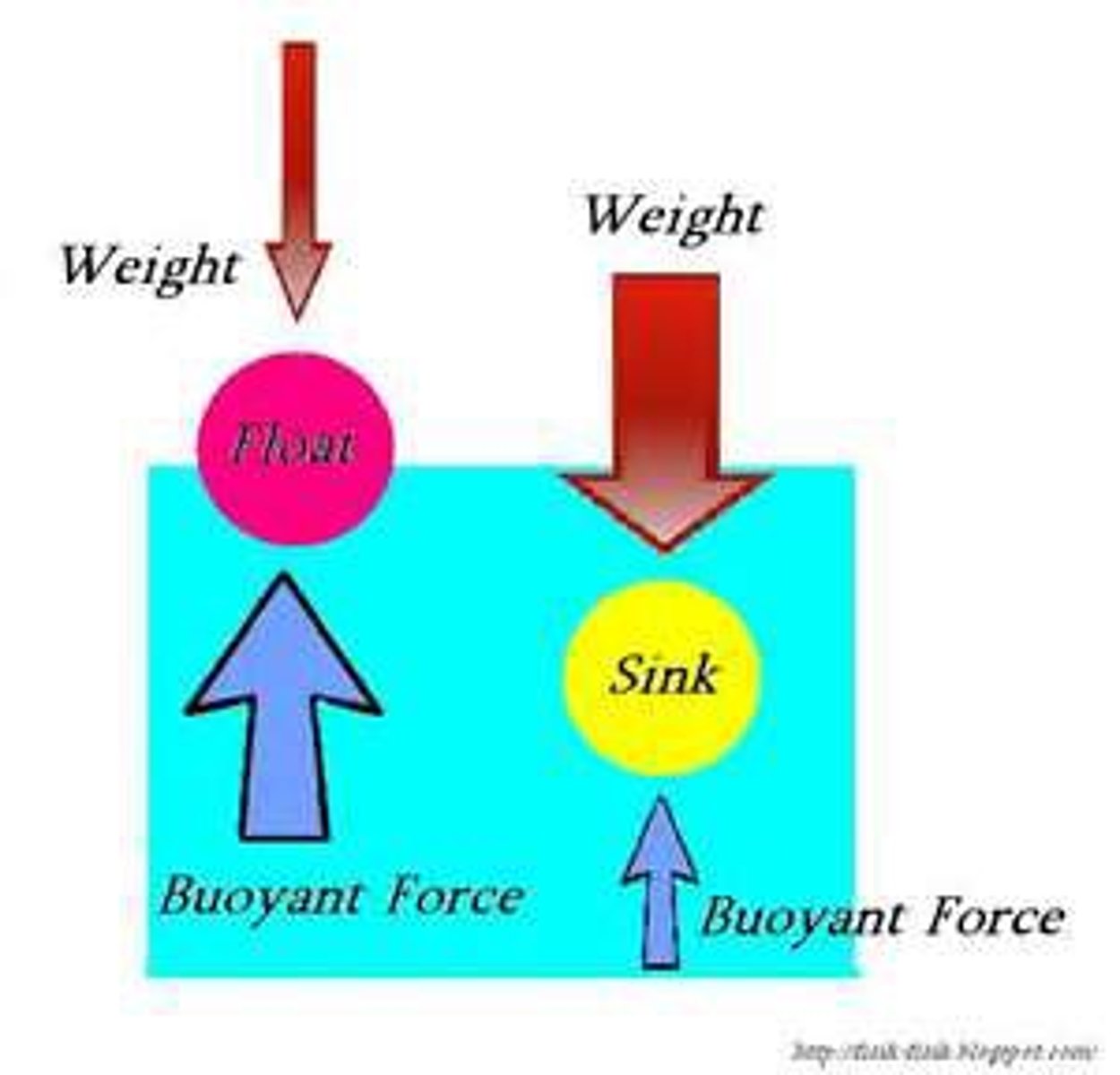
It depends on the forces, if it sinks this means the weight is greater than the viscous drag and the upthrust until terminal velocity and if it rises this means the upthrust is larger than the weight and viscous drag.
If it floats this means that the upthrust was larger than weight to begin with so no sinking ever occured.
Laminar Flow
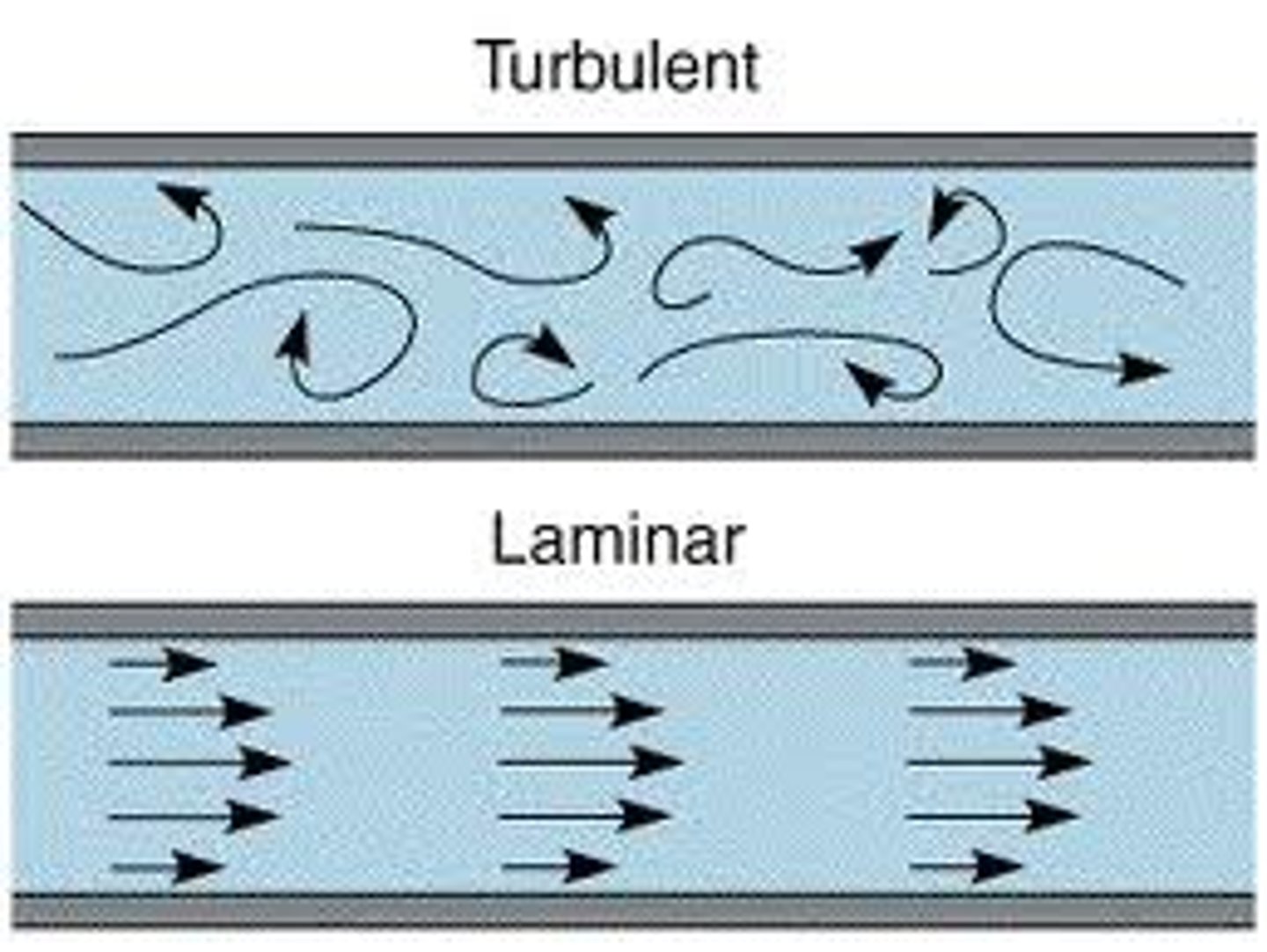
Particles in a fluid moving in smooth paths with no mixing between adjacent layers of fluid
Conditions for laminar flow
fluid should be incompressible and non viscous
Turbulent flow
Particles in a fluid mix between layers and form separate currents - it is chaotic
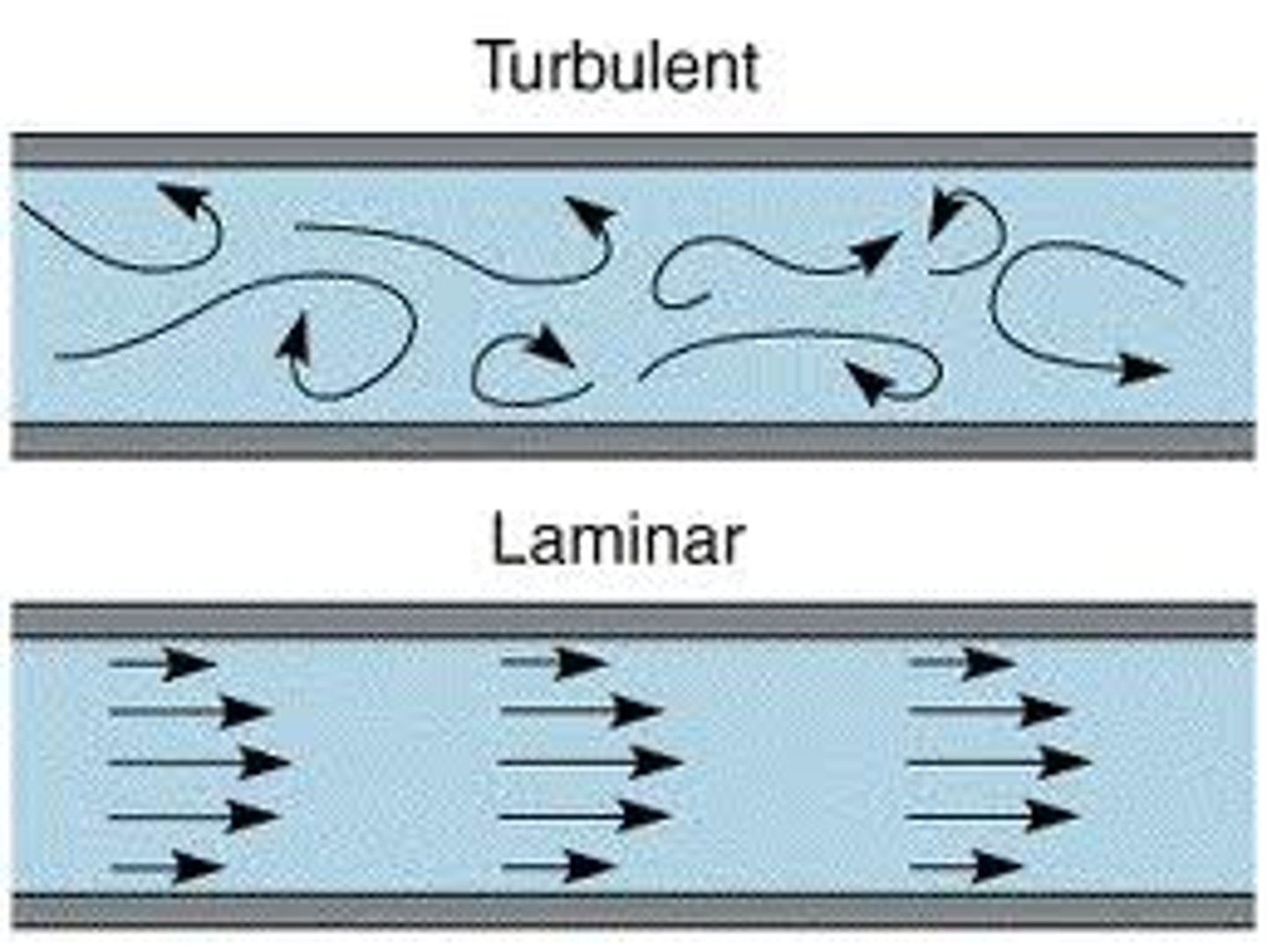
Transitional flow
Mostly laminar but suffers occasional bursts of non-laminar flow
Viscosity
Internal friction in the fluid due to the interaction of moving molecules due to an object flowing through it (how resistant a fluid is to deformation)
Viscosity coefficient
Measure to the degree which a fluid exhibits viscous effects
Effect of temperature on viscosity of (most) liquids
As temperature increases there is a decrease in the attractive forces between molecules, and increase in kinetic energy, thus reducing the effect of viscosity as there is less interchange between layers of the fluid
Effect of temperature on viscosity of gases
Increase in temperature leads to an increase in viscosity as the increase in KE leads to an increase in intensity of intermolecular collisions , reducing the motion of the gas and leading to an increase in viscosity
Necking
When there is a localised decrease in the cross sectional area, and this necked area is then subject to more stress as area decreases while force remains constant
Reinforced concrete
When steel bars called rebar are imbedded into concrete to increase tensile strength by helping to resist tensile stresses.
Prestressed concrete
Steel tendon is tensioned, and concrete is cast on top of tendon, when concrete hardens, tensile stresses are removed and concrete is left in a compressed state.
Elastomers
Long chain polymers with a degree of cross linking, sufficient to allow chains to slide past eachother but numerous enough to pull chains back together when stress is removed
What does stretching metals do
Stretches the bonds between the atoms they are made up of
Why is extension linear (in terms of particles)
Because bond force varies linearly with the separation of atoms
Extension Rubber
When Rubber is stretched it gradually becomes less stiff, and becomes relatively easy to stretch as the chains uncoil due to the intermolecular forces between the molecules of rubber in a chain that make up a piece of rubber being relatively weak and easy to break. Once that has completeled the rubber is much more stiff, as after this you have to break intramolecular forces between atoms as you have one long chain of rubber and these forces are too strong and require too much energy to break so the rubber band is very stiff
Creep (Rubber)
When a material like a rubber band has a load placed on it a further extenstion will be seen over a period of time after the initial reading was taken if a material deforms plastically in this way when stress is applied we call it creep so on a graph of extension by time you will see more and more extension after the inital over time
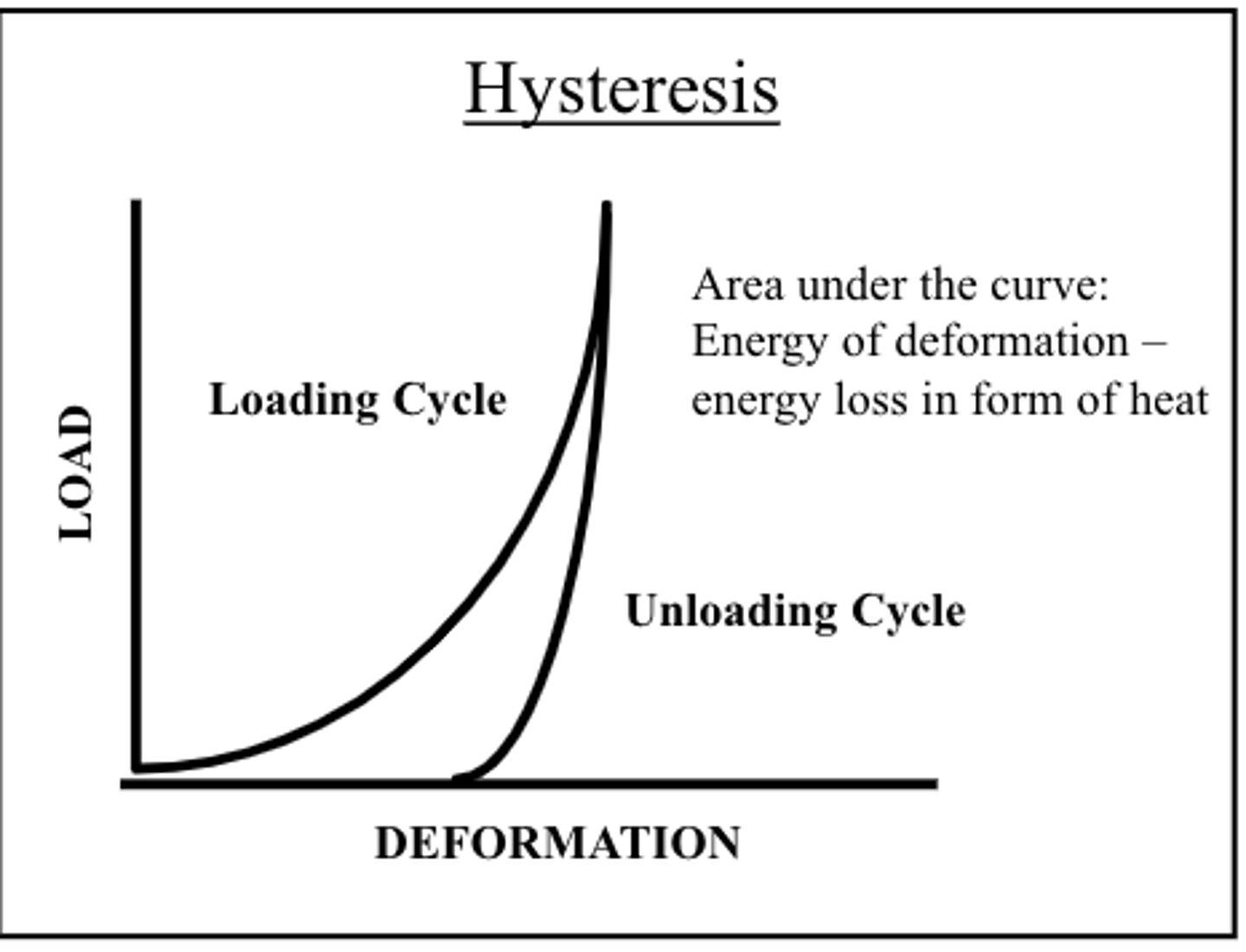
Hysterisis
When upon unloading, less energy is returned than what was put in from loading these curves make a hysterisis loop on a stress-strain graph, the area between the curves is the work done as some energy has been transferred to KE in the particles of the object and work done to uncoil the chained molecules and permanently deform the material.
(Check online for an image this one is dodgy)
Hooke's Law
F = kx, extension is directly proportional to the force applied given that the environment e.g. temp is constant, k is spring constant (stiffness) and x is extension
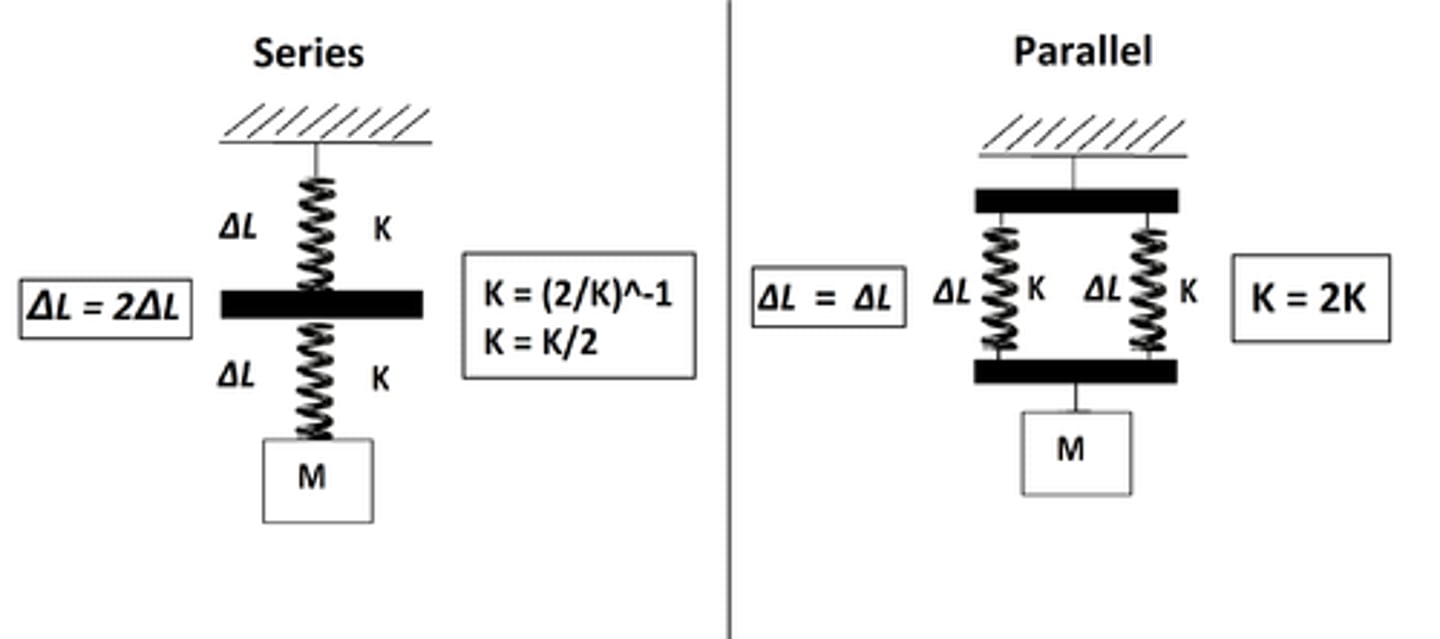
Springs in Series and Parallel
Our extension doubles from springs if we two identical springs that are in series, as they both experience the weight pulling them down, while our extension halves when we have two identical springs in parallel as the weight pulling down is shared between them.
You can see spring constant halves for a series of springs making it less stiff and vice versa for parallel springs.
Young's Modulus
Describes the property of a material to resist strain from stress, up to the limit of proportionality stress is proportional to strain so it is a constant value.
YM = (Stress/Strain)
What does the young modulus of a material represent
A materials resistance to a change in length while it behaves elastically
Stress
The force applied to a material/object divided by its cross sectional area in Nm^-2
Strain
A measure of how much an object/material has been stretched, calculated by change in length no unit as it a ratio and it is (m/m in units)
Stress-Strain Graphs
Describes the behaviour of a material not of an object (use the word material when referring to this graph)
Force-Extension Graphs
Show the extension of an object with force applied to it. (use the word object not material when referring to this graph)
Force-Compression Graphs
Show the compression of an object with force applied to it, similar to Force-Extension graph except beyond the elastic limit due to a compressive force the compressed solid will buckle (suddenly change shape) and break instead of extending plastically.
(Search up image online to see)
Elastic Strain Energy
When work is done to stretch or compress a material/object this energy is stored as elastic strain energy, it is variable but it is the area under a force-extension graph up to the limit of proportionality
(E = 1/2kx^2) or (E = 1/2Fx)
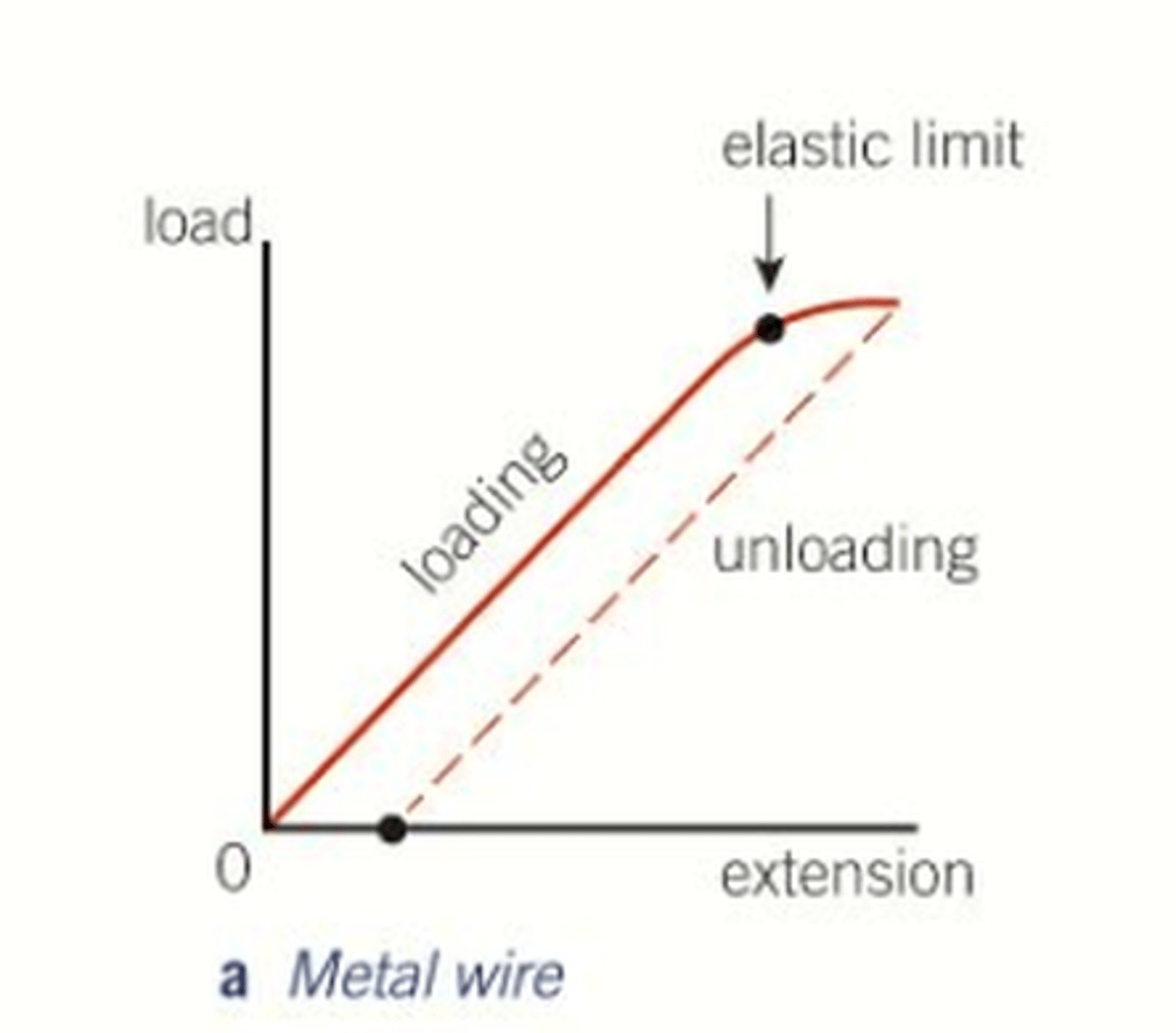
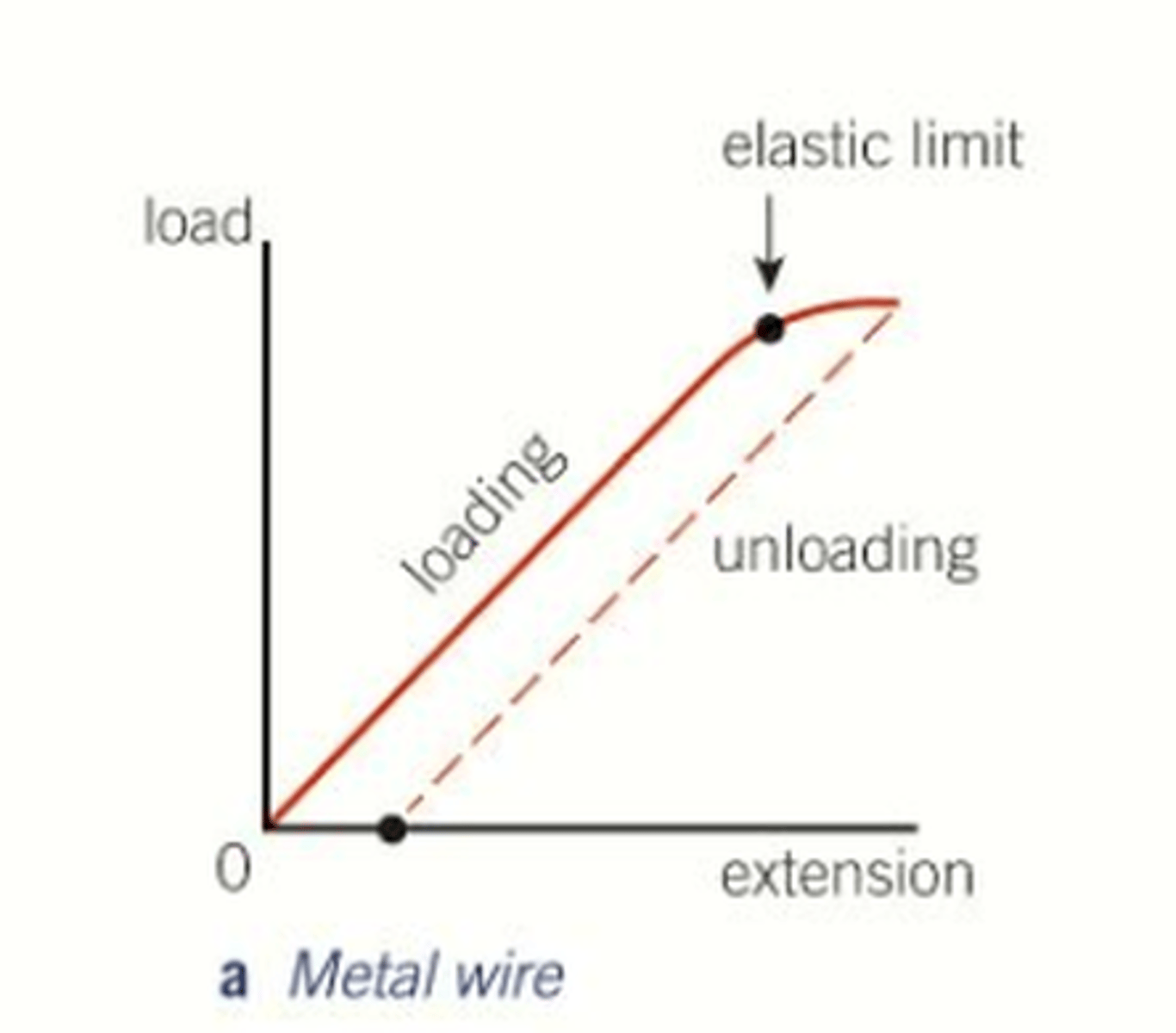
Once a material is stretched past it's elastic limit a force-extension graph showing loading and unloading will not return to the origin however these lines will be parallel as stiffness is constant, the area between these lines is the work done to permanenty deform the material.
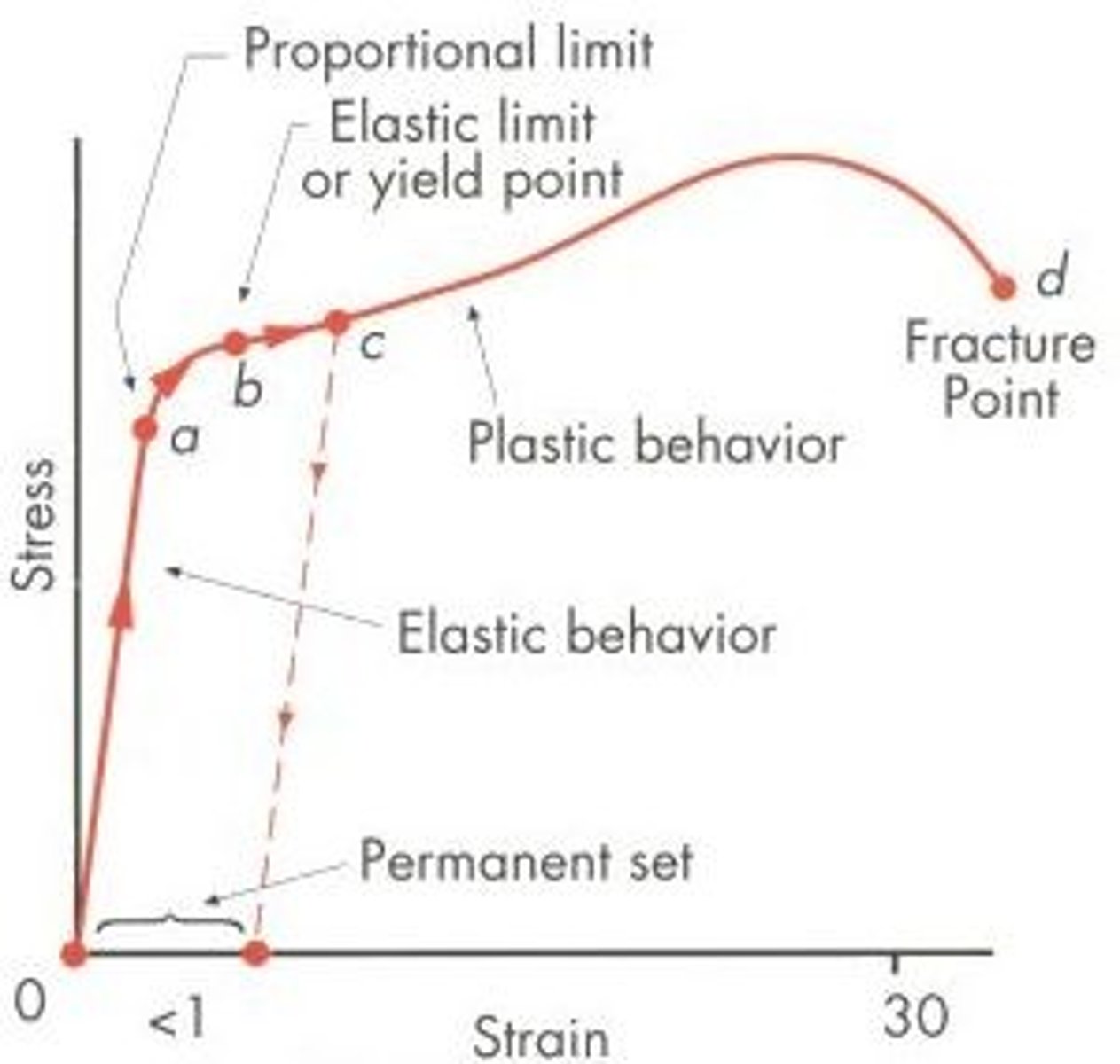
Limit of Proportionality
The point after which Hooke's law is no longer obeyed.
Yield point
Increase in force when the material continues to stretch despite no additional stress being applied
Elastic Limit
The limit up to which elastic deformation occurs, after which plastic deformation occurs of the material
Elastic Deformation
The deformation of which when stress is applied the material returns back to it's original shape, as all the work done is stored as elastic strain energy
Plastic Deformation
The deformation of which when stress is applied the material does not return back it's original shape and there is permanent deformation due to work being done to move atoms (break intramolecular forces) meaning some energy is dissipated as heat and not as elastic strain energy.
Breaking Stress
The value of stress at which the material will break apart depending on conditions like temp.
Ultimate tensile strength
The maximum stress that a material can withstand
Ductile
Can undergo large amounts of plastic deformation before breaking/fracturing and can be drawn (pulled) into wires without breaking
Brittle
When a material undergoes little to no plastic deformation before breaking/fracturing at a low strain (can't resist a high tensile force)
Plastic
When a material will experience a large amount of extension as the load is increased.
Malleable
Materials that can be beaten into sheets without breaking, which show large plastic deformation under compression
Hard
Materials that resist plastic deformation from surface indenting or scratching
Tough
Materials that can withstand impact forces and absorb a lot of energy before breaking (toughness is the energy measured to break a material which is the area under a stress strain curve)
Thickness and Length of Material
If a material is more thin and longer it experiences greater extension and vice versa for thick and shorter materials.
Amorphous solids
Have no uniut cells, no long range order, no defined melting point, can be treated as liquids with very high viscosity
Thermoplastics
Soften and become more flexible when heated, and regain rigidity when cooled