Clinical Psychology and Mental Health
 Call Kai
 Learn
Learn Practice Test
 Spaced Repetition
 Match
Match Flashcards
 Knowt Play
1/67

There's no tags or description
Looks like no tags are added yet.
Name | Mastery | Learn | Test | Matching | Spaced | Call with Kai |
|---|
No analytics yet
Send a link to your students to track their progress
68 Terms
what is clinical psychology
the study of mental illnesses
what is a mental illness
a psychological condition where people display changes in their thoughts, feelings and behaviours which are long lasting
why is clinical psychology good
helps diagnose people and provide treatment, also benefits the economy (reduced absenteeism)
what are the 4 definitions used to identify mental illnesses
deviation from ideal mental health
deviation from social/ cultural norms
failure to function adequately
statistical failure
what is deviation from ideal mental health
a person might be experiencing mental illness if they fail to display behaviors that indicate ideal mental health
Jahoda’s 6 criteria for ideal mental health
Self-attitudes – having positive self-concept and a strong sense of identity
Self-actualisation – the extent to which an individual develops their full capabilities
Integration – being able to cope with stressful situations
Autonomy – being independent and self-reliant and able to make personal decisions
Having an accurate perception of reality – perceiving the world in a non-distorted fashion.
Mastery of the environment – being competent in all aspects of life and being able to meet the demands of any situation
what is deviation from social/ cultural norms
when a person's behaviour doesn't follow or deviates from what's considered culturally or socially normal
what is failure to function adequately
Defines a person as abnormal if they are not able to cope with everyday living.
Not functioning adequately causes distress and suffering for the individual and/ or to others
what is statistical failure
when someone displays attitudes or behaviors that are statistically infrequent more specifically two standard deviations away from the norm
evaluate deviation from ideal mental health
enables participants to set clear goals
the criteria is overly demanding and difficult to measure objectively
evaluate deviation from social/ cultural norms
norms change over time - lacks temporal validity. can lead to misdiagnosis
can offend some cultures that considers behaviour normal
evaluate failure to function adequately
involves behaviours that are easy to measure, observe and therefore diagnose
mentally ill people don’t always struggle with day to day life
not all maladaptive behaviours are signs of mental illness
evaluate statistical infrequency
objective and practical
some mental illnesses aren’t statistically infrequent
some statistically infrequent traits are desirable
what is a phobia
an irrational fear of an object or situation
what 3 symptoms are used to identify phobias
Emotional Characteristics - Fear, anxiety and panic (cued by the presence or anticipation of the object)
Behavioural Characteristics - Avoidance
Cognitive Characteristics - Irrational thinking and resistance to rational arguments
what is the 2 process model
the idea that phobias are acquired by classical conditioning and maintained by operant conditioning
research/ evidence for the 2 process model: classical conditioning
LITTLE ALBERT CASE STUDY:
9-month-old Albert was shown a white rat (initially showed no fear).Researchers paired the rat with a loud metal noise that frightened him.
After several pairings, Albert became scared of the rat even without the noise.
His fear generalised to other white fluffy objects
concluded fear can be learned through classical conditioning.
research/ evidence for the 2 process model: operant conditioning
BARLOW AND DURAND:
found 50% of participants with a severe driving phobia, could recall a traumatic event during driving and haven't drove since (CC)
evaluate behaviourist approach on phobias
not all phobias caused by past traumatic experience
genetically determined? ancestors fighting bears eg
what is flooding
person with phobia experiences fear in one, prolonged session, experiencing the phobia at its worst. the session continues until the anxiety has disappeared. (Can be virtual reality or in vivo exposure).
what is systematic desensitisation
introduced by Wolpe. Involves introducing patients to the feared stimulus gradually and bringing about a relaxation response through counterconditioning.
what are the steps involved in systematic desensitisation
relaxation techniques are taught
a fear/ desensitization hierarchy is created
gradually work way through hierarchy
patient then masters feared sensation
what is the rationale for flooding
A person’s fear response (and adrenaline release) has a time limit. As adrenaline levels naturally decrease, a new stimulus-response can be learned (a relaxation response).
Strength of behavioural treatments for phobias
Faster, cheaper and less effort on the patients part than CBT (in turn benefits the economy)
CBT requires a willingness for the patient to think deeply about their mental problems, but this is not required for behavioural therapies.
This lack of thinking means the therapies work for people who lack insight into their motivations or emotions such as children or patients with learning difficulties (good population validity).
evidence on how both treatments (flooding and sd) are effective
McGrath et al reported that about 75% of patients with phobias were successfully treated using systematic desensitisation, when using in vivo techniques; shows SD is effective in treating phobias
Choy et al compared the effectiveness of various treatments for specific phobias; reported both flooding and SD are effective but that flooding is more effective.
weaknesses for flooding
Ethical concerns
If people are highly anxious would quit during process and reduce effectiveness
weaknesses for SD
Öhman et al. (1975) suggested that SD may not be as effective in treating phobias that have underlying evolutionary survival components, compared to phobias which have been acquired as a result of personal experiences.
This reduces the real-world applications of the treatments.
support for flooding
KAPLAN AND TOLIN:
65% of patients treated for specific phobias with a single session of flooding showed no symptoms four years later.
support for SD
McGRATH ET AL:
reported that about 75% of patients with phobias were successfully treated using systematic desensitisation, when using in vivo techniques; shows SD is effective in treating phobias
what are the emotion symptoms of depression
low mood
loss of pleasure
what are the cognitive symptoms of depression
irrational negative beliefs
difficulty concentrating
what are the behavioural symptoms of depression
change in appetite
change in sleep patterns
social withdrawal
Catastrophizing meaning
Viewing a situation as worse than it actually is (driven by negative core schemas).
Musturbatory Thinking meaning
The irrational belief that certain things must be a particular way (e.g., "I must be loved by everyone").
what criteria needs to be met in order to be diagnosed with depression
must experience 5 or more symptoms for more than 2 weeks
one of those symptoms must be emotional
what is manic depression
when someone cycles between manic (high mood for at least 1 week) and depressive episodes (low mood for at least 1 week)
Explain ellis ABC model
when a person with depression experiences a negative activating event, they form irrational negative beliefs about the event. as a consequence, they experience the symptoms of depression
A- activating event occurs
B- beliefs are formed about causes of activating event
C- consequences are formed due to thoughts, behaviour and feelings of belief
Becks cognitive triad
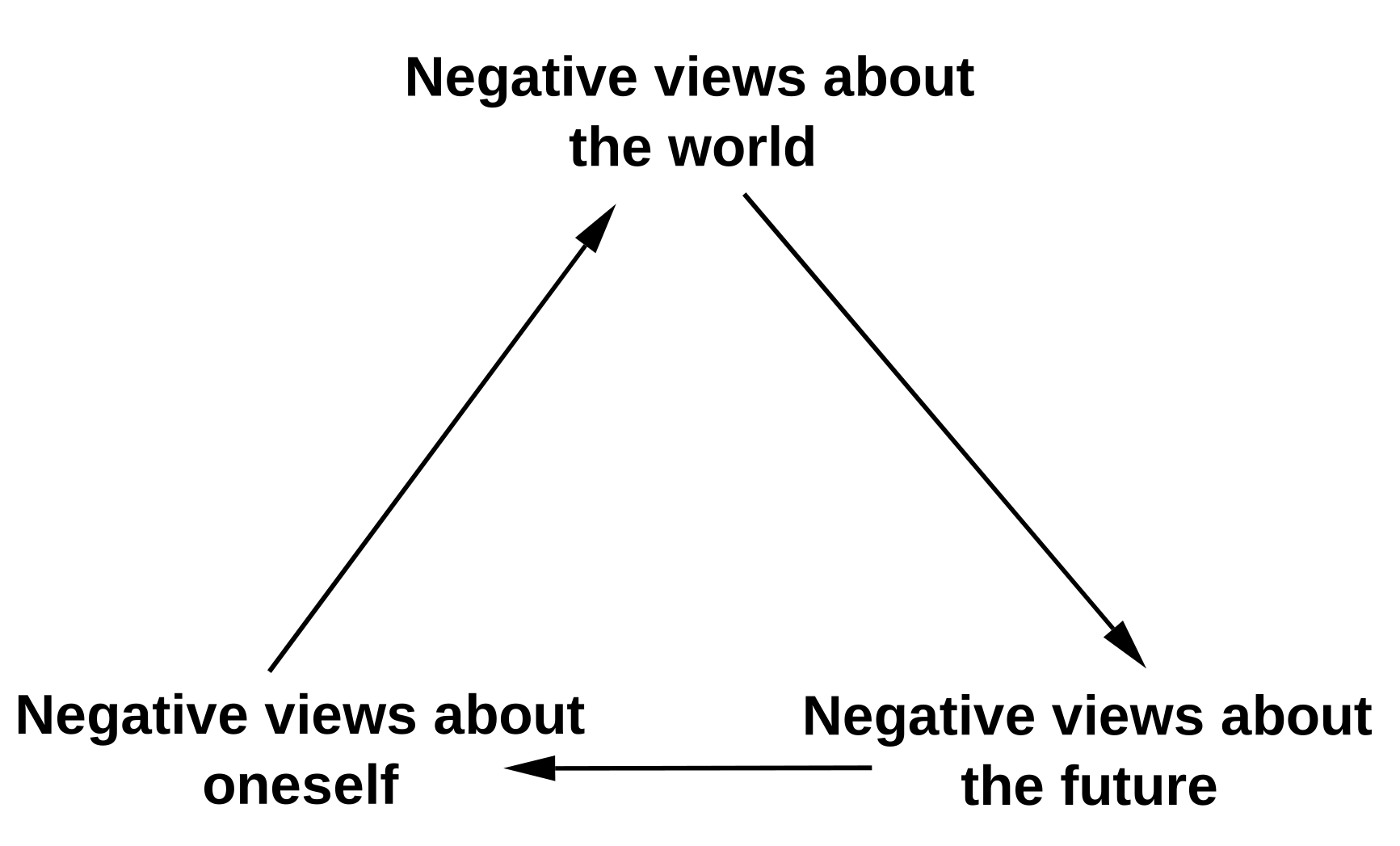
Beck argues negative self schemas cause irrational negative beliefs leaving people to form negative expectations about themselves, the world and the future.
He also suggests people with depression have a negative cognitive bias, meaning they fixate on negative information, which is assimilated into their negative self schema, making it even stronger.
evidence against the cognitive role in depression
ALLOY ET AL
investigated expectations of participants with and without depression
participants were asked to press a button and observe whether a green light came on
researchers manipulated the degree of control the participants had over the light, ranging from 0% (no control) to high control.
they were asked to estimate the degree of control they had over the light changing
partic’ with depression estimated more accurately than control group
what is CBT
a treatment for depression that aims to remove the negative beliefs that cause depression. involves 4 steps:
identify negative core beliefs
challenge negative beliefs
test hypothesis through homework
evaluate the evidence
The role of "Homework" in CBT
Accessible, agreed-upon tasks set between sessions to challenge beliefs and provide data for the next session.
support for CBT
CUIJPERS ET AL
reviews all studies in the USA that compared depressive patients receiving and not receiving cbt
experimental group had a significant improvement in symptoms compared to control group
limitations of CBT
may not be effective for everyone, there are individual differences in depressive experiences (cuijpers et al found variation between individuals)
not as effective as other treatments such as antidepressants - may more effective
OCD: Emotional Characteristics
Fear, Panic, Dread, and Despair.
OCD: cognitive characteristics
Obsessive thoughts, Catastrophization, Hypervigilance
OCD: behavioural Characteristics
Compulsions, Avoidance, Withdrawal, and Preparation.
Ruminating meaning
Repetitive, deep thinking about self, others, and the future.
Obsessions vs. Compulsions
Obsessions: Internal/Intrusive thoughts.
Compulsions: External/Repetitive behaviors used to reduce anxiety.
Two biological explanations for OCD
1. Neural: Abnormal brain mechanisms and neurotransmitters.
2. Genetic: Hereditary transmission from parents.
what does the genetic explanation of ocd say
we can inherit ocd
the are specific alleles on different genes that can increase a persons risk of developing ocd
Neurotransmitter levels in OCD
Dopamine: Abnormally high.Serotonin: Abnormally low.
Function of Dopamine in OCD
An excitatory neurotransmitter linked to reward and memory; its main function in OCD is habit forming
Function of Serotonin in OCD
inhibitory neurotransmitter. Its main behavioral function is impulse control. Low levels lead to a lack of control over behavioral impulses
what is the COMT gene
A low-activity variant that fails to degrade dopamine properly, leading to high dopamine levels and therefore compulsive behaviors
what is the SERT gene
A high-activity variant that removes serotonin from the synapse too quickly via the reuptake process, leading to low serotonin levels and therefore, hypervigilance and obsessive thoughts.
explain the two alleles of the SERT gene
short and long.
the long allele produces more reuptake proteins (less serotonin available in synapse and therefore less inhibition of neural activity in post s.n)
outline the neural chemistry process of someone without ocd
orbitofrontal cortex detects worrying stimuli and decides on action
once action has been decided it sends signals to the motor cortex
basal ganglia monitors outcomes of our actions
when worrying stimulus has been dealt with, the BG send inhibitory responses to the orbitofrontal cortex
this shuts down signals responding to worrying stimulus
outline the neural chemistry process of someone with ocd
OFC is overactive and sends "worry signals" to the thalamus.
impaired communication between BG and OFC
therefore the caudate nucleus that normally suppresses OFC signals is underactive/damaged, failing to stop minor worry signals.
since the signal isn’t stopped, OFC is less inhibited than it should be and becomes hyperactive
thalamus receives unsuppressed signals and becomes overactive; generates learned response of compulsions and sends signals back to the OFC.
this generates the symptom of ocd
case studies for the neural explanation on ocd
MAX ET AL
studied a girl who developed ocd after brain damage
conducted an mri and found damage in the BG
suggests structural damage to BG can cause ocd
supports idea that disturbed communication between BG and OFC is the cause of ocd
brain imaging studies for the neural explanation on ocd
SAXENA AND RAUCH
compared brain activity of adults with and without ocd
found increased activity in OFC in adults with ocd
suggest hyperactivity of OFC can cause ocd
limitations of neural explanation of ocd
brain imaging results are inconsistent and haven’t always been replicated →Aylward et al found no difference of the activity in BG between those with and without ocd
suggest structural damage in BG and hyperactivity in the OFC may not be the only causes of ocd
twin studies for the genetic explanation of ocd
BILLET ET AL
review of twin studies
found concordance rate of twins w ocd was 68% for MZ and 31% DZ
large difference suggests ocd is partially inherited
CAREY AND GOTTESMAN:
MZ twins (identical): 87% concordance.
DZ twins (non-identical): 47% concordance.
limitations of twin studies
assume MZ and DZ twins have the same amount of shared environment
how do SSRIs work for ocd
block the reuptake of serotonin at the synapse. This creates a "build-up" of serotonin, increasing its inhibitory effect and improving impulse control.
how do Tricyclics differ from SSRIs
wider effects, blocking the reuptake of both serotonin (improving impulse control) and noradrenaline (increasing motivation/arousal).
They are rarely prescribed first due to more powerful side effects
how does Benzo work
mimic GABA and bind to GABA receptors, increasing its inhibitory effect. This causes hyperpolarization, reducing neuron activity and lowering impulsivity.
strengths of drug treatment for ocd
success and speed - benzo works in minutes, ssris in few weeks. crucial for suicidal patients. fast action = ethical
scientific validity/ objectivity - objective methods like fmri showing brain functions provides high validity compared to subjective therapies
weakness of drug treatments for ocd
side effects - benzos cause lethargy, reduced cognitive ability, driving bans. ssris cause weight gain, permanent sexual dysfunction, reduced empathy, and increased suicide risk after stopping (lederberg 2022)
biological determinism/ reductionism - ignores environmental triggers, impling genes = disorder