2.1.5 biological membranes
 Call Kai
 Learn
Learn Practice Test
 Spaced Repetition
 Match
Match Flashcards
 Knowt Play
1/38

There's no tags or description
Looks like no tags are added yet.
Name | Mastery | Learn | Test | Matching | Spaced | Call with Kai |
|---|
No analytics yet
Send a link to your students to track their progress
39 Terms
What term is used to describe the model of membrane structure?
Fluid mosaic
Give 3 roles for membranes
1) Partially permeable barrier between a cell and its environment
2) Partially permeable barrier between organelles and the cytoplasm
3)Sites for attaching enzymes and carrying out metabolic reactions such as respiration
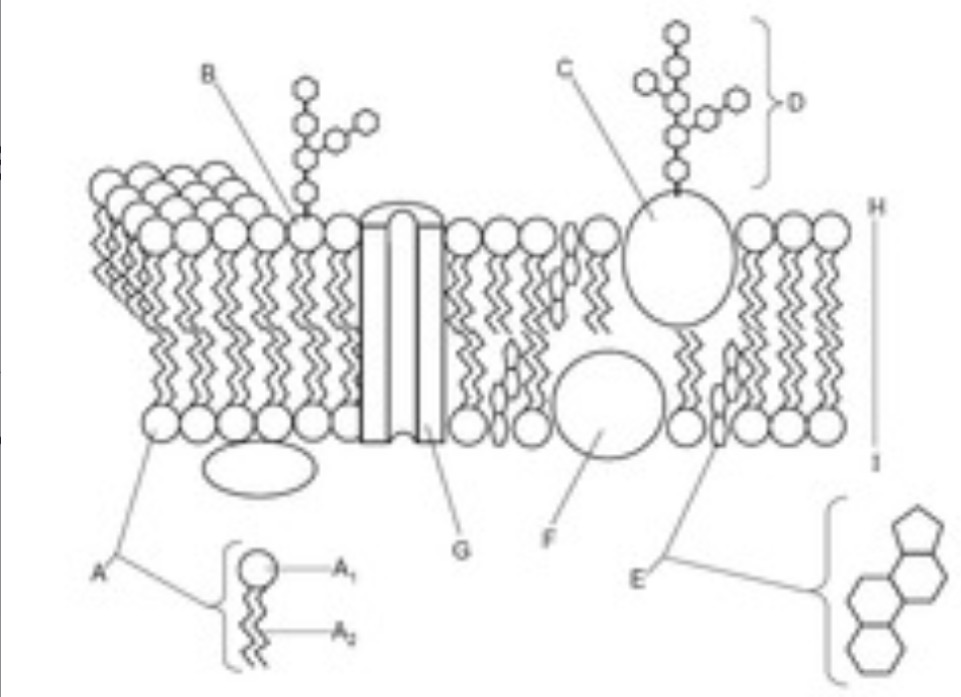
A Phospholipid molecule
A1 Hydrophillic head
A2 Hydrophobic fatty acids
B Glycolipid
C Glycoprotein
D Carbohydrate group
E Cholestrol
F Peripheral (extrinsic) protein
G Protein channel
H Phospholipid bilayer
What is the width of the membrane?
7-10 nm
Why does temperature affect membrane permeability?
Denatures the proteins and causes the contents to leak out
Why do organic solvents such as alcohol affect the membrane permeability?
Dissolves the phospholipids
Over which part of the membrane does diffusion take place?
Phospholipid bilayer
What types of molecules can diffuse across the phospholipid bilayer?
Uncharged molecules such as respiratory gases (oxygen and carbon dioxide)
Define diffusion
The passive movement of molecules from an area of high to low concentration
Membrane bound receptors are made from which biochemical groups in the membrane?
Glycolipids and Glycoproteins
What is facilitated diffusion?
Diffusion across the membrane using a carrier or channel protein
Will diffusion be faster then facilitated diffusion and if so why?
Yes because it is not limited by the availability of carrier proteins
Define active transport
The movement of a substance from an area of low concentration to an area of high concentration using carrier proteins, ATPase and ATP
Which types of transport are affected by respiratory inhibitors?
Active transport / Endo and Exocytosis (both require ATP - this is produced through aerobic respiration)
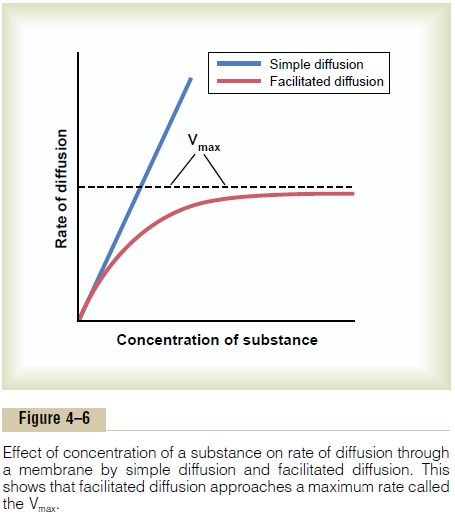
Can you explain this graph?
Simple diffusion will continue to increase as it takes place across the phospholipid bilayer whereas facilitated diffusion will start to plateau due to a fixed availability of carrier proteins
There are two types of endocytosis - phagocytosis and pinocytosis - which one involves pseudopodia and solid particles?
Phagocytosis
What is exocytosis?
The secretion of large molecules out of the cell across the plasma membrane
Why are intrinsic / integral proteins secure in the membrane?
The amino acids with hydrophilic R groups are positioned next to water (cytoplasm or tissue fluid or the fluid lined channels) and amino acids with hydrophobic R groups are positioned next to the fatty acids
Phospholipids are referred to as amphipathic molecules - what does this mean?
They have a hydrophilic (phosphate containing head) and a hydrophobic (fatty acids) part of the molecule
Cells need to interact with their environment and other cells around them. What is this called?
Cell signalling
Cells can detect signals through the use of receptor molecules on their plasma membrane. What parts of the membrane usually act as receptors?
Glycolipids and glycoproteins
Give two general examples of molecules that are used as a cell signalling molecule
Hormones and neurotransmitters
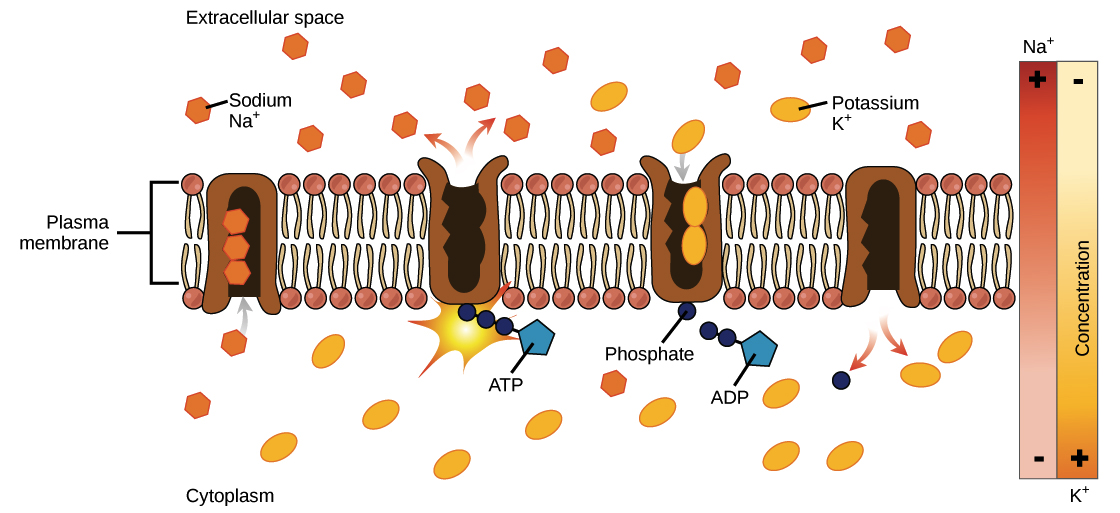
What type of transport?
Active transport
What does the term tonic refer to?
The concentration of solutes
If a cell is in an isotonic solution what does this mean?
It is in a solution which has the same concentration of solutes as its own cytoplasm this means that they will be no net movement of water
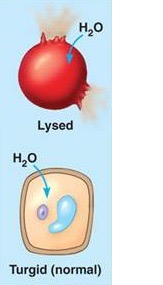
Are these cells in a hypotonic, hypertonic or isotonic solution?
Hypotonic (low level of solutes therefore higher water potential)
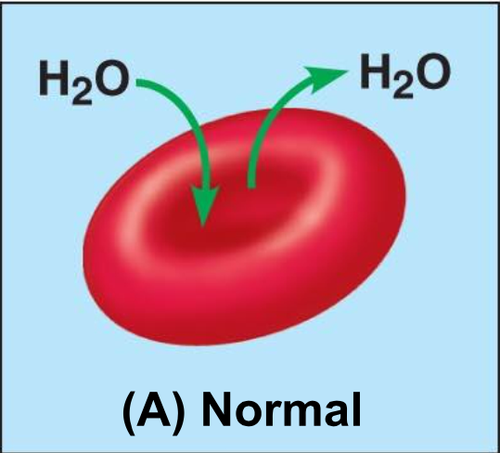
Are these cells in a hypotonic, hypertonic or isotonic solution?
Isotonic (no net movement of water as the solute concentration inside the cell and outside the cell are the a same)
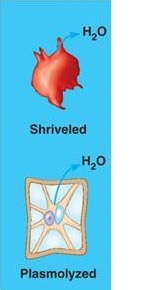
Are these cells in a hypotonic, hypertonic or isotonic solution?
Hypertonic (solute concentration outside the cell is higher - water moves out)
Define water potential
The pressure exerted by water molecules as they collide with a membrane or a container
What water potential does pure water have
0KPa
What happens to the water potential of water as solute molecules are added?
It drops from 0 to negative numbers
Define osmosis interns of water potential
The movement of water from an area of high water potential to an area of low water potential across a partially permeable membrane
What type of pressure is exerted by water moving into a cell?
Hydrostatic pressure
Explain how water molecules cross selective permeable membrane by simple diffusion
Water molecules are small, fast moving molecules. They can pass through the momentary gaps between phospholipid molecules easily
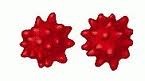
How would you describe these cells?
Shrivelled
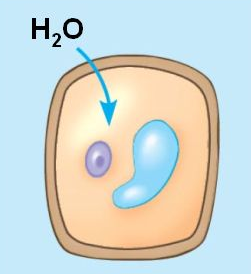
How would you describe this cell?
Turgid
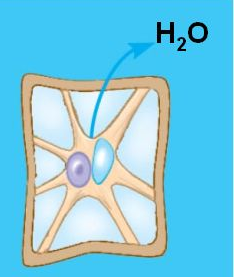
How would you describe these cells?
Plasmolysed
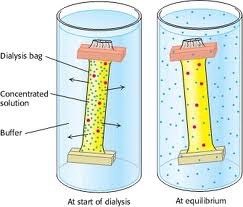
Potato can be used to look at the effect of osmosis - what would you measure?
The mass of potato cylinders before and after being left in solutions of different molarity. Then use this date to calculate % change in mass.
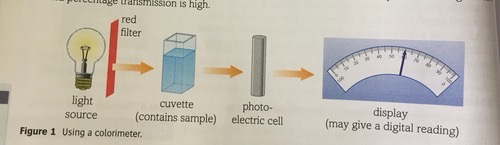
How could you use a colorimeter to look at the effect of temperature on cell membranes?
Get beetroot cylinders of the same size.
Immerse in water of the same volume but varying temperatures for the same length of time.
Remove cylinders and measure the absorbance of the water using a colorimeter.