Plants
 Call Kai
 Learn
Learn Practice Test
 Spaced Repetition
 Match
Match Flashcards
 Knowt Play
1/26

There's no tags or description
Looks like no tags are added yet.
Name | Mastery | Learn | Test | Matching | Spaced | Call with Kai |
|---|
No analytics yet
Send a link to your students to track their progress
27 Terms
What organelles are found in plant cells?
Cell wall
Middle Lamella
Plasmodesmata
Pits
Chloroplasts
Amyloplasts
Vacuole and tonoplast
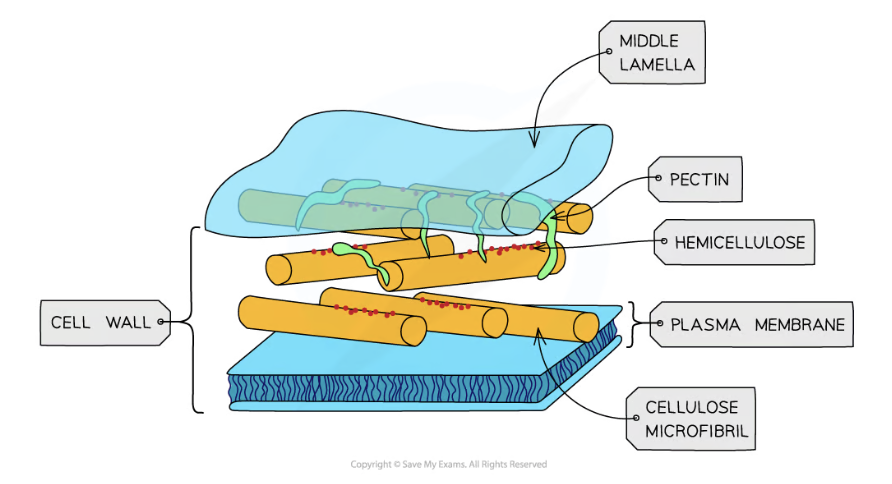
What is the cell wall?
a rigid structure, outside the cell membrane, that provides structural support
this structural support is provided by the polysaccharide cellulose
What is the middle lamella?
outermost layer of the cell
acts as an adhesive, helping stick to other cells
gives the plant stability
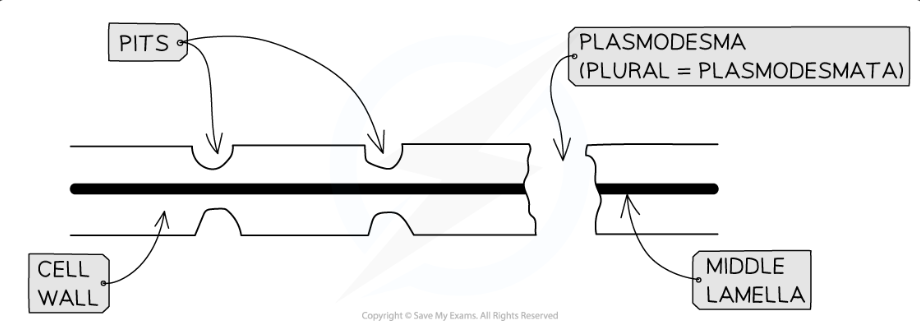
What is the plasmodesmata?
plasmodesmata are narrow threads of cytoplasm (surrounded by a cell membrane) which connect the cytoplasm of neighbouring plant cells
This allows:
→ substances to be transported between plant cells
→ facilitates cell to cell communication
What are pits?
These are very thin regions of the cell wall
The pits in adjacent plant cells are lined up in pairs
This facilitates transport of substances between cells
What are chloroplasts?
larger than mitochondria
small and flat membrane bound compartments
double membraned
membranes inside called thylakoids,contaning chlorophyll, which stack to form grana
grana linked by lamella membrane
surrounded by thick fluid ( stroma )
photosynthesis happens both partly in grana and stroma
contain small circular peices of DNA and ribosomes → used to synthesis proteins needed in chloroplast replication and photosynthesis
What are amyloplasts?
small organelle surrounded by a membrane
contains strach granules
stor strach grains
covert starch into glucose when the plant needs it
What is the vacuole and tonoplast?
a compartment surrounded by tonoplast membrane
vacuole holds the cell sap, a mixture of water, minerals, enzymes and waste
vacuoles keep the cell turgid → stops plants wiliting
break down unwanted chemicals in the cell
tonoplast controls what enters and leaves the vacuole
What is the structure of xylem vessels?
made up of dead, hollow cells with no end walls.
This forms one continuous tube when the xylem cells are stacked on top of each other
no organelles or cytoplasm → creates more space inside for transporting water
cell walls contain lignin which enables the vessels to withstand the pressure created by the moving column of water
Lignin is deposited in the cell wall → wall becomes thick, rigid, and waterproof → transport of substances into and out of the cell is cut off → the cell can no longer function → the cell dies → dead cells lose their contents → leaving a hollow lumen → cells join end-to-end → forming long, strong, hollow tubes → creating a continuous pipe for water transport
What is the function of xylem cellsi in plants?
transport of water and mineral ions upwards through the stem (transpiration) AND support.
Structural support
Where in the stem are xylem vessels found?
On the inside of the vascular bundle (towards the centre/pith).
What is the function of lignified cell walls in xylem vessels
adds strength to withstand the hydrostatic pressure → so vessels do not collapse
Lignin is hydrophobic and fills gaps in the cell wall, making it dense and impermeable to water
What is the function of no end plates in xylem vessels
allows mass flow of water + dissolved solutes → since cohesive and adhesive forces aren’t impeded
What is the function of pits in xylem vessels?
pits allow water to move sideways between neighbouring xyelm vessels or into surrounding tissues → water can be rerouted when one vessel becomes blocked e.g. by air bubbles
What is the function of the small diameter of vessels?
helps prevent the water column from breaking and assits with capillary action
What is the function of phloem?
Transport organic compounds (assimilates), particularly sucrose, from sources (e.g. leaves) to sinks (e.g. roots). The transport of these compounds can occur up and down the plant
This is known as translocation
Phloem has no support function in a plant, it is a living tissue
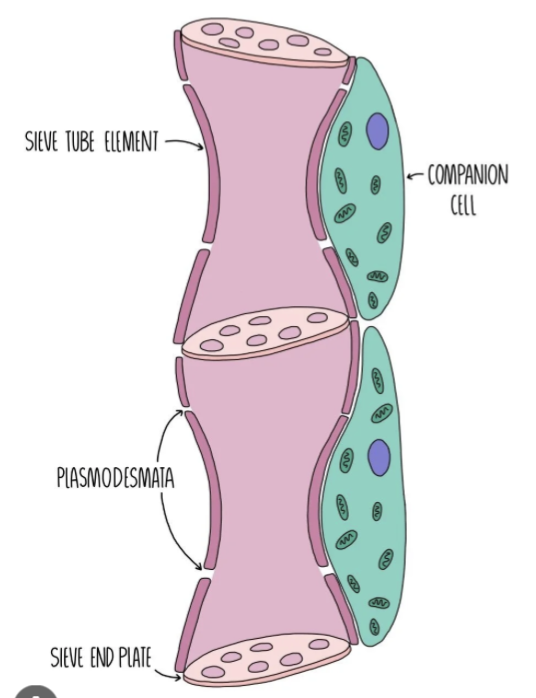
made up of sieve tube elements and companion cells, each sieve tube element has a companion cell associated with it, as companion cells control the metabolism of their associated sieve tube member
Where in the stem in phloem found?
On the outside of the vascular bundle (between xylem and sclerenchyma fibres).
What are the structural compoments of the sieve tube elements and their function?
sieve plates with pores → for continuous translocation of solutes through the plant
made up of living cells → transloation requires energy due to bidirectional movement
cellulose cell wall → strengthens the wall to withstand the hydrostatic pressures that move the assimlates
no nucleus,vaucole,ribosomes ( Some ER and mitochondria present )→ maximises space for translocation
thin cytoplasm → reduces friction to facilitate movement of the assimilates
What are the structural compoments of the companion cells and their function?
nucelus and other organelles present → provides metabollic support to sieve tube elements, helps with loading and unloading
transport proteins in plasma membrane → moves assimilates into and out the sieve tube elements
large number of mitochondria → provides ATP for the active transport of assimiliates into or out of the companion cells
plasmodesmata →link to sieve tube elements, allowing organic compound to move from companion cells into sieve tube elements
What is the function of scelernchyma fibres?
Support ONLY – sclerenchyma fibres are NOT involved in transport.
What is the strcuture of scelernchyma fibres?
• Bundles of dead cells (similar to xylem) →no transport function allows full lignfication of cells
• Long, hollow tubes →support the stem along its entire length
Hollow lumen + end walls present (unlike xylem) → strength and support
• Cell walls impregnated with lignin and high proportion of cellulose – very thick, rigid walls
• No pits (unlike xylem) – because they do not transport substances
• Long fibres run the length of the stem
What are vascular bundles?
made up of three key tissues: xylem, phloem, and sclerenchyma fibre
xylem located towards middle of stem, phloem is closer outwards
What is the importance of water to plants?
• Required for photosynthesis (raw material)
• Transports minerals and dissolved substances throughout the plant
• Maintains turgidity in plant cells
• Regulates plant temperature through transpiration
What is the importance of magnesium ions for plants?
Central component of chlorophyll molecules
• Essential for photosynthesis (without it, photosynthesis cannot occur)
• Deficiency symptom: Leaves appear yellow (chlorosis) while veins remain green
What is the importance of nitrate ions for plants?
• Essential for synthesis of DNA, RNA, and proteins e.g. enzymes
• Required for chlorophyll formation
• Critical for plant growth, fruit production, and seed production
• Deficiency symptom: Leaves appear very pale/yellow
What is the importance of calcium ions for plants?
• Essential structural component of cell walls (forms calcium pectate in the middle lamella)
• Required for plant growth and development
• Helps maintain cell membrane integrity
How do plants obtain minerals?
• Minerals are dissolved in soil water
• Uptake occurs in root hair cells
• Mineral concentrations in soil are very low
• Plants must move minerals AGAINST the concentration gradient
• Therefore, ACTIVE TRANSPORT is used (requires ATP energy)
• Transportation around plant occurs via the XYLEM