Unit H - Reflection & Refraction

0.0(0)
Studied by 2 people
call kaiCall Kai
learnLearn
examPractice Test
spaced repetitionSpaced Repetition
heart puzzleMatch
flashcardsFlashcards
GameKnowt Play
Card Sorting

1/15

flashcard set

Earn XP

Description and Tags

3d (3.14-3.22)

Last updated 2:31 PM on 11/25/23
Name
Mastery
Learn
Test
Matching
Spaced
Call with Kai

No analytics yet

Send a link to your students to track their progress

16 Terms

1
New cards

Light waves are…

transverse waves
that can be reflected and refracted

2
New cards

Law of reflection

Angle of incidence = Angle of reflection
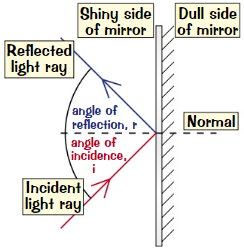
<p>Angle of incidence = Angle of reflection</p>
3
New cards

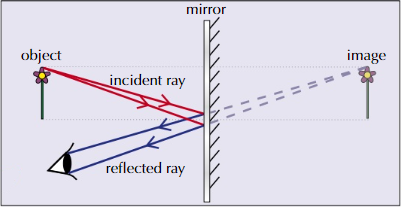
Ray diagrams for reflected waves

knowt flashcard image
4
New cards

Refraction

Waves travel at different speeds in substances with different densities
Sound waves travel faster in denser substances

When a wave crosses a boundary between two substances (e.g. glass to air), it changes speed
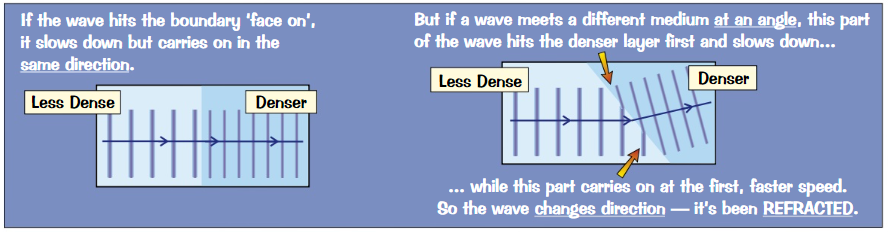
<p>Waves travel at <strong>different speeds</strong> in substances with <strong>different densities</strong><br>Sound waves travel <strong>faster </strong>in <strong>denser </strong>substances</p><p>When a wave crosses a boundary between two substances (e.g. glass to air), it <strong>changes speed</strong></p>
5
New cards

Ray diagrams for refracted waves

Show the path that a wave travels

  1. Draw boundary between two materials and the normal (a line perpendicular to boundary)

  2. Draw incident ray that meets normal at boundary

  3. Angle between ray and normal = angle of incidence

  4. Draw refracted ray on other side of boundary
    If second material is denser than first, refracted ray bends towards normal
    Angle between refracted ray and normal (angle of refraction) is smaller than angle of incidence

  5. If second material is less dense, angle of refraction is larger than angle of incidence
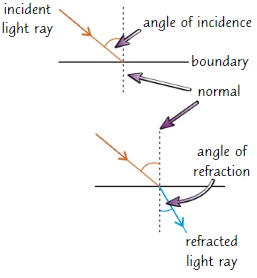
<p>Show the <strong>path </strong>that a <strong>wave </strong>travels</p><ol><li><p>Draw <strong>boundary </strong>between two materials and the <strong>normal</strong> (a line perpendicular to boundary)</p></li><li><p>Draw <strong>incident ray</strong> that <strong>meets normal</strong> at <strong>boundary</strong></p></li><li><p>Angle <strong>between ray</strong> and <strong>normal</strong> = <strong>angle of incidence</strong></p></li><li><p>Draw <strong>refracted ray</strong> on other side of boundary<br>If second material is <strong>denser</strong> than first, refracted ray <strong>bends towards</strong> normal<br><strong>Angle </strong>between <strong>refracted</strong> ray and <strong>normal</strong> (angle of <strong>refraction</strong>) is <strong>smaller</strong> than <strong>angle of incidence</strong></p></li><li><p>If second material is <strong>less dense</strong>, angle of refraction is <strong>larger </strong>than angle of incidence</p></li></ol>
6
New cards

Investigating refraction

  • Place glass block on piece of paper, and carefully draw around rectangular perspex block using pencil

  • Switch on ray box and direct beam of light at side face of block

  • Mark on paper:

    • Point on ray close to ray box

    • Point where ray enters block

    • Point where ray exits block

    • Point on exit light ray which is 5cm away from block

  • Draw dashed line normal (at right angles) to outline of block where points are

  • Remove block and join points marked with 3 straight lines

  • Replace block within its outline and repeat process for ray striking block at different angle

  • Repeat procedure for each shape of perspex block (semi-circular and prism)
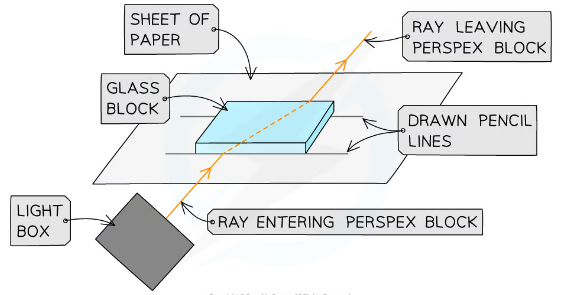
<ul><li><p>Place glass block on piece of paper, and carefully draw around rectangular perspex block using pencil</p></li><li><p>Switch on ray box and direct beam of light at side face of block</p></li><li><p>Mark on paper:</p><ul><li><p>Point on ray close to ray box</p></li><li><p>Point where ray enters block</p></li><li><p>Point where ray exits block</p></li><li><p>Point on exit light ray which is 5cm away from block</p></li></ul></li><li><p>Draw dashed line normal (at right angles) to outline of block where points are</p></li><li><p>Remove block and join points marked with 3 straight lines</p></li><li><p>Replace block within its outline and repeat process for ray striking block at different angle</p></li><li><p>Repeat procedure for each shape of perspex block (semi-circular and prism)</p></li></ul>
7
New cards

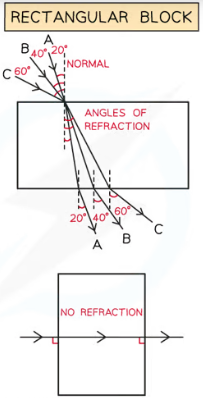
Rectangular block

knowt flashcard image
8
New cards

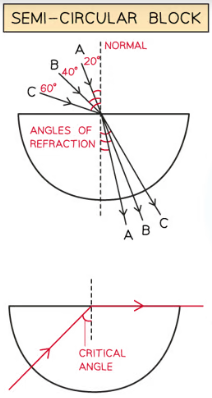
Semi-circular block

knowt flashcard image
9
New cards

Triangular prisms

Different wavelengths of light refract by different amounts, so white light (mixture of all visible frequencies) disperses into different colours as it enters a prism and different wavelengths are refracted by different amounts
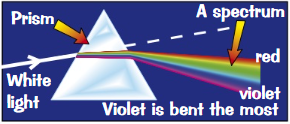
<p><strong>Different wavelengths</strong> of light refract by <strong>different amounts</strong>, so <strong>white light</strong> (mixture of all visible frequencies) disperses into <strong>different colours</strong> as it <strong>enters a prism</strong> and different wavelengths are refracted by different amounts</p>
10
New cards

Equation: Refractive Index, Angle of incidence and Angle of refraction

n = sin(i) / sin(r)
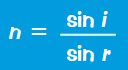
<p>n = sin(i) / sin(r)</p>
11
New cards

Investigating refractive index of glass

  • Draw around rectangular glass block on paper and direct ray of light through it at an angle

  • Trace incident and emergent rays, remove block, then draw in refracted ray between them

  • Draw normal, perpendicular (at 90ᵒ) to edge of block, at the point where ray enters block

  • Use protractor to measure angle of incidence (i) and angle of refraction (r)

  • Calculate refractive index (n) using equation: n = sin(i) / sin(r)

12
New cards

Total internal reflection

When all light is reflected in the medium

Occurs when angle of incidence is greater than critical angle

13
New cards

Optical fibres

  • Made of plastic/glass and consist of central core surrounded by cladding with lower refractive index

  • Core of fibre is so narrow that light signals passing through it always hit core-cladding boundary at angles higher than C

  • So light is always totally internally reflected
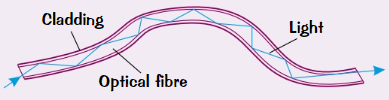
<ul><li><p>Made of <strong>plastic/glass</strong> and consist of <strong>central core</strong> surrounded by <strong>cladding</strong> with <strong>lower </strong>refractive index</p></li><li><p>Core of <strong>fibre</strong> is so <strong>narrow</strong> that <strong>light </strong>signals passing through it <strong>always</strong> hit core-cladding boundary at angles <strong>higher than C</strong></p></li><li><p>So light is <strong>always totally internally reflected</strong></p></li></ul>
14
New cards

Prisms

  • TIR allows us to use prisms to see objects that aren’t in direct line of sight - this is how a periscope works

  • Ray of light travels into one prism where it is totally internally reflected by 90ᵒ

  • Then travels to another prism lower down and is totally internally reflected by another 90ᵒ

  • Ray is now travelling parallel to initial path but at different height
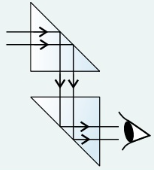
<ul><li><p>TIR allows us to use <strong>prisms</strong> to see objects that aren’t in direct line of sight - this is how a <strong>periscope</strong> works</p></li><li><p>Ray of light travels into one prism where it is totally internally reflected by 90ᵒ</p></li><li><p>Then travels to <strong>another prism</strong> lower down and is totally internally reflected by another 90ᵒ</p></li><li><p>Ray is now travelling <strong>parallel</strong> to initial path but at <strong>different height</strong></p></li></ul>
15
New cards

Critical angle

Angle that gives angle of refraction of 90ᵒ

Above critical angle, TIR occurs

16
New cards

Equation: Critical angle and Refractive index

sin C = 1/n