muscles
 Call Kai
 Learn
Learn Practice Test
 Spaced Repetition
 Match
Match Flashcards
 Knowt Play
1/21

There's no tags or description
Looks like no tags are added yet.
Name | Mastery | Learn | Test | Matching | Spaced | Call with Kai |
|---|
No analytics yet
Send a link to your students to track their progress
22 Terms
what are the 3 types of muscle
what are muscle cells and striations
skeletal muscle
smooth muscle
cardiac muscle
muscle cells = myocytes
striations = stripes
what is skeletal muscle
most common
attaches to bone skeleton
under VOLENTARY control
fibres: striated, tubular and multi nucleated
smooth
stomach, intenstine, urinary system, throughout arteries and veins plays vital role in regulation of blood pressure and tissue oxygenation ( covers walls of organs)
no striations, uninucleated
INVOLENTARY control
cardiac muscle
INVOLENTARY
contracts to pump blood around body
only covers wallsof heart
uninucleated
straited
not fatiguing ( lots of mitochondria)
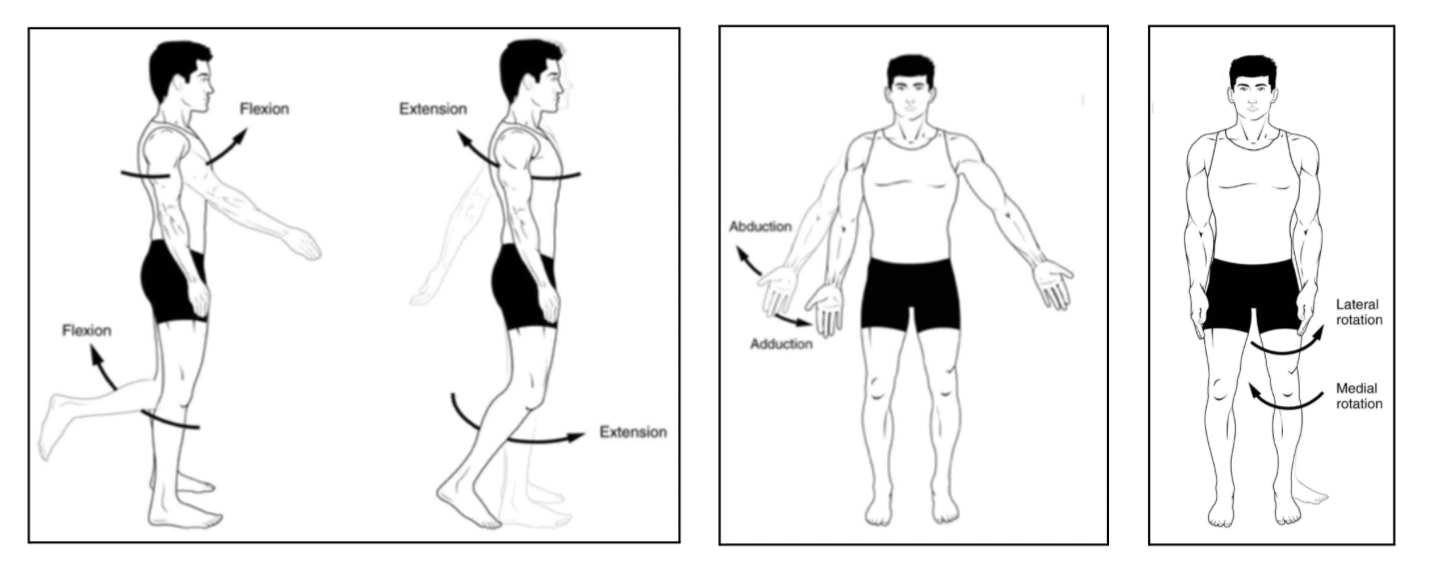
major types of movement:
flexion
extension
abduction
adduction
medial rotation
lateral rotation
flexion = movement decreases angle between body parts
extension = movement to increase angle between body parts
abduction = movement away from midline
adduction = movement towards midline
medial rotation = rotation towards midline
lateral rotation = rotations away from midline
easy way to remember flexion and extension:
flexion = forward or folded
extension = backward or straiten
define
actin
myosin
the neutransmitter that muscles use
sarcomere
actin - thin filament
myosin - thick filament
neurotransmitter that muscles use = acetylcholine
sarcomers = basic functional units of muscle fibres that shorten to produce muscle contractions
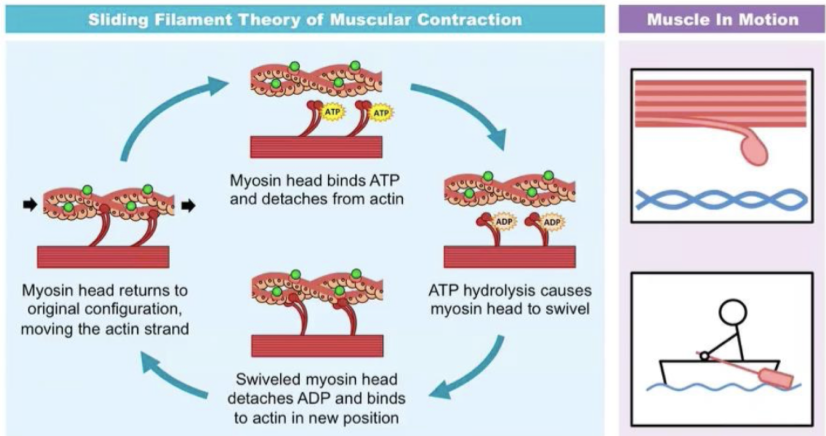
what is sliding filament theory
muscles contract because actin filaments slide past myosin filaments pulling sarcomers shorter without the filaments themselves changing lengths
what is
a motot uit
neuromuscular junction
Alpha (α) motor neurons:
include what is needed to create a large force and high precision respectively
a motot uit = motor neuron + muscle fibres it innervates
neuromuscular junction = synapse between motor neuron and muscle fibre
Alpha (α) motor neurons: innervate extrafusal skeletal muscle fibres → cause contraction.
large forces need motor neurons with more muscle fibres
high precision needs more motor neurons
3 types of muscle fibres
type 1: slow, oxidative , fatigue-resistant
type 2a: fast, oxidative , intermediate metabolic properties
type 2b: fast, glycolic , fatigable
way to remember:
type 1 be SO FR
type 2 FOI
type 2 bfgf
motor unit types
differ in size of α motor neuron, number of fibres & fibre type
slow (s) motor units
fast-fatiguable (FF) motor units
fast-fatigue-resistant (FR) motor units
Slow ( S) motor units (4 points)
innervate small ‘red’ muscle fibres
contract slowly,generate relatively small forces
rich in myoglobin, cappillaries and mitochondria → fatigue resistant
importnat for sustained contracts e.g. upright posture
Fast-fatiguable (FF) motor units
large α motor neurons innervate larger, pale muscle fibres
produce large force but sparce mitochondia → fast fatiguing
useful for brief exertions needing large forc e.g. running
Fast - fatigue-resistant ( FR) motor units
intermediate size motor units
not as fast as FF → more resistant to fatigue
generate twice force of slow( S) motor units
what is motor recruitment t
how nervous system increases muscle force by activation motor units in specific order
S→FR→FF
muscle spindles
stretch receptors within body of skeletal muscle that primarily detects changes in muscle length
comvey length info to cns via afferent nerve fibres
have both sensory and motor components
muscle spindle gamma motor neurons
what do they do
efferent signals that innervate muscles fibres ( myofibrils) in the muscle spindle
keep muscle spindles taut and adjust sensitivity of muscle spindle
what is golgi tendon organ (GTO)
sends info about force level to spinal cord
what happens if a muscle's force level exceeds its set point
the golgi tendon organ inhibits the alpha motor neurons which innevrate the muscle, lowering force
what is the tonic vibration reflex
sustained contraction of a muscle subject to vibration
30-100Hz vibration activates muscle spindles and sends inputs to afferent nerve fibres, causing muscle to contract
how can proprioceptive signals be tricked
tonic vibration illusion - vibration of muscle tendon can give illusion that the limb is moving even when it is stationary because cns interprets strong muscle spindle activity as movement
( this isnt super important)
what is H reflex (Hoffmann reflex)
electrically stimulating 1a afferents sensory fibres without activating the muscle spindles directly
what is the sliding filament theory ( 4 steps )