10.1 Government macroeconomic policy objectives
 Call Kai
 Learn
Learn Practice Test
 Spaced Repetition
 Match
Match Flashcards
 Knowt Play
1/57

There's no tags or description
Looks like no tags are added yet.
Name | Mastery | Learn | Test | Matching | Spaced | Call with Kai |
|---|
No analytics yet
Send a link to your students to track their progress
58 Terms
What are macroeconomic policy objectives
The targets a government aims to achieve in managing the overall performance of the overall economy, such as low inflation, low unemployment, growth and stability.
What do the macroeconomic policy objectives focus on
• the performance of the whole economy
• not individual markets or firms
Core idea - Why do governments have macroeconomic objectives
Governments face scarcity, so they cannot achieve all objectives fully at the same time.
This leads to trade-offs, policy conflicts, and possible government failure.
What are the 7 macroeconomic objectives
Low and stable inflation
Economic growth
Low unemployment
Balance of payments stability
Economic development
Sustainability
Redistribution of income and wealth
Exam tip - What do I need to know for each macroeconomic objective (5)
• definition
• why it matters
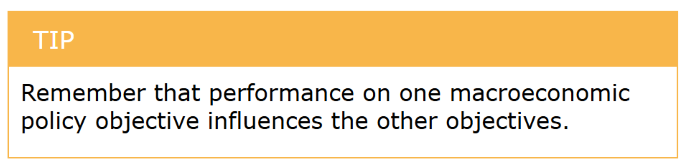
• how it links to other objectives
• chains of reasoning
• exam application
What is inflation
A sustained increase in the general price level over time, resulting in a fall in the internal value of money.
What is the government’s inflation objective
To achieve low and stable inflation, often around 2% (for UK), to maintain confidence and economic stability.
- Many set a target inflation rate for their central bank to achieve.
What influences a government’s ability to achieve low and stable inflation (1 + 2 examples/explanations)
Success is influenced by international factors, especially inflation in other countries
1. Importing raw materials, capital goods, or oil from high‑inflation countries raises production costs and causes cost‑push inflation.
2. High inflation abroad in rival trading partners can also reduce pressure on domestic firms to keep prices low.
How do international policy differences (2 examples) affect inflation and competitiveness
A government’s anti‑inflation policies are affected by what other countries do.
- If one country raises income tax while others do not, it may lose skilled workers and deter multinational firms.
- If interest rates rise above those in rival countries, capital inflows may occur, causing exchange rate appreciation, which helps lower inflation but reduces international competitiveness.
Governments and central banks therefore often coordinate policy internationally.
Why is high inflation a problem/why do governments care (chain of reasoning - 6)
• High inflation → purchasing power falls
• Consumers can buy fewer goods and services → Economic growth may slow
• Real incomes fall (especially for those on fixed incomes) - worsens income inequality
• Uncertainty increases → Firms may delay investment
• Reduces international competitiveness → Economic growth may slow
• Menu costs and shoe leather costs
What are menu costs and shoe leather costs and what do they show
Both are examples of real costs of inflation — they show that inflation creates inefficiencies in the economy even if money doesn’t “buy less stuff” directly.
Menu costs: The costs to firms of changing prices due to inflation, such as reprinting price lists, updating systems, and administrative time.
Shoe-leather costs: The time and effort consumers spend managing money in high inflation, such as making more frequent bank trips to avoid holding cash.
Why can very low inflation or deflation be harmful (chain of reasoning - 4)
Consumers delay spending, firms reduce output, unemployment rises, and economic growth slows.
How does inflation affect economic growth
High inflation creates uncertainty, discourages investment, and can reduce long-term growth.
What is the balance of payments
A record of all economic transactions between a country and the rest of the world over a given period.
What is the government’s balance of payments objective
To achieve a stable and sustainable balance of payments position, particularly on the current account.
- Usually aim in the long run for the total credit items to equal the total debit items
Why does a stable and sustainable BoP matter
Current account deficit = reduces AD and can result in external debt
Current account surplus = can be inflationary and involved an opportunity cost of forgone imports
What is the problem with a persistent current account deficit (chain of reasoning - 7)
Persistent current account deficit →
Country imports more than it exports →
Increased borrowing from abroad →
Rising external debt →
Loss of confidence in the currency →
Exchange rate depreciation →
Imported inflation
Why is a persistent current account deficit a concern (4)
It may lead to:
• Rising foreign debt
• Loss of confidence in the currency
• Exchange rate depreciation
• Imported inflation.
Why might a current account deficit be acceptable (2)
If it is financed by foreign direct investment or reflects strong economic growth and capital inflows.
Exam tip: Do NOT say “surplus is always good” – this is simplistic and loses marks. Instead say….
Therefore, a budget surplus is not inherently good or bad; its effectiveness depends on economic conditions and policy priorities.
Why do governments also seek to avoid large changes in the current account balance
Because fluctuations in the current account balance can result in changes in the exchange rate.
- Lots of fluctuations of balance = rise and fall in exchange rate -> creates uncertainty and can reduce investment and economic growth
What is unemployment
When people who are willing and able to work at the current wage rate are unable to find employment.
What is the government’s unemployment objective + why
To achieve low unemployment and of short duration to minimise the waste of productive resources.
- The quicker then unemployed can return to work, the less output will be lost and the lower gov spending on benefits will be.
Why is unemployment economically costly / why is it a problem (5)
• Unemployment causes a loss of output (negative output gap)
• Productive resources are wasted
• Government tax revenue falls
• Government spending on benefits rises
• Budget deficit may increase
What are the social costs of unemployment (4)
Higher poverty
Inequality
Loss of skill
Lower long-term employability.
Why is some unemployment unavoidable
Frictional unemployment exists as workers move between jobs, making zero unemployment unrealistic.
What is economic growth
An increase in real GDP over time.
What is the government’s growth objective
To achieve sustained long-term economic growth to improve living standards.
Why do governments aim for economic growth and how might they achieve it
Governments aim for economic growth, especially when there is a negative output gap.
They may use expansionary fiscal policy and/or expansionary monetary policy to increase aggregate demand, raise national output, and reduce unemployment. (However, if demand rises too much, this can cause demand‑pull inflation.)
What are the possible effects of economic growth on the current account
The effect is uncertain.
- Economic growth may increase exports, but higher production usually requires more imports of raw materials and capital goods.
- Rising incomes may also increase spending on imported goods and services, which could worsen the current account balance.
Why might economic growth be unsustainable + example
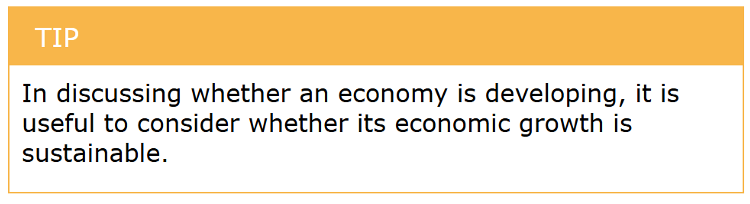
Growth may be unsustainable if it leads to depletion of non‑renewable resources or environmental damage.
- For example, short‑term agricultural output may rise through chemical use, but soil damage can reduce long‑term productivity, causing future output to fall.
How can supply‑side policies promote potential economic growth
Supply‑side policies expand productive capacity, reducing the risk of demand‑pull inflation.
Lower production costs can improve international competitiveness and the balance of payments.
Measures include education and training, technological improvement, and investment in capital.
What is the impact of economic growth and supply‑side policy on employment
The impact on employment is uncertain.
- Education and training can improve workers’ skills and employability, but without sufficient demand, jobs may not be created.
- Technological progress may create new jobs while making others redundant.
Why is economic growth important (chain of reasoning - 5)
Growth → higher output → Higher incomes → Higher living standards → Increased tax revenue → Greater ability to fund public services
What is the difference between short-run and long-run growth
• Short-run: driven by AD
• Long-run: driven by AS and productivity
What negative effects could growth have (3)
Growth may cause:
• inflation
• environmental damage
• inequality
What is actual growth vs potential growth vs real growth (in long or in short form)
Actual growth: The increase in real GDP an economy experiences in the short term.
Potential growth: The maximum sustainable increase in real GDP an economy can achieve in the long run without causing inflation.
Real growth: The increase in real GDP after adjusting for inflation, showing the economy’s true increase in output.
So in short:
• Actual growth: Short-term increase in GDP
• Potential growth: Long-term sustainable GDP growth
• Real growth: GDP growth adjusted for inflation
What is economic development
An improvement in living standards and quality of life, including high standards of health and nutrition, better education and infrastructure, less poverty, a cleaner environment, equality of opportunity etc. - not just higher income
How does economic growth differ from economic development
Growth is quantitative (output and income), while development is qualitative (well-being and living standards).
Why is economic development an important objective
It improves human capital, productivity, and long-term sustainable growth.
What is the government objective for economic development and where in it especially important
To improve human development, especially in developing economies
What are 4 indicators for economic development
Indicators:
• HDI
• life expectancy
• literacy
• access to clean water
Chain of reasoning (5) for why investment in education is good for economic development and economic growth
Investment in education → Higher skills & productivity → Higher wages → Improved living standards → Sustainable growth
What is sustainability
Meeting the needs of the present without compromising future generations.
What is sustainable development + examples on how to achieve it (5)
Development that ensures that the needs of the present generation can be met without harming the well-being of future generations
- e.g. recycling, renewable resources, improvements of technology to help pollution, cutting back on CO2 emissions, reducing landfill etc
What is sustainability as a macroeconomic objective
Ensuring that economic growth does not damage the environment or reduce the ability of future generations to meet their needs.
• To ensure growth does not cause long-term environmental damage
Why is sustainability important for long-term growth (Chain of reasoning on why unsustainable growth is bad - 5)
• Unsustainable growth → • Resource depletion → • Environmental degradation → • Higher future costs → • Lower long-run growth potential
Why may sustainability conflict with economic growth
Policies to protect the environment may raise costs and reduce short-run growth.
- Requires long-term planning
Why is tourism in the Maldives an example of an unsustainable growth pattern
Tourism accounts for over 60% of GDP in the Maldives, supporting economic growth and employment. However, it is responsible for around 80% of greenhouse gas emissions and creates significant waste and litter, damaging the environment. Although recycling has improved, the heavy environmental costs mean that growth driven by tourism may be unsustainable in the long run if environmental damage reduces future income and living standards.
Tip - in discussing whether an economy is developing, what is it useful to consider
What is redistribution of income and wealth
The use of government policies to reduce income and wealth inequality within an economy.
- To achieve a more equitable distribution of income and wealth
Why do governments distribute (chain of reasoning - 5)
Market forces → income inequality
High inequality → Social tension, lower social mobility, underinvestment in human capital
How does governments aiming to redistribute income and wealth help (3)
• To reduce inequality
• Improve social mobility
• Ensure access to basic services.
How can governments redistribute income and wealth (3)
• Progressive taxation
• Welfare benefits
• Provision of public services
What is a potential drawback of redistribution
It may reduce incentives to work, save, and invest (discourage enterprise) if taxes are too high.
EXAM SKILL: Linking Objectives - Examiners LOVE answers that show conflicts. Hence what are the conflicts in objectives
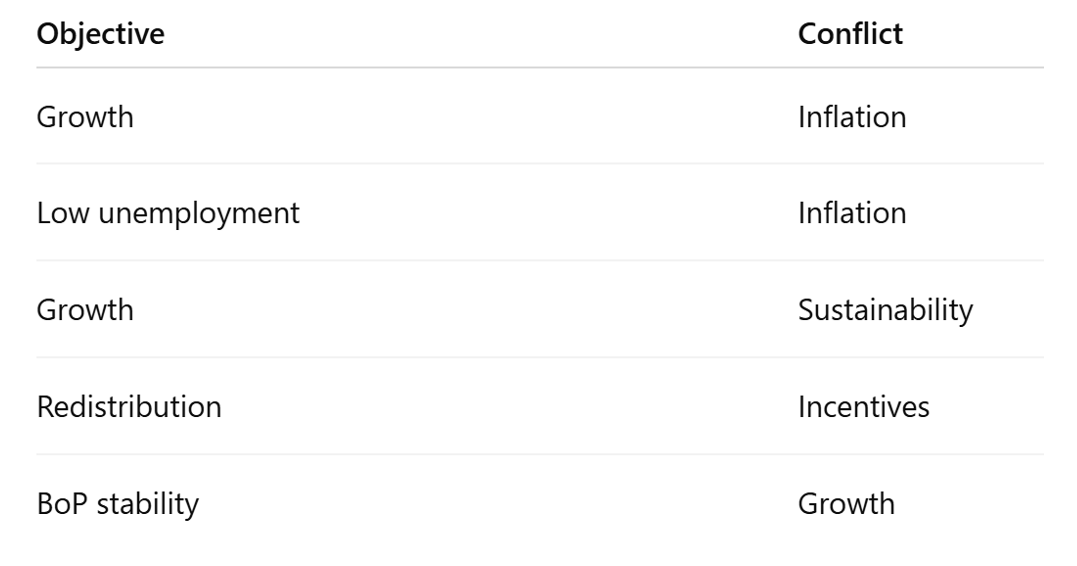
Why can governments not achieve all macroeconomic objectives at the same time
Because trade-offs exist between objectives, such as inflation and unemployment or growth and sustainability.
Why is evaluation essential in macroeconomic policy answers (4 evaluation points)
Because policies often involve conflicts, uncertainty, time lags, and unintended consequences.