Extranuclear/Cytoplasmic/Organelle Inheritance Lecture 7
 Call Kai
 Learn
Learn Practice Test
 Spaced Repetition
 Match
Match Flashcards
 Knowt Play
1/38

Earn XP
Description and Tags
Flashcards covering key terms and concepts related to extranuclear, cytoplasmic, and organelle inheritance as discussed in the lecture.
Name | Mastery | Learn | Test | Matching | Spaced | Call with Kai |
|---|
No analytics yet
Send a link to your students to track their progress
39 Terms
Uniparental Inheritance
Inheritance pattern where genes are inherited from only one parent, typically the mother.
Extranuclear Inheritance
Inheritance of traits determined by genes located outside of the nucleus, particularly in organelles like mitochondria and chloroplasts.
Endosymbiotic Theory
The theory that mitochondria and chloroplasts originated from prokaryotic organisms that were engulfed by ancestral eukaryotic cells.
Heteroplasmy
The presence of a mixture of genetically different DNA within a single cell, especially in the context of organelles.
Homoplasmy
The condition where all organelles within a cell contain the same genetic material.
Cytoplasmic Male Sterility (CMS)
A condition in plants that prevents the production of functional pollen, often due to mitochondrial mutations.
Mitochondrial Mutations
Genetic changes in the mitochondrial DNA that can affect cellular metabolism and traits, such as those seen in petite mutants in yeast.
Maternal Inheritance
The transmission of genetic traits from the mother to offspring, often linked to organelle genes.
Paternal Leakage
A rare occurrence where paternal mitochondria are also inherited alongside maternal mitochondria.
Segregational Petite Mutations
Mutations in nuclear genes that lead to defects in mitochondria, following Mendelian inheritance patterns.
Vegetative Petite Mutations
Mutations within mitochondrial DNA that do not follow normal Mendelian inheritance and can result in different phenotypes based on competition.
Hybrid Vigor
The phenomenon where hybrid offspring exhibit enhanced characteristics compared to their parents.
Chloroplasts
Photosynthetic organelles in plant cells containing their own DNA and responsible for converting light energy into chemical energy.
Mitochondria
Cellular organelles important for energy production, possessing their own DNA and involved in metabolism.
Synteny
The conservation of genetic blocks between species, particularly in the context of organelle inheritance.
Cyanobacteria
Photosynthetic prokaryotic organisms thought to be the ancestors of chloroplasts.
Mitochondrial Replacement Therapy (MRT)
A reproductive technology aimed at preventing mitochondrial diseases by replacing defective mitochondrial DNA with healthy mitochondrial DNA from a donor.
A phenomenon in which an organism’s phenotype is affected by the expression of genes contained in the DNA of ______ or ______ rather than the ______, generally referred to as organelle ______ or ______.
A phenomenon in which an organism’s phenotype is affected by the expression of genes contained in the DNA of mitochondria or chloroplasts rather than the nucleus, generally referred to as organelle heredity or inheritance.
Based on the ______ theory of origin, the organelles ______ and ______ are supposedly the early prokaryotic ______ (cyanobacteria and aerobic free-living bacteria, respectively) that had been ingested or eaten by ______.
Based on the Endosymbiotic theory of origin, the organelles Chloroplast and Mitochondria are supposedly the early prokaryotic endosymbionts (cyanobacteria and aerobic free-living bacteria, respectively) that had been ingested or eaten by eukaryotes.
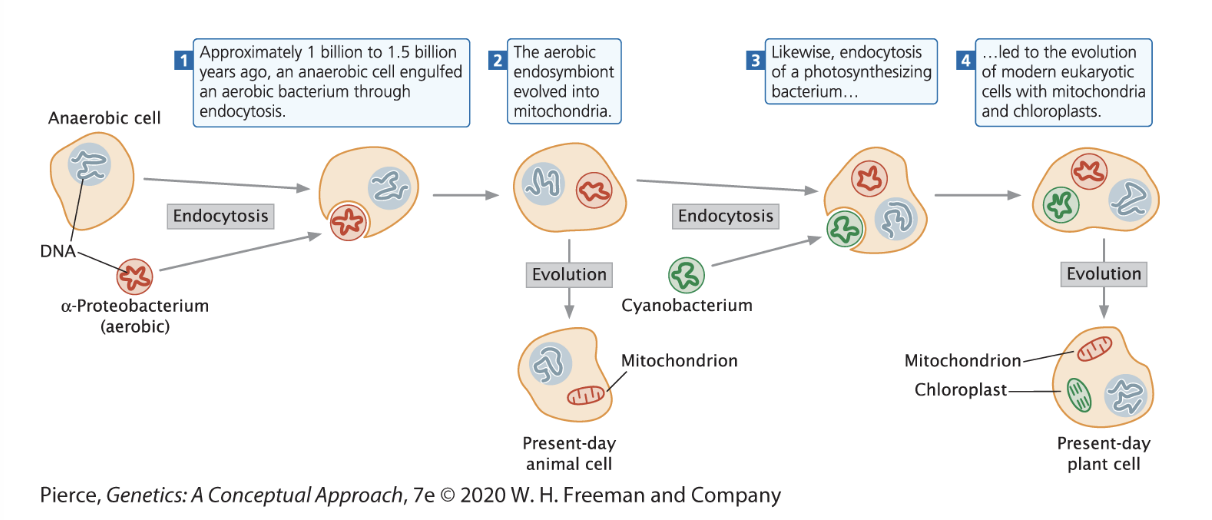
What is the basis of endosymbiotic theory?
Mitochondria and chloroplasts have their own DNA
Ribosomes that more closely resemble those in prokaryotic cells (70S ribosomes)
Codon usage is similar to prokaryotes
Reproduce by fission like porkaryotes
rRNA sequences are simllar to prokaryotes.
Majority of the ______ proteins are synthesized from ______ genes.
Majority of the organelle proteins are synthesized from nuclear genes.
Two reasons why mutant alleles in chloroplasts and mitochondria is more complex is because..
The function of mito/chloro is dependent on gene products made by the nucleus, which is difficult to find.
99% of proteins required for mitochondrial function are encoded by nuclear genes, synthesized as proteins in cytoplasm and transported to the mitochondria.
95% of proteins required for chloroplast function are encoded by nuclear genes, synthesized as proteins in cytoplasm and transported to the chloroplast.
There are many mitochondria and chloroplasts in each cell, so finding a mutation among normal population is hard.
Cytoplasmic organelles such as the mitochondria and chloroplast are most often inherited through the mother because…
In hetergamous species (Aa/Bb), the female is larger and has more cytoplasmic/organelles than male.
During the end of fertilization, female gives more cytoplasm than male.
Autophagy event occurs at the end of fertilization, where males mitochondria is disintegrated.
A male can provide mitochondria to zygote, called parental leakage.
______ is two different DNA within the cytoplasm of a single cell.
Heteroplasmy is two different DNA within the cytoplasm of a single cell.
______ is when all organelle genomes are identical.
Homoplasmy is when all organelle genomes are identical.
______ male ______ (CMS) is a condition which a ______ is unable to produce functional ______.
Cytoplasmic male sterility (CMS) is a condition which a plant is unable to produce functional pollen.
CMS is a ______ inheritied trait that is often associated with ______ mutations.
CMS is a maternally inheritied trait that is often associated with mitochondria mutations.
Male sterility can be reversed by ______-enocded fertilitiy ______ (RF) genes.
Male sterility can be reversed by nuclear-enocded fertilitiy restorer (RF) genes.
Sterility is caused by ______ mutations that cause ______ dysfunction, however to restore ______, it relies on ______ genes that suppress ______ dysfunction.
Sterility is caused by mitochondria mutations that cause cytoplasmic dysfunction, however to restore fertility, it relies on nuclear genes that suppress cytoplasmic dysfunction.
CMS plants are male sterile and require another fertile male to give it’s ______ that contains ______ DNA.
CMS plants are male sterile and require another fertile male to give it’s pollen that contains nuclear DNA.
CMS systems are used in production of ______, because they will fertilize the ______ they are given.
CMS systems are used in production of hybrids, because they will fertilize the pollen they are given.
______ mutants (yeast) were unable to carry out ______ respiration resulting in a ______ colony size. This is due to ______ mutations.
Petite mutants (yeast) were unable to carry out aerobic respiration resulting in a smaller colony size.This is due to mitochondria mutations.
There are two types of petite mutations, ______ and ______.
There are two types of petite mutations, segregational and vegetative.
______ petite mutations consist of
Mutation in ______ gene (nucleus) resulting in defective ______
Seperate in ______ fashion
_ : _ ratio (wt/m)
Segregational petite mutations consist of
Mutation in nuclear gene (nucleus) resulting in defective mitochondria
Separate in Mendelian fashion
2 : 2 ratio (wt/m)
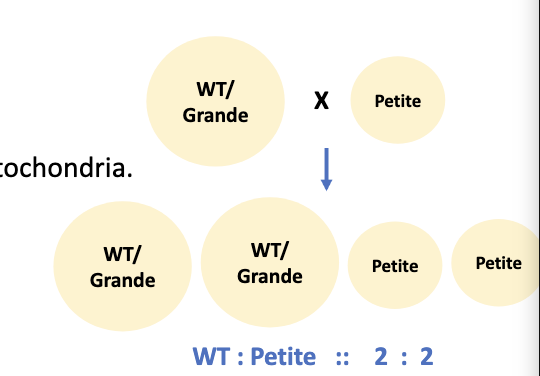
______ petite mutations consist of
Mutation or ______ in mitochondrial DNA resulting in defective mitochondria
Do not separate ______ fashion
_ : _ (neutral) or _ : _ (suppressed) ratio (wt/m)
Vegetative petite mutations consist of
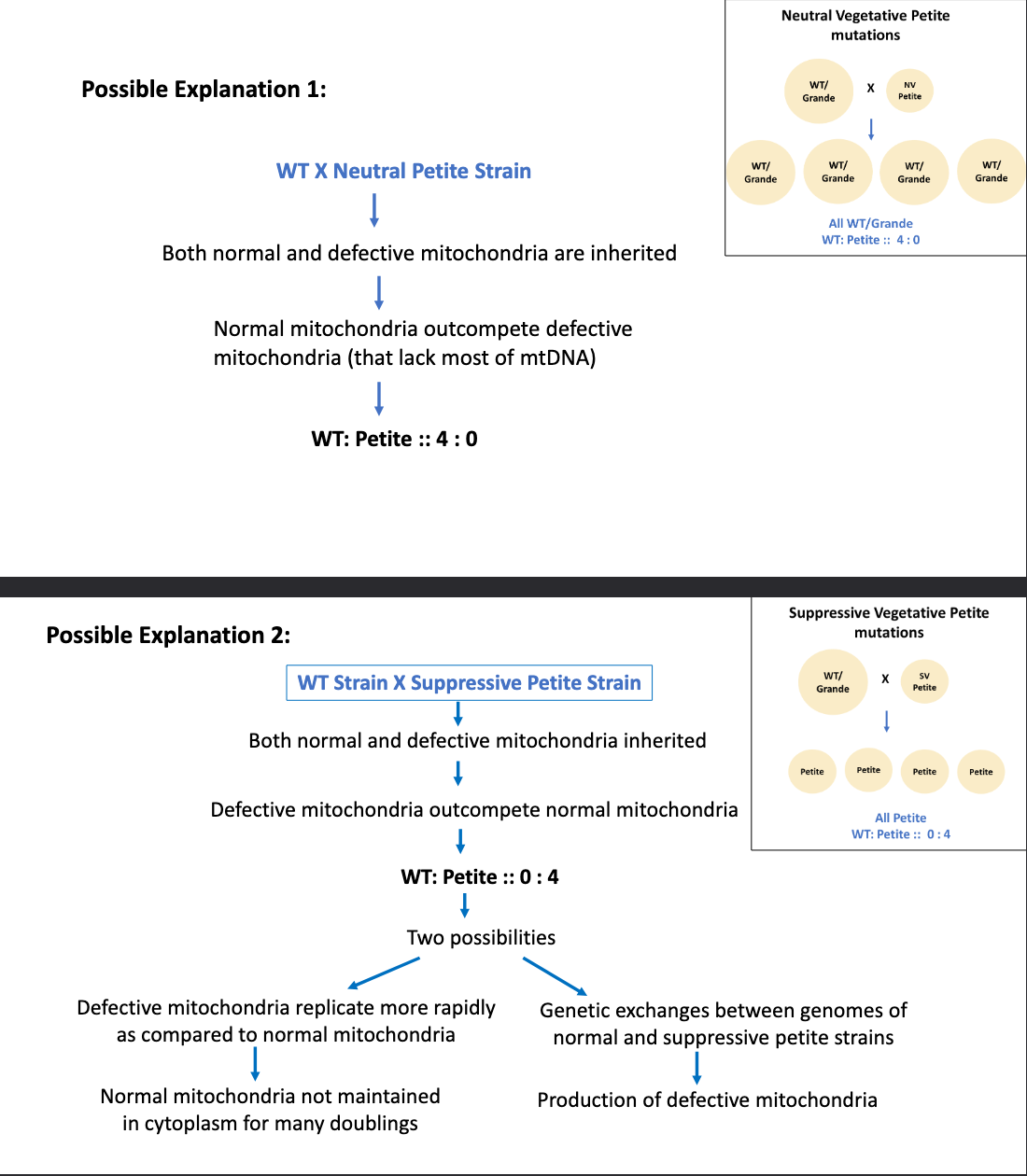
Mutation or deletion in mitochondrial DNA resulting in defective mitochondria
Do not separate Mendelian fashion
4 : 0 (neutral) or 0 : 4 (suppressed) ratio (wt/m)
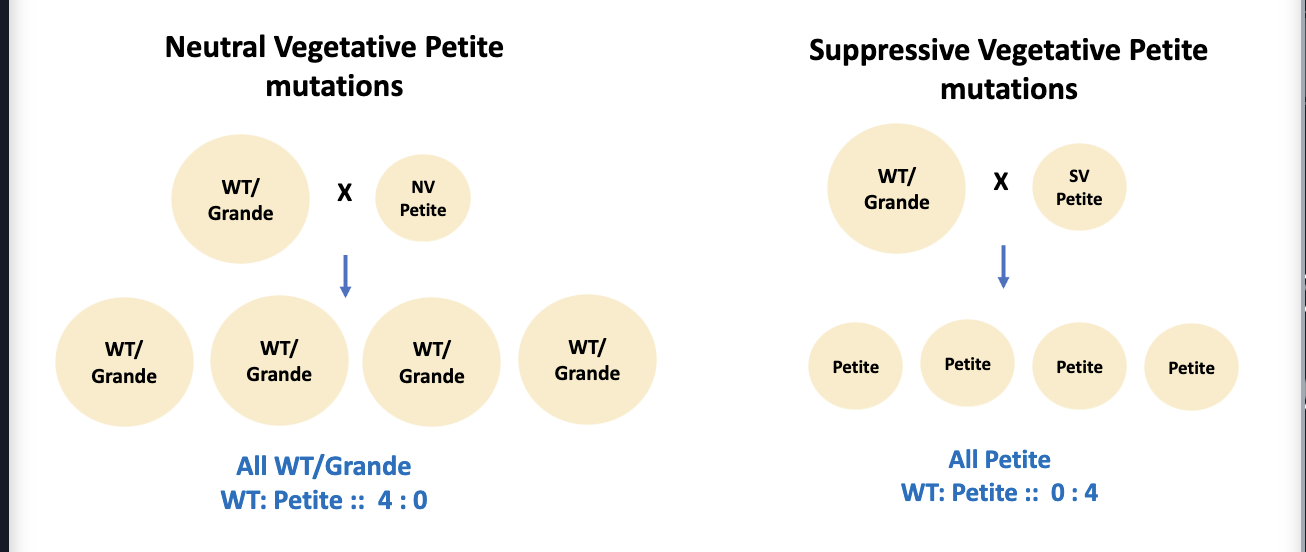
______ vegetative petites lack most of their ______ DNA, whereas ______ vegetative petites lack small ______ of ______ DNA.
Neutral vegetative petites lack most of their mitochondrial DNA, whereas suppressed vegetative petites lack small segments of mitochondrial DNA.
Explain how vegetative petites can either become neutral or suppressive.
Human mitochondrial diseases that show maternal inheritance.
Leber’s Hereditary Optic Neuropathy (LHON)
Respiratory proteins (Complex I)
Mitochondrial myopathy
tRNA-Leu
Leigh Syndrome
Pyruvate dehydrogenase
Cardiomyopathy
tRNA-Gly
MERRF
tRNA-Lys
Mitochondrial Donation Treatment (MDT) consists of a mother whos’s egg has a faulty mitochondrial, is mixed with father’s sperm, then nucleus from that egg that contains both parents DNA, go into a egg that contains healthy DNA donated by another woman, the reconstructed embryo goes back into mother and the kid has 3 parents.
Mitochondrial Donation Treatment (MDT) consists of a mother whos’s egg has a faulty mitochondrial, is mixed with father’s sperm, then nucleus from that egg that contains both parents DNA, go into a egg that contains healthy DNA donated by another woman, the reconstructed embryo goes back into mother and the kid has 3 parents.