2.1.1 Structure of eukaryotic cells
 Call Kai
 Learn
Learn Practice Test
 Spaced Repetition
 Match
Match Flashcards
 Knowt Play
1/13

There's no tags or description
Looks like no tags are added yet.
Name | Mastery | Learn | Test | Matching | Spaced | Call with Kai |
|---|
No analytics yet
Send a link to your students to track their progress
14 Terms
What are the distinguishing features of eukaryotic cells?
Cytoplasm containing membrane-bound organelles.
DNA enclosed in a nucleus.
Which other cell types are similar to plant cells?
Algal and fungal cells are similar to plant cells.
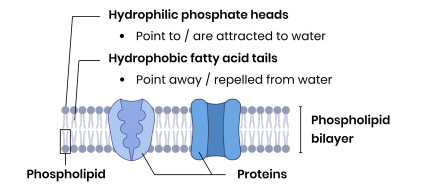
Describe the structure and function of the cell-surface membrane.
Structure: phospholipids form a bilayer with hydrophobic fatty acid tails facing inwards and hydrophilic phosphate heads facing outwards.
Function: selectively permeable to control substance passage, with molecules, receptors, or antigens on the surface allowing cell recognition and signalling.
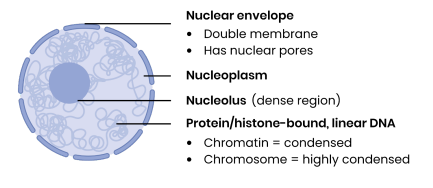
What are the main structural features of the nucleus?
Nuclear envelope with double membrane and nuclear pores.
Nucleoplasm.
Nucleolus.
Histone-bound, linear DNA existing as chromatin (condensed) or chromosomes (highly condensed).
What are the functions of the nucleus?
Holds genetic information in the form of DNA coding for amino acid sequences of polypeptides.
Site of DNA replication
Site of transcription, producing mRNA.
Nucleolus makes ribosomes or rRNA.
Describe the structure and function of a ribosome.
Structure: made of ribosomal RNA and protein with two subunits; not a membrane-bound organelle.
Function: site of protein synthesis, specifically translation.
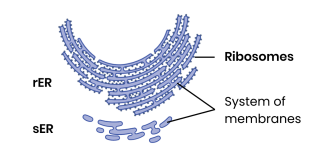
Describe the structure and functions of rough and smooth endoplasmic reticulum.
Rough ER: ribosomes on surface synthesise proteins during translation; proteins are processed, folded, and transported inside rER, then packaged into vesicles for transport to the Golgi apparatus.
Smooth ER: synthesises, processes, transports, and packages lipids and carbohydrates, for example cholesterol and steroid hormones.
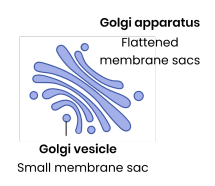
Describe the structure and functions of the Golgi apparatus and Golgi vesicles.
Golgi apparatus: flattened membrane sacs that modify proteins and lipids, package them into Golgi vesicles, and produce lysosomes.
Golgi vesicles: small membrane sacs that transport proteins and lipids to their required destination, fusing with the cell-surface membrane.
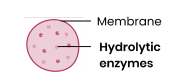
Describe the structure and function of a lysosome.
Structure: membrane-bound sac containing hydrolytic enzymes.
Function: releases hydrolytic enzymes such as lysozymes to hydrolyse pathogens or worn-out cell components.
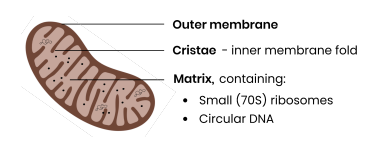
Describe the structure and function of mitochondria.
Structure: outer membrane, cristae (inner membrane folds), and matrix containing small 70S ribosomes and circular DNA.
Function: site of aerobic respiration, producing ATP to release energy for processes such as protein synthesis, vesicle movement, or active transport.
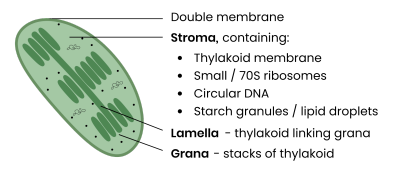
Describe the structure and function of chloroplasts.
Structure: double membrane, stroma containing thylakoid membrane, small 70S ribosomes, circular DNA, and starch granules; grana are stacks of thylakoid; lamella are thylakoids linking grana.
Function: pigments absorb light energy for photosynthesis to produce organic substances.
Describe the structure and function of the cell wall in plants, algae and fungi.
Structure: composed mainly of cellulose in plants and algae; composed of chitin in fungi.
Function: provides mechanical strength and prevents the cell changing shape or bursting under osmotic pressure.
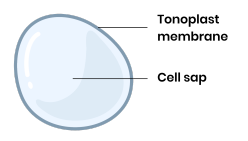
Describe the structure and function of the plant cell vacuole.
Structure: tonoplast membrane surrounding cell sap.
Function: maintains turgor pressure to stop plant wilting and stores sugars, amino acids, pigments, and waste chemicals.
How are eukaryotic cells organised in complex multicellular organisms?
Cells become specialised for specific functions.
Tissue: group of specialised cells working together.
Organ: aggregations of tissues performing specific functions.
Organ system: group of organs working together.