Earth&Space
 Call Kai
 Learn
Learn Practice Test
 Spaced Repetition
 Match
Match Flashcards
 Knowt Play
1/35

There's no tags or description
Looks like no tags are added yet.
Name | Mastery | Learn | Test | Matching | Spaced | Call with Kai |
|---|
No analytics yet
Send a link to your students to track their progress
36 Terms
Weather
state of the atmosphere at a specific location
and time, what you get
climate
the average/longterm/typical temperature,
precip etc, what you expect
Climate change
change in climate over time, change in expectations
Heat
a type of light (infrared) and it moves in the direction it was emitted. Does not rise
Warm air
Rises because molecules have MORE energy (infrared) causing them to move faster and collide
with each other more frequently. This expands the volume of the gas (distance between the molecules) creating a lower density.
Cool air
more dense air pushes warm air up.
Wind
UNequal heating of the Earth's surface, some places get hotter (receives more energy from the sun, albedo etc), some places do NOT get as hot (reflect more light, have "weak rays" from the sun etc).
Rising air cools
as air rises in our atmosphere, the air pressure (weight of the air from above pushing down) decreases. If you DECREASE the pressure on a gas, you DECREASE the temperature of the gas.
Sinking air warms
As air sinks, the pressure increases causing the
temperature to increase.
Latitude
Locations with lower latitudes (closer to the equator) receive MORE energy from the Sun
Land vs water
Land heats up faster and cools down faster than water, locations receiving air from land will have greater seasonal changes (hotter summers, colder
winters) than locations receiving air from the oceans.
Albedo
Some surfaces have a higher ______ (ability to reflect light from the sun) than others. If more light is
reflected, then less is absorbed making it cooler.
Solids
Little tiny solids in our atmosphere that allow water to condensate, condensation nuclei (dust, ash, smoke, etc).
Cloud
water vapor present in the air, rising air (needs to rise so that the air pressure rapidly decreases) A decrease in pressure (decreases the temperature and allows water to cool from a gas to a liquid) this forms a ______
greenhouse effect
Light from the Sun is high energy, short wavelength visible light. Portions of the Earth's surface absorb the energy from the Sun, the energy is transferred. the Earth will RE-emit the energy. BUT, the Earth is NOT as hot as the Sun, so the light Earth gives off is less energy,
longer wavelengths infrared light. Infrared is absorbed by greenhouse gases warming our atmosphere.
Coriolis effect
Because of Earth's rotation, the movement of air (or anything in the air) appears to be DEFLECTED (changed, altered) in its direction of motion.
Right
The coriolis effect affects winds in the northern hemisphere by deflecting wind to the _____
Left
The coriolis effect affects winds in the southern hemisphere by deflecting wind to the _____
No coriolis effect
Without this there would be no wind or pressure belts, air would move straight from high to low
Oceans
Heat and cool slower than land, because it is really good at transferring heat from one place to another through convection and conduction. It is also transparent, and has a high specific heat.
Altitude
This can affect climate because an increase in ________ decreases air pressure, which will decrease temperature.
Warm ocean currents
Warms the air above, the warm air moves over the land (Europe for example) and increases the temperature.
Westerlies
Michigan gets its air from the __________, air comes from the land to the WEST of Michigan
East
What direction do the trade winds come from?
30 degrees
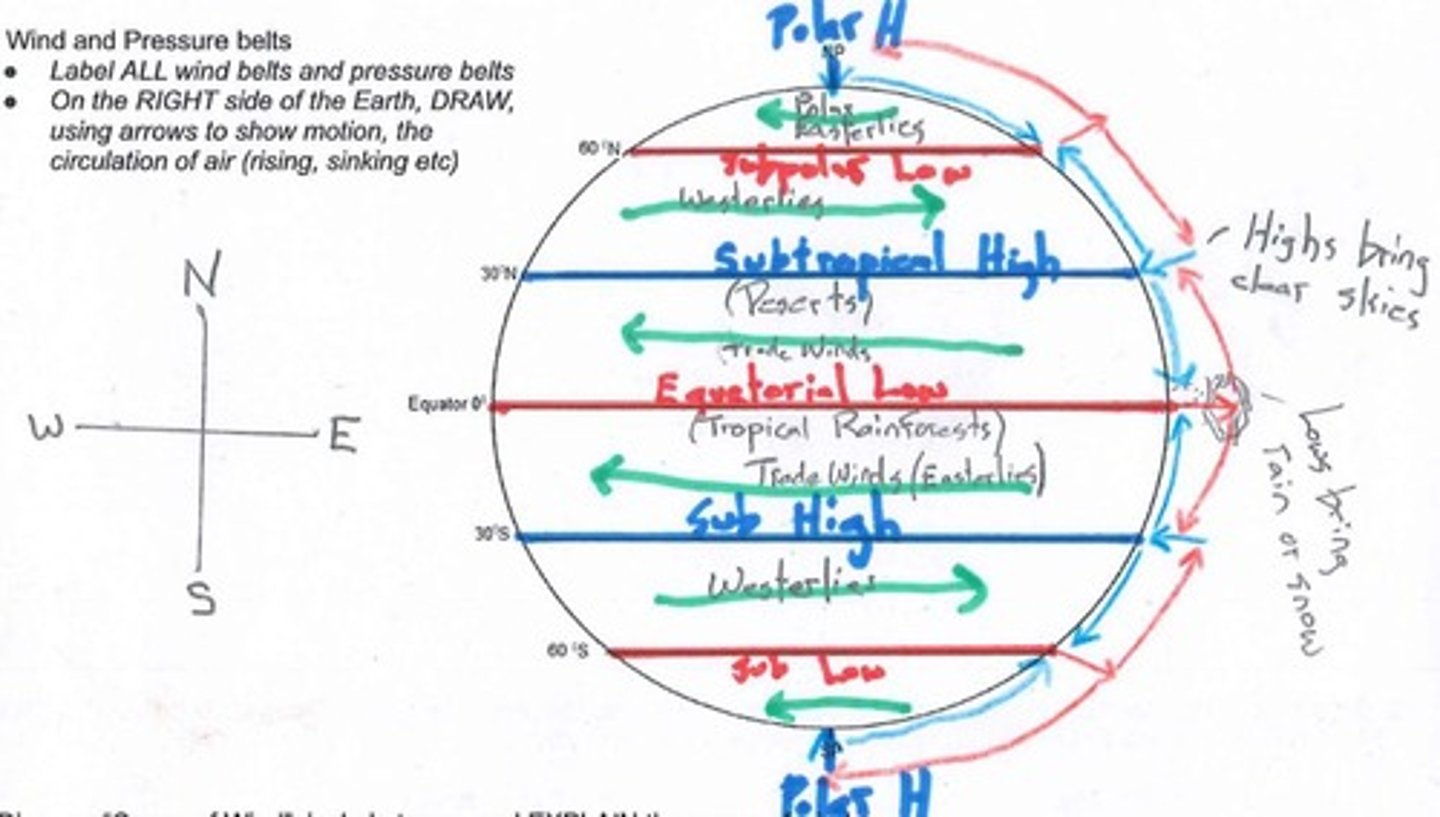
This (N and S) latitude is where most deserts are, because there is a subtropical high pressure belt. Highs bring clear skies
Equator
Equatorial low pressure belt is along this, the warmest location on earth.
Wind pressure belts
Polar High, Polar easterlies, Subpolar low, Westerlies, subtropical high, trade winds, equatorial low, trade winds (easterlies) sub high, westerlies, sub low, polar high (Top to bottom)
Low latitudes
close to the equator, receive LOTS of energy from the Sun so they have a HIGH average temperature and a very small temperature range because they have STRONG RAYS (angle is more direct) and LONG DAYS (12 hours of daytime) every single day.
Mid latitudes
receive a medium amount of energy from the Sun, so these locations typically have a medium average temperature and a medium range of temperatures. (Farmington Hills)
High latitudes
receive very little energy from the Sun. the North Pole receives NO energy from the Sun because it's nighttime for the entire 6 months. Even when it has 24 hours of daylight, it still receives very little energy because the angle is very indirect.
Continental climate
a region with4 distinct seasons, featuring hot/warm summers and cold/severe winters, found mostly in the interior of large northern landmasses
Landforms
These can drastically change the climate of cities based on what side of the _______ the city is located. Cities on the WINDWARD side experience LOTS of rain and a more MILD climate. Cities found on the LEEWARD side of a mountain experience very little rain and LOTS of sunshine.
Windward
the side facing into the wind (east), experiencing colder, wetter weather and higher wind resistance.
Leeward
the opposite, sheltered side (west), which is generally warmer and drier.
Equatorial low
a belt of LOW air pressure found near the equator. LOWS bring rain or snow, so this
location gets LOTS of precipitation.
Subtropical High
belts of HIGH air pressure. Highs bring clear skies = deserts