Chapter 02: Chemical Basis of Life
 Call Kai
 Learn
Learn Practice Test
 Spaced Repetition
 Match
Match Flashcards
 Knowt Play
1/106

Earn XP
Description and Tags
Comprehensive practice questions and answers covering the chemical basis of life, including atomic structure, bonding, pH, and organic/inorganic molecules based on Chapter 02 lecture notes.
Name | Mastery | Learn | Test | Matching | Spaced | Call with Kai |
|---|
No analytics yet
Send a link to your students to track their progress
107 Terms
Why is chemistry studied in Anatomy and Physiology?
Because all anatomical structures are chemicals, and all physiological processes are based on chemical reactions.
Define Matter.
Anything that takes up space and has mass; it is composed of elements and exists as solids, liquids, and gases.
Define Mass
Mass is the amount of matter present
Define Weight
the heaviness due to the gravitational pull on mass
Define Chemistry
Studies composition, properties, interaction of matter
What is the focus of Biochemistry?
biological chemistry, which studies physiological processes and disease.
What are Elements?
The simplest types of matter with certain chemical properties; there are 92 naturally occurring elements.
Compounds
particle formed when two or more atoms of different elements chemically combine
all compounds are molecules but not all molecules are compounds
Atoms
Smallest particles of an element that have properties of that element
Define Bulk elements and provide examples.
Elements required by the body in large amounts, such as Carbon (C), Oxygen (O), Hydrogen (H), Nitrogen (N), Sulfur (S), and Phosphorus (P).
What is a Trace element?
An element required by the body in small amounts, such as Iron (Fe) and Iodine (I).
Ultratrace elements
Required by the body in very minute amounts, like Arsenic (As)
Table of bulk and trace elements in the body
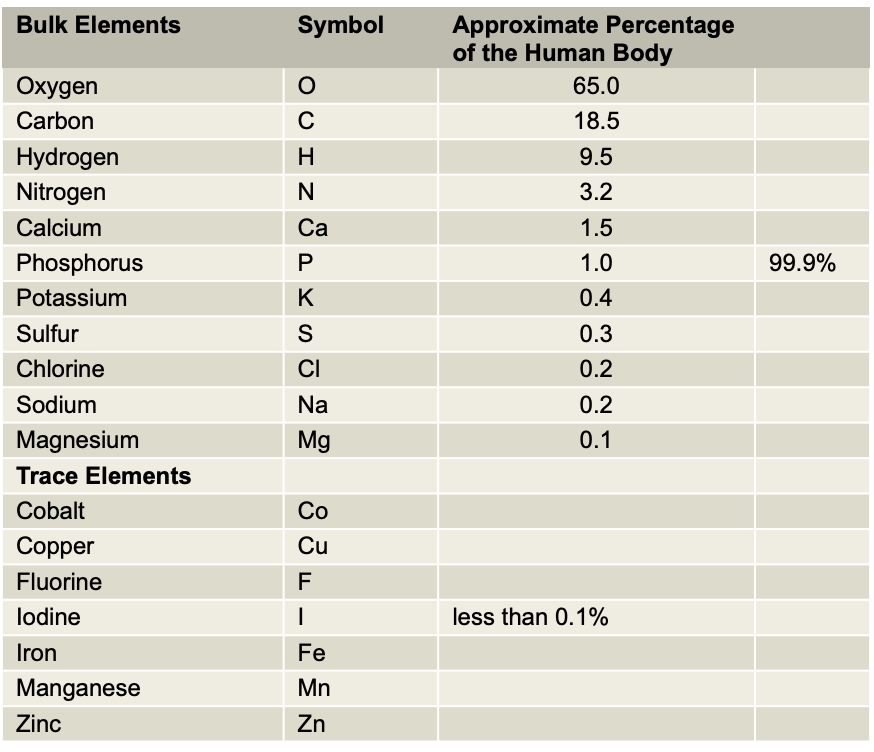
What is the most abundant element in the human body by weight?
Oxygen (O), making up approximately 65.0% of the human body.
Describe the three subatomic particles of an atom.
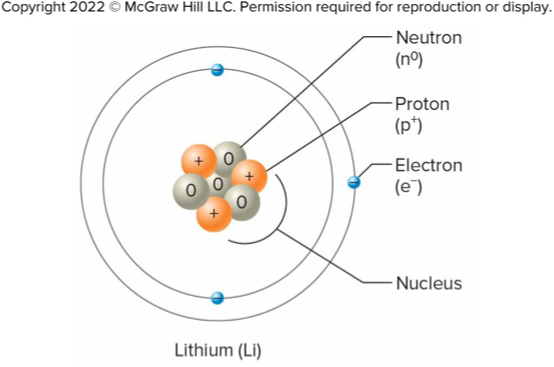
Protons (positive charge), Neutrons (neutral; no charge), and Electrons (negative charge).
Protons
Large particles; carry a single positive charge
Neutrons
Large particles; carry no electrical charge
Electrons
Small particles; carry a single negative charge
Atoms consist of
a central nucleus (protons + neutrons) and electrons in constant motion around the nucleus
Why are atoms considered electrically neutral?
The number of protons in an atom equals the number of electrons.
Atomic Structure
Define Atomic Number.
The number of protons in the nucleus of an atom of a specific element.
each element has a unique atomic number
Define Mass Number.
The number of protons plus the number of neutrons in one atom.
What are Isotopes?
Atoms with the same atomic numbers but different mass numbers due to containing different numbers of neutrons.
Radioactive isotopes
unstable atomic forms that release energy or atomic fragments (atomic radiation) until gaining stability
What are some medical uses of Radioactive isotopes?
used to detect:
coronary blood vessel disorders,
evaluate kidney function,
measure hormone concentrations in body fluids,
assess changes in bone density
What is the medical use for Radioactive iodine-131?
It is used to destroy cancerous thyroid gland tissue because the thyroid is the only part of the body that actively transports and metabolizes iodine.
What is Ionizing Radiation?
Radiation (alpha, beta, and gamma) that has enough energy to remove electrons from atoms, forming ions (charged atoms).
free electrons can damage nearby atoms
What are sources of Ionizing radiation?
include X-rays, naturally occurring radioactive elements in the crust of the earth, and nuclear weapons
Computerized Tomography (CT scanning)
Imaging uses X-rays to create 3-dimensional images of soft tissues
used to see internal anatomy
Positron Emission Tomography (PET) imaging
imaging uses radioactive isotopes to detect biochemical activity and brain disorders
Define Molecule.
A particle formed when two or more atoms chemically combine.
Molecular formulas
Depict the elements present and the number of each atom present in the molecule
H2
a molecule of hydrogen (not a compound)
C6H12O6
a molecule of glucose (a compound)
H2O
a molecule of water (a compound)
Chemical bond
Bonds form when atoms combine with other atoms.
They result from interactions between the electrons of the atoms.
Electron shells
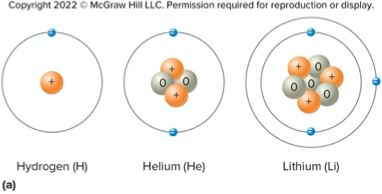
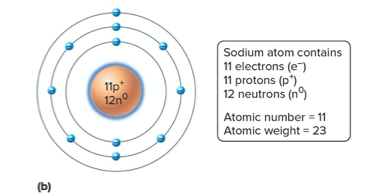
Electrons of an atom occupy regions of space, which encircle the nucleus, called
What are the electron capacity rules for the first three shells of an atom with an atomic number of 18 or less?
The first shell can hold up to 2 electrons, the second shell up to 8, and the third shell up to 8.
Lower energy shells/inner orbits are filled first
How do the electrons in the outermost shell affect an atom's reactivity?
The number of electrons in the outermost (valence) shell determines if an atom will react with other atoms to form chemical bonds
What is an Ion?
An electrically charged atom that has gained or lost electrons to become stable.
have a full outermost shell
cation
a positively charged ion (loses electrons)
anion
a negatively charged ion (gains electrons)
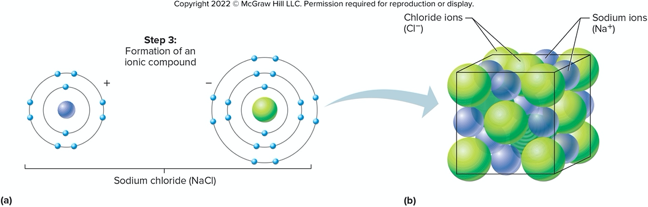
How is an Ionic Bond formed?
It is a strong chemical bond formed when ions of opposite charges attract each other.
cations attract anions
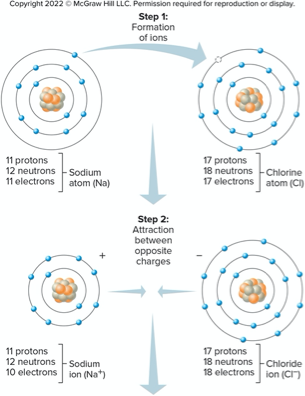
ionic bond
How is a Covalent Bond formed?
A strong chemical bond formed between atoms that share electrons.
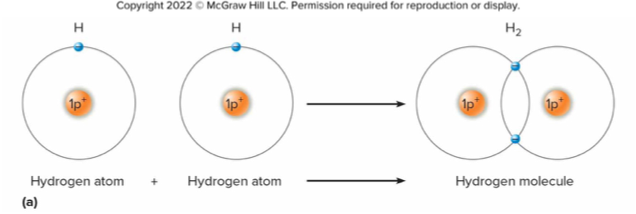
Covalent bonds
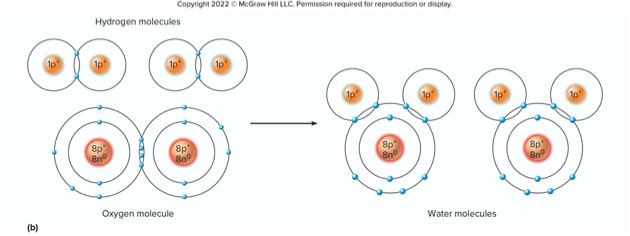
Structural formulas
•show how atoms bond and are arranged in various molecules
more detailed than a molecular formula because it shows form
One line between atoms means
that 1 pair of electrons are being shared (forming single covalent bonds), while two lines indicate that 2 pairs are being shared (forming double bonds).
Nonpolar covalent bonds
Covalent bonds in which electrons are shared equally
Found between atoms with same electronegativity
What is Electronegativity?
The pull for electrons exerted by the protons in the nucleus of an atom.
Polar covalent bonds
share electrons unequally, creating molecules with slightly negative and positive parts
atoms with a larger number of protons have higher electronegativity, and pull shared electrons closer to their nucleus
Polar molecules
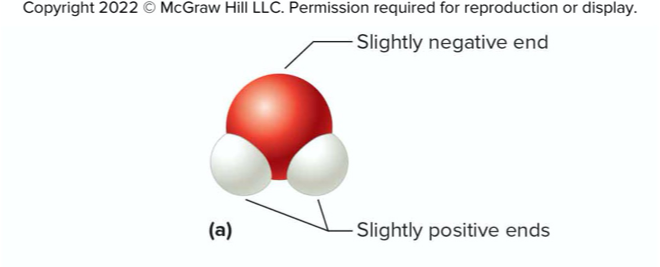
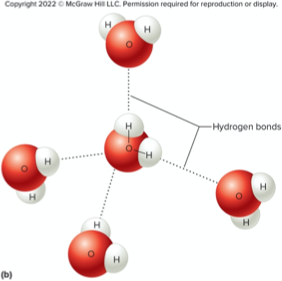
What is a Hydrogen Bond?
A relatively weak attraction between the slightly positive (H) end of one polar molecule and the slightly negative (N or O) end of a nearby polar molecule.
Chemical reactions
reactions occur when chemical bonds form or break between atoms, ions, or molecules
Reactants
Reactants are the starting materials of a chemical reaction
Products
are the substances formed at the end of a chemical reaction
List the four types of chemical reactions identified in the notes.
Synthesis Reaction, Decomposition Reaction, Exchange Reaction, and Reversible Reaction.
synthesis reaction
chemical bonds are formed to make a more complex structure

Decomposition Reaction
chemical bonds are broken to form a simpler chemical structure

Exchange Reaction
chemical bonds are broken and new bonds are formed

Reversible Reaction
the products can change back to the reactants

What happens when an ionically bonded substance is put into water?
The charged ions separate and are attracted to the polar water molecules, causing the substance to dissociate.
The cations and anions become surrounded by water molecules.
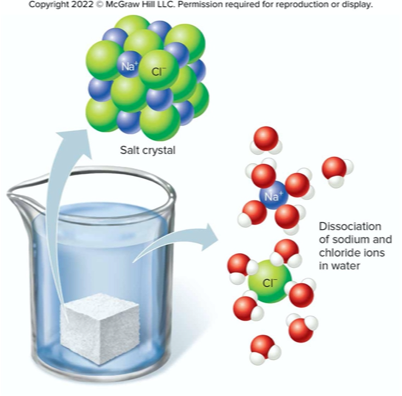
What is an Electrolyte?
A substance that releases ions in water and can conduct an electric current.

Define Acid and Base according to their dissociation in water.
are electrolytes that release hydrogen ions (H+)

Base
are electrolytes that release ions that combine with hydrogen ions

salts
Electrolytes formed by the reaction between an acid and a base

How is pH determined?
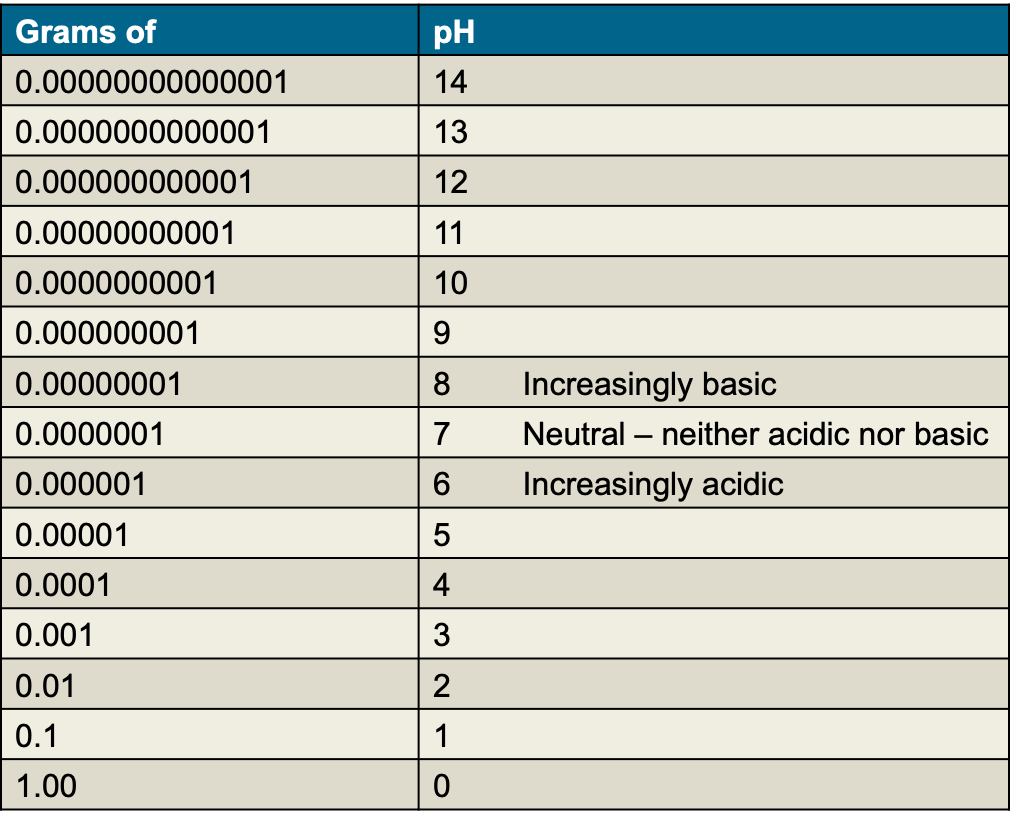
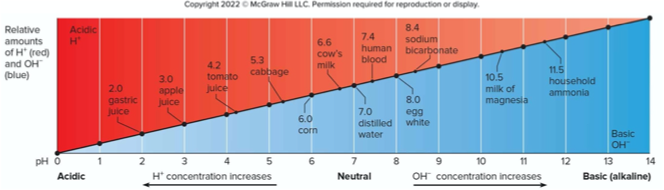
pH is a shorthand for H+ concentration, based on the number of decimal places in the concentration in g/L.
If the H+ concentration = 0.01g/L, the pH is 2
If the H+ concentration = 0.000000001 g/L, the pH =9
pH scale
Indicates the relative concentration of hydrogen ions (H+) and hydroxide ions (OH-) in a solution
What pH values represent Acidic, Neutral, and Basic solutions?
pH scale runs from 0 through 14
Acidic: < 7; a higher concentration of H+ than OH-
Neutral: 7; indicates equal concentrations of H+ and hydroxide ions (OH-)
Basic (alkaline): > 7; indicates a higher concentration of OH- than H+
Hydrogen Ion Concentration and pH
pH scale
What is the normal range of blood pH?
7.35 through 7.45.
What terms describe blood pH falling below 7.35 or rising above 7.45?
Acidemia (7.0–7.3)
What terms describe blood pH rising above 7.45?
Alkalemia (7.5 –7.8)
Alkalosis
makes a person feel dizzy and agitated
What is the function of a Buffer?
Buffers are chemicals that resist pH changes by binding or releasing H+.
Organic molecules.
contain C and H
include carbohydrates, proteins, lipids, and nucleic acids
Inorganic molecules
generally do not contain both C and H and usually dissolve in water to form ions
include water, oxygen, carbon dioxide, and inorganic salts
What are the primary functions of Water in the human body?
It is the most abundant compound,
acts as a medium for metabolic reactions, transports chemicals and heat, and serves as a solvent.
What is the role of Oxygen (O2) in cells?
It is used by organelles to release energy from nutrients to drive metabolic activities.
Carbon dioxide (CO2)
Waste product released during metabolic reactions
Must be removed from the body through exhaling
Inorganic salts
Sources of necessary ions
Play important roles in metabolism
Help control H2O concentration, pH, blood clotting, nerve and muscle processes
Electrolyte balance exists when gains equal losses
Na+, Cl-, K+, Ca2+, etc.
Carbohydrates
Main source of cellular energy
Supply materials to build cell structures
Water-soluble
Contain C, H, and O
Ratio of H to O close to 2:1 (C6H12O6 = glucose)
List the classifications of carbohydrates by size.
Monosaccharides (single sugars), Disaccharides (double sugars), and Polysaccharides (complex carbohydrates)
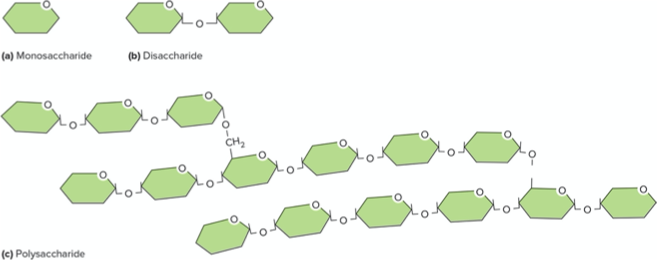
Monosaccharides
glucose, fructose
Disaccharides
sucrose, lactose
Polysaccharides
starch, glycogen, cellulose
Lipids
Insoluble in water, but soluble in organic solvents
Include triglycerides (fats), phospholipids, steroids
Important component of cell membranes, and have several functions in cells
most abundant lipid
Triglycerides (fats)
•Used for cellular energy
•Contain more energy per gram than carbohydrates
•Contain C, H, and O, but less O than carbohydrates
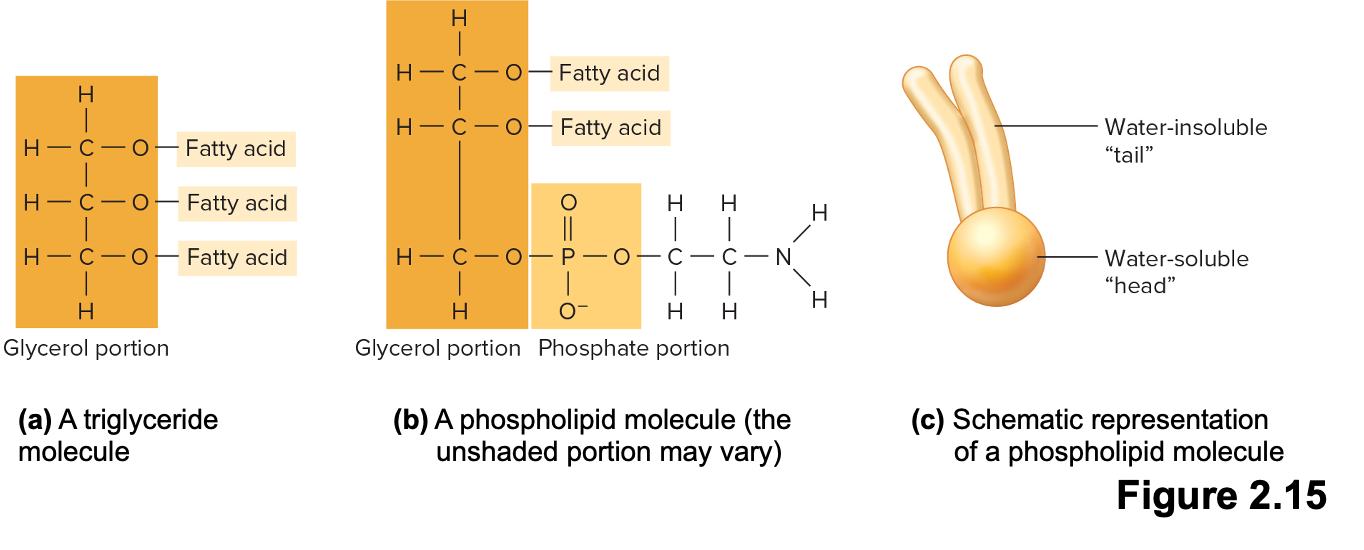
What is the composition of a Triglyceride?
One molecule of glycerol and three fatty acids.
Fatty acids are chains of hydrogen and carbon with two oxygens at one end
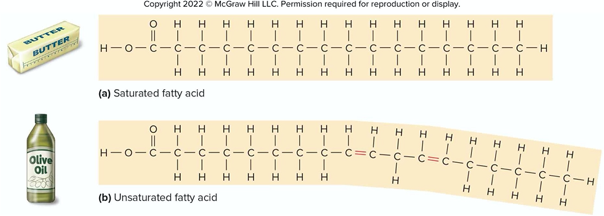
Compare Saturated and Unsaturated fatty acids.
have only single carbon-carbon bonds and are usually solid at room temp (animal origin)
Unsaturated fatty acids
have one or more double bonds and are usually liquid at room temp (plant origin).
fatty acids
What are Phospholipids?
Lipids consisting of 1 glycerol, 2 fatty acids, and a phosphate group
they are the main structural component of cell membranes.
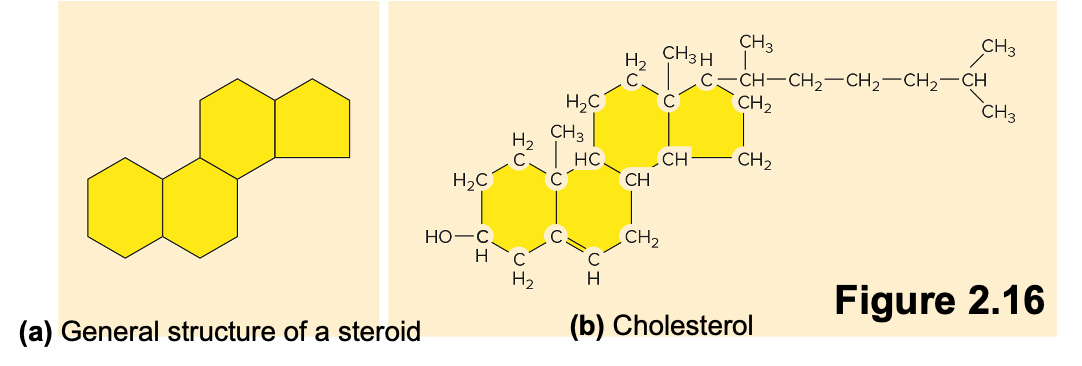
Steroids
4 connected rings of carbon
Widely distributed in the body, various functions
Component of cell membranes
Used to synthesize adrenal and sex hormones
What is the main steroid in the body?
Cholesterol
Proteins
Used as structural materials, energy source, hormones, receptors, enzymes, antibodies, and many more functions
Consist of building blocks called amino acids
Define the structure of an Amino Acid.
Contains an amino (−NH2) group, a carboxyl (COOH) group, and a unique R (side chain) group.
•bound to each other by peptide bonds