linear
 Call Kai
 Learn
Learn Practice Test
 Spaced Repetition
 Match
Match Flashcards
 Knowt Play
1/93

There's no tags or description
Looks like no tags are added yet.
Name | Mastery | Learn | Test | Matching | Spaced | Call with Kai |
|---|
No analytics yet
Send a link to your students to track their progress
94 Terms
Matrix Inverse
are fundamental concepts in linear algebra. They allow us to solve complex systems of equations efficiently.
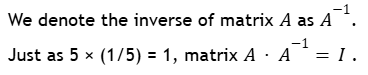
matrix inverse notation
Properties of Matrix Inverses
Square Requirement
Inverse of Inverse
Inverse of Product
Transpose Relation
Square Requirement
Only square matrices (the same number of rows and columns) can have inverses.
Inverse of Inverse

Inverse of Product

Transpose Relation

Conditions for Matrix Invertibility
Square Matrix
Non-zero Determinant
Full Rank
Square Matrix
The matrix must have equal numbers of rows and columns. A non-square matrix cannot have an inverse.
Non-zero Determinant
The determinant must not equal zero. Matrices with zero determinants are called "singular" matrices.
Full Rank
The matrix must have full rank, meaning all rows and columns are linearly independent.
The Invertible Matrix Theorem
Unique Solution
Linear Independence
Full Rank
Non-zero Determinant
Unique Solution
Ax = b has a unique solution for every b.
Linear Independence
Columns form linearly independent set
Full Rank
Matrix has rank n
Non-zero Determinant
det(A) ≠ 0
LINEAR ALGEBRA
Is a branch of mathematics that deals with vectors, vector spaces,
and linear transformations.
Why is it IMPORTANT in COMPUTING
Graphic Rendering, Machine Learning, Cryptography, Search Engines, Data Compression
Graphic Rendering
Turning mathematical descriptions into 3D images in video games
and virtual reality.
Machine Learning
Training models to recognize patterns in massive datasets.
Cryptography
Encrypting and securing sensitive information
Search Engines
Optimizing how search results are ranked.
Data Compression
Reducing file sizes for storage and transmission
MATHEMATICAL FOUNDATION
Linear algebra is a branch of mathematics that
deals with vector spaces, linear transformations,
and systems of linear equations.
COMPUTATIONAL POWER
It provides a powerful framework for solving
problems in various fields, including computer
science, engineering, and physics.
Vectors
are fundamental
building blocks in linear
algebra, representing
quantities with both
magnitude and direction
Abstract Spaces
provide a
framework for working with
vectors and linear
transformations in a general
setting.
Linear Transformations
map vectors in one vector space to
vectors in another.
Matrix representation
provide a compact and efficient way to represent
and manipulate linear transformations.
Computer Graphics
used for transformations like rotation,
scaling, and translation in computer graphics.
Networking
Network analysis, data routing, and traffic flow
management rely on linear algebra techniques.
SCALAR
is a single number. It can be a real number, complex number, etc.
VECTOR
is an ordered list of numbers. It can
represent points in space, directions, or quantities
with both magnitude and direction.
MATRIX
is a rectangular array of numbers arranged
in rows and columns. Matrices are used to
represent linear transformations and systems of
linear equations.
Vectors
often represented as column
matrices.
Matrices
are
typically denoted by bold capital letters, with
elements identified by subscripts indicating
their row and column positions.
Robotics
Used to represent and control
the position and motion of
robots.
Computer Graphics
Used to manipulate images
and objects in computer
graphics
Machine Learning
Used to analyze and predict
data patterns in machine
learning.
Quantum Mechanics
Used to describe the behavior
of particles in quantum
mechanics.
Field
a set equipped with two operations,
addition (+) and multiplication (·), satisfying a set
of axioms. These axioms include closure,
associativity, commutativity, distributivity,
identity elements, and inverses.
Real Numbers (R)
The set of all _ numbers, including
rational and irrational numbers,
forms a field. They are used in
everyday calculations and are the
foundation for many mathematical
concepts.
Complex Numbers (C)
extends
the real numbers by including the
imaginary unit "i" (√-1). They are
essential in various areas of
mathematics, physics, and
engineering
Finite Fields
a finite number of elements. These fields are widely used in
coding theory, cryptography, and computer science.
Vector Addition
are closed under
vector addition, meaning that
the sum of any two vectors in
the space is also a vector in the
space.
Scalar Multiplication
allows
scaling vectors by a factor.
Multiplying a vector by a scalar
results in another vector within
the same space.
Vector Space Axioms
These operations must satisfy specific axioms, including associativity,
commutativity, identity elements, and inverses.
Subspaces
is a subset of a vector space that is closed
under vector addition and scalar multiplication.
Linear Independence
linearly independent if no vector in the
set can be expressed as a linear combination of the other
vectors in the set.
Basis
is a linearly independent set of
vectors that spans the entire space. Any vector in the space
can be expressed as a linear combination of the basis
vectors
Dimension
is the number of vectors in
a basis. It represents the number of independent directions
needed to span the entire space.
Matrix Multiplication
can be used to compose linear
transformations. Multiplying two matrices represents applying the
transformations sequentially
solving equations
provides methods for solving systems of linear equations, which are essential in many computational tasks
applications
Examples include finding solutions to optimization problems, modeling physical systems, and analyzing data.
| Substitution Method
| Rules
1. Solve ONE equation for ONE variable.
2. Substitute or Replace ONE expression into Equation.
3. Solve, then plug in the Equation.
| Elimination Method
| Rules
1. Add the equations to eliminate the y
If the y coefficients are different, look for their Least Common Multiple (LCM), and change the signs to make the sum result in 0.