4. Visual Cortex Organization and Brain Processing in Psychology, 4. the organised brain
 Call Kai
 Learn
Learn Practice Test
 Spaced Repetition
 Match
Match Flashcards
 Knowt Play
1/103

There's no tags or description
Looks like no tags are added yet.
Name | Mastery | Learn | Test | Matching | Spaced | Call with Kai |
|---|
No analytics yet
Send a link to your students to track their progress
104 Terms
What is the primary area of the brain responsible for vision?
The occipital lobe, specifically Area V1.
what is feedforward?
information moves UP the hierarchy
Example:
Retina → LGN → V1 → V2 → V4 → IT
Motion: Retina → LGN → V1 → MT
👉 Think: raw data → more complex processing.
what is feedback?
higher areas send info BACK down
Example:
IT (object recognition) sends signals back to V1 to sharpen edges.
Attention areas send signals to V1 to boost important objects.
👉 Think: the brain saying “focus on this” or “expect this”.
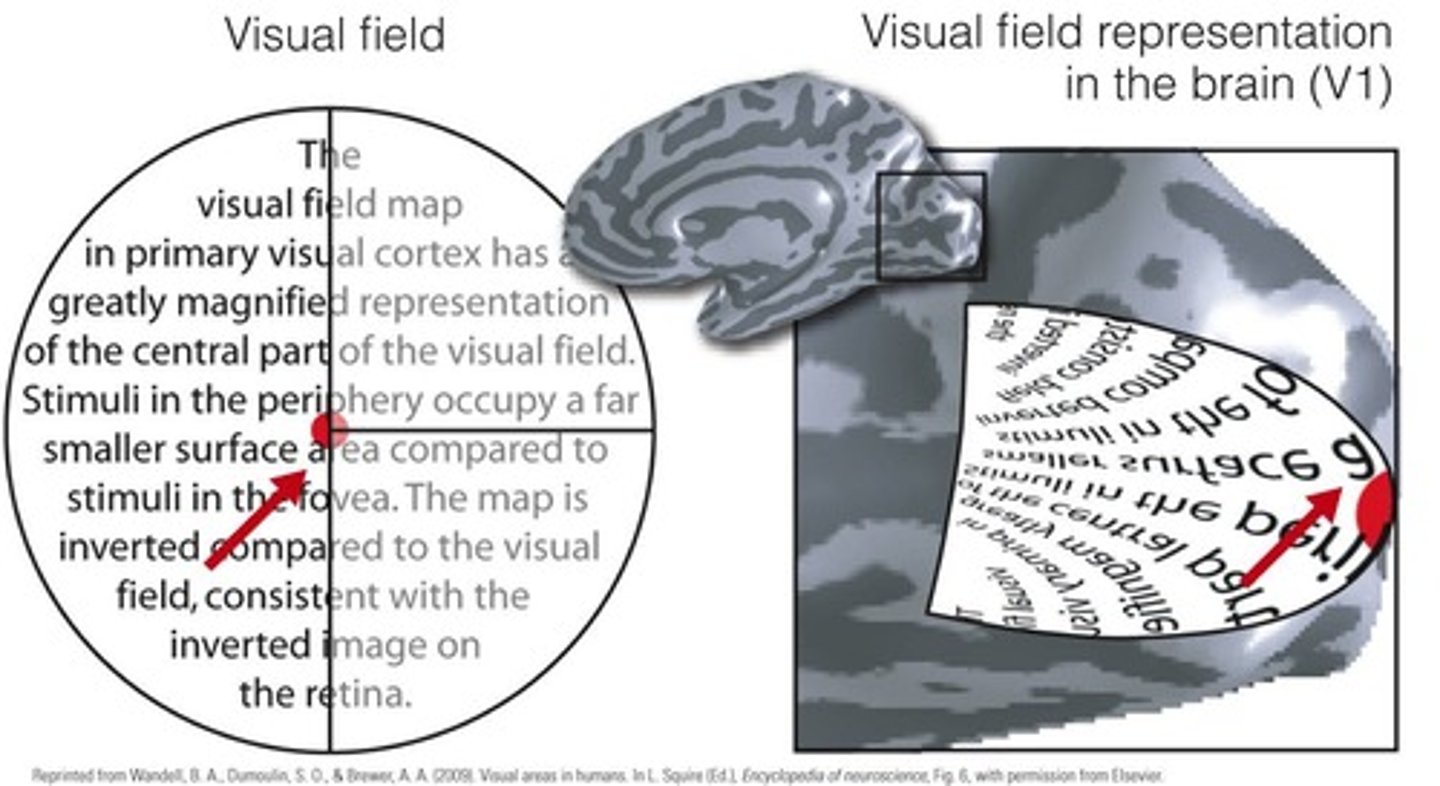
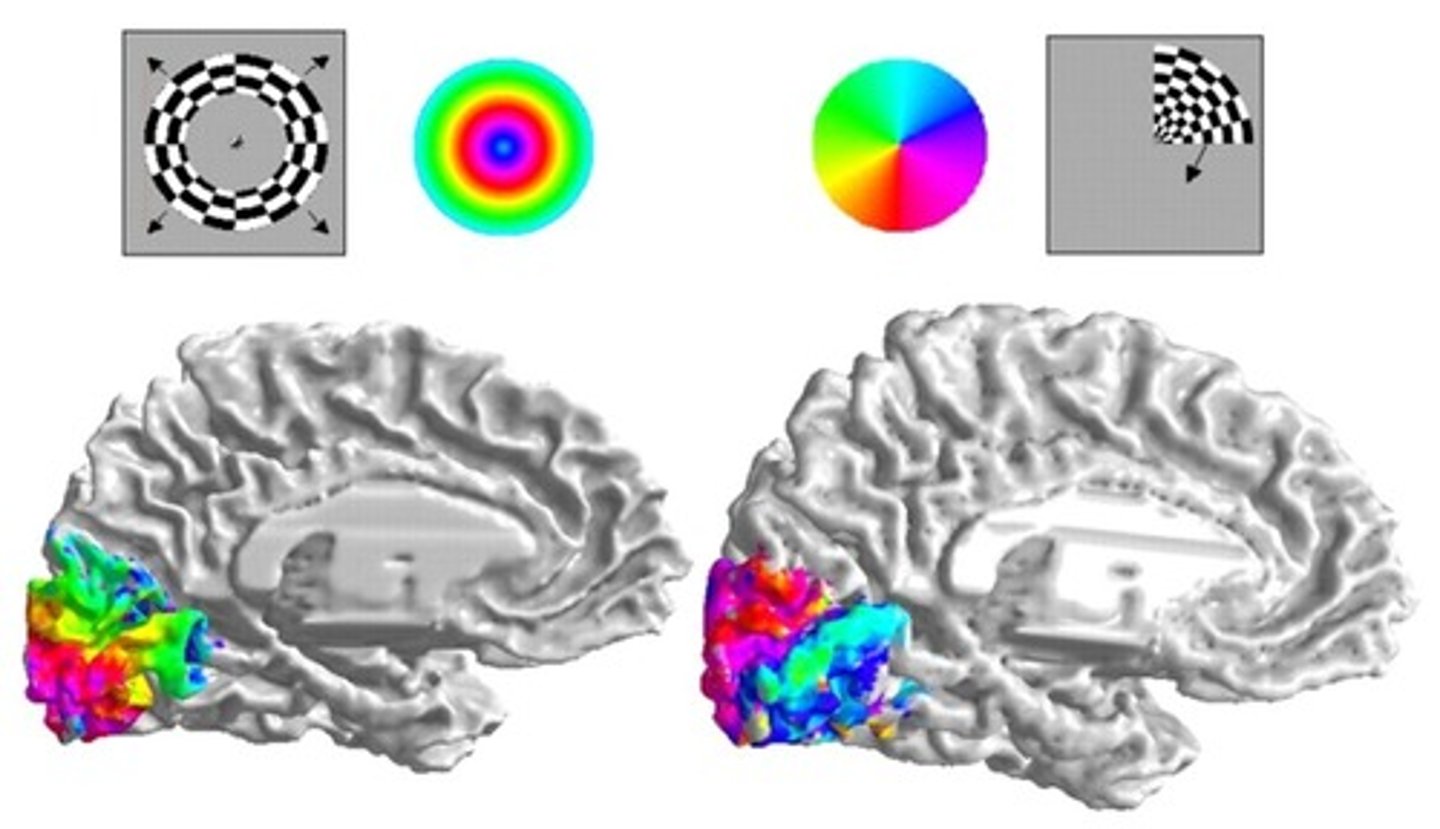
What does the retinotopic map represent?
It corresponds each location on the retina to a location in the visual cortex.
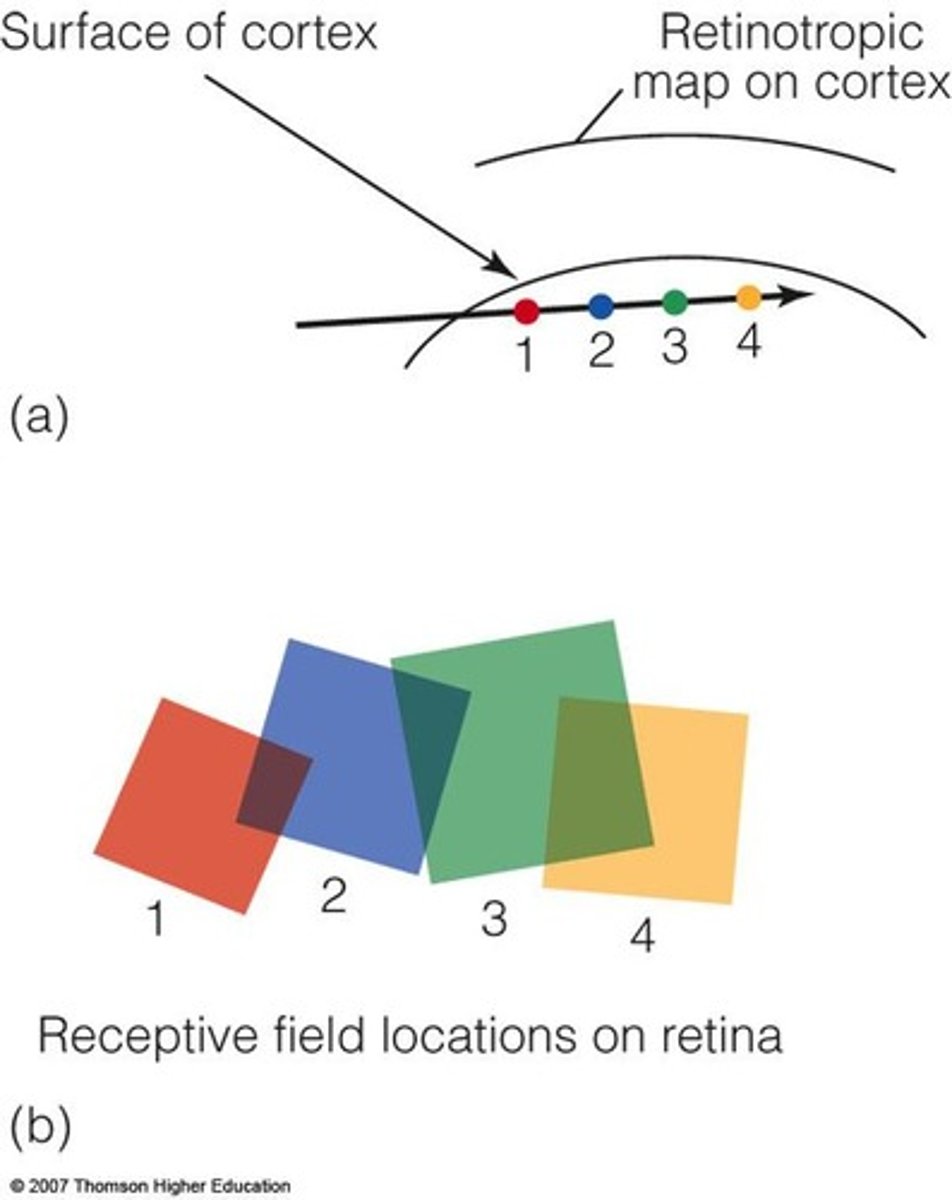
How is retinotopic mapping determined?
By recording from neurons with electrodes that penetrate the cortex.
What is cortical magnification?
The phenomenon where the fovea is represented more extensively in the visual cortex than the periphery.
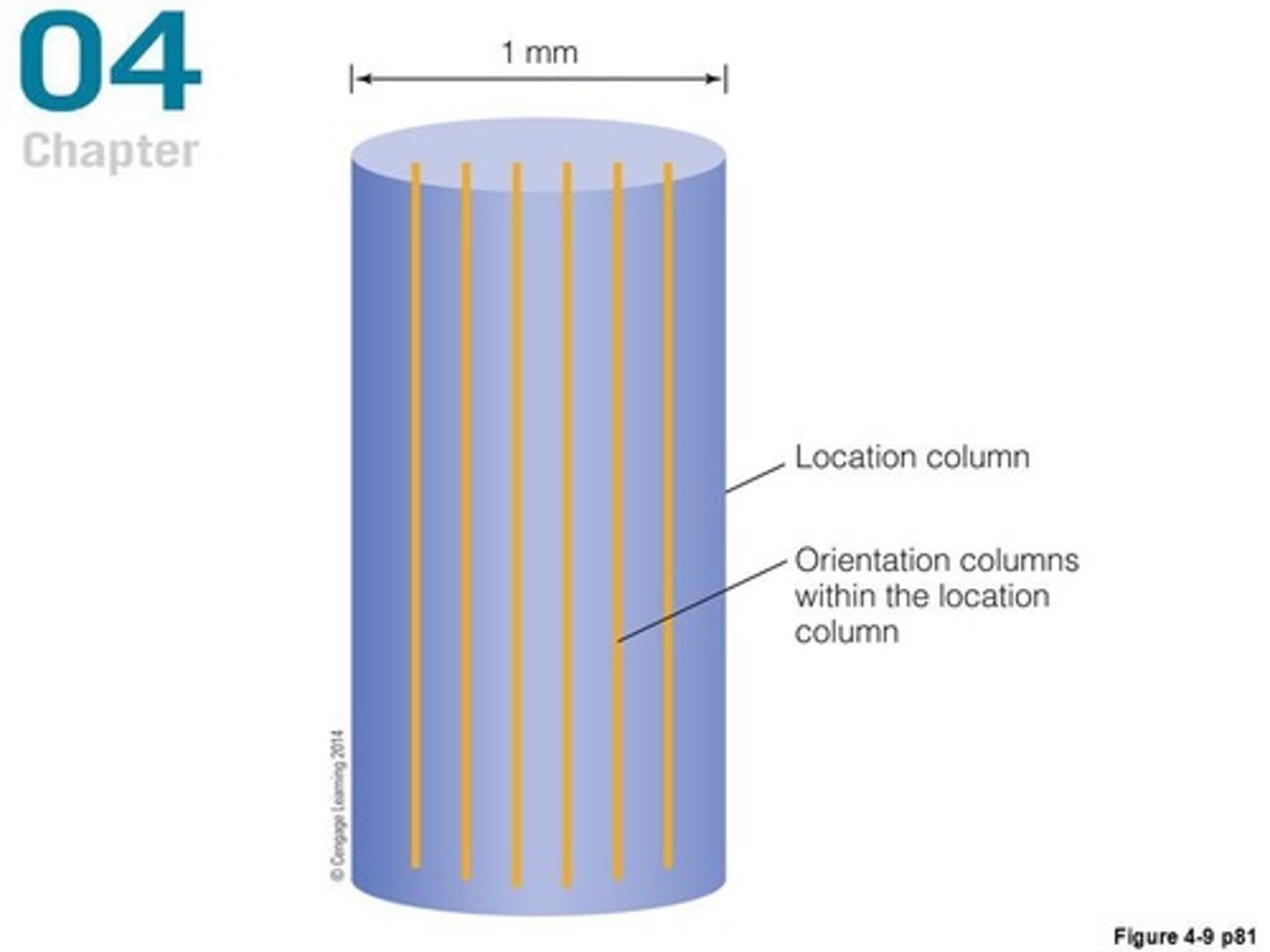
What are location columns in V1?
Columns in the visual cortex where receptive fields at the same location on the retina are grouped together.
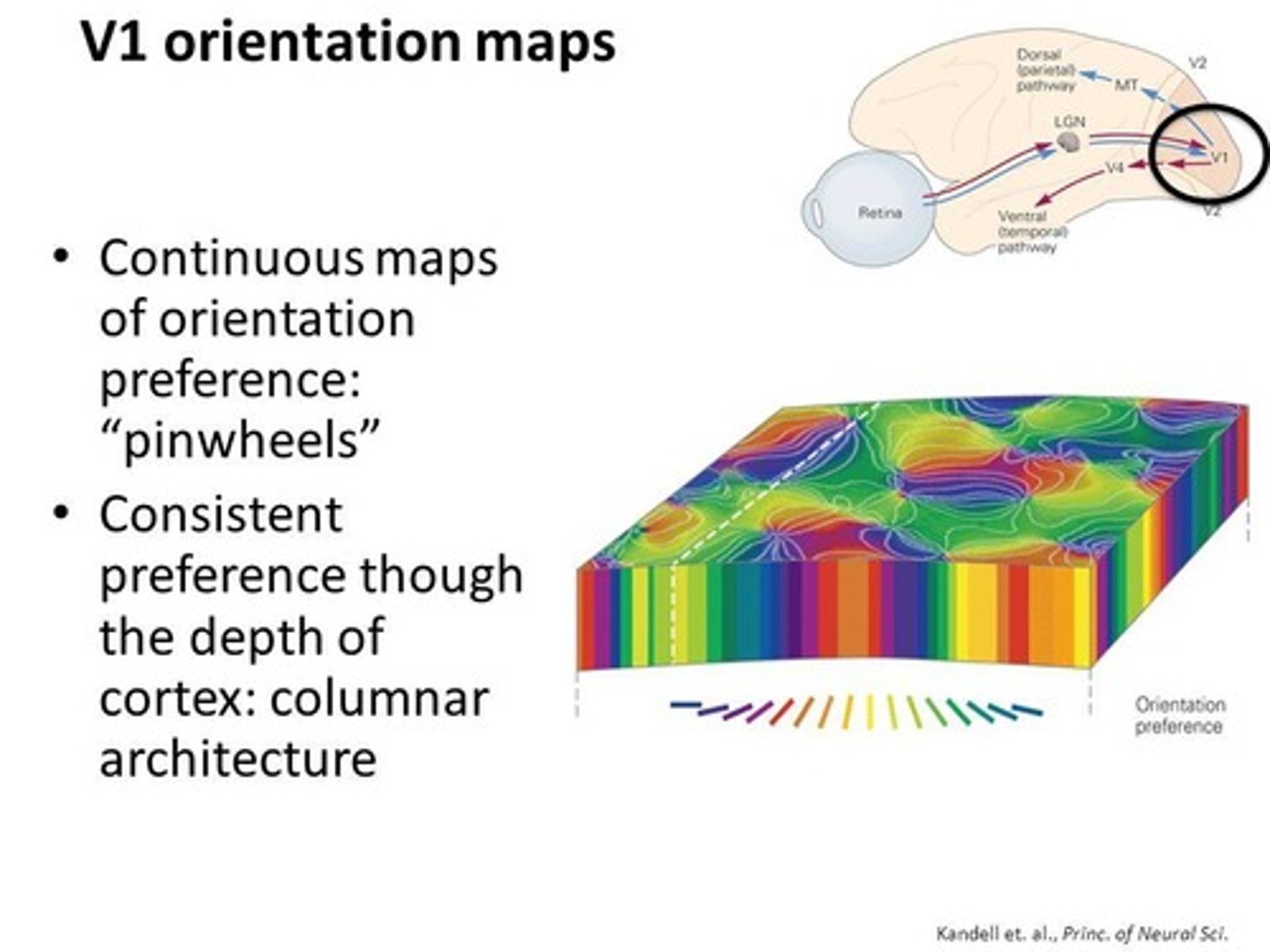
What are orientation columns in V1?
Columns where neurons fire maximally to the same orientation of stimuli. Neurons next to each other prefer slightly different orientations
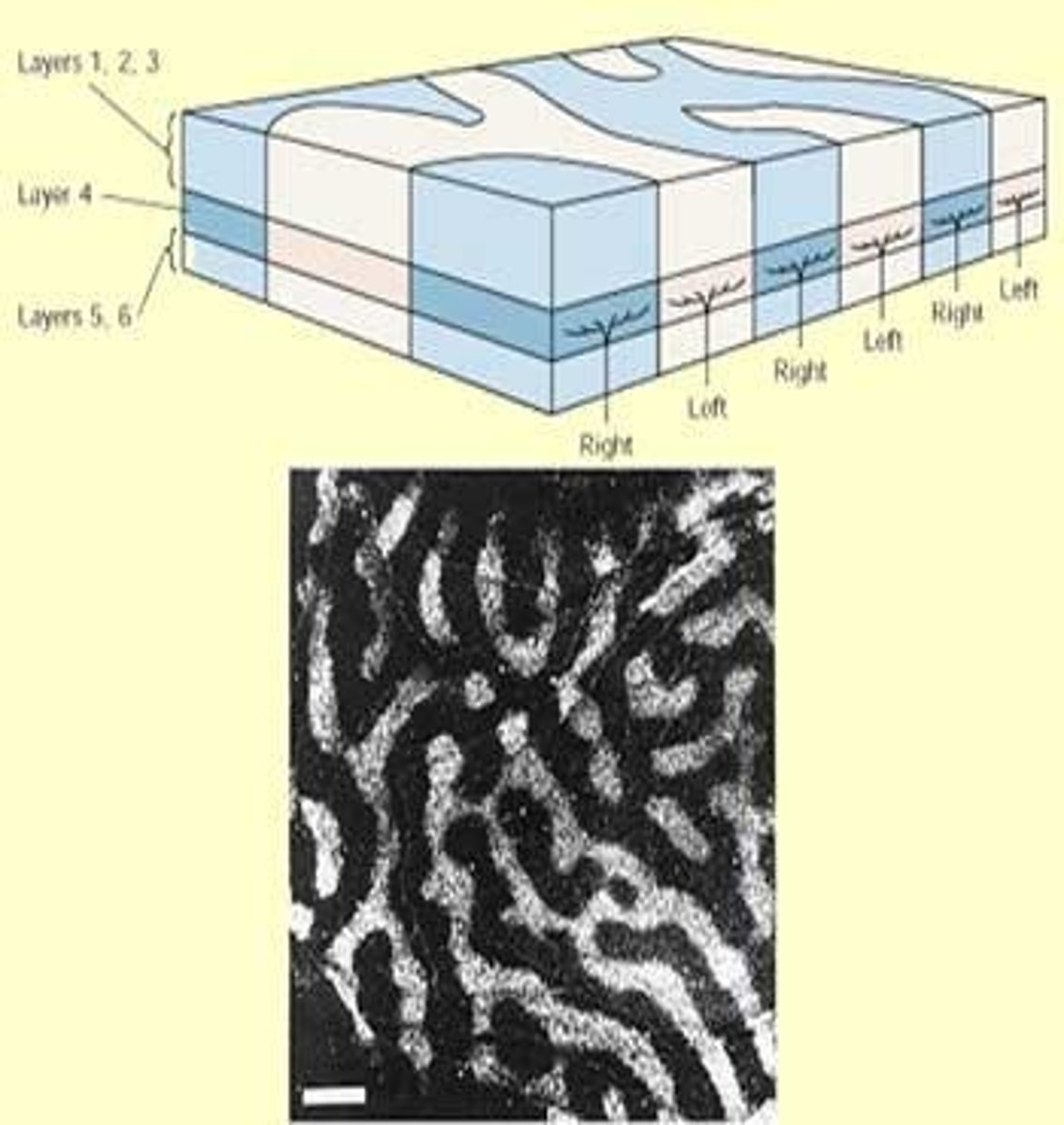
What is ocular dominance in V1?
The preference of neurons to respond to stimuli from one eye over the other.
What is a hypercolumn in visual processing?
A 1mm² region in the visual cortex that contains a complete ocular dominance cycle and a full range of preferred orientations.
What did early thinkers like Aristotle believe about the brain?
They believed the heart was the origin of sensation and movement, not the brain.
What is phrenology?
The study of the shape and size of skulls to determine mental attributes based on bumps and bulges.
What is the significance of lesioning or ablation experiments?
They help determine the functions of specific brain regions by observing behavioral changes after brain tissue removal.
What is Transcranial Magnetic Stimulation (TMS)?
A technique that sends localized electrical currents to parts of the cortex to temporarily knock out functions.
What were the findings of Ungerleider and Mishkin's experiments?
They identified the 'What' pathway (object discrimination) and the 'Where' pathway (landmark discrimination) in visual processing.
What is the 'What' pathway in visual processing?
The ventral pathway from the occipital lobe to the temporal lobe responsible for object identification.
Goes to temporal lobe
Identifies objects
Begins with P-cells
P-cells → LGN layers 3,4,5,6 (parvocellular)
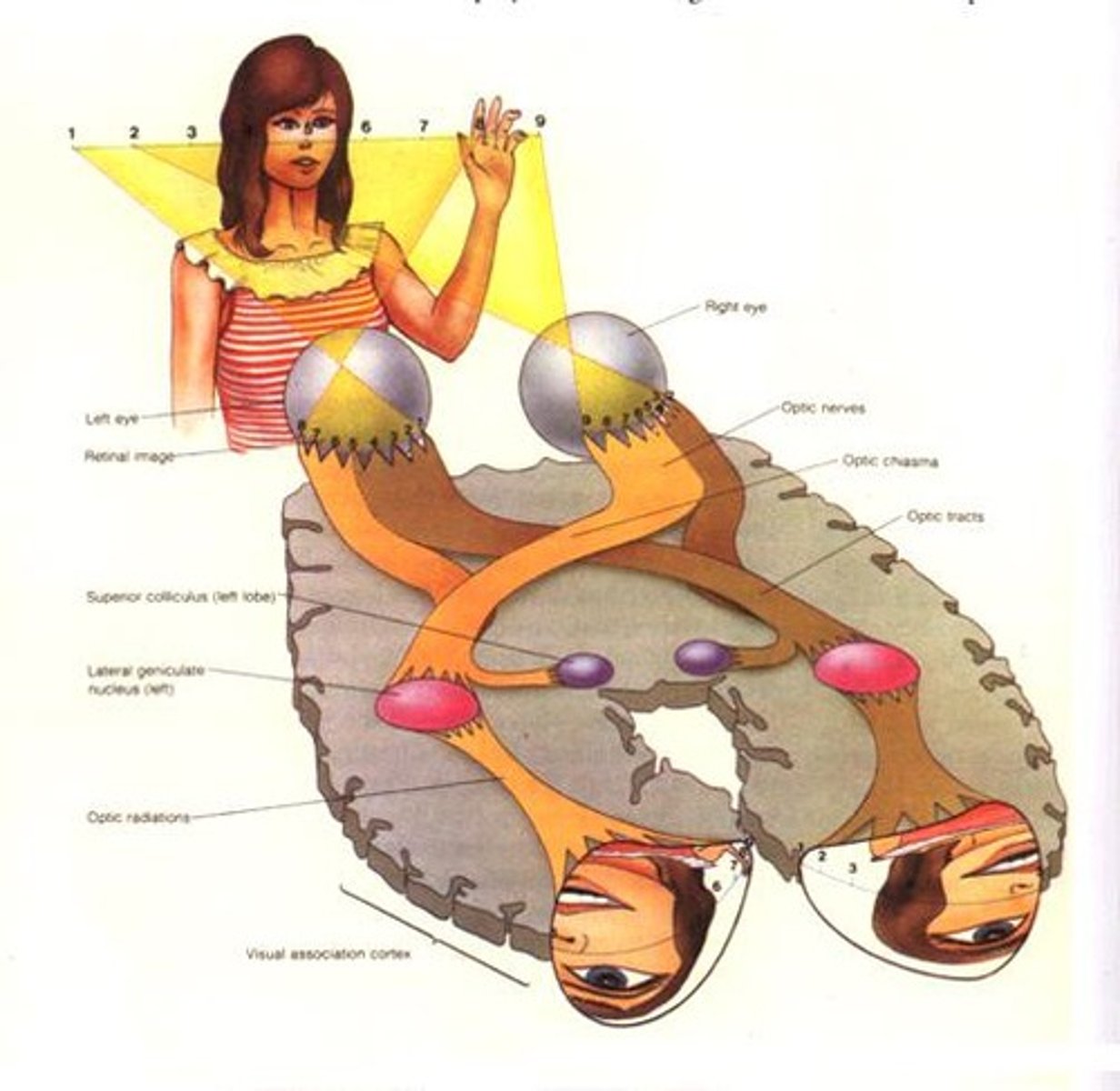
What is the 'Where' pathway in visual processing?
The dorsal pathway from the occipital lobe to the parietal lobe responsible for spatial location.
Goes to parietal lobe
Locates objects + guides action
Begins with M-cells
M-cells → LGN layers 1 & 2 (magnocellular)
👉 Motion, spatial location, visually guided movement.
Also connects to motor cortex → explains action guidance.
What is the role of the parietal lobe in visual processing?
It is involved in the landmark discrimination task, indicating spatial awareness.
What is the role of the temporal lobe in visual processing?
It is involved in the object discrimination task, indicating object recognition.
What is the significance of cortical columnar organization?
It allows for systematic processing of visual information based on location and orientation.
What does the term 'feature detector' refer to?
Neurons that respond to specific features of stimuli, such as edges or movement.
What is the relationship between receptive fields and visual stimuli?
Receptive fields are areas of the retina that respond to specific visual stimuli.
How does the visual cortex represent visual information?
Through a highly convoluted structure that is organized into different functional areas.
What is the 'ice cube' model proposed by Hubel and Wiesel?
A hypercolumn = all the machinery needed to analyse one tiny spot of the visual world.
Inside one hypercolumn (~1 mm²):
Full set of orientation columns
Full left + right eye columns
All location info for that spot
👉 Think: one hypercolumn = one complete “processing unit” for one pixel of your vision.
Hubel & Wiesel discovered:
Receptive fields
Orientation tuning
Columnar organisation
Hypercolumns
Feature detectors
They won the Nobel Prize for this.
What is the importance of studying individual differences in brain structure?
It helps understand variations in intelligence and cognitive abilities.
What does the term 'tiling' refer to in visual processing?
The arrangement of receptive fields in a systematic way across the visual cortex.
What is the significance of the fovea in visual processing?
It has a higher density of photoreceptors, leading to greater visual acuity.
What is the primary function of the occipital lobe?
To process visual information received from the retina.
How do feedforward and feedback connections function in visual processing?
Feedforward connections carry information from lower to higher visual areas, while feedback connections modulate processing based on higher-level information.
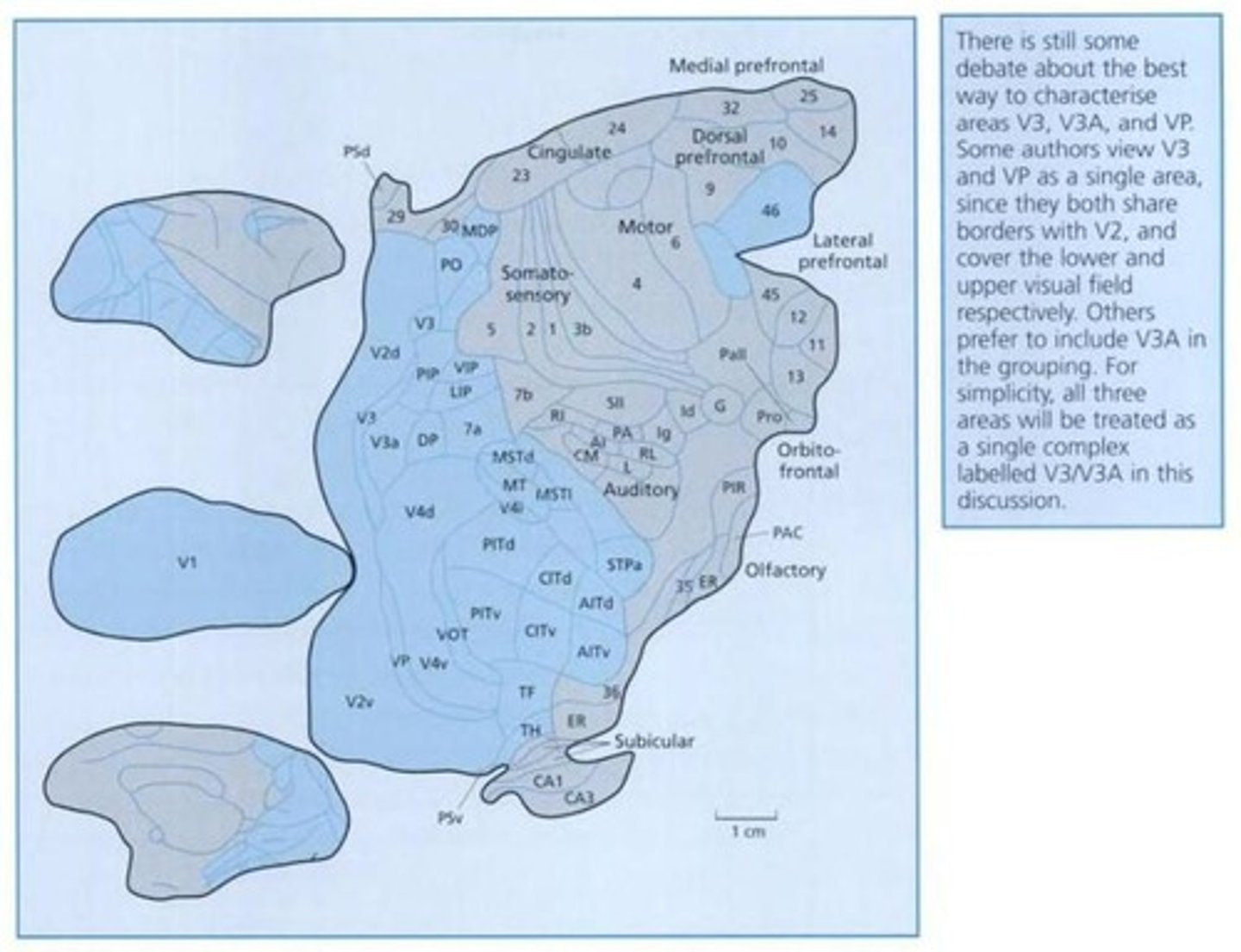
What are the two main visual processing pathways?
The What pathway (ventral) and the Where/How pathway (dorsal).
What type of ganglion cells does the ventral pathway originate from?
Small or medium ganglion cells, known as P-cells.
In which layers of the LGN do the axons of the ventral pathway synapse?
Layers 3, 4, 5, and 6, known as the parvocellular layers.
What type of ganglion cells does the dorsal pathway originate from?
Large ganglion cells, known as M-cells.
In which layers of the LGN do the axons of the dorsal pathway synapse?
Layers 1 and 2, known as the magnocellular layers.
What type of information do parvo channels send?
Color, texture, shape, and depth information.
What type of information do magno channels send?
Motion information.
What does the dorsal pathway also function as?
The 'How' pathway, involved in location and action.
What is double dissociation in neuropsychology?
It describes the interaction between two types of deficits and two behaviors.
What was the effect of damage to the ventral pathway in patient D.F.?
She was unable to match the orientation of a card with a slot but could match it when placing the card in the slot.
What task involves the ventral pathway?
The matching task.
What task involves the dorsal pathway?
The grasping task.
What is a module in the context of brain processing?
A localized brain area that processes information about specific types of stimuli.
What is the function of the fusiform face area (FFA)?
It responds best to faces and context implying a face.
What does the parahippocampal place area (PPA) respond best to?
Spatial layout.
What does the extrastriate body area (EBA) respond best to?
Pictures of full bodies and body parts.
What is the motion area MT responsible for?
Responding to moving stimuli, including real, motion aperture, and implied motion.
What is experience-dependent plasticity?
The brain's ability to change and adapt based on experiences.
What did studies show about newborn monkeys and sensory responses?
They respond to direction of movement and depth of objects.
What is the significance of fMRI in understanding brain functions?
It shows areas that respond best to specific stimuli, such as letters and words.
What is the goal of encoding models in neuroscience?
To discover how information is encoded in the brain.
What is the process of reconstructing an image from brain activity?
Using a model of how brain activity maps to image features to create a representation of what a viewer is experiencing.
What was demonstrated by the Gallant lab in UC Berkeley?
The reconstruction of moving images based on brain activity.
What are potential future applications of understanding brain processes?
Neurological evaluation, therapies for brain damage, brain-machine interfaces, and communication.
What does the term 'distributed representation' refer to in the context of face recognition?
The idea that recognizing faces involves multiple aspects, such as emotional cues and familiarity, not just isolated features.
What is the importance of understanding brain processes?
It helps in developing therapies, brain decoding, and improving our understanding of mental states.
What is the primary visual cortex also known as?
Area V1 in the occipital lobe.
What is a retinotopic map?
Each location on the retina corresponds to a location in visual cortex.
How are retinotopic maps determined?
By recording from neurons with an electrode that penetrates cortex while stimulating receptive fields on the retina.
What pattern is seen in electrode recordings from cat visual cortex?
Receptive fields on the retina that overlap also overlap in the cortex.
What is observed with oblique penetration of the cortex?
Retinotopic organisation is maintained.
What is cortical magnification?
Disproportionate cortical representation devoted to the fovea due to high density of photoreceptors.
Why is the visual cortex disproportionately devoted to the fovea?
Most detailed visual information comes from foveal input.
What happens when an electrode penetrates cortex perpendicularly?
Receptive fields represent the same location on the retina (location columns).
What are orientation columns in V1?
Neurons within columns fire maximally to the same orientation of stimuli.
How do orientation preferences change across cortex?
Adjacent columns change preference in an orderly fashion; 1 mm represents entire range of orientations.
What are ocular dominance columns?
Neurons respond preferentially to one eye; columns alternate left-right every 0.25 to 0.50 mm.
What happens moving horizontally across cortex?
Ocular dominance shifts repetitively between left and right eye; orientation preference changes too.
What is a hypercolumn?
1 mm² region containing one complete ocular dominance cycle and full range of preferred orientations.
What does a hypercolumn analyse?
All neural machinery needed to analyse a particular region of the visual field.
How large is a hypercolumn for central vision?
0.25° or less.
How large is a hypercolumn for peripheral vision at 20°?
Covers 30× more than central vision.
What are the two major visual processing streams?
Ventral (what) pathway and dorsal (where/how) pathway.
Where does the ventral pathway originate?
Small or medium ganglion cells (P-cells) synapsing in parvocellular layers of LGN.
What information does the ventral pathway carry?
Colour, texture, shape, and depth (parvo channels).
Where does the dorsal pathway originate?
Large ganglion cells (M-cells) synapsing in magnocellular layers of LGN.
What information does the dorsal pathway carry?
Motion (magno channels).
What did Ungerleider and Mishkin (1982) use to identify pathways?
Ablation experiments in monkeys.
What task was impaired by temporal lobe removal?
Object discrimination (what pathway).
What task was impaired by parietal lobe removal?
Landmark discrimination (where pathway).
Why is the dorsal pathway also called the how pathway?
It supports both location and action planning.
What are examples of modules?
Specialised areas (FFA, PPA, EBA, MT)
What is the extrastriate body area?
Responds to bodies and body parts.
What does the parahippocampal place area (PPA) respond best to?
Spatial layout and scenes.
What does the extrastriate body area (EBA) respond best to?
Pictures of full bodies and body parts.
What does area MT respond to?
Moving stimuli, including real motion, motion aperture, and implied motion.
What technique sends a localised electrical current to cortex?
Transcranial magnetic stimulation (TMS).
What does repeated TMS do?
Temporarily knocks out function in that region.
What is double dissociation?
Two types of deficit affecting two different behaviours differently.
What did patient D.F. show?
Ventral damage impaired orientation matching but spared posting action (dorsal intact).
Damage: ventral stream (WHAT)
Could NOT:
Judge orientation of a slot
Could:Post a card into the slot (action)
👉 Perception damaged, action intact.
What illusion shows dissociation between ventral and dorsal pathways?
Rod and frame illusion: frame affects matching (ventral) but not grasping (dorsal).
What is experience-dependent plasticity?
Cortical representation changes with training or expertise.
What happened when monkeys were trained on specific object views?
IT cortex neurons showed maximal response to trained orientation.
What happened after humans were trained on novel Greebles?
FFA responded to Greebles after training.
What happens in experts (e.g., car or bird experts)?
FFA responds to cars or birds due to expertise.
What is distributed representation?
Information about a stimulus (e.g., face) is spread across multiple brain areas (emotion, gaze, motion, attractiveness, familiarity).
What is neural plasticity in newborns?
Newborn monkeys respond to motion direction and depth; babies prefer assembled face parts.
What is brain decoding?
Using brain activity to reconstruct what someone is perceiving.
Scientists can reconstruct what someone is seeing by:
Knowing how each brain area encodes features
Reading fMRI activity
Matching it to a model of image features
Reconstructing a blurry version of the image/video
What technique is used for brain reconstruction?
fMRI combined with encoding models.
How do reconstruction models work?
Fit models to brain data; use prior knowledge of natural images to converge on accurate reconstruction.
What limitation affects current reconstruction speed?
fMRI is slow (1-2 seconds per snapshot); reconstructions lag behind real-time movie rate.