Unit 2 WHAP - Networks of Exchange
 Call Kai
 Learn
Learn Practice Test
 Spaced Repetition
 Match
Match Flashcards
 Knowt Play
1/46

There's no tags or description
Looks like no tags are added yet.
Name | Mastery | Learn | Test | Matching | Spaced | Call with Kai |
|---|
No analytics yet
Send a link to your students to track their progress
47 Terms
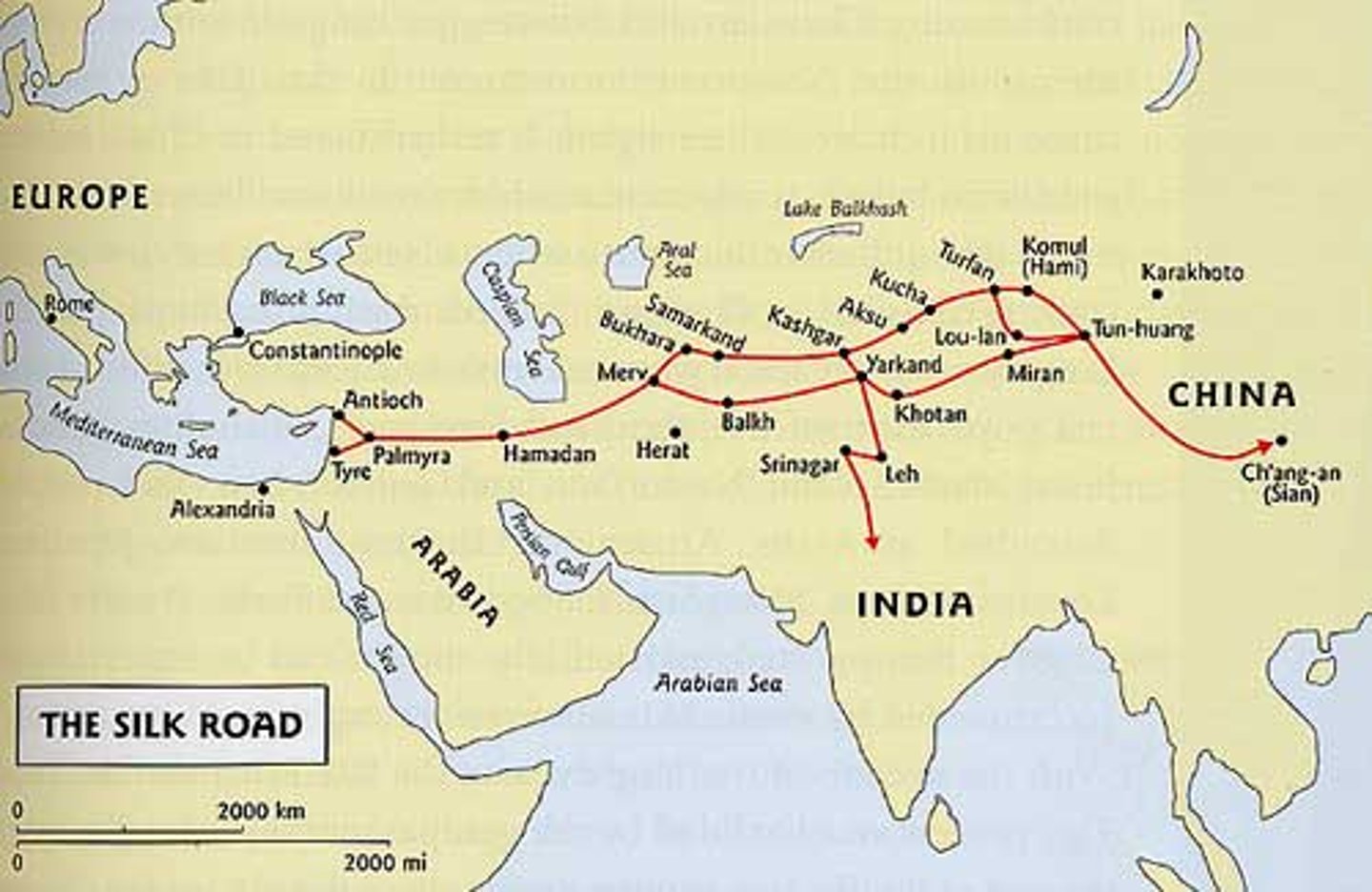
Silk roads
Land based route that connects East Asia to the Mediterranean sea. The east was controlled by the Han (China) and the Roman Empire had control of the Mediterranean (Western side)
Where did the silk road get its name?
Trading silk that China sold (luxury item)
Important cities on the Silk Road
Chang'an, Samarkand, and Kashgar
Goods important on the silk road
They traded luxury goods like silk, porcelain, gunpowder, rice, tea, olive oil, and Persian rugs
What technology was used on the silk road?
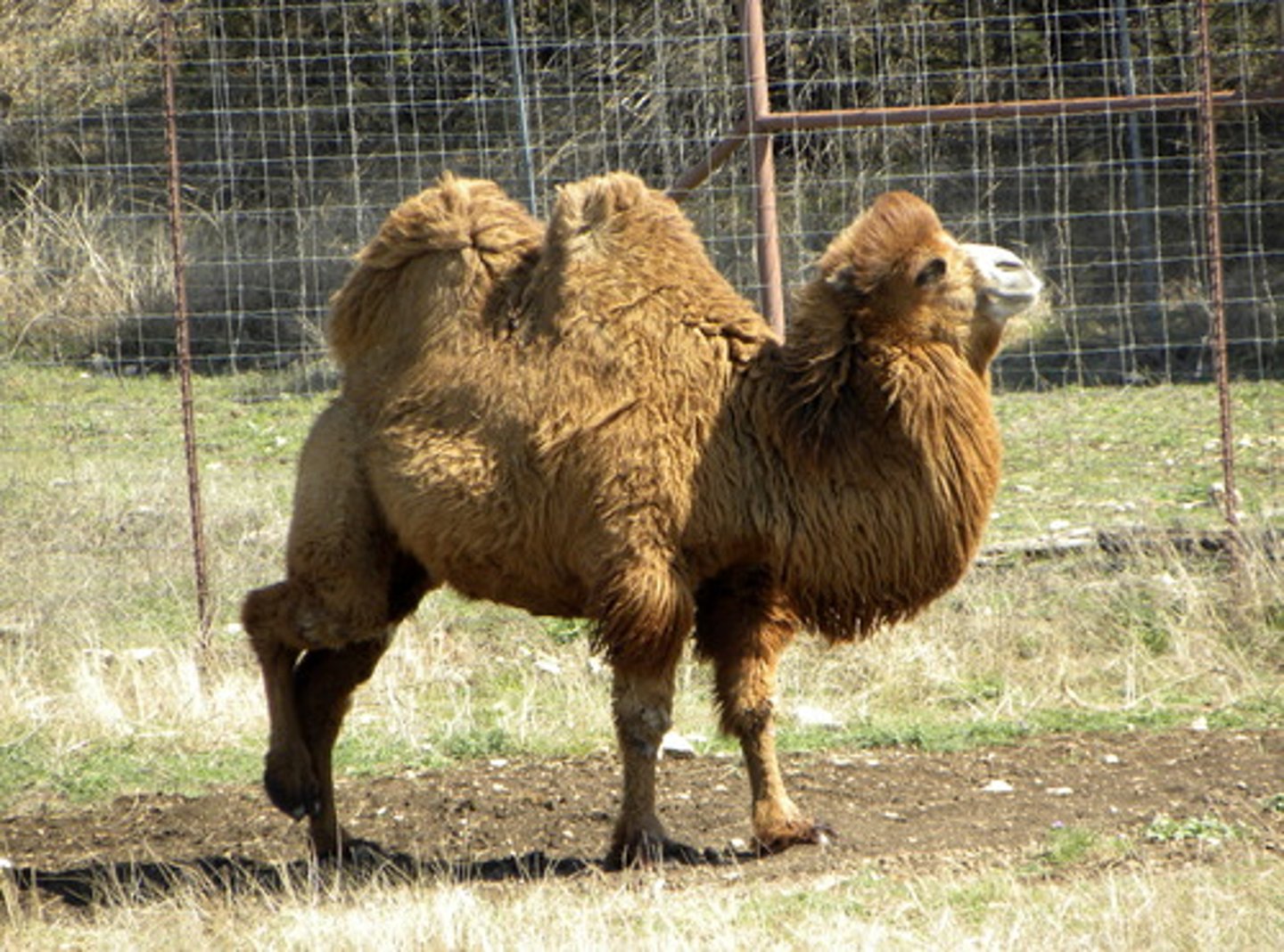
- Bactrian camels were used
- China invented paper money (coins were too heavy)
- Banking houses (Proto-banks): They had bills of exchange where you could deposit
- Caravanserais - a motel you could "park" your camel at and spend the night.
Religion spreading on Silk Road
- Buddhism: Mahayana is spreading. It starts in India and then spreads to China, Korea, and Japan.
- Hinduism: Starts in India and goes to Southeast Asia. Ethnic religion, so barely moves.
- Islam - Begins in Arabian Peninsula and moves to Central Asia
Who had the largest continuous land based empire ever?
Mongols, literally goes from West Asia all the way to East Asia.
Pros of Mongols
- Religious tolerance (as long as they paid tribute)
- Soldier status based on merit
- Helped unify empires
- Vast postal network
- They saved artisans, scholars, and relocated them to spread knowledge
- Made Silk Road safe, "Counterfeiting will resolve in death"
- Universal law
Cons of Mongols
- Killed 40 million people (10% of human population)
- Wiped out entire villages
- Spread the plague
- Very violent
- Burned Baghdad (House of Wisdom)
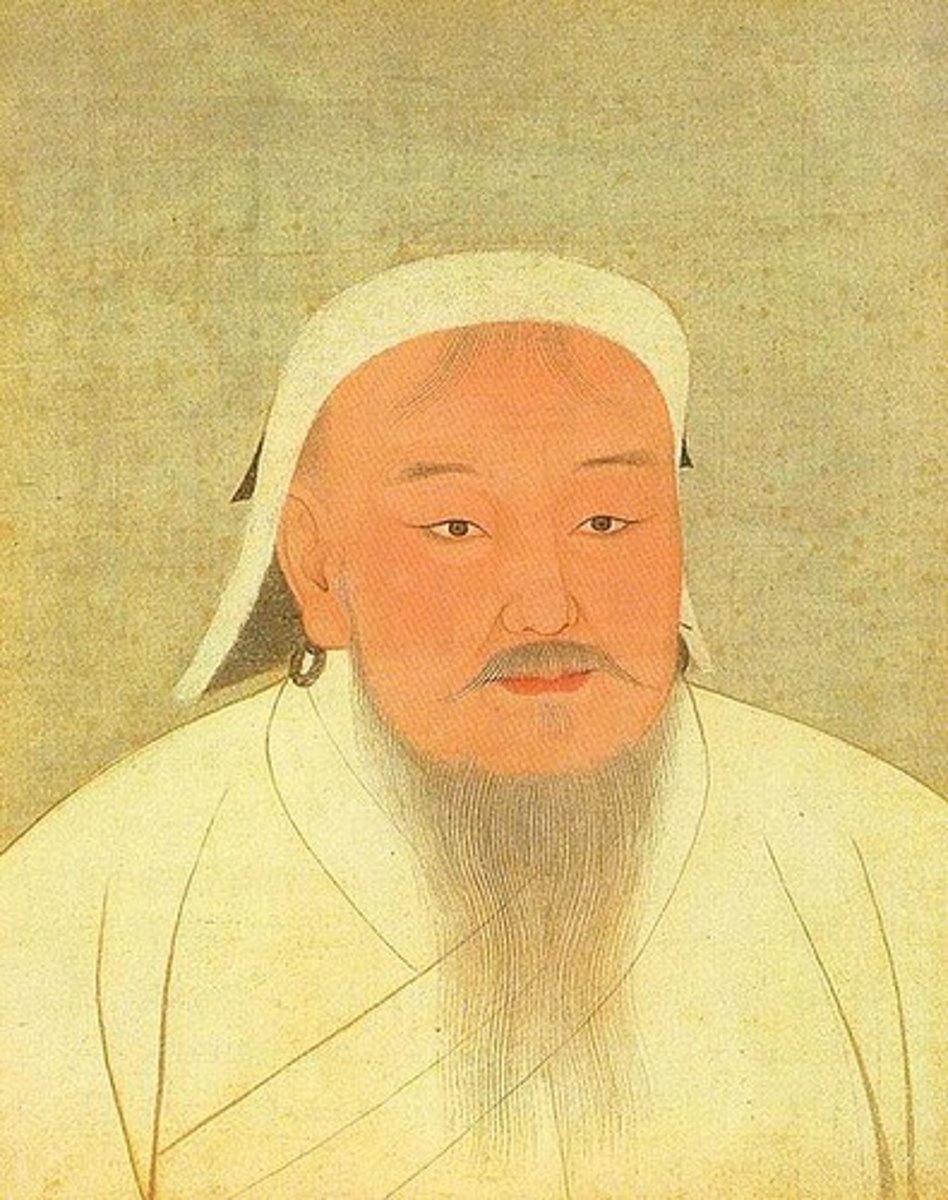
Who is leader of Mongols?
Genghis Khan
What happens when Genghis Khan dies?
A civil war between his sons and grandsons take place. This forms 4 different Khanates (a Khan rules a Khanate)
4 different Khanates
1. Yuan Dynasty
2. Il-Khanate of Persia
3. Khanate of the Golden Horde
4. Khanate of Jagadai
Yuan dynasty (Khanate)
The Song dynasty falls and is replaced with the Yuan dynasty. The Mongols made the capital of the Yuan dynasty Beijing. (They rename it Khanbalik meaning city of the Khans)
- Leader: Kublai Khan (Genghis Khan's grandson)
- Marco Polo serves 17 years with Kublai Khan (which he talks about in his book)
- This is where Columbus wanted to go to see Kublai Khan's palace.
Il-Khanate of Persia (Khanate)
The group that sacked Baghdad when the Abbasid Caliphate was fragmenting, destroyed the House of Wisdom and this shook Islam.
Khanate of the Golden Horde
This is in modern day Russia. Their capital city was Kiev, but the Mongols burned this to the ground - Kiev was the original place to the Rus which are descendants of Russians. The Mongols' new capital is called Moscow
- Example of how the Mongols have shaped the modern world!!
Khanate of Chagatai
Located in Central Asia, and the Silk Road went right through it.
Some limitations to the Mongols
- Mongols failed to invade Africa (Mamluks, a slave group stopped them)
- Japan: Mongols tried to invade Japan, but they were defeated by typhoons (Kamikaze is what the Japanese named the typhoons aka "divine wind")
What did the Mongols control?
The Silk Road, they made it safe to trade, so trade flourishes and increases.
What did the Mongols do at Caffa?
Throw plague victims over the wall, this is how the plague entered Europe.
- Effect on the Silk Road: Silk Road stops flourishing because of the plague.
What did the Mongols help to do regarding the babysitting knowledge?
They helped facilitate the Greco-Islamic medical knowledge and the numbering system to Europe
What language did the Mongols use?
They used Uyghur script, a form of written language used throughout their entire empire and it is the only written language written vertical from left to right.
What did the Sea Roads (Indian Ocean Trade Network) Connect?
The Swahili coast (Western end), India (fulcrum), and the Strait of Malacca (Eastern end)
What do boats on the sea road carry?
Bulk
Diasporic communities
Communities that leave their home country, but bring their culture with them.
What type of goods were sold on the sea road?
Spices and bulk
What type of technology was traded on the sea roads?
The Lateen sail - Arab invention, triangular sails which allowed for rotation.
Dhow - Arab boat that had the Lateen sails.
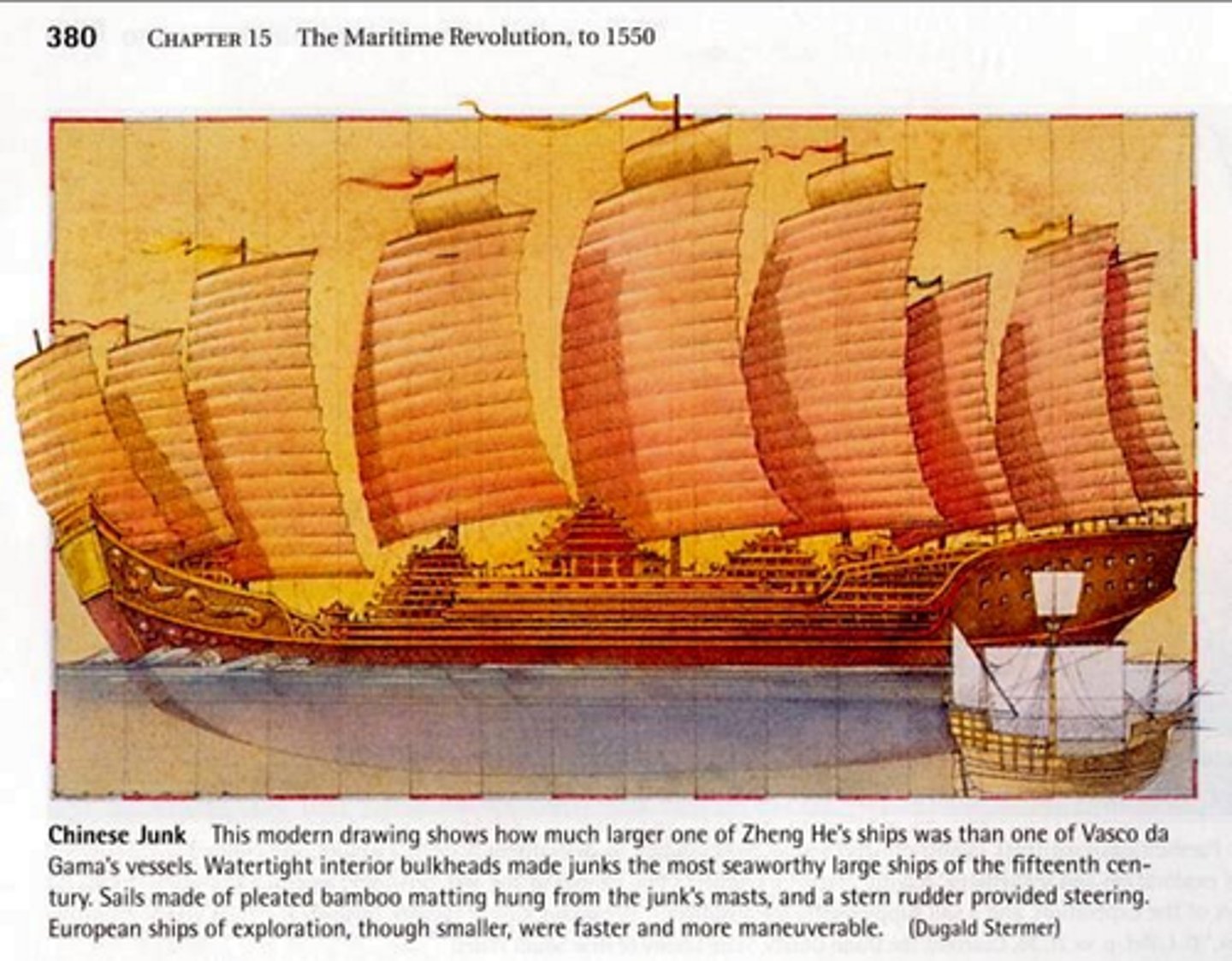
Junk Boat - Chinese boat
Stern Post Rudder - Rudder posted to the back which allowed you to move your boat.
Astrolabe - Using starts to navigate latitude
Magnetic compass - directions
Maps - Maps were slowly evolving overtime, but most were not accurate
Monsoon winds
Seasonal winds that carry ships in the Indian Ocean - during the summer, the winds blow towards India, during the winter, it blows towards Swahili.
- Sailors would be stuck for 6 months until the next monsoon wind.
- Created Diasporic communities.
Admiral Zheng He
He was a Chinese Islamic navigator that sailed around flexing the Ming dynasty's power. He did not do anything new.
- Kingdom of Bengal, East India, gifted him a "dragon"... it was a giraffe.
- His ships were massive and he had a ton of people (27,000 sailors and 300 ships)
- He shows the power of the Ming/Chinese dynasty at this time compared to Columbus.
Trans-Saharan Trade
Trade across the Saharan desert, salt was huge in the sand roads
- Salt: The Sahara was a big inland sea, but the water dried up and all the salt was left there.
- Mining salt is huge in the Sahara. (Salt preserves food as well)
What regions does the Sand roads connect?
North Africa, West Africa, and East Africa.
How is it possible to travel across the Sahara?
Camels! They can carry 600 pounds and is the only animal that can cross the desert.
Inventions regarding sand roads
Different types of saddles (in front, behind, on top of hump)
- Stirrups to sit up.
Caravan and caravanserai
Caravan: Group of people riding camels
Caravanserai: Motel on the sand
Diffusion of cultures
Culture and religions spreading out across the different countries
- Universalizing: always seeking converts and very open
- Ethnic: Not a lot of converts, born into religion.
Diffusion of 5 important religions
- Hinduism: Starts from India (Ankor Wat) and moves to south Asia and Southeast Asia. Stays there.
- Buddhism: Starts from India and moves to south Asia and East Asia through Silk Road - Mahayana
- Islam: Started in Middle East, spreads to North Africa and West Africa through sand roads, goes to Central and South Asia through Silk Roads and to East Africa through Sea roads. SPREADS A LOT!!
- Christianity - Same as Buddhism - spread a lot. Started in Jerusalem.
Who invents everything?
China
- Gunpowder: changes course of human history. This gets to Europe through the Silk road and Europeans make the hand cannon. An arms race starts to happen for gunpowder with Germany.
- Paper: Paper money and having a written language (tonal language) Traveled through the Silk and Sand roads.
- Moveable type printing: You can sub characters out to create different versions. When Europe gets paper, they print Bibles
Different travelers
Ibn Battuta, Marco Polo, Margery Kempe
Ibn Battuta
He is Muslim and goes to the Middle east, East and West Africa, South Asia, Central Asia. He travels the entire Dar Al-Islam. He is very critical of all the places he goes.
Marco Polo
He went to China (Yuan Dynasty at the time) through the Silk Road. He delt in jewels and saw Kublai Khan's palace and wrote a book about it - Columbus read this book
Margery Kempe
Catholic from England and wants to visit Jerusalem. She writes an autobiography and there is only one physical copy left.
What foods get introduced on the trade routes?
- Bananas - from Indonesia and goes to Africa through the Sea Roads. They are found in the rainforests. Bananas aided the Bantu people in migrating to create Swahili. They also impacted the Bay of Pigs and causing the overthrow of an elected leader.
- Champa Rice - 4 harvests a year, doubled population
- Sugar - From Papua New Guinea and goes to India from the Sea Roads and goes to Middle East from Silk Roads. Crusaders bring it to Europe. Haiti was the first sugar plantation, and this also creates slavery because of harvesting.
--- Chattel slavery: buy, own, and sell people (like cattle, VERY BAD)
- Lemons and oranges (Citrus) - From Southeast Asia and moved on sea roads and silk roads.
Environmental degradation
Overgrazing (animals eating all the gras and soil erodes) and deforestation.
Where do people think the plague started?
Tibet
Black Death
Fleas on rats, the plague makes the silk road die out because of the major infection. Caffa=Mongols throwing infected people over. The plague kills 2/3 of the population.
Plague impact on Catholic Church
A lot of people lose faith and their numbers went down (clergy died). The power of the Catholic Church diminished.
Who did people blame for the plague?
Jews and lepers
Impact of the plague on serfdom
Serfs can make more money and profit because less serfs are alive - high demand and they will charge high.