Honors Bio FINAL REVIEW, SJHHS, Price.
 Call Kai
 Learn
Learn Practice Test
 Spaced Repetition
 Match
Match Flashcards
 Knowt Play
1/134

There's no tags or description
Looks like no tags are added yet.
Name | Mastery | Learn | Test | Matching | Spaced | Call with Kai |
|---|
No analytics yet
Send a link to your students to track their progress
135 Terms
What are the three parts of a nucleotide?
a phosphate group, a 5-carbon sugar, and a nitrogen base.
How do the nucleotides match?
DNA base-pairing rules are A-T and C-G. In RNA, A pairs with U instead of T.
How is DNA different from RNA?
DNA is double stranded, contains deoxyribose sugar, and uses thymine. RNA is single stranded, contains ribose sugar, and uses uracil. DNA stores genetic information while RNA helps make proteins.
Explain the process of transcription. Where does it take place?
The process of making mRNA from DNA in the NUCLEUS. DNA unzips, RNA polymerase reads the DNA strand, and matching RNA nucleotides are added.
Explain all the steps of translation. Where does it take place?
Occurs at RIBOSOMES in the CYTOPLASM. Ribosomes read mRNA codons while tRNA brings amino acids that join together to form a protein.
Know how to read an mRNA chart
Read the mRNA three bases at a time. Each codon matches an amino acid on the chart. AUG is the start codon and codes for methionine.
What are some of the things shown in a karyotype?
Shows the number, size, and shape of chromosomes. It can also show gender and chromosome disorders like Down syndrome.
Where are sex-linked genes located?
located on the sex chromosomes, usually the X chromosome.
Why is colorblindness more common in males than females?
because males only have one X chromosome. One recessive allele on the X chromosome causes the trait.
For a female to have a recessive sex-linked trait, what must her genotype be?
A female must have two recessive alleles to show a recessive sex-linked trait, such as XᶜXᶜ.
What are restriction enzymes? Where do they come from?
proteins that cut DNA at specific sequences. They come from bacteria and act like molecular scissors.
What is gel electrophoresis? How does it separate DNA fragments?
separates DNA fragments by size. DNA moves through a gel with electricity, and smaller fragments move farther and faster.
How is a restriction map read?
shows where restriction enzymes cut DNA and the sizes of DNA fragments in base pairs.
What is PCR?
(Polymerase Chain Reaction) is a process used to make millions of copies of a DNA sample quickly.
What is a transgenic organism? How is it produced?
contains genes from another species. Scientists insert a desired gene into the organism's DNA.
What is a clone? How is the process done?
genetically identical copy of an organism. Cloning is done by placing the nucleus from a body cell into an egg cell without a nucleus.
What is DNA fingerprinting used for? Be able to read.
used in crime investigations, paternity testing, and identifying people. Scientists compare DNA band patterns for matches.
What is variation?
differences in traits among individuals in a population.
What is adaptation?
an inherited trait that improves an organism's survival and reproduction.
What is fitness?
an organism's ability to survive and reproduce successfully in its environment.
What is natural selection? What does it act directly on?
when organisms with beneficial traits survive and reproduce more often. It acts directly on phenotypes, or physical traits.
What are homologous structures? What do they tell us about evolution?
structures have similar anatomy because of common ancestry, even if they have different functions. Example: whale fin and human arm.
Explain analogous structures.
structures have similar functions but different evolutionary origins.
Example: insect wings and bird wings.
What is a vestigial structure and how does that show evidence of evolution? Know examples.
structures are leftover body parts with little or no function. They show evidence of evolution because ancestors once used them.
Example: human appendix.
What is the importance of genetic variation in a population?
important because it increases the chance that some organisms survive environmental changes or disease.
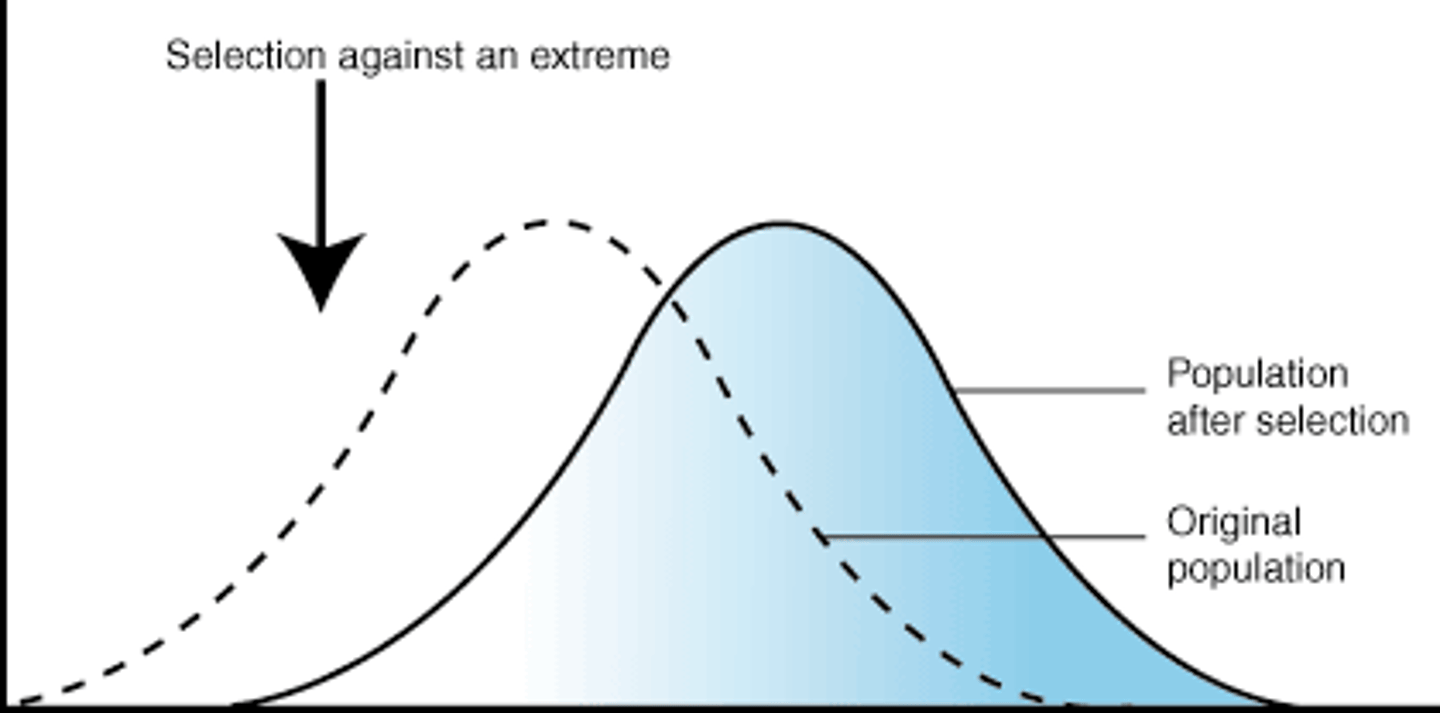
Directional Selection
favors one extreme trait and shifts the graph left or right.
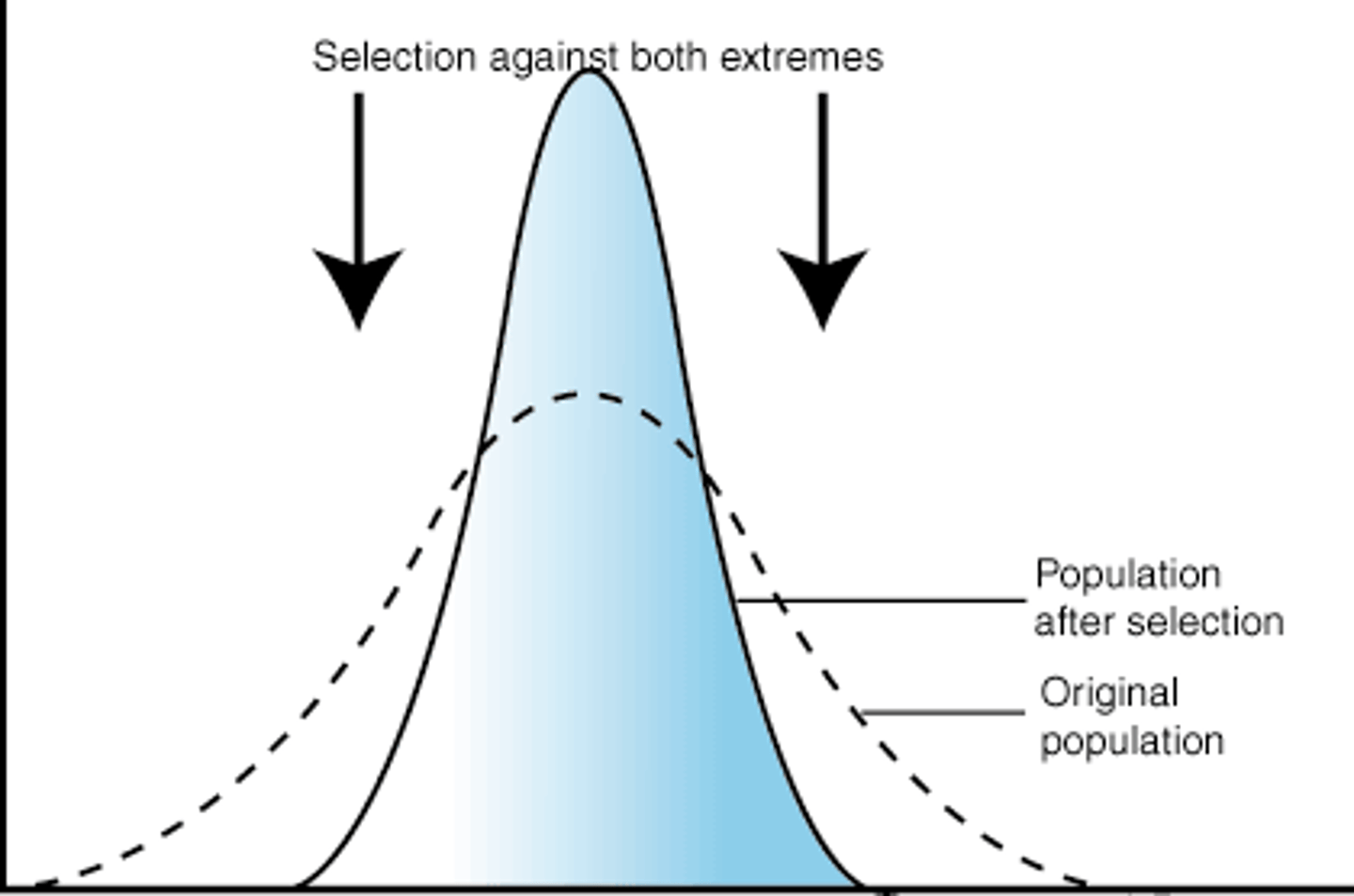
Stabilizing Selection
favors average traits and narrows the graph.
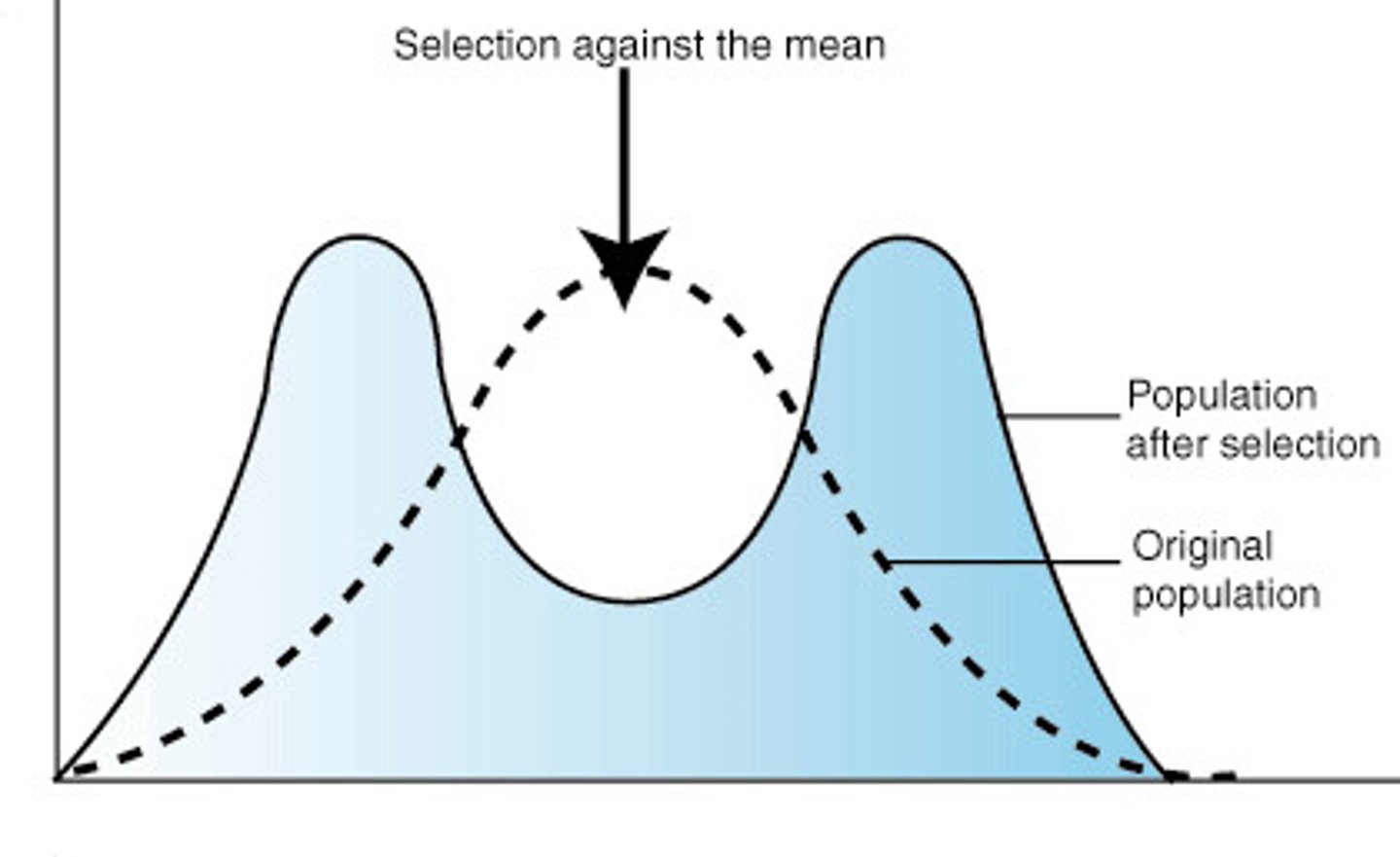
Disruptive Selection
favors both extremes and creates two peaks.
What is gene flow? Does it increase/decrease genetic variation?
the movement of genes between populations through migration. It usually increases genetic variation.
What is genetic drift? Does it increase/decrease genetic variation?
a random change in allele frequencies, especially in small populations. It usually decreases genetic variation.
What is the difference between the bottleneck effect and founder effect?
The bottleneck effect happens when a population suddenly decreases due to disaster.
The founder effect occurs when a small group starts a new population.
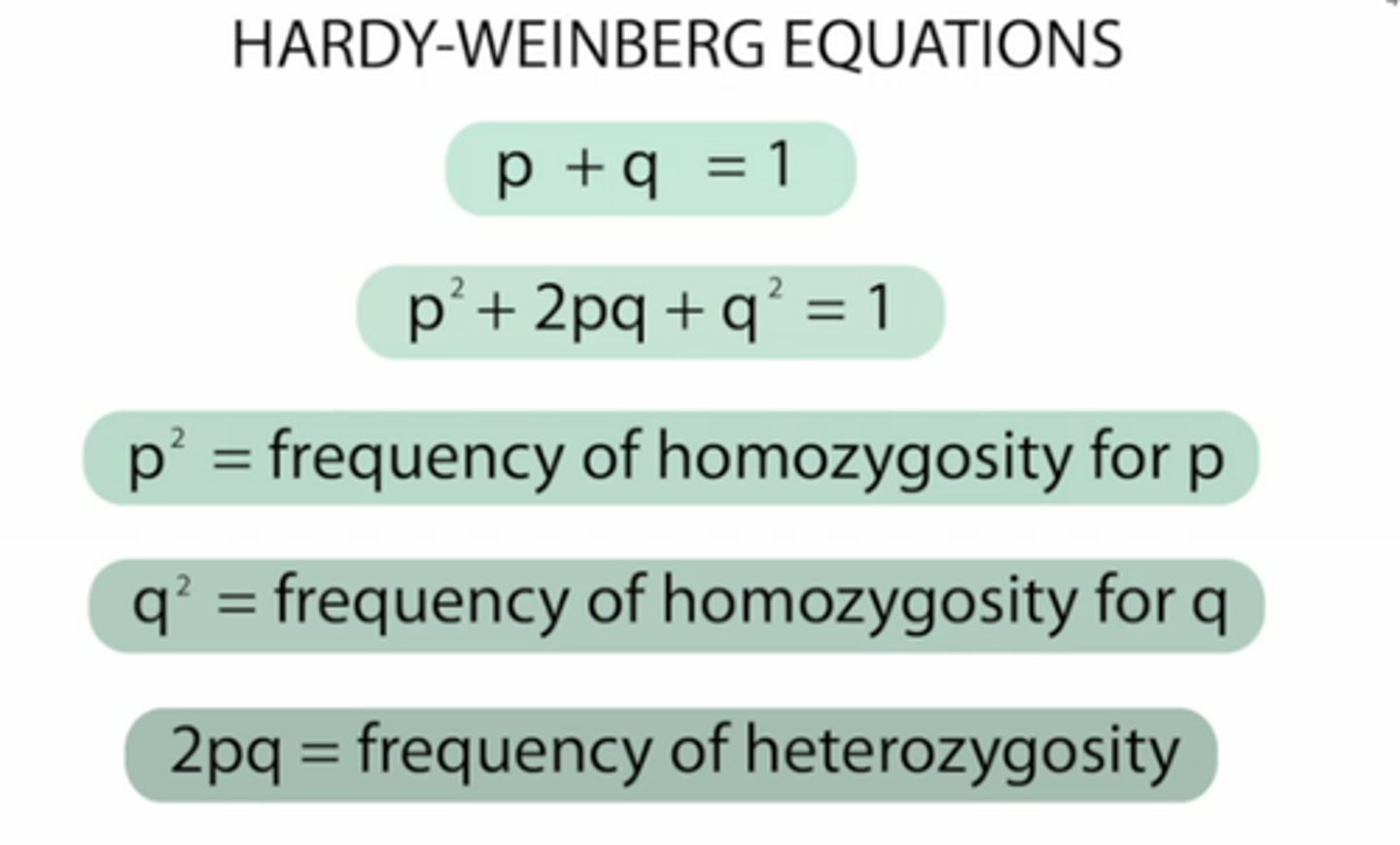
What is Hardy-Weinberg equilibrium? What conditions are necessary for a population to be in equilibrium?
means a population is not evolving.
Conditions include large population, random mating, no mutations, no migration, and no natural selection.
What does it mean to be the same species?
if they can mate and produce fertile offspring.
What is speciation?
the formation of a new species through evolution and reproductive isolation.
What does it mean to be reproductively isolated?
means populations cannot successfully breed together anymore.
Geographic isolation
occurs when physical barriers separate populations.
Behavioral isolation
happens when populations have different mating behaviors.
Temporal isolation
occurs when organisms reproduce at different times.
What is plate tectonics?
the movement of Earth's crustal plates, which can cause earthquakes, volcanoes, and mountain formation.
Explain how radiometric decay is used to determine the age of a fossil. What is a half-life?
uses radioactive decay to determine fossil age.
A half-life is the time it takes for half of a radioactive isotope to decay.
What did the Miller-Urey experiment show?
showed that organic molecules like amino acids could form from simple gases under early Earth conditions.
What is endosymbiosis?
symbiosis in which one of the symbiotic organisms lives inside the other.
the theory that mitochondria and chloroplasts were once free-living bacteria that were engulfed by larger cells.
What does a geological time scale tell us? How is it organized?
shows Earth's history and major evolutionary events.
It is organized into eons, eras, periods, and epochs.
What is the difference between a mass extinction and background extinction?
Background extinction is the normal slow rate of extinction. Mass extinction is when many species go extinct in a short period of time.
What is coevolution? Give an example.
when two species evolve in response to each other. Example: flowers and pollinating bees.
What are the levels of organization in ecology?
Levels of organization are organism, population, community, ecosystem, biome, and biosphere.
What is the greenhouse effect?
occurs when greenhouse gases trap heat in Earth's atmosphere and warm the planet.
How does the sun affect different latitudes?
The equator receives more direct sunlight and is warmer, while the poles receive less direct sunlight and are colder.
What creates wind?
created by unequal heating of Earth's surface, which causes differences in air pressure.
How do winds impact the oceans?
create ocean currents that move heat, nutrients, and water around Earth.
Know the basics of different biomes and how to read climate graphs.
Biomes are classified mainly by temperature and precipitation. Climate graphs use bars for precipitation and lines for temperature.
What are biotic factors?
factors are living things in an ecosystem.
What are abiotic factors?
factors are nonliving things like sunlight, water, and temperature.
What is a producer and consumer? What does each type of consumer consume?
Producers make their own food using photosynthesis. Herbivores eat plants, carnivores eat animals, omnivores eat both, and decomposers break down dead organisms.
What is the difference between a food chain and a food web?
A food chain shows one pathway of energy flow.
A food web shows many interconnected food chains in an ecosystem.
What are the trophic levels of a community? How much energy is transferred between trophic levels, how much energy is lost as heat?
include producers, primary consumers, secondary consumers, and tertiary consumers. About 10% of energy transfers to the next level while 90% is lost as heat.
Water Cycle (Hydrologic Cycle)
includes evaporation, condensation, precipitation, runoff, and transpiration.
Carbon cycle
includes photosynthesis, respiration, combustion, and decomposition.
Nitrogen cycle
includes nitrogen fixation, nitrification, assimilation, ammonification, and denitrification.
Phosphorus Cycle
includes weathering, absorption, decomposition, and sedimentation.
What is the difference between niche and habitat?
A habitat is where an organism lives.
A niche is the organism's role or job in the ecosystem.
Interspecific competition
competition occurs between different species.
Intraspecific competition
competition occurs within the same species.
What is competitive exclusion?
means two species cannot occupy the exact same niche for a long time.
What is dividing resources? Why is it an advantage?
Resource partitioning occurs when species divide resources to reduce competition. This helps species survive together.
Mutualism (symbiotic relationship)
benefits both species (+/+).
Commensalism (symbiotic relationship)
benefits one species while the other is unaffected (+/0).
Parasitism (symbiotic relationship)
benefits one species and harms the other (+/-).
What is a keystone species? Give an example.
species has a major effect on its ecosystem.
Example: sea otters controlling sea urchin populations.
What is succession?
the gradual change in an ecosystem over time after a disturbance or formation of new land.
What is Primary succession?
begins where no soil exists, like after lava cools.
What is Secondary succession?
begins where soil already exists, like after a forest fire.
How is population density measured?
measured by dividing the number of organisms by the area they occupy.
Clumped dispersion
means organisms live in groups.
Uniform dispersion
means organisms are evenly spaced.
Random dispersion
means there is no pattern.
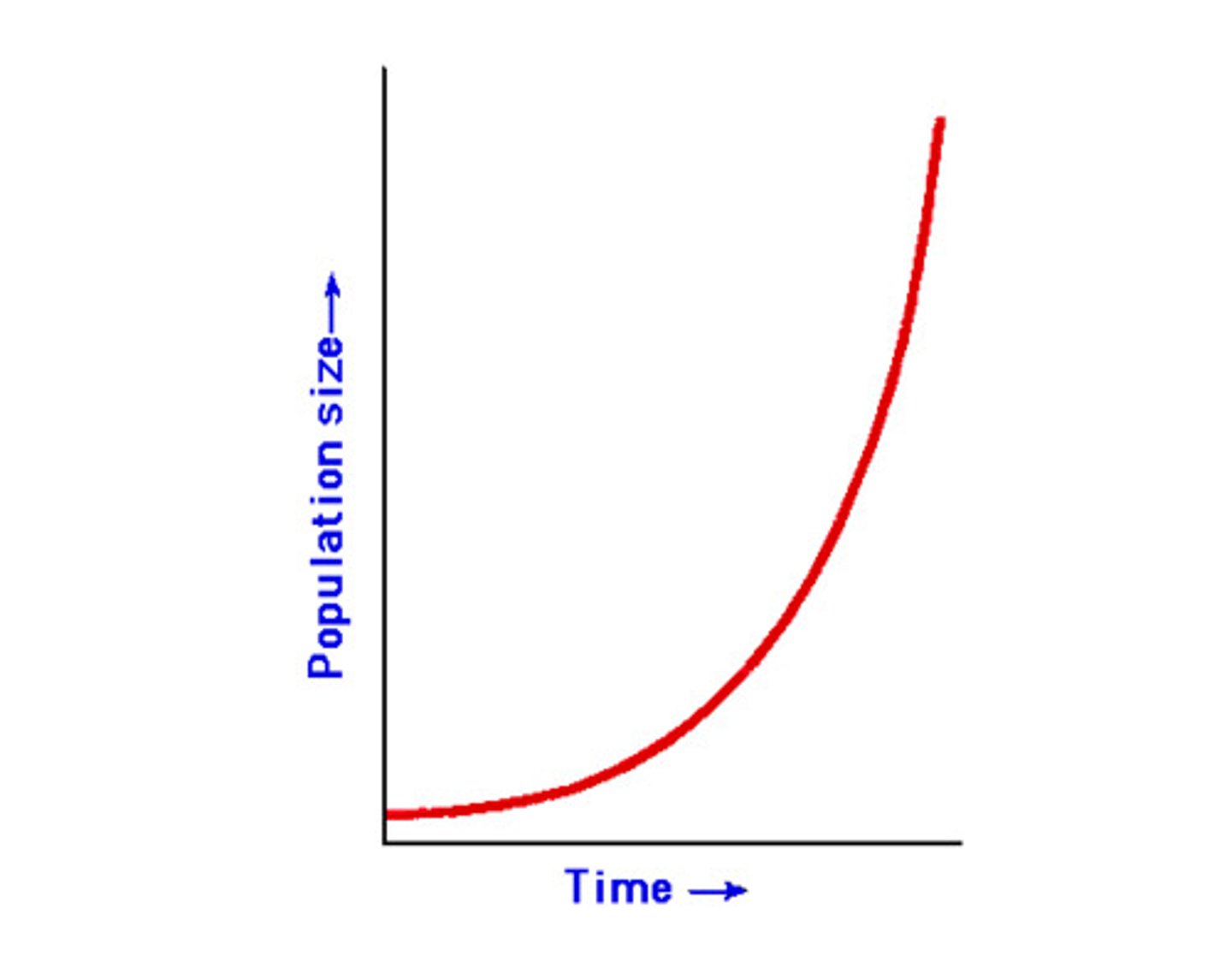
What are the conditions for exponential growth of a population?
occurs when resources are unlimited and competition is low, creating a J-shaped curve.
What are the conditions for logistic growth of a population?
occurs when resources become limited and growth slows near carrying capacity.
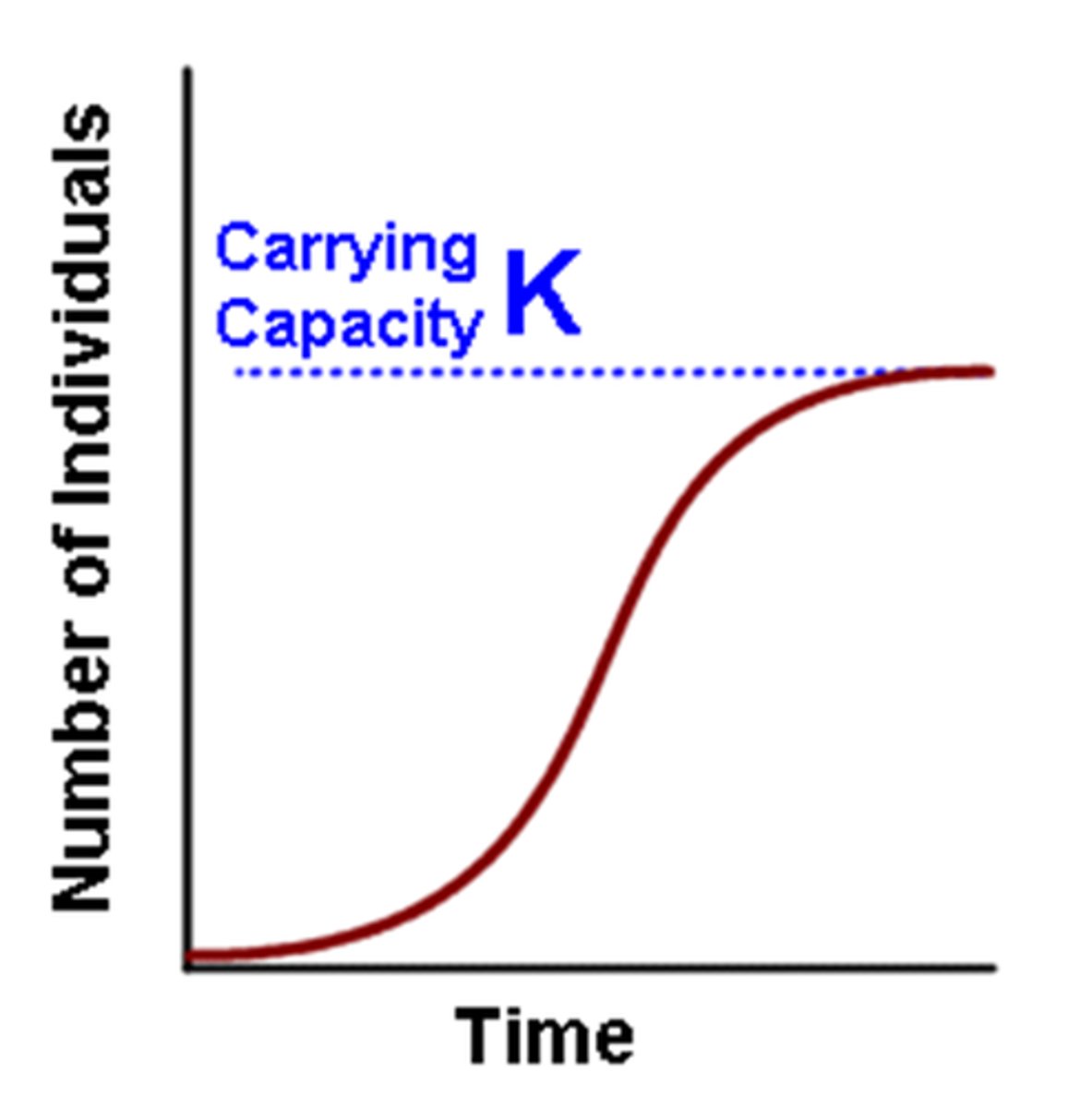
What is carrying capacity?
is the maximum population size an environment can support long-term.
What are density-dependent limiting factors for population growth? Examples?
limiting factors become stronger as population size increases. Examples include disease, competition, and predation.
What are density-independent limiting factors for population growth? Examples?
limiting factors affect populations regardless of size. Examples include floods, fires, droughts, and hurricanes.
What is demography?
the study of human populations, including birth rates, death rates, and population growth.
What can an age structure diagram tell us about a population? (know how to read)
shows the age distribution of a population and whether it is growing, stable, or shrinking.
What is meant by our ecological footprint?
measures how much land, water, and resources a person or population uses.
What is the Anthropocene? What has changed with humans' relationship to the Earth?
the current time period in which human activity strongly affects Earth's environment and climate.
What are the 3 main greenhouse gases? Why are they necessary for life?
gases are carbon dioxide, methane, and water vapor. They are necessary because they trap heat and keep Earth warm enough for life.
What is the main way greenhouse gases are increasing?
mainly increasing because humans burn fossil fuels like coal, oil, and natural gas.
What is the meaning of global warming?
the increase in Earth's average temperature.
What is the meaning of climate change?
includes long-term changes in temperature, weather, and climate patterns.
How is acid rain created? What is the effect?
forms when sulfur dioxide and nitrogen oxides mix with water vapor in the atmosphere.
It damages forests, lakes, soil, and buildings.
What is ocean acidification? What is the effect of ocean acidification?
occurs when oceans absorb excess carbon dioxide, lowering ocean pH. It harms coral reefs and shell-forming organisms.
What is the purpose of the ozone layer? What is the effect of its destruction?
protects Earth from harmful ultraviolet radiation.
Its destruction increases skin cancer, cataracts, and ecosystem damage.
What is the effect of urbanization / habitat fragmentation / deforestation?
all destroy habitats and reduce biodiversity.
What are 3 direct human activities that have threatened species with extinction?
Pollution, deforestation, and overhunting/overfishing are three major human activities threatening species with extinction.
What is the effect of invasive species? Give an example.
outcompete native species and disrupt ecosystems. Example: zebra mussels in the Great Lakes.
What is biomagnification and how does it affect certain species?
when toxins build up at higher trophic levels. Top predators are affected the most.
With climate change and global warming, what is the effect of rising sea levels, floods, and droughts?
all destroy habitats, damage crops, reduce water supplies, and displace populations.
What is sustainable development?
means using resources responsibly so future generations can still meet their needs.
What is a renewable resource?
resources can naturally be replaced, such as solar or wind energy.
What is a Nonrenewable resource?
resources are limited, such as coal and oil.