Stem cell test 2
 Call Kai
 Learn
Learn Practice Test
 Spaced Repetition
 Match
Match Flashcards
 Knowt Play
1/103

There's no tags or description
Looks like no tags are added yet.
Name | Mastery | Learn | Test | Matching | Spaced | Call with Kai |
|---|
No analytics yet
Send a link to your students to track their progress
104 Terms
Lecture 7: Cell Culture Basics: General Passaging rules: passage at _ % to _% confluence, do not over _, abdicate neutralize _ properly
70 80 trypsonize trypsin
Lecture 7: Cell Culture Basics: General Passaging rules: Feeding
you should change the media every _ to _ days
check under microscope every _ to _ days
keep _ and do not let _
2 3 1 2 warm dry
Lecture 7: Cell Culture Basics: Lab 1 what are the phases in a cell growth curve
lag log stationary death
Lecture 7: Cell Culture Basics: Lab 1: Proliferation affects what 3 things
differentiation metabolism drug response
Lecture 7: Cell Culture Basics: Lab 1 Growth curves are a __
baseline measurement
Lecture 7: Cell Culture Basics: Lab 1 Growth Curve Lag Phase: Cells adapt to new _
attachment, spreading, and __
little to no increase in __
lag DNE dead cells
environment metabolic adjustment cell number
Lecture 7: Cell Culture Basics: Lab 1 Log phase
cells divide at a __
nutrients are _
__ is measurable
constant rate sufficient doubling time
Lecture 7: Cell Culture Basics: Lab 1 stationary phase
Nutrients _
_ accumulates
Division rate = __
depleted waste death rate
Lecture 7: Cell Culture Basics: Lab 1 Death phase
Cell death exceeds _
_, nutrient depletion, and _
division stress overcrowding
Lecture 7: Cell Culture Basics: Not all cells grow the same: Stem cells
Slower _
sensitive to density, __, and passage number
Balance between __ and _
Growth is Regulated
proliferation media consumption self renewal differentiation
Lecture 7: Cell Culture Basics: Not all cells grow the same Cancer cells:
Faster _
reduced contact inhibition
Less dependence on external _
Often metabolically _
Growth is deregulated
proliferation signals aggressive
Lecture 7: Cell Culture Basics: How do we measure cell growth
Cell count
_ + _
measures actual cell _
distinguishes _ vs _ cells
hemocytometer trypan blue number live dead
Lecture 7: Cell Culture Basics: How do we measure cell growth
What are the pro and con of hemocytometer
accurate labor intensive
Lecture 7: Cell Culture Basics: How do we measure cell growth Metabolic Assay
_, XTT, Resazurin, etc
measures cell __
__ reduction of a reagent
used as an _ proxy for viable cell number
MTT metabolic activity enzyme mediated indirect
Lecture 7: Cell Culture Basics: How do we measure cell growth
what are the pros and cons of metabolic assay
fast scalable does not directly measure cell number
Lecture 7: Cell Culture Basics: Cell growth and differentiation
Stem cell differentiation depends on the what of the cells
growth state
Lecture 7: Cell Culture Basics: Cell growth and differentiation
Growth phase influences
__ activity
_ state
sensitivity to __
cell cycle metabolic differentiation cues
Lecture 7: Cell Culture Basics: Cell growth and differentiation
Growth phase matters
Lag phase: cells adapting —> poor _ response
log phase: healthy, responsive cells → __
Stationary phase: stress and nutrient depletion → __
differentiation optimal induction altered fate
Lecture 7: Cell Culture Basics: Adipogenic differentiation timeline
what are the phases of Adipogenic differentiation
proliferation and commitment early differentiation intermediate differentiation mature adipocytes
Lecture 7: Cell Culture Basics: Adipogenic differentiation timeline
what days do early differentiation, intermediate differentiation, and mature adipocytes occur
2-4 5-7 10-14
Lecture 8: Biomechanics basics: Mechanobiology
Paradigm: mechanical forces modulate _, structure, and _ of tissues, particularly _ tissues such as bone cartilage ligaments and tendons
morphology functions skeletal
Lecture 8: Biomechanics basics: Mechanobiology
Traditional biomechanics is focused on how these tissue perform the _ and _ functions of the _
structural locomotory skeleton
Lecture 8: Biomechanics basics: Mechanobiology
Mechanobiology is more concerned with the theme of how these __ tissue are produced, _, and adapted by cells as responses to __ (tissue homeostasis)
load bearing maintained biophysical stimulus
Lecture 8: Biomechanics basics: Mechanobiology
Goal- understand the _ adaptation to benefit _ and human health (e.g., congenital deformities, osteoporosis) and to enhance __
functional medicine tissue engineering
Lecture 8: Biomechanics basics: Mechanotransduction
Cells and tissues are known to respond to mechanical stimuli such as _, _, and _ (gravity is one of the best examples)
shear stress compression tension
Lecture 8: Biomechanics basics: Mechanotransduction
Ultimately, all _ stimuli must be converted to either _ and _ signals. but the exact mechanisms remain to be elucidated
external bioelectrical biochemical
Lecture 8: Biomechanics basics: Mechanotransduction
One of the key mechanotransduction mechanisms is now believed to be mediated by __ bindings via _ → _ transmit the force
cell ecm integrins directly
Lecture 8: Biomechanics basics: Mechanotransduction
Other potential mechanisms could include __ biochemical signaling, _ activated ion channels, _ activation, and altered _ (e.g., altered affinity binding)
integrin triggered mechanically G protein conformation
Lecture 8: Biomechanics basics: Mechanical Language
In order to understand mechanical aspects of cell/tissue _ and _, one has to become familiar with the language of mechanics
responses regulation
Lecture 8: Biomechanics basics: Mechanical language
Stress (σ) is defined as the _ per area _ to the _ of force applied (tensile or compressive force)
force perpendicular direction
Lecture 8: Biomechanics basics: Mechanical language
Stress has units of pascals which are what and what is the other unit
N/m² dynes/cm²
Lecture 8: Biomechanics basics: Mechanical language
Strain (𝜺) is what? (unitless)
deformation due to stress
Lecture 8: Biomechanics basics: Mechanical language
Strain is defined as what
deviation from the unstressed dimension
Lecture 8: Biomechanics basics: Mechanical language
Strain is defined as deviation from the unstressed dimension
for example, in 1D bar, 𝜺=𝜹L/Lo, where Lo is the original length and 𝜹L is the _
deviation
Lecture 8: Biomechanics basics: Stress and Strain
Intuitive to suggest that, as stress becomes _, the _ (i.e. deformation) should _
large strain increase
Lecture 8: Biomechanics basics: Stress and Strain
Intuitive to suggest that, as stress becomes large, the strain (i.e. deformation) should increase
If in fact a material is considered _, there is a _ relationship between _ and _
elastic linear stress strain
Lecture 8: Biomechanics basics: Stress and Strain
Intuitive to suggest that, as stress becomes large, the strain (i.e. deformation) should increase
If in fact a material is considered elastic, there is a linear relationship between stress and strain
σ=E𝜺, this is called what law? and E is a _ and known as what?
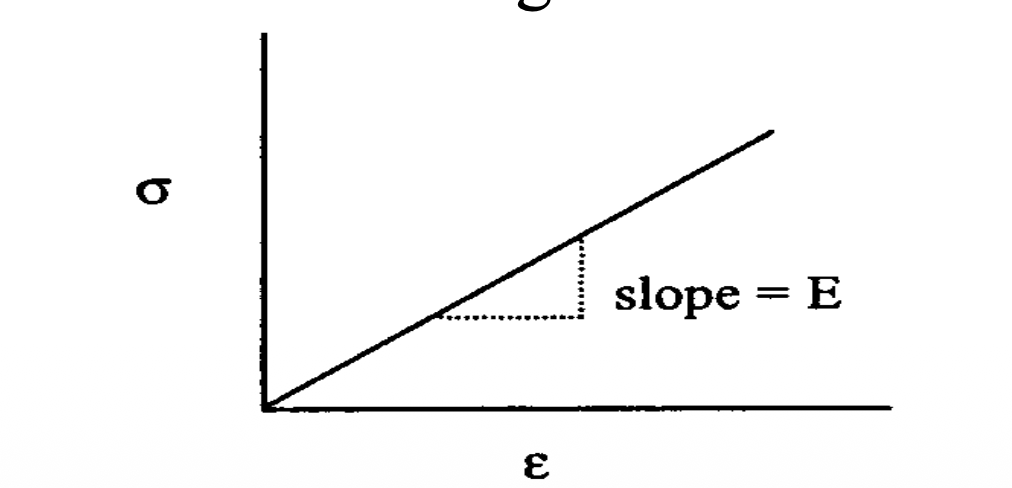
hookes constant youngs modulus
Lecture 8: Biomechanics basics: Other Mechanical Models
Not all biological systems could or should be described by the linear relationship of __
What are other models that are more sophisticated and complicated? these are collectively referred to as _ models
In addition to _ behavior of the system, incorporation of the _ behavior provides a more _ description of how a biological system may respond to a stimulus
hookes law viscoelastic elastic viscous realistic
Lecture 8: Biomechanics basics: Mechanical Tissue Response
Linear relationship between stress and strain applicable in a _ range
Proper mechanical description of such response based on _
limited viscoelasticity
Lecture 8: Biomechanics basics: Mechanical Tissue Response
Linear relationship between stress and strain applicable in a limited range
Proper mechanical description of such response based on viscoelasticity
Relaxation: _ relaxes while _ is continuously applied
Creep: _ increase after _ is removed
Strain stress strain stress
Lecture 8: Biomechanics basics: Mechanical Tissue Response
What is relaxation?
strain relaxes while stress continuously applied
Lecture 8: Biomechanics basics: Mechanical Tissue Response
What is creep?
strain increase after stress removed
Lecture 8: Biomechanics basics: Mechanical Tissue Response
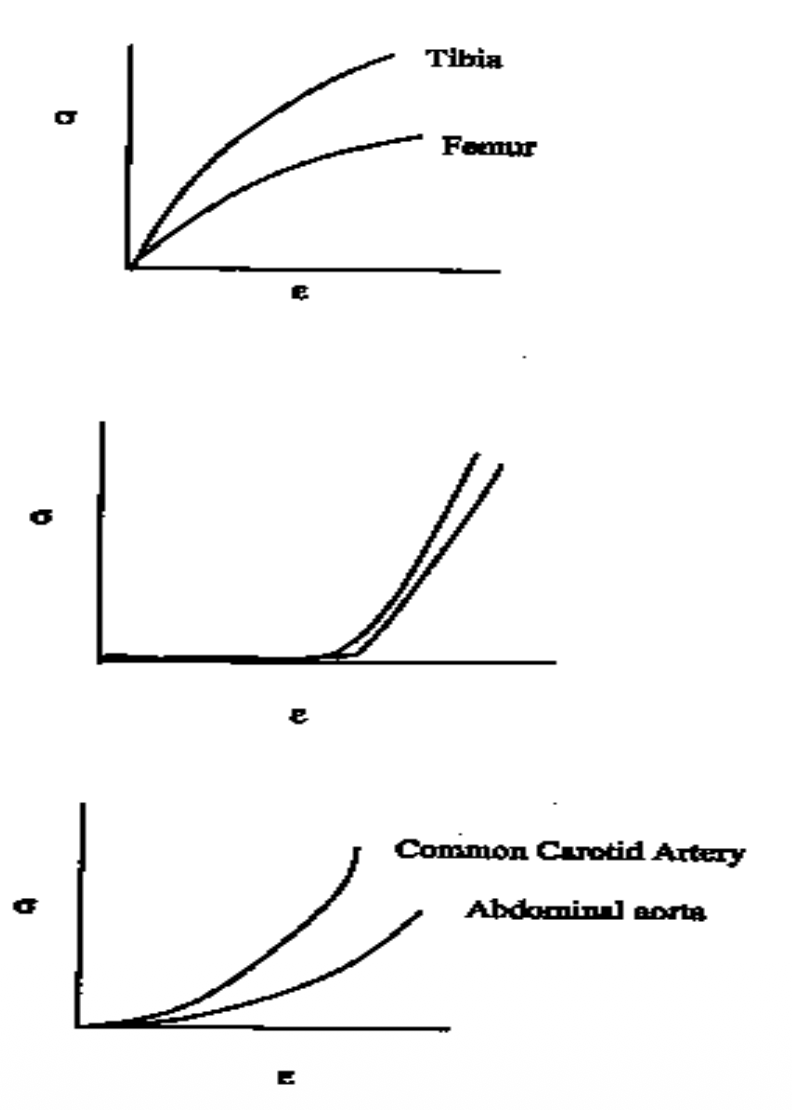
what tissues are these curves depicting
bone skin cartilage
Lecture 8: Biomechanics basics: Maxwell Model
A dashpot (e.g., shock absorber) is added to the system, Unlike a spring the dashpot displacement is proportional to dx dashpot/dt.
Total displacement of the system, of course is
x(t)= x (_) + x(_)
dashpot spring
Lecture 8: Biomechanics basics: Maxwell Model
A dashpot (e.g., shock absorber) is added to the system, Unlike a spring the dashpot displacement is proportional to dx dashpot/dt.
Total displacement of the system, of course is
x(t)= xspring + xspring
Note that his is entirely analogous to an electrical circuit in series
F(t)= Fspring = Fdashplot
Finally, one can show, without too much difficulty that
x(t)/F=1/K0+(_)t
1/n0
Lecture 8: Biomechanics basics: Kelvin Model
A slightly more complicated model that has the Maxwell body in _ with another spring (k1). In analogous to a parallel electric circuit, force can be _ distributed but the _ (x) of each branch must be the same

where 𝝉 is the ___ and is given by n0 {(k0+k1)/k0k1
relaxation time constant
Lecture 8: Biomechanics basics: Structural Organization of Articular Cartilage
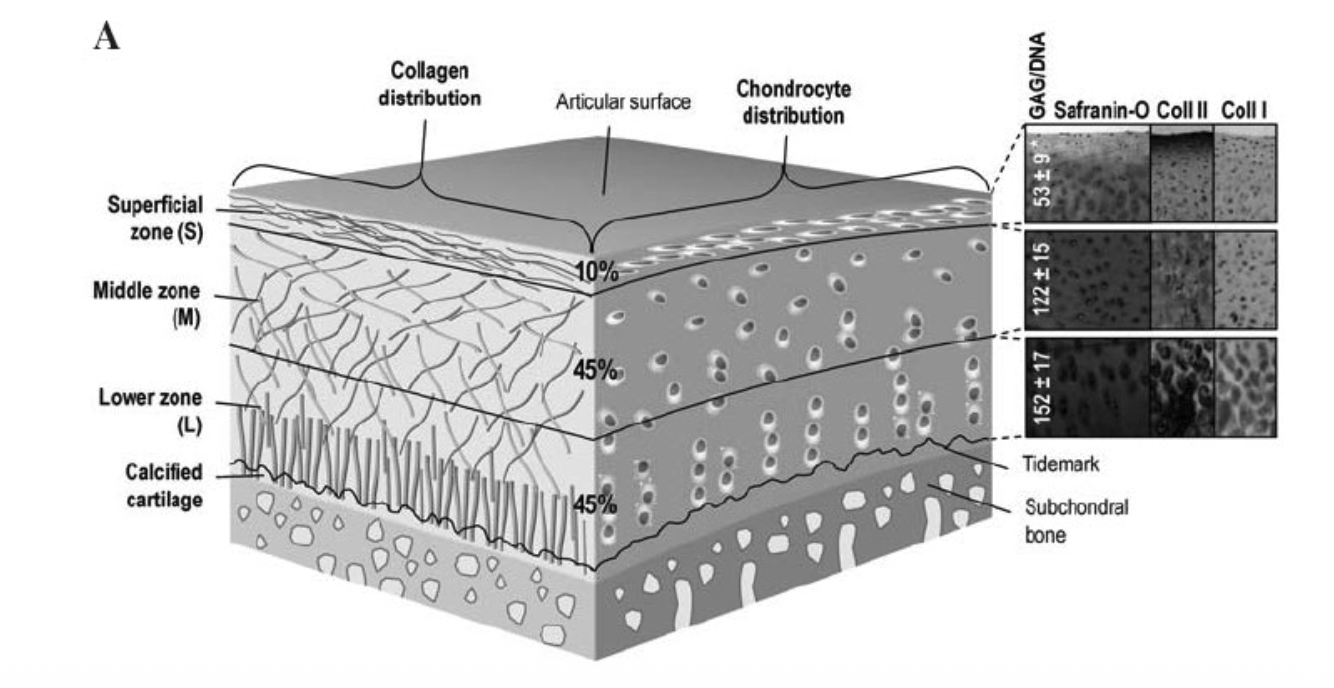
what are the 3 zones
superficial middle lower
Lecture 8: Biomechanics basics: Structural Organization of Articular Cartilage
what percent of collagen and chondrocyte distribution do the superficial zone, middle zone, and lower zone have?
10 45 45
Lecture 8: Biomechanics basics: Mechanical Requirements for Articular Cartilage
What are the four zones from top to bottom?
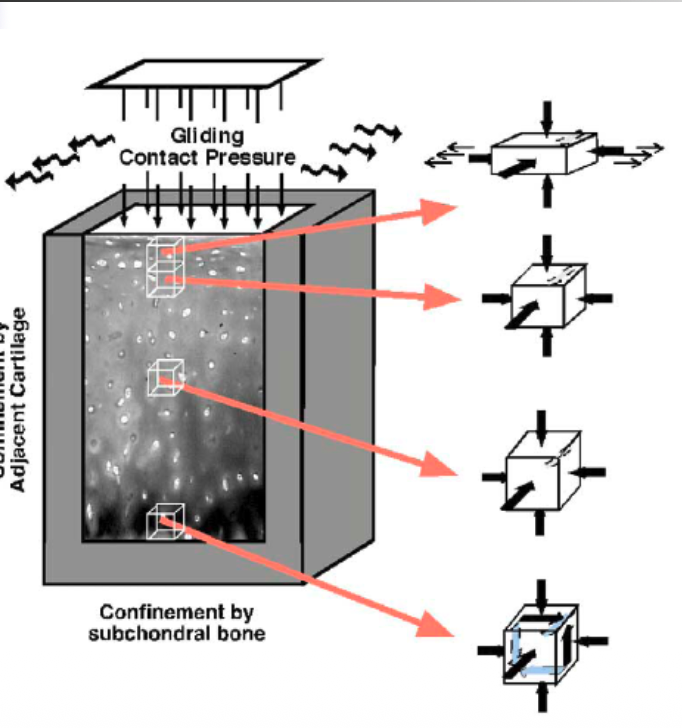
surface transitional radial tidemark
Lecture 8: Biomechanics basics: Structural Organization of Articular Cartilage
What are the requirements for the surface zone
__ in/out
_ pressure/tension
large __ (consolidation)
_ surface strains
high flow fluid compressive strain tensile
Lecture 8: Biomechanics basics: Structural Organization of Articular Cartilage
What are the requirements for the transitional zone
_ fluid flow
mainly _ pressure
_ compressive strains (consolidation)
low fluid moderate
Lecture 8: Biomechanics basics: Structural Organization of Articular Cartilage
What are the requirements for the radial zone
_ fluid flow
_ pressure
_ compressive strain (consolidation)
little fluid small
Lecture 8: Biomechanics basics: Structural Organization of Articular Cartilage
What are the requirements for the tidemark zone
_ fluid flow
_ pressure
_ compressive strain (consolidation)
interface __
no fluid no shear strains
Lecture 8: Biomechanics basics: AFM image analysis
__ (nm heights) on the surface MDCK cells (5×5 um)
A: control cell
B: control cell + P188
C: .01% Saponin without P188
D: .01% Saponin + P188
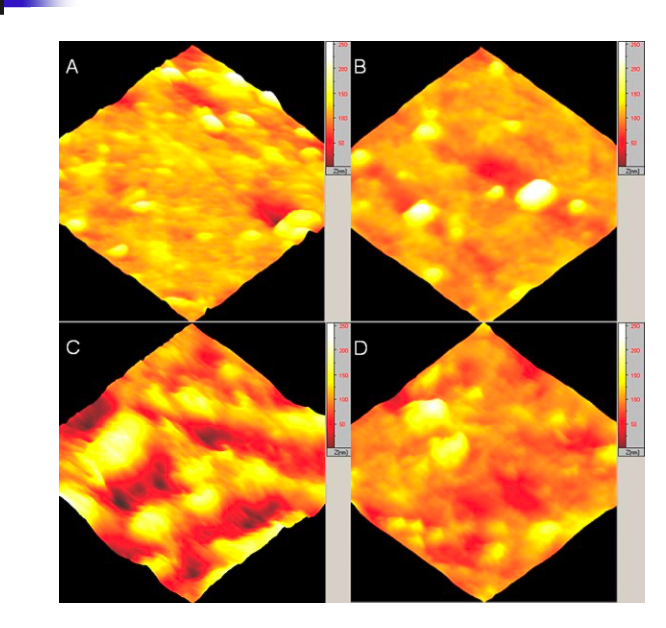
topographical measurements
Lecture 8: Biomechanics basics: Biomechanics properties
What is the youngs modulus of human bone marrow stem cell, human osteoblast, bovine aortic EC, human adipocyte (stem cell derived), mouse myotube, and human vascular EC
3.2 1.8 1.7 .82 2.8 2.6
Lecture 8: Biomechanics basics: Cell Detachment by Shear Stress
_ dynes/cm² (3.3 pa) induced _% cell detachment
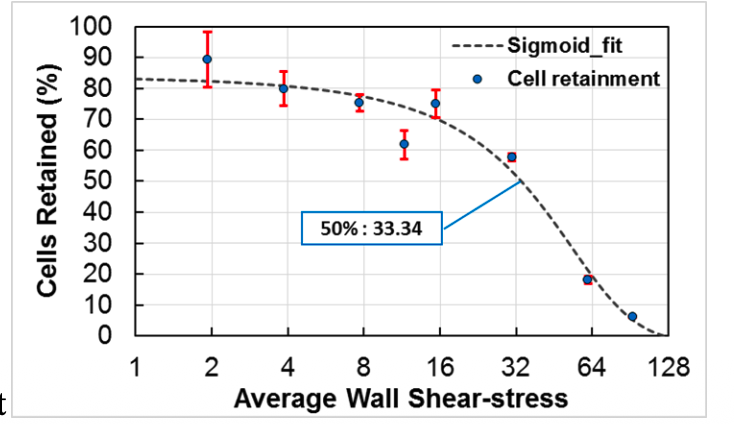
33 50
Lecture 8: Biomechanics basics: Shear Stress or Stretching
One of the best known examples in mechanobiology is the _ responses by _ or _.
cellular shear stress stretching
Lecture 8: Biomechanics basics: Shear Stress or Stretching
One of the best known examples in mechanobiology is the cellular responses by shear stress or stretching. Postulate is that _ forces act on the __ sites. At least some, but certainly not all, of the _ pathways have been identified
external focal adhesion signaling
Lecture 8: Biomechanics basics: Shear Stress
Shear stress is the what?
frictional force exerted by blood flow on vessel walls
Lecture 8: Biomechanics basics: Shear Stress
frictional force exerted by blood flow on vessel walls
Endothelial cells line the interior surface of blood vessels and directly sense __ and transduce it into __ that regulate gene expression, cell _, and _
shear stress biochemical signals morphology function
Lecture 8: Biomechanics basics: Shear Stress
frictional force exerted by blood flow on vessel walls
Endothelial cells line the interior surface of blood vessels and directly sense shear stress and transduce it into biochemical signals that regulate gene expression, cell morphology, and function
Normal _ shear stress promotes _ whereas disturbed (turbulent) or _ shear stress contributes to _ dysfunction such as atherosclerosis
laminar homeostasis low endothelial
Lecture 8: Biomechanics basics: Shear Stress
Shear stress at the wall in a laminar flow is Tw=what/what
4uq piR³
Lecture 8: Biomechanics basics: Shear Stress
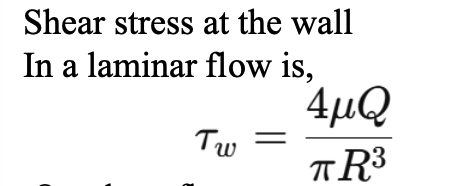
what are Q, u, and R
volume flow rate fluid viscosity radius of tube
Lecture 8: Biomechanics basics: Shear Stress and Stem cells
Some stem cells typically do interact with shear stress such as
_ progenitor cells
_ stem cells in bone marrow
_ progenitor cells
endothelial hematopoietic cardiac
Lecture 8: Biomechanics basics: Shear Stress and Stem cells
Some stem cells typically do interact with shear stress such as
endothelial progenitor cells
hematopoietic stem cells in bone marrow
cardiac progenitor cells
Shear stress has been used as a tool to manipulate stem cell responses
through __ that connect the ECM to the cytoskeleton
__ ion channels on the cell surface
focal adhesions mechanosensitive
Lecture 8: Biomechanics basics: Shear Stress and Differentiation
Shear stress influences MSCs differently depending on what and what
magnitude pattern
Lecture 8: Biomechanics basics: Shear Stress and Differentiation
Low/physiological shear levels (1-10 dyne/cm²) encourages what kind of cell responses
High shear levels (>10 dyne/cm²) encourages what kind of cell responses
Oscillatory/disturbed shear levels encourages what kind of cell response
endothelial osteogenic osteogenic chondrogenic pro inflammatory phenotype
Lecture 8: Biomechanics basics: Shear Stress and Differentiation
Challenges
How to _ precise shear stress
how to determine the complexity of _
how to scale from in _ to in _
how to apply shear stress for a _ period of time
control mechanotransduction vitro vivo long