Protein synthesis
 Call Kai
 Learn
Learn Practice Test
 Spaced Repetition
 Match
Match Flashcards
 Knowt Play
1/25

There's no tags or description
Looks like no tags are added yet.
Name | Mastery | Learn | Test | Matching | Spaced | Call with Kai |
|---|
No analytics yet
Send a link to your students to track their progress
26 Terms
In an eukaryotic cell, where is DNA contained within
A double membrane called the nuclear envelope
What are the benefits of a nuclear envelope
This protects the DNA from being damaged in the cytoplasm.
Where does protein synthesis occur?
cytoplasm at ribosomes
Why does transcription happen?
Protein synthesis occurs in the cytoplasm at ribosomes, but a chromosomal DNA molecule is too large to leave the nucleus to supply the coding information needed to determine the protein's amino acids sequence.
This is why, transcription happens.
What does the process transcription produce
shorter molecules of RNA.
Although transcription results in a different […], it has many similarities with […]
Although transcription results in a different polynucleotide, it has many similarities with DNA replication
The section of DNA that contains the gene unwinds and unzips under the control of a […], beginning at a start codon.
This involves the breaking of […] between the bases.
The section of DNA that contains the gene unwinds and unzips under the control of a DNA helicase, beginning at a start codon.
This involves the breaking of hydrogen bonds between the bases.
Describe the sense strand
one of the two strands of DNA contains the code for the protein to be synthesised .
It runs from 5' to 3'.
Describe the antisense strand
The stand (3' to 5') that is a complementary copy of the sense strand and does not code for a protein.
It acts as the template strand during transcription.
It acts as a template so that the complementary RNA strand formed carries the same base sequence as the sense strand.
Transcription process/steps
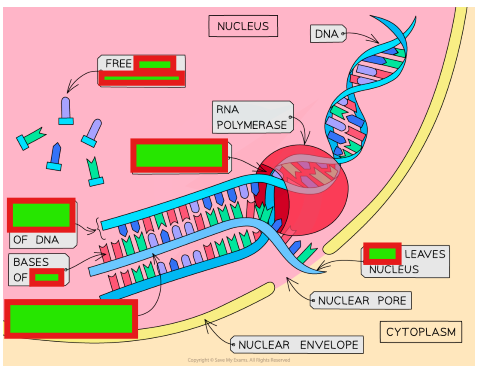
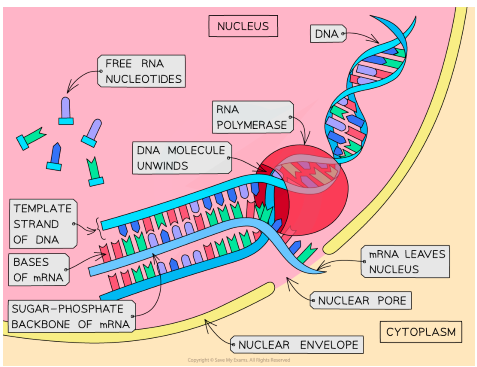
1. RNA polymerase attaches to the DNA - Transcription starts when RNA polymerase (an enzyme) attaches to the DNA double-helix at the beginning of a gene. The hydrogen bonds between the two DNA strands in the gene break, separating the strands, and the DNA molecule uncoils at that point. One of the strands is then used as a template to make an mRNA copy.
2. Complementary mRNA is formed - The RNA polymerase lines up free RNA nucleotides alongside the template strand. Complementary base pairing means that the mRNA strand ends up being a complementary copy of the DNA template strand (except the base T is replaced by U in RNA). Once the RNA nucleotides have paired up with their specific bases on the DNA strand, they're joined together by RNA polymerase, forming an mRNA strand.
3. RNA polymerase moves down the DNA strand - The RNA polymerase moves along the DNA, assembling the mRNA strand. The hydrogen bonds between the uncoiled strands of DNA re-form once the RNA polymerase has passed by and the strands coil back into a double-helix.
4. mRNA leaves the nucleus - When RNA polymerase reaches a stop codon, it stops making mRNA and detaches from the DNA. The mRNA moves out of the nucleus through a nuclear pore and attaches to a ribosome in the cytoplasm, where the next stage of protein synthesis takes place.
What are ribosomes made up of in eukaryotic cells
two subunits, one large and one small.
What are ribosomes subunits composed of
composed of almost equal amounts of protein and a form of RNA -> ribosomal (r)RNA.
Why is (r)RNA important
rRNA is important in maintaining the structural stability of the protein synthesis sequence and plays a biochemical role in catalysing of reaction.
Briefly describe translation
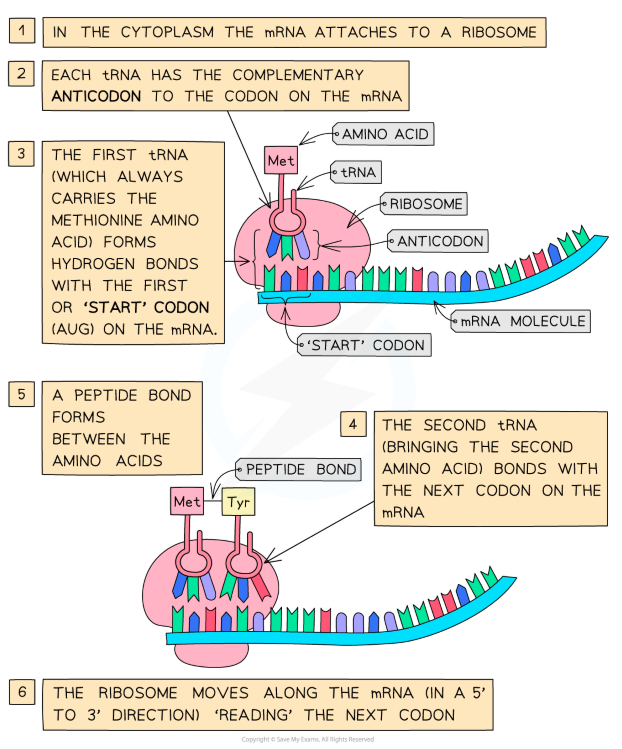
After leaving the nucleus, the mRNA binds to a specific site on the small subunit of a ribosome.
The ribosome holds mRNA in position while it is decoded, or translated, into a sequence of amino acids. This process is called translation.
What is (t)RNA and what is it composed of
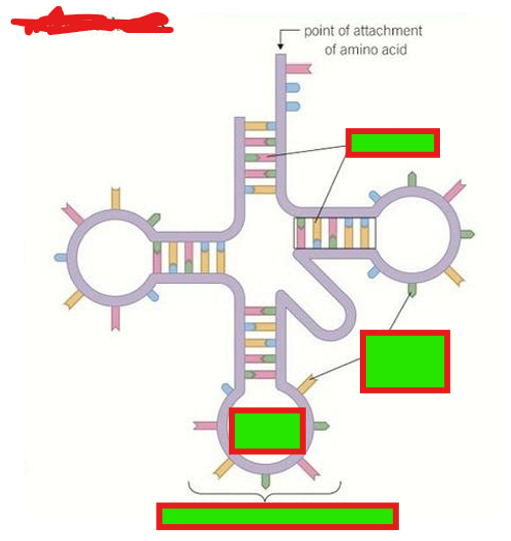
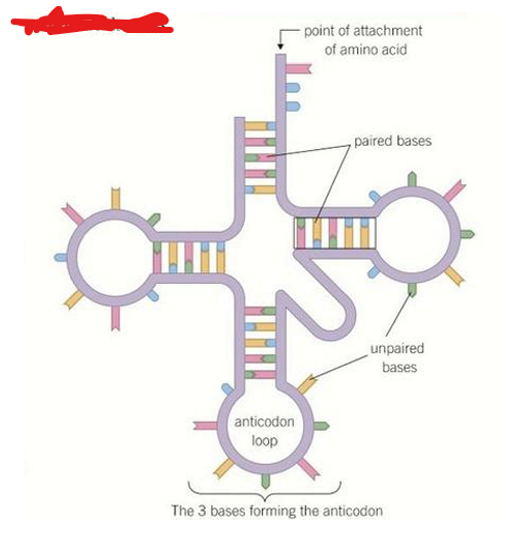
Transfer (t)RNA is another form of RNA, which is necessary for the translation of the mRNA.
It is composed of a strand of RNA folded in such a way that three bases, called the anticodon, are at one end of the molecule.
What happens when the tRNA anticodons bind to complementary codons along the mRNA
When the tRNA anticodons bind to complementary codons along the mRNA, the amino acids are brought together in the correct sequence to form the primary structure of the protein coded for by the mRNA.
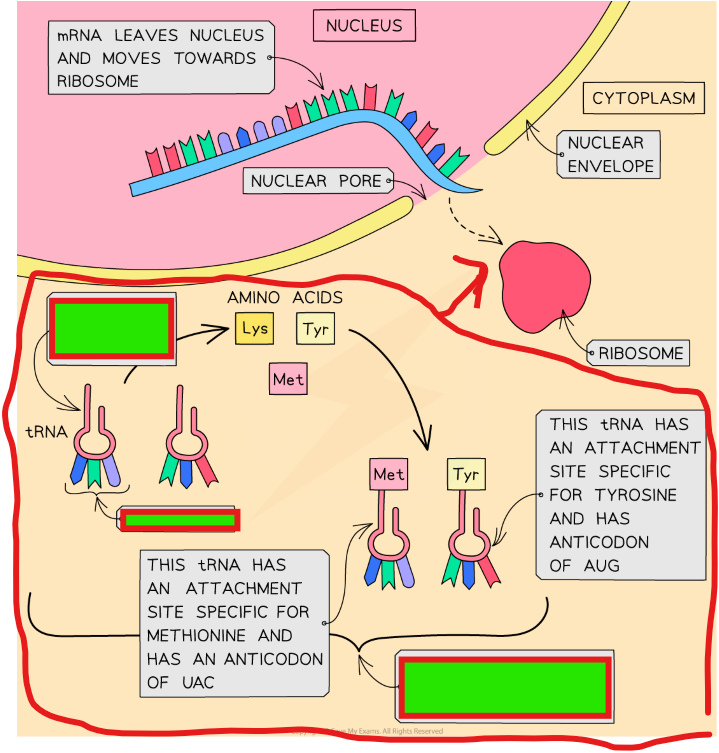
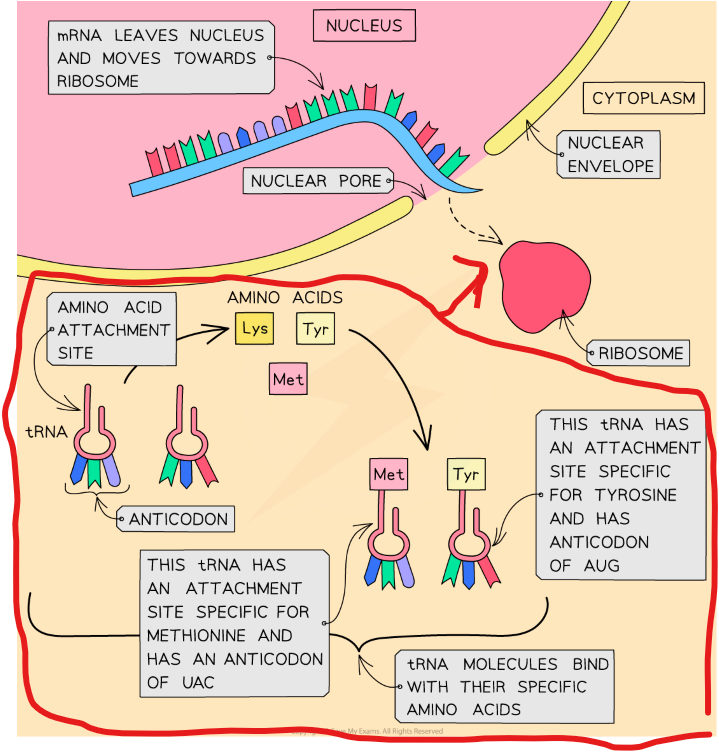
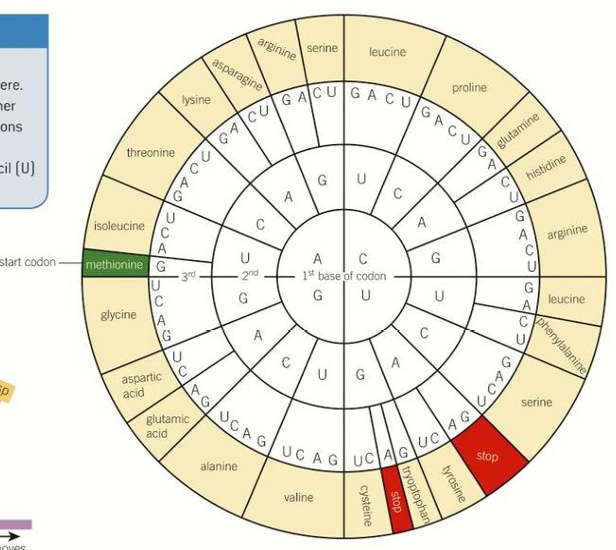
What is this diagram called
codon wheel
What is the Translation process/steps
The mRNA binds to the small subunit of the codon (AUG).
A tRNA with the complementary anticodon (UAC) binds to the mRNA start codon. This tRNA carries the amino acids methionine.
Another tRNA with the anticodon UCG and carrying the corresponding amino acids, threonine, then binds to the next codon on the mRNA (ACG). A maximum of two tRNAs can be bound at the same time.
The first amino acid, methionine, is transferred to the amino acid (threonine) on the second tRNA by the formation of a peptide bond. This is catalysed by the enzyme peptidyl transferase, which is an rRNA component of the ribosome.
The ribosome then moves along the mRNA, releasing the first tRNA. The second tRNA becomes the first.
Stage 3-5 are repeated, which another amino acid added to the chain each time.
The process keeps repeating until the ribosome reaches the end of the mRNA at a stop codon and the polypeptide is released.
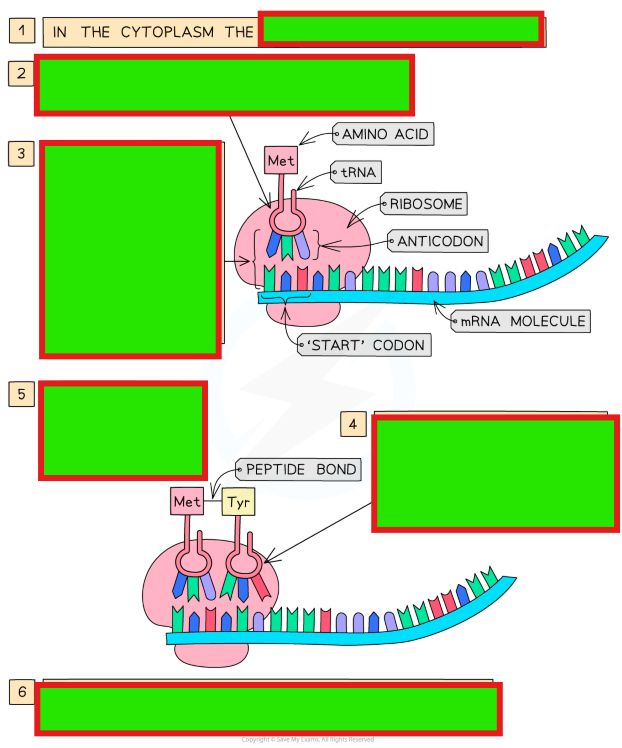
Fill in the blanks
Answers
As the amino acids are joined together forming the primary structure of the protein, what do they fold into
they fold into secondary and tertiary structures.
How are the folding and the bonds that are formed determined by
The folding and the bonds that are formed are determined by the sequence of amino acids in the primary structure.
The proteins may undergo further modification at the […] before it is fully functional and ready to carry out the specific role for which it has been synthesised.
The proteins may undergo further modification at the Golgi apparatus before it is fully functional and ready to carry out the specific role for which it has been synthesised.
Many ribosomes can follow on the mRNA behind the first, so that multiple […] can be synthesised […].
Many ribosomes can follow on the mRNA behind the first, so that multiple identical polypeptides can be synthesised simultaneously.