Electricity 1
 Call Kai
 Learn
Learn Practice Test
 Spaced Repetition
 Match
Match Flashcards
 Knowt Play
1/29

There's no tags or description
Looks like no tags are added yet.
Name | Mastery | Learn | Test | Matching | Spaced | Call with Kai |
|---|
No analytics yet
Send a link to your students to track their progress
30 Terms
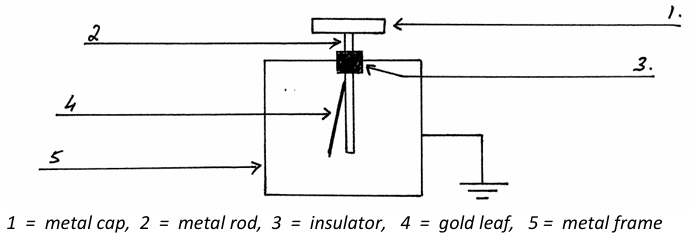
Gold Leaf Electroscope
To charge a metal sphere by induction
Take a conducting sphere (metal) sitting on an insulated stand.
Bring a negatively charged rod near the sphere. Charge separation happens on the sphere, i.e. some electrons move to the far side of the sphere, leaving behind atoms lacking some of their electrons (i.e. positive charge).
When the right side of the sphere is earthed, the electrons that moved to the right now run to earth.
Remove the earth connection and then remove the negative rod. Some electrons from atoms on the right side of the sphere move over to the positive atoms on the left side. The result is now that some atoms all over the sphere lack electrons, i.e. the positive charge has been distributed all over the sphere.

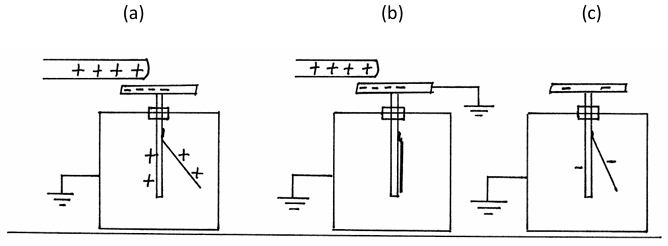
To charge a gold leaf electroscope by induction
Bring a positively charged rod near the cap of the electroscope. The gold leaf rises. The leaf region is positively charged. The cap has a negative charge.
Touch the cap with your finger i.e. earth the cap. The leaf falls as the charge in that region is neutralised. Electrons come from the earth to the leaf region to neutralise the positive charges.
Remove your finger (earth connection) from the cap. Then remove the positively charged rod. The leaf rises again as the negative charge from the cap spreads over the leaf region and the cap.
Conclusion: The gold leaf electroscope has been charged by induction.
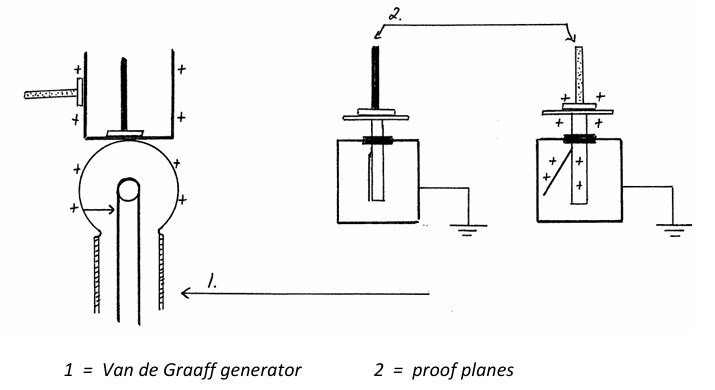
Demonstration experiment to show that total charge resides on the outside of a conductor
A metal can is placed on the top of a Van de Graaff generator as it is being charged up. Charge accumulates on the sphere of the generator and on the outside of the can.
Let a proof plane touch the inside of the metal can. Transfer the proof plane to the cap of a gold-leaf electroscope. The gold leaf does not diverge as there is no charge on the inside of the metal can.
Let a proof plane touch the outside of the metal can. Transfer the proof plane to the cap of a gold-leaf electroscope. The gold leaf will diverge as charges reside on the outside of the metal can.
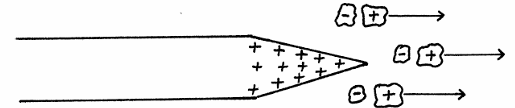
Point discharge
Air molecules near the sharp point of a charged object are ionised. The air molecules split into positive and negative ions.
The negative ions are attracted to the large concentration of positive ions at the sharp point. (The negative ions combine with some of the positive charges on the sharp point. The negative ions from the air discharged some of the positive charge at the point.)
The positive ions are repelled by the very large concentration of positive ions at the sharp point. This movement of positive ions away from the sharp point gives rise to an electrostatic wind.
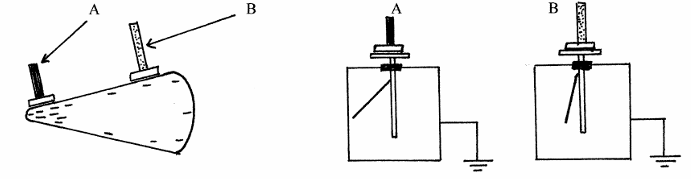
Demonstration experiment to show that charge concentrates at the sharp corner of an object
The pear shaped conductor shown above is charged by induction.
Two similar proof planes touch the conductor, A at the sharp end and B at the blunt end.
The proof planes are now placed on the caps of identical gold leaf electroscopes.
Proof plane A causes a larger deflection than proof plane B, showing that there was a greater concentration of charge at the sharper end.
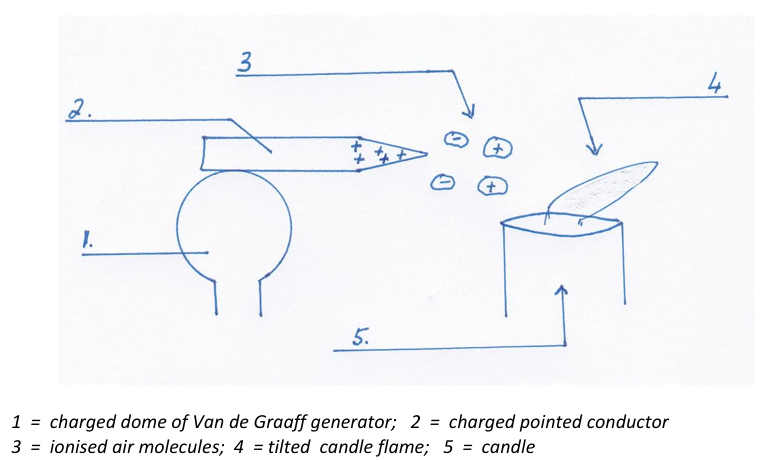
Demonstration experiment to show point discharge/point action in the laboratory
A pointed charged conductor ( a sharp pin ) is placed on the top of a charged Van de Graaff generator.
The large concentration of charge at the point of the conductor ionises the surrounding air.
The positive ions are repelled away from the pointed conductor.
The flame of the candle is tilted to one side due to the electrostatic wind.
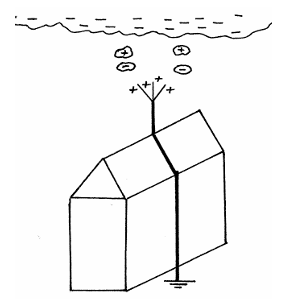
Lightning conductor
point discharge
electrons in the clouds
transfers charge to ground
Electric field
The region around a charged object in which its electric forces act
4 types of electric fields
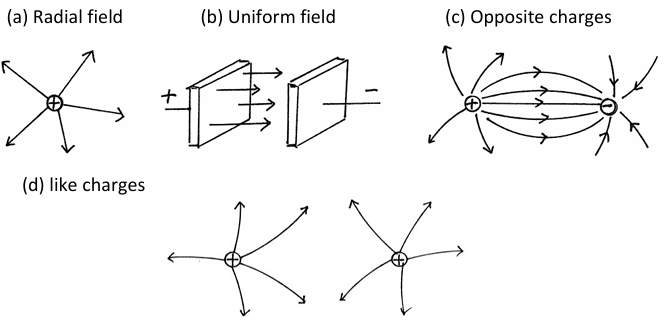
5 properties of electric field lines
Electric field lines start on a positive charge and end on a negative charge.
Electric field lines do not intersect each other.
Electric field lines are perpendicular to the surface of a charged conductor.
There are no electric field lines inside an empty hollow charged conductor.
A metal like aluminium can be used to alter an electric field. This is the basis of electrostatic shielding.
The Faraday Cage
Michael Faraday once sat in a wire cage charged to a very high voltage in front of a live audience. No harm came to him. This was to demonstrate that there is no electric field inside an empty hollow charged conductor.
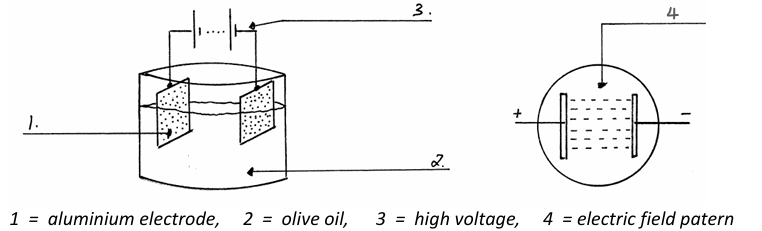
Demonstration of an electric field pattern in the laboratory
Place two aluminium electrodes in a beaker of olive oil. The voltage across the electrodes would be of the order of 2 000 V.
Sprinkle semolina grains onto the oil.
The grains line up in such a way that they show the electric field pattern.
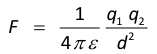
Coulomb’s law
F = force
q₁,q₂ = magnitude of charges
d = distance
ε = permittivity
Define the unit of charge, the coulomb
The amount of charge that passes a point when a current of 1 amp flows for 1 second, i.e. 1 ampere * 1 second
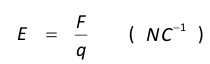
Electric field strength
E = electric field strength
F = force on test charge
q = magnitude of charge
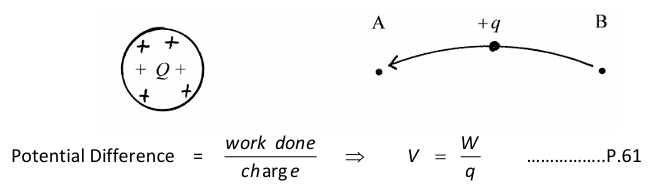
Definition of Potential Difference
work done to move a charge from B to A per unit charge
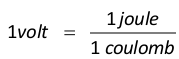
Definition of the unit for potential difference
Definition of capacitance
C = capacitance
q = charge
V = voltage

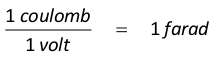
Definition of the unit for capacitance
What is a capacitor
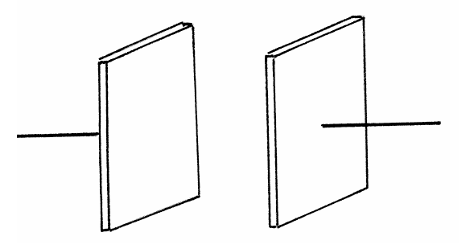
Capacitors consist of two parallel metal plates separated by an insulator which is called the dielectric.
Capacitors are used to store electric charge.
Capacitors come in different shapes and sizes but are essentially parallel plates.
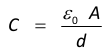
Capacitance of a parallel plate capacitor
C = capacitance
A = common area
d = distance between plates;
ε₀ = permittivity
Uses of capacitors
touchscreen
tune a radio
flash on a camera
defibrillator
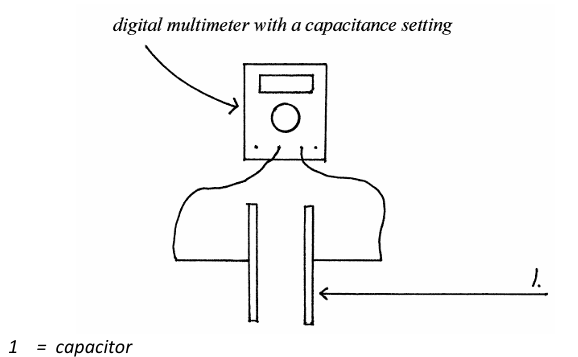
Demonstration experiment to show the factors that capacitance of a capacitor depends on Distance
Move the plates closer together, keeping ε and A constant.
The multimeter shows an increase in capacitance.
In conclusion, a smaller distance gives a larger capacitance, C ∝ 1/d.
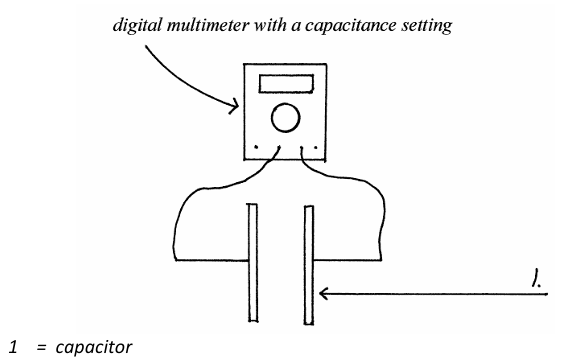
Demonstration experiment to show the factors that capacitance of a capacitor depends on Common area
Slide the plates apart, keeping ε and d constant.
The multimeter shows a decrease in capacitance.
In conclusion, a smaller common area gives a smaller capacitance, C ∝ A
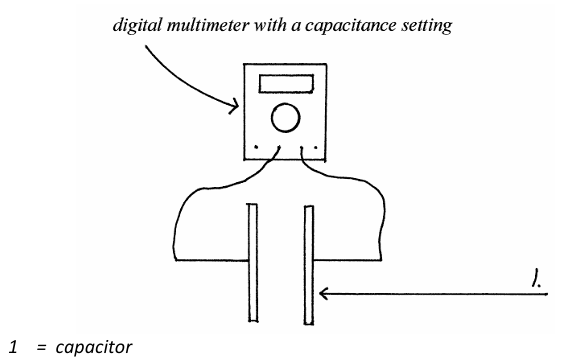
Demonstration experiment to show the factors that capacitance of a capacitor depends on Permittivity
Place a piece of wax between the plates, keeping A and d constant. The permittivity of wax is greater than the permittivity of air.
The multimeter shows an increase in capacitance.
In conclusion, a larger permittivity gives a greater capacitance, C ∝ ε
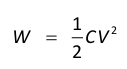
Energy stored in a charged parallel plate capacitor
W = energy
C = capacitance
V = voltage
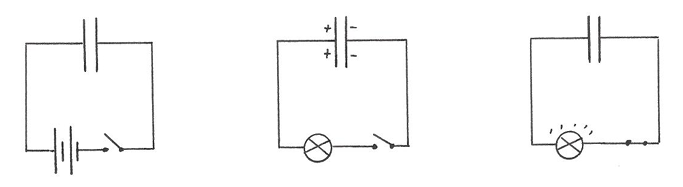
Demonstration experiment to show that a charged capacitor stores energy
When the switch is closed the capacitor is charged up from the battery
You now open the switch and replace the battery with a bulb.
You now close the switch and the bulb lights briefly.
The conclusion is that the charged capacitor stored energy.
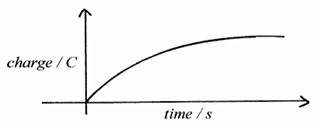
Charging a capacitor graph
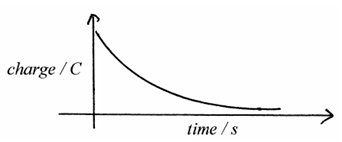
Discharging a capacitor graph