Lecture 5 - Financial Statement Analysis and Interpretation
 Call Kai
 Learn
Learn Practice Test
 Spaced Repetition
 Match
Match Flashcards
 Knowt Play
1/105

There's no tags or description
Looks like no tags are added yet.
Name | Mastery | Learn | Test | Matching | Spaced | Call with Kai |
|---|
No analytics yet
Send a link to your students to track their progress
106 Terms
What are liquidity ratios concerned with?
A business's ability to meet short-term liabilities as they fall due.
What is the formula for the current ratio?
Current assets divided by current liabilities.
What does the acid test ratio measure?
The availability of liquid resources to meet current liabilities, excluding inventory.
What is considered a 'good' current ratio?
A current ratio of 2:1, though it can vary by industry.
What does a quick ratio of less than 1:1 indicate?
The company does not have enough liquid short-term assets to cover short-term liabilities.
How is the return on equity (ROE) calculated?
Net income divided by shareholder's equity, multiplied by 100.
What does ROCE stand for?
Return on Capital Employed.
How is the operating profit margin calculated?
Operating profit divided by sales, multiplied by 100.
What does the gross profit percentage (GP%) indicate?
The percentage of revenue that exceeds the cost of goods sold.
What is the formula for calculating inventory days?
Inventory divided by cost of sales, multiplied by 365.
How are trade receivable days calculated?
Trade receivables divided by credit sales, multiplied by 365.
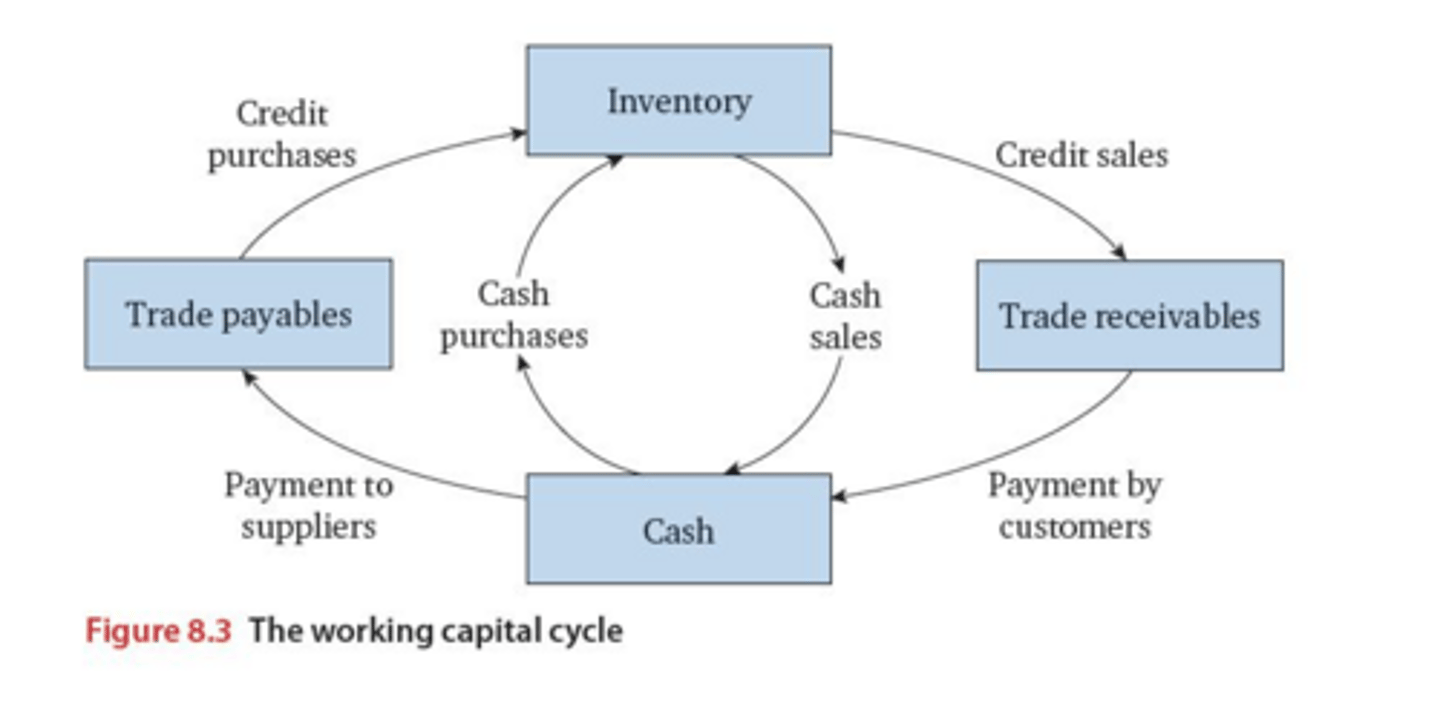
What does the working capital cycle represent?
The time taken to convert inventory and receivables into cash, minus the time taken to pay suppliers.
What is the formula for trade payables days?
Trade payables divided by credit purchases, multiplied by 365.
How do you calculate the working capital cycle?
Inventory days plus trade receivable days minus trade payable days.
What is the significance of the operating profit (PBIT)?
It represents the profit a company makes from its operations, excluding interest and taxes.
What does a decrease in ROE indicate?
A potential decline in the company's profitability relative to shareholder equity.
What does a high current ratio suggest?
It may indicate that a company has too much inventory or receivables, which could be inefficient.
What is the formula for calculating profit after tax?
Profit before tax minus taxation.
What does the term 'efficiency ratios' refer to?
Ratios that assess how well a company utilizes its assets and manages its liabilities.
What is the importance of calculating financial ratios?
They help analyze the financial performance and position of a business.
What does the term 'expenses' refer to in financial statements?
Costs incurred in the operation of a business.
What is the formula for calculating net assets?
Total assets minus total liabilities.
What does a negative working capital cycle indicate?
The company collects receivables faster than it pays its payables, which can be advantageous.
What is the significance of the share price in financial analysis?
It reflects the market's valuation of a company's equity.
What does the term 'dividends paid' refer to?
The portion of earnings distributed to shareholders.
What is the purpose of financial statement analysis?
To assess the financial health and performance of a business over time.
What is ratio analysis?
A technique to interpret accounting information, highlighting underlying trends not always obvious from the figures.
What are the major categories of profitability ratios?
Return on capital employed (ROCE) and return on equity (ROE).
How do profitability ratios help in financial analysis?
They measure how successfully the business is trading.
What does liquidity ratio indicate?
How effectively cash is managed in the business.
What is the purpose of efficiency ratios?
To assess how well short-term business assets and liabilities are managed.
What does financial gearing ratio reveal?
How efficient the financial (capital) structure of the business is.
What do investment ratios measure?
How much return investors can earn from shares.
What is benchmarking in ratio analysis?
Comparing ratios with past periods, similar businesses, industry averages, or analysts' predictions.
What is the formula for Return on Capital Employed (ROCE)?
ROCE = (Operating profit / (Equity + Non-current liabilities)) x 100.
How is Return on Equity (ROE) calculated?
ROE = (Profit after tax / Equity) x 100.
What does Operating Profit Margin (OP margin) measure?
OP margin = (Operating profit / Sales) x 100.
What is Asset Turnover (AT)?
AT = Sales / Capital employed.
How is Gross Profit Margin (GP margin) calculated?
GP margin = (Gross profit / Sales) x 100.
What does the Expenses to Sales ratio indicate?
Expenses to Sales = (Expenses / Sales) x 100.
What is the significance of a high Return on Equity (ROE)?
It indicates effective management and profitability relative to shareholders' equity.
What does a low Operating Profit Margin suggest?
It may indicate high expenses relative to sales, affecting profitability.
What is the typical ROE for restaurants according to the data?
15.6%.
What is the typical Net Operating Profit Margin (NOPM) for printing and publishing?
6.5%.
What does a high Asset Turnover ratio imply?
It indicates efficient use of assets to generate sales.
What financial performance aspect does the term 'financial gearing' refer to?
The proportion of debt in the capital structure of a business.
What is the purpose of calculating financial ratios?
To analyze financial performance and position of a business.
What does a trend analysis involve?
Comparing financial ratios over multiple periods to identify patterns.
What is the formula for calculating Gross Profit Percentage?
GP % = (Gross Profit / Sales) x 100.
What does the term 'expenses to sales' ratio reveal?
It shows the percentage of sales that is consumed by expenses.
What is the significance of the Pyramid of Ratios?
It breaks down ROCE into various components to analyze performance.
How do analysts use financial ratios?
To predict future performance and assess current financial health.
What is the importance of comparing ratios with industry averages?
It helps to evaluate a company's performance relative to its peers.
What are the key ratios used for analyzing long-term financial structure?
Investor's ratios
What should you be able to interpret regarding financial ratios?
Their significance
What is a limitation of ratio analysis?
It may not provide a complete picture of financial health.
What was Burberry's current ratio in March 2020?
2.3:1
What was Burberry's acid test ratio in March 2019?
1.8:1
How do you calculate Inventory Days?
Inventory / Cost of Goods Sold x 365
What was Burberry's Inventory Days in March 2020?
177 days
What is the formula for calculating the Gearing Ratio?
Long-term liabilities / (Equity + long-term liabilities) × 100
What is considered low gearing?
Less than 10%
What is the impact of high gearing on financial risk?
It increases the volatility of returns to equity holders.
What happens to equity share prices in highly geared companies?
They tend to be lower.
What does Interest Cover indicate?
How many times operating profit covers interest expenses.
What is a sign of greater risk regarding interest payments?
Low interest cover.
What was the available profit to shareholders for Company A in Year 1?
£2,800
How much did Company B's available profit to shareholders decrease by in Year 3?
90%
What is the WC Cycle formula?
Inventory Days + Trade Receivables Days - Trade Payables Days
What is the significance of gearing in financial analysis?
It indicates the extent of debt finance compared to equity.
What does an increase in gearing imply for a company's borrowing ability?
Additional borrowing becomes more difficult.
What is the Gearing Ratio for Company A?
17%
What is the Gearing Ratio for Company B?
83%
What does a decrease in profit before interest indicate for both companies?
A decrease of 60% between years 1 and 3.
What financial strategy might companies use to manage high gearing?
Off-balance sheet finance, such as sale and leaseback.
What are liquidity ratios used for?
To assess a company's ability to meet short-term obligations.
What is the significance of the Acid Test ratio?
It measures a company's ability to pay off current liabilities without relying on inventory sales.
What does a high acid test ratio indicate?
Strong liquidity position.
What does the term 'financial gearing' refer to?
The extent of debt financing in a business compared to equity.
What is the formula for Earnings per Share (EPS)?
EPS = Earnings (Profit After Tax) / Number of ordinary shares in issue.
What does a high Price to Earnings (P/E) ratio indicate?
It implies expectation of growth in future returns and lower risk compared to similar companies.
How is the Dividend Yield calculated?
Dividend Yield = Dividend per Share / Market Price per Share.
What does the Gearing ratio measure?
It measures the proportion of a company's borrowed funds to its equity.
How is the Interest Cover ratio calculated?
Interest Cover = Operating Profit (PBIT) / Interest Expense.
What are the components of the Statement of Financial Position?
It includes Non-current assets, Current assets, Current liabilities, Non-current liabilities, and Equity.
What does a Dividend Cover ratio of 2.9 times indicate?
It indicates that the profit is 2.9 times the total dividends paid.
What is the significance of the Gross Profit in financial statements?
Gross Profit indicates the efficiency of production and pricing strategies.
How do you calculate the Gearing ratio?
Gearing = (Non-current liabilities / (Equity + Non-current liabilities)) x 100.
What does the term 'Net Assets' refer to?
Net Assets = Total Assets - Total Liabilities.
What is the formula for calculating Dividend per Share?
Dividend per Share = Total Dividends / Number of Equity Shares.
What does a low P/E ratio suggest about a company?
It suggests that the market has lower expectations for future growth compared to peers.
What is the purpose of Ratio Analysis?
To interpret accounting information and assess profitability, liquidity, efficiency, and capital structure.
What is the formula for calculating the Dividend Yield?
Dividend Yield = (Dividend per Share / Market Price per Share) x 100.
What does the term 'Operating Profit (PBIT)' represent?
Operating Profit (PBIT) represents the profit generated from normal business operations before interest and tax.
What is the impact of high Gearing on a company?
High Gearing indicates higher risk at low levels of profitability but can lead to high returns at higher profitability.
What does the term 'Dividends Paid' refer to?
Dividends Paid refers to the distribution of a portion of a company's earnings to its shareholders.
What is the formula for calculating Profit after Tax?
Profit after Tax = Profit before Tax - Taxation.
What does a company's share price indicate?
It reflects the market's valuation of the company's future earnings potential.
What are the limitations of Ratio Analysis?
Limitations include reliance on historical figures, lack of qualitative insights, and potential distortions from accounting policies.
What does the term 'Current Assets' include?
Current Assets include inventory, receivables, and cash.