Michaelmas diversity of life
 Call Kai
 Learn
Learn Practice Test
 Spaced Repetition
 Match
Match Flashcards
 Knowt Play
1/43

There's no tags or description
Looks like no tags are added yet.
Name | Mastery | Learn | Test | Matching | Spaced | Call with Kai |
|---|
No analytics yet
Send a link to your students to track their progress
44 Terms
what is the molecular soup idea of the origin of life?
organic molecules were formed in early oceans due to the release of heat by the reaction of atmospheric gases (catalysed by UV light and lightning)
these condensed into polymers
by chance, a self-replicating polymer formed, which took over the molecular soup due to exponential growth
random changes that improved the speed of replication would be more successful and selected for by evolution
most believe this polymer would have been RNA, because it can fold into ribozymes which can catalyse RNA replication (whereas DNA needs auxiliary protein catalysts)
what are the problems with the molecular soup idea and what is an alternative?
the oceans would have been very dilute, to the point that it would be rare for two nucleotides to meet to polymerise, let alone enough nucleotides to form a catalytic chain (50-60 nucleotides) of RNA
hence, the process would be very slow
also, RNA is actually unstable in water (unlike DNA)- hydrolysis is more likely than condensation because it is exothermic
some believe clay mineral layers could be the formation site of RNA, instead of the ocean:
molecules are able to bind to clay silicates, which concentrates them closer in order to polymerise
repeat cycles of hydration and dehydration would reduce the likelihood of hydrolysis so that RNA formation is favourable
what are the problems with the RNA world theory?
relying on wet-dry cycles would make the process incredibly slow
many unwanted organic molecules would also be present in the molecular soup/minerals that would pollute the process- so why would RNA be made of just three components
we don’t know how the formation of RNA would lead to the formation of cell membranes + metabolism to produce real life
what is an alternative to the RNA world theory?
membranes could have come first because they are self-assembling structures
amphiphiles (molecules that are both hydrophilic and hydrophobic) can form bilayers that can result in stable vesicles/micelles
phospholipds are too complex to have formed independently but simpler amphiphiles like fatty acids could have
however, the membrane of this proto-cell provides no functional advantage for RNA synthesis and replication
what is the spontaneous metabolism theory?
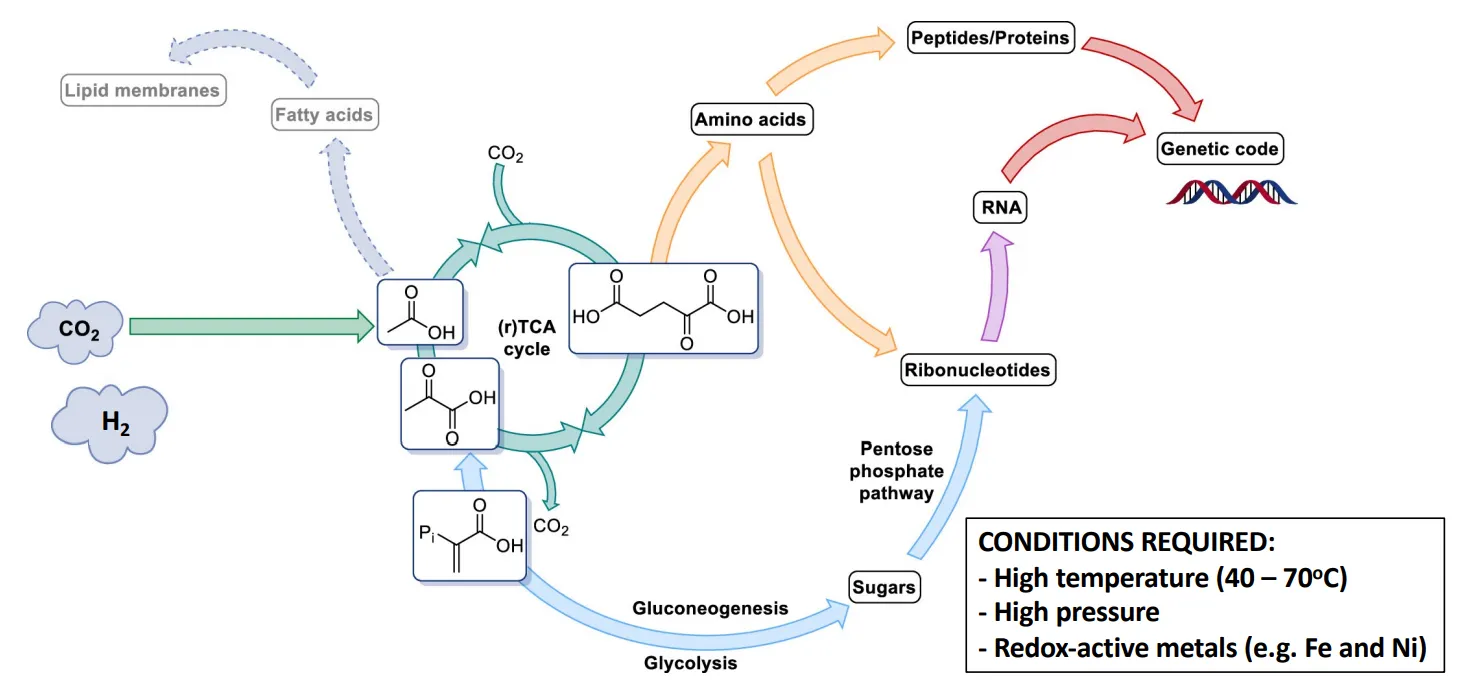
life could have begun with a simplified metabolism that has been seen to occur spontaneously, without protein catalysts
this process produces fatty acids (for membranes), pyruvate (for metabolism), RNA and proteins from CO2 and H2O
however it requires very high temperatures and pressures and redox-active metals (like Fe and Ni) to act as catalysts, so the clay mineral theory can’t apply
alkaline smokers are the main candidate as a place for this to occur:
minerals rich in iron and nickel are formed by serpentinization and assemble into networks of interconnected micropores
the reaction also generates heat, hydrogen gas, and hydroxide ions (alkaline)
there is high pressure due to being at the bottom of the ocean, so all the conditions for spontaneous metabolism are satisfied
the metabolism would be catalysed by the minerals and driven by a proton gradient between the acidic seawater (due to dissolved CO2) and the alkaline hydrothermal fluid
however, the self-assembly of membranes would immediately isolate the metabolites from the mineral catalysts
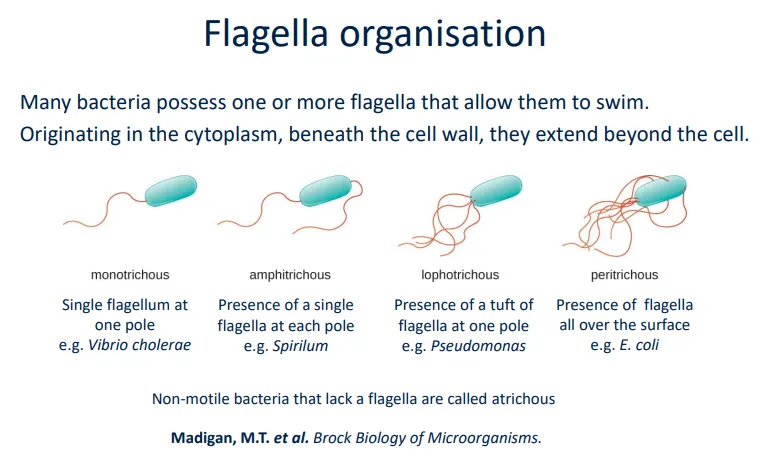
what are the different kinds of flagella organisation?
what are linkage equilibrium and disequilibrium?
linkage equilibrium is found in sexual organisms- this is where different genes are randomly assorted in a population
linkage disequilibrium is found in asexual organisms- this is where genes are associated non-randomly in a population eg. two genes are more likely to be found together because one parent organism has both, so its whole lineage will also have both- particular patterns will accumulate in different lineages
in bacteria these exist on a continuum depending on the degree of horizontal gene transfer and recombination
what is Muller’s ratchet?
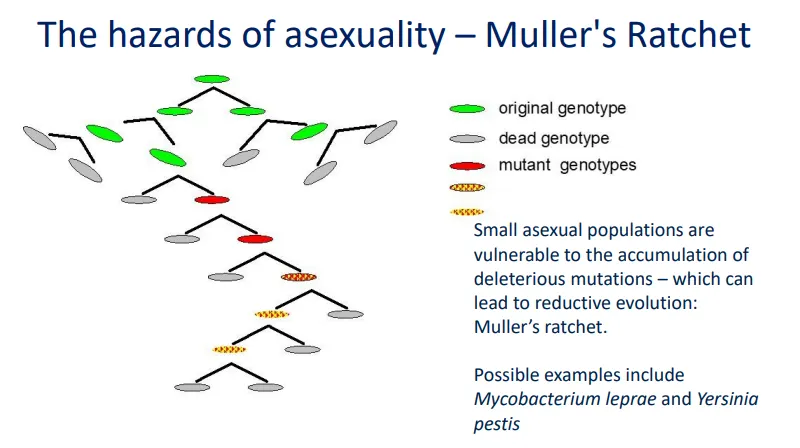
Muller’s ratchet is a case of reductive evolution- small asexual populations (without recombination) are vulnerable to the accumulation of deleterious mutations
ultimately these species will go extinct, because they evolve themselves into a corner and can’t be ‘rescued’ by recombination
in asexual populations, genomes are inherited as indivisible blocks, so that an organism inherits the same mutations as its parent, more mutations occur, and it passes the entire increased mutational load onto its own offspring
one generation will never have fewer mutations than the generation before, so they accumulate
this is greater in small populations because they are more affected by genetic drift, so less mutated lineages may die out due to stochastic changes
as the prokaryotic genome size increases, how do the proportions of different kinds of genes change?
as the genome size increases:
the proportion of genes for DNA translation, replication and repair decrease- new proteins (eg. kinds of polymerase) aren’t needed as the genome increases, the process doesn’t change
the proportion of genes for metabolism and transport increases- the metabolic diversity increases so the organism can deal with a wider range of environments + becomes more resilient
the proportion of regulatory genes increases- more structural genes mean more regulatory genes are needed to control transcription
why are bacterial coding sequences non-randomly arranged in the chromosome?
coding sequences, particularly of more essential genes, are more likely to be encoded on the leading strand of the chromosome- there is a bias of coding locations in the chromosome
this is because when simultaneously replicating and transcribing DNA, head-on collisions between the machinery are much less likely in the leading strand than the lagging strand- this forms truncated products, so it is selected against
ie. DNA polymerase from replicating the lagging strand (forming the Okazaki fragments) can collide head-on with RNA polymerase from transcribing the newly formed DNA
what are pangenomes?
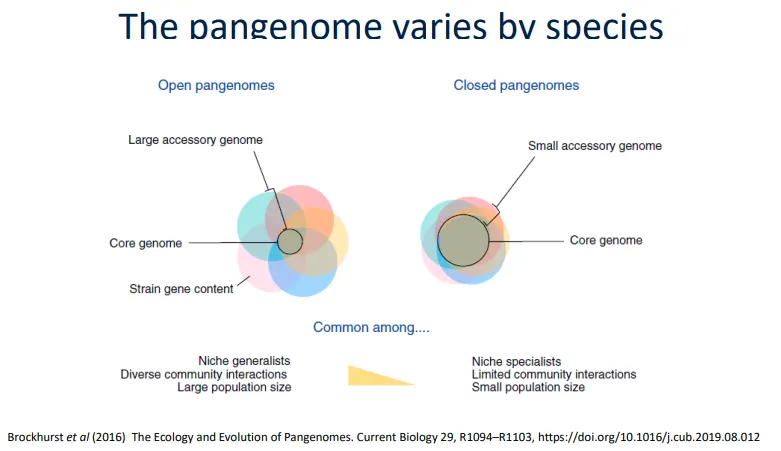
the pangenome is the entire array of genes available to a bacterium- essentially, the gene pool of a species/group
bacteria have a core genome and an accessory genome, comprising the genes in the population which each individual/strain may or may not have
most bacteria have an open genome (along a continuum) because horizontal gene transfer is widespread (compared to human closed genomes, where most of our genes are the same, and the differences are pretty superficial)
how can bacteria be characterised?
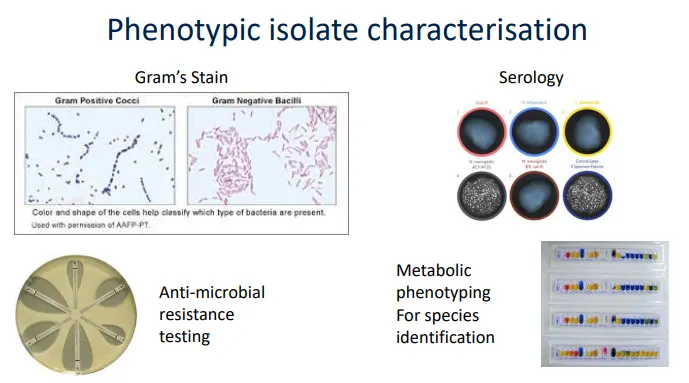
staining + microscopy to observe morphology
responses to anti-microbial compounds, pHs and temperatures
serology- applying antibodies and determining responses
metabolic phenotyping- using strips with different metabolites to produce a metabolic fingerprint
MALDI-TOF- mass spectrometry of all proteins found to obtain a protein fingerprint
DNA sequencing- comparing single genes, multiple loci or whole genomes using gel electrophoresis/Sanger sequencing
what is a single locus that is often sequenced for bacterial classification?
the 16S rRNA gene- codes for a highly conserved ribosomal RNA strand
contains universal regions that can be easily used to generate primers for PCR and Sanger sequencing
however, this high conservation means it has a limited resolution- to species level at best
it is a single gene so it is rapid, but for a higher resolution multi-locus sequencing is needed (normally conserved housekeeping genes are used)
sometimes there can be multiple gene copies in a cell, so there may be variation within an isolate
what do we predict luca was like?
anaerobic- all oxygen was reduced into water in the early world
CO2 fixing
H2 dependent
N2 fixing
thermophilic
dependent on transition metals
these traits are all consistent with a hydrothermal setting
why is the surface origin of life hypothesis not valid?
UV light, low pressures and the possibility of drying up makes them unstable and unfavourable environments for the origin of life
subsurface hydrothermal vents are actually ideal, they produce large temperature gradients, mineral gradients etc
what are the mitochondria early and mitochondria late hypotheses?
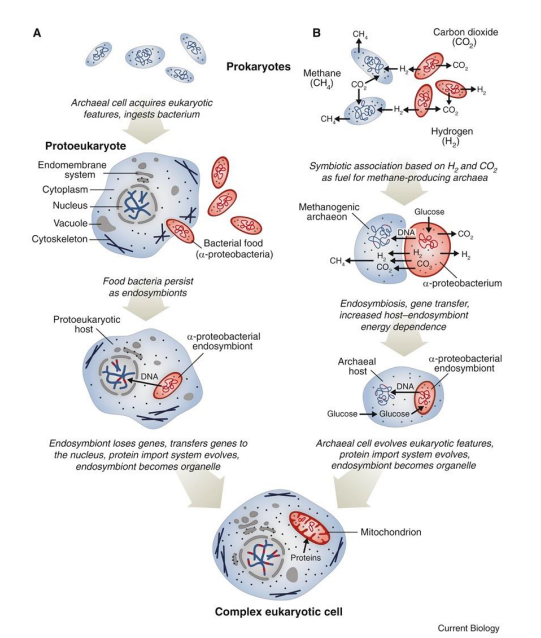
these are two hypotheses describing the endosymbiotic event introducing an aerobic bacterium into another host, resulting in a eukaryotic cell containing a mitochondrion
the mitochondrion late hypothesis (A) assumes that the host, a protoeukaryote, was already quite developed (endosymbiotic event occurred late in its development), as it had evolved the process of phagocytosis of the bacteria
however, in this theory, the host would have had to exist and evolve for a long period, solely living off of fermentation as its metabolism, which is very weak
the mitochondrion early hypothesis (B) assumes that the host, an archaeal cell, was not very developed (no nucleus yet), and instead it lived in a metabolic symbiosis with a bacterium
this bacterium would have produced CO2 and H2 in its metabolism, and this hydrogen provided vital fuel for the metabolism (methane-producing) of the archaea, in a highly dependent relationship, until eventually they merged
what are lichens and what are the roles of the symbionts?
lichens are mutualistic associations of a fungus with a cyanobacteria or algae
the mycobiont (fungus) is a macrobe, so it can form a large structure which protects the photobiont and absorbs minerals
the photobiont (bacteria or algae) photosynthesises, fixes nitrogen and synthesises organic nutrients
what are the roles of legumes and Rhizobium in their symbiosis?
the bacterium fixes nitrogen from the atmosphere into bioavailable nutrients
the plant provides the bacterium with carbohydrates, protects it within root nodule structures, and creates a specific microenvironment
it produces the leghaemoglobin protein, which buffers the free oxygen concentration- this keeps it high enough to allow for aerobic respiration, but low enough to allow the oxygen-sensitive nitrogenase enzyme to work
what are the three types of insect endosymbionts?
obligate mutualists:
these are domesticated within the host and can’t survive outside it (next best thing to an organelle/organ)
they are restricted in bacteriomes produced by the host
dependent on host-based mechanisms for transmission
facultative symbionts:
resemble pathogens as they invade cells in uninfected hosts (and can establish maternal inheritance) and are erratically distributed
not required for host reproduction but may confer benefits
reproductive manipulators:
parasites that spread by maternal inheritance, and manipulate proportions of female offspring to spread through a population
eg. infected males sterilise uninfected females, so that offspring from infected females individuals are more successful
what are two examples of a intracellular insect endosymbionts?
Buchnera are an obligate intracellular endosymbiont of aphids (mutualist)
these are vertically transmitted through the ovary cells
they live in specialised bacteriocyte cells (obligate- they are unculturable)
the host aphid supplies energy, carbon and nitrogen
the symbiont produces amino acids, especially tryptophan
Wolbachia is a large and highly prevalent group of intracellular endosymbionts
in some cases (eg. nematodes) they are mutualists
often they are reproductive manipulators, altering host sex ratios
how do Wolbachia alter host sex ratios?
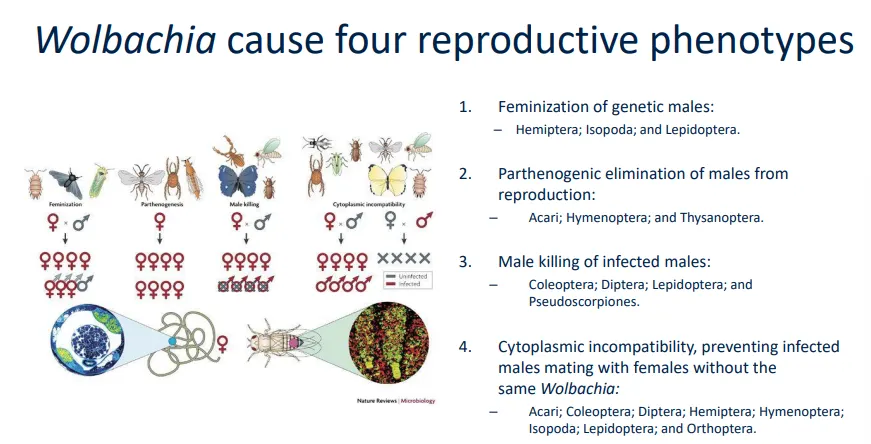
feminisation of genetic males from infected mothers
causing parthenogenesis (where only female offspring can be produced)
killing of infected males
cytoplasmic incompatibility so that infected males can’t mate with uninfected females
these methods all increase the proportion of infected females in the population, because vertical transmission can only occur through infected females
what are holobionts?
the macrobe and its microbiome combined comprise the holobiont (metaorganism)
how do the measles and varicella zoster viruses behave differently?
measles is an acute infection:
hosts infected with the measles virus develop life-long immunity to it, so it can only survive in large populations
otherwise it runs out of susceptible hosts and dies out as it has no other reservoir
chickenpox/shingles is a chronic infection:
hosts infected with the varicella zoster virus (VZV) develop chickenpox
the pathogen then remains in a quiescent state in the host
it can be reactivated to cause shingles
how can microbes cause cancers?
certain viruses and bacteria can cause cancers directly or indirectly eg. by the alteration of host cells or the production of toxic substances
eg. human papillomaviruses (HPV), which cause cervical cancer
eg. devil facial tumour disease (DFTD) and canine transmissible venereal tumour (CTVT)
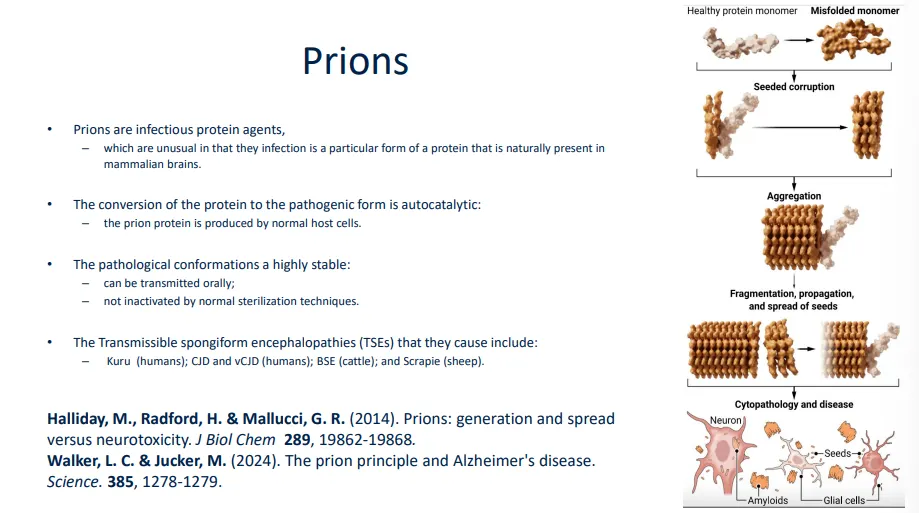
what are prions?
what is the osmotrophic mode of nutrition?
most fungi (excluding microsporidia and cyptomycota, no osmotrophism or hyphae, hence debatable) secrete enzymes into their environment to depolymerise + digest nutrients extracellularly
eg. cellulose, proteins and lignin (partially)
this relies on a high surface area to volume ratio- restricts hyphal diameter
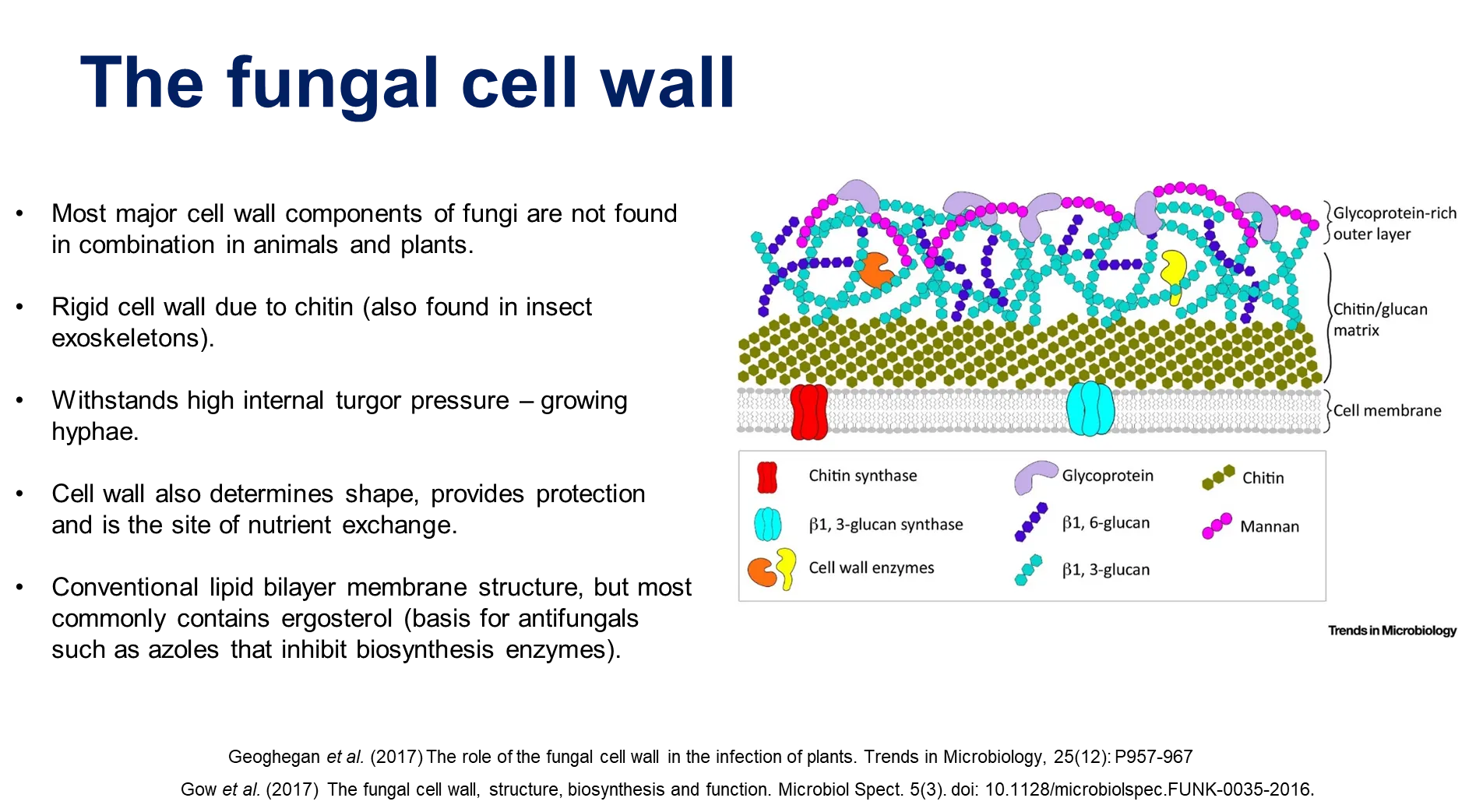
what is the structure of the fungal cell wall?
thick, rigid chitin inner layer
glucan layer
glycoprotein-rich outer layer
the lipid bilayer normally contains ergosterol
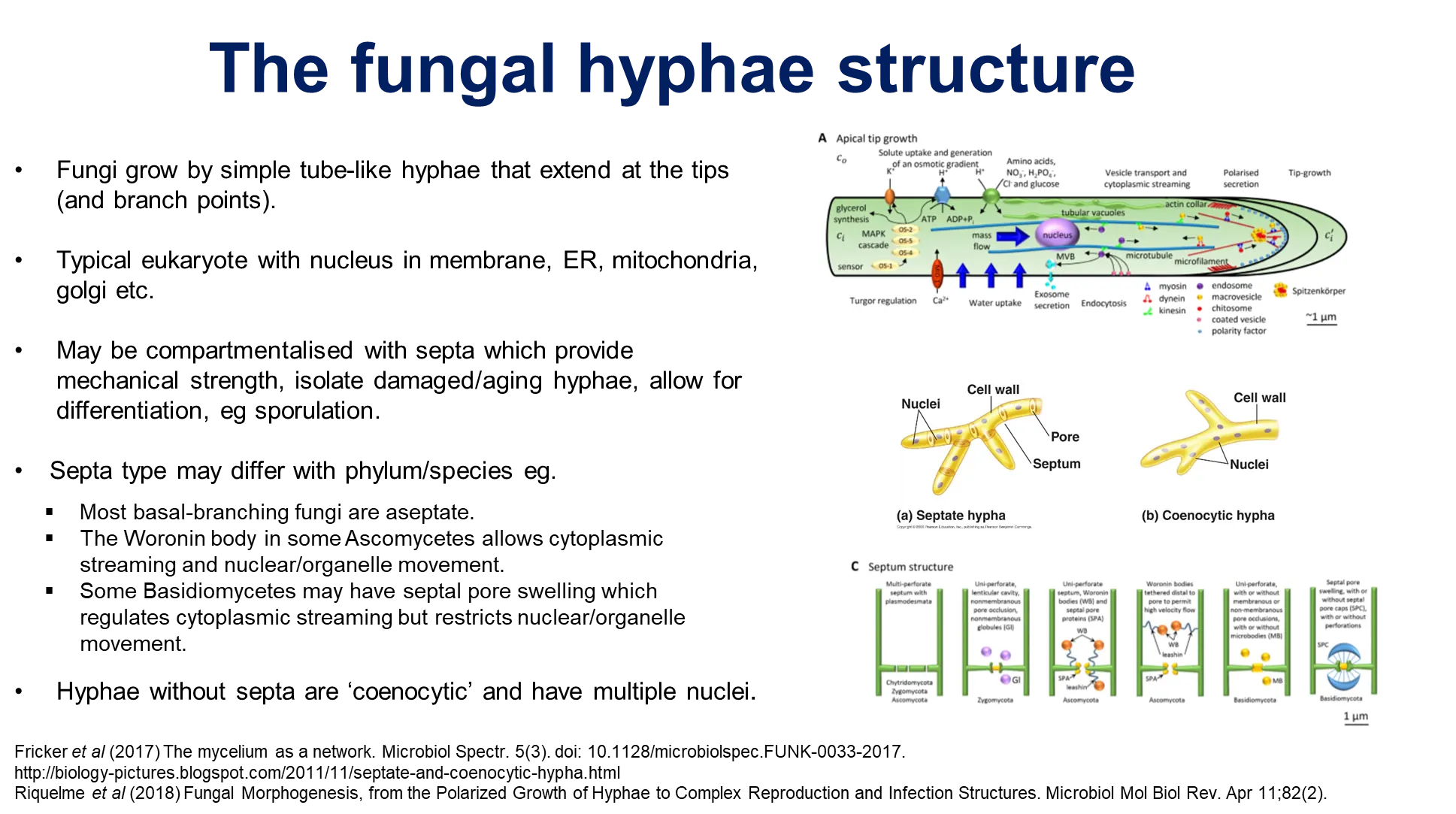
what is the structure of fungal hyphae?
tube-like eukaryotic cell structures that extend at the tips and branch
can be compartmentalised with septa that allow for isolation, differentiation and mechanical strength
non-septated hyphae are coenocytic and have multiple nuclei in one cell
when branching, two adjacent hyphae can avoid eachother by negative autotropism or can rejoin together during anastomosis by positive autotropism
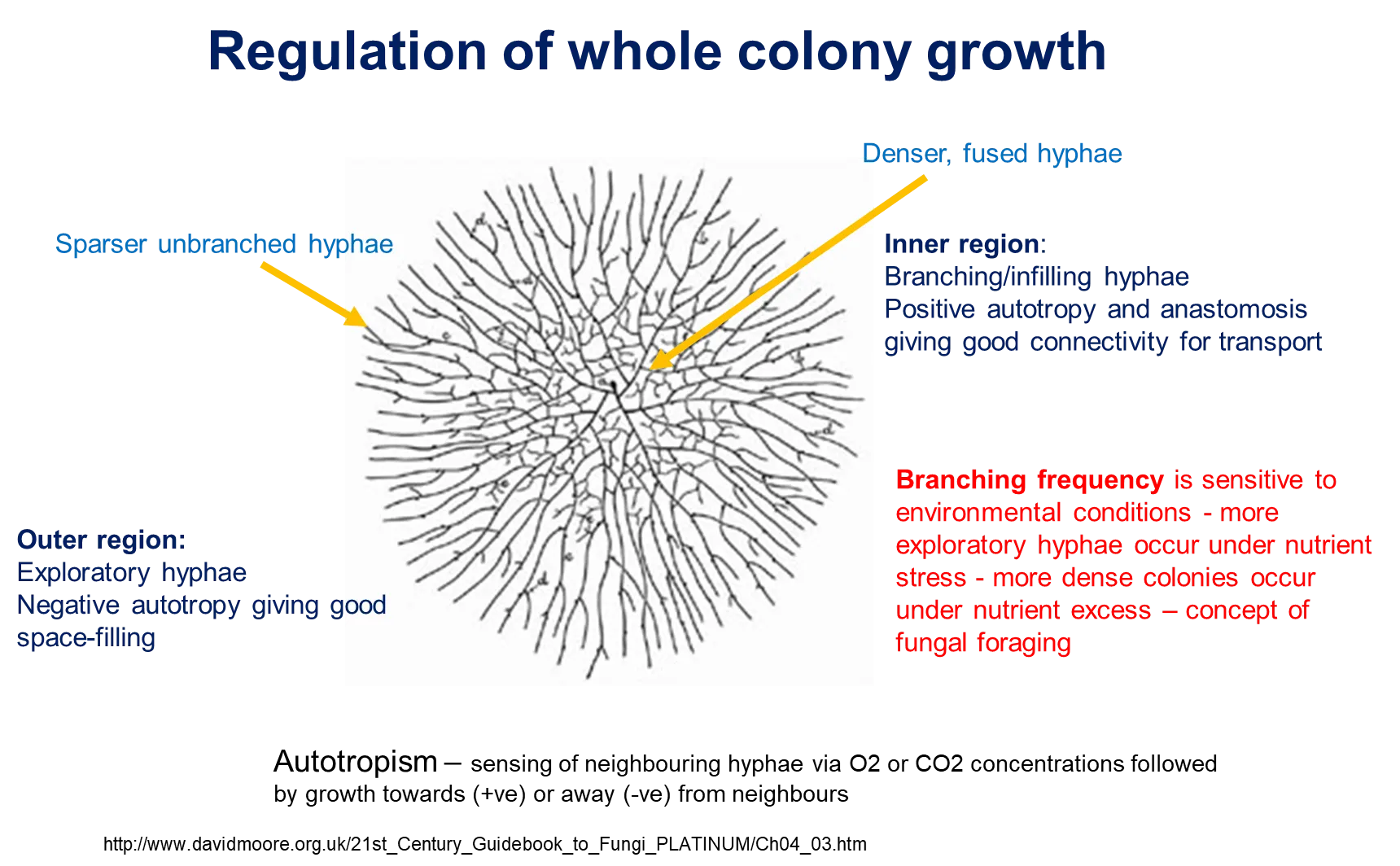
how is hyphal colony growth regulated?
at the centre, the hyphae are more densely packed and fused together by anastomosis + positive autotrophy for transport and exchange
moving further out, the hyphae become exploratory, unbranched and sparser, governed by negative autotrophy for space-filling
these are called radial colonies
as such, branching frequency is controlled by environmental conditions
under stress more exploratory hyphae are produced
under excess colonies become more dense
other growth forms exist- unicellular division by budding and binary fission in yeasts, though some species are dimorphic and change their growth form depending on the environment
what are the forms of asexual and sexual reproduction in fungi?
asexual:
asexual production of spores
anastomosis of genetically identical hyphae
unicellular division in budding yeasts
sexual:
spore production by fusion of gametes/2 haploid cells
anastomosis, plasmogamy (cytoplasm fusion) and karyogamy (nuclear fusion) of genetically distinct but compatible hyphae
how do fungi survive in a haploid state?
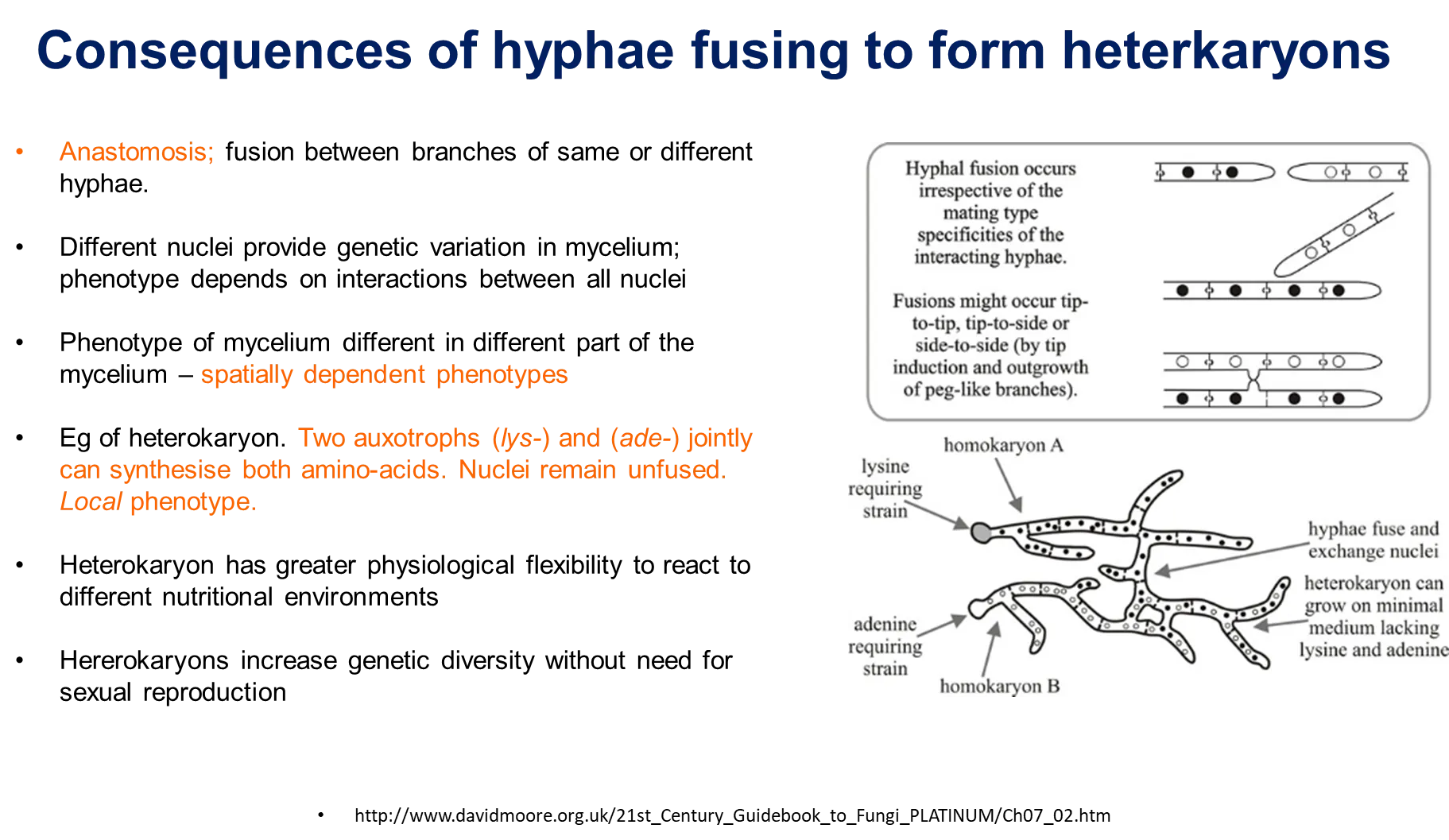
mutations are visible since genes are single copy
but many hyphae are coenocytic, containing multiple nuclei- mutations can exist in the different nuclei, so multiple genotypes can exist at once and locally complement each other
these heterokaryons are produced by anastomosis
the different nuclei increase genetic variation, so the phenotype depends on the interactions between the nuclei and can be spatially different/localised
however, hyphae may not be vegetatively compatible for anastomosis, dependent on the het (heterokaryon) loci and may die instead
what are viruses?
obligate intracellular parasites
viruses are infectious microbes consisting of a segment of nucleic acid surrounded by a protein coat
they can’t replicate alone, they must infect cells and use the host cell machinery to replicate
metabolically inert, so they rely on host cells for energy, metabolites and protein synthesis
what are the structures of viruses?
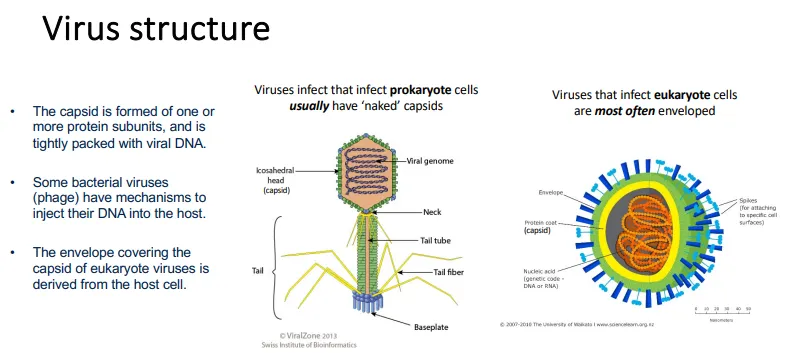
tightly packed viral DNA/RNA is surrounded by a protein capsid
viruses that infect eukaryotic cells normally have an envelope around the capsid (derived from the host cell) and spikes to attach to specific cell surfaces
whereas viruses that infect prokaryotes normally have a ‘naked’ capsid
some viruses, bacteriophages, have mechanisms to inject their viral genome into the host
on what basis are viruses classified under baltimore classification? what are other methods of classification?
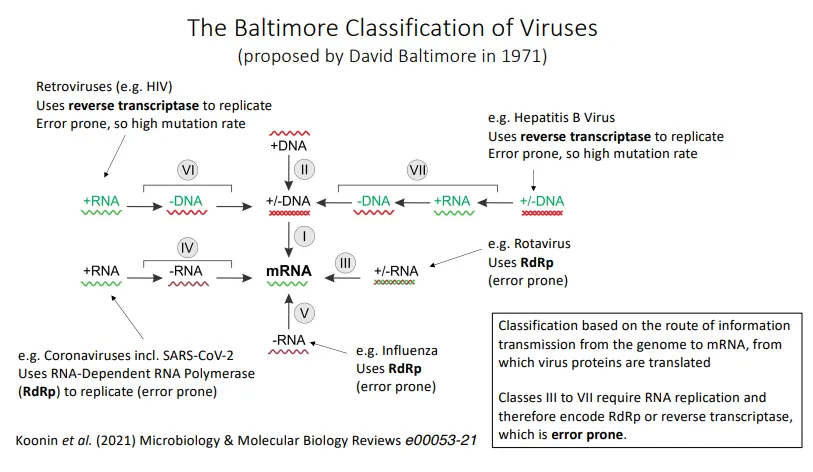
based on the route of information transmission from the genome to the mRNA
dependent on whether they use double/single (sense/antisense) stranded DNA/RNA
different pathways and proteins are used by each class
viruses in a class aren’t necessarily closely related, but behave in the same way and have similar mutation rates:
viruses which use reverse transcriptase or RNA-dependent RNA polymerase (RdRp) are very error-prone and have higher mutation rates
double stranded DNA viruses have lower mutation rates
alternatively, taxonomy and phylogeny can be used by tracking mutations in superviral hallmark genes (VHGs), which encode for core viral replication proteins
what are the three hypotheses for where new zoonotic viral variants come from?
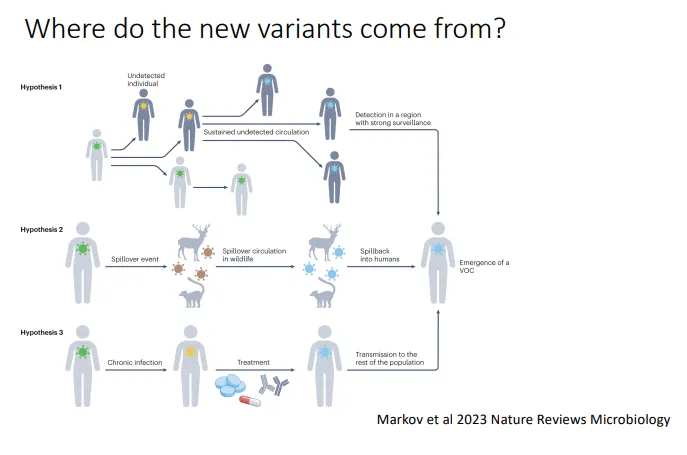
the virus circulates and mutates in an unsampled population, then spills over into a surveilled population
the virus spills over into other species, mutates then spills back into humans
long chronic infections of immunocompromised individuals allow for the rapid evolution of the virus- this is the favoured hypothesis
this is how we believe new variants of concern (now called major variants) of covid-19 evolved
this hypothesis is most popular because it is the only one which favours mutations in the spike genes that allow new variants to cause waves of infections by binding to host cells and evading host antibodies better
what is reassortment and how does it occur in viral DNA?
the genome of the virus is segmented (eg. influenza genome is in 8 segments)
the host cell is coinfected by two different strains of virus
this produces viruses with a mixture of segments from each virus
reassortment is a kind of recombination (recombination refers to the exchange of fragments of genes)
recombination creates mosaic genes, while reassortment creates novel combinations of existing genes (chimeric genomes)
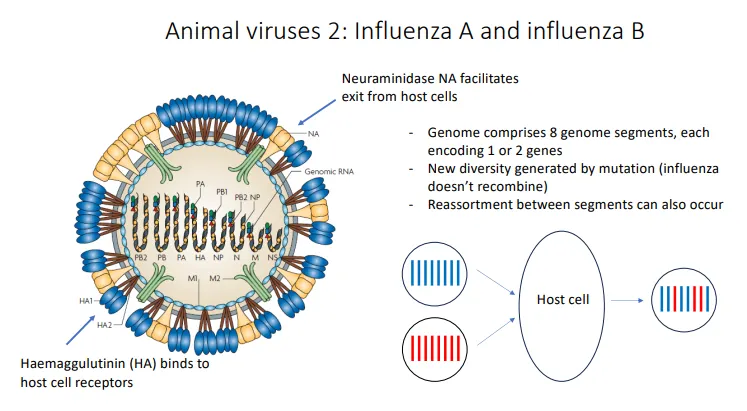
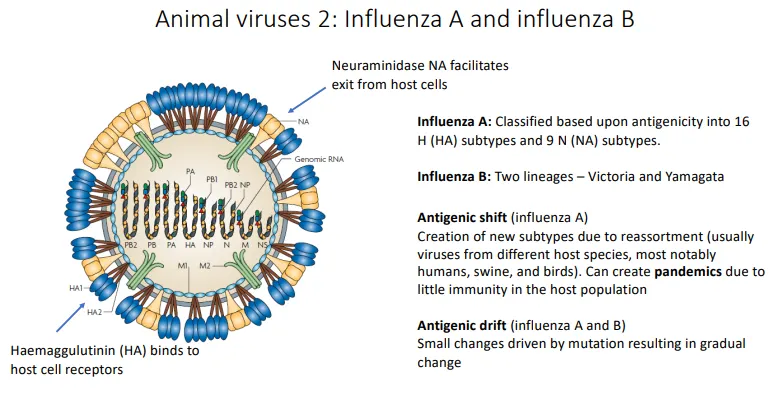
what are antigenic drift and shift and which forms of influenza use each?
antigentic shift is only seen in influenza A (because B only infects humans), and is much less common
new subtypes are created due to reassortment (coinfection of a host cell by two different strains, usually strains that have different target host species)
this usually causes pandemics due to little immunity in the host population
antigenic drift is seen in influenza A and B, and is why we need new vaccines each year
small changes driven by mutations result in gradual change
what kind of virus is faba bean necrotic stunt virus?
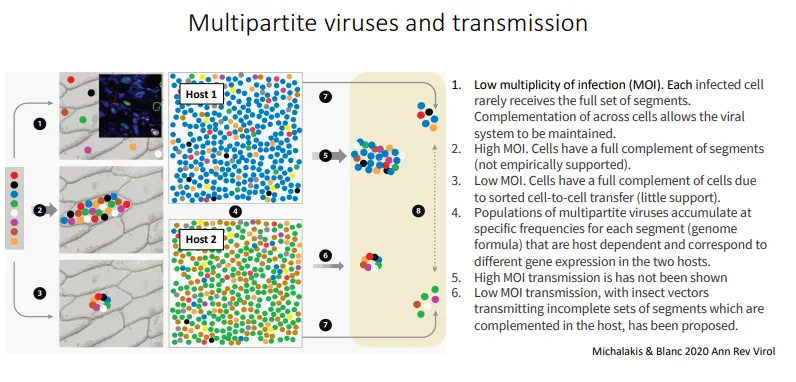
fbnsv is multipartite- each gene segment is packaged into a different virion
all the separate virions need to infect one plant, so that all segments are present, for a productive infection
we think that each infected cell rarely receives the full set of segments (low multiplicity of infection), but complementation across the cells allows the virus to be produced
this virus is transmitted by aphids
what is the life cycle of the lambda phage?
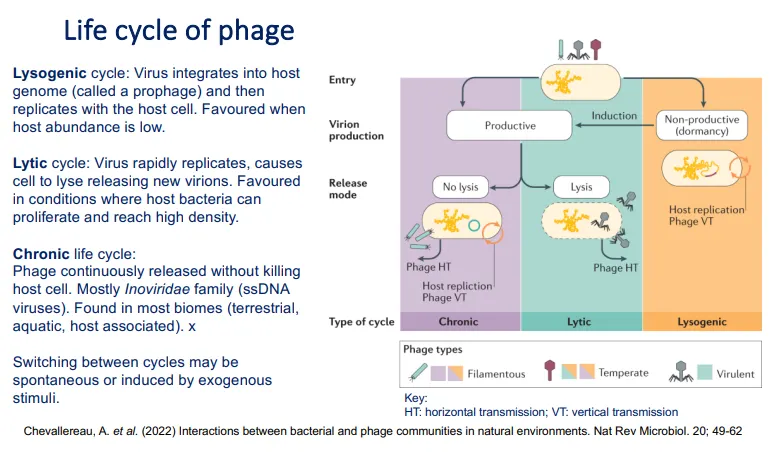
in the lysogenic cycle:
the virus attaches to its target cell, E.coli and viral contents are released into the cytoplasm
the viral DNA integrates into the host genome where it stays dormant and is replicated as the host genome is replicated
this is favoured when host abundance is low, as killing host cells is unfavourable
in the lytic cycle:
the viral DNA is excised from the host genome
proteins eg. polymerases are synthesised from the viral DNA, which are used to replicate the genetic material
new virus particles are assembled and are released when the cell lyses
the switch from the dormant lysogenic cycle to the productive lytic cycle can be spontaneous or caused by a stimulus
in the chronic life cycle:
the virions are continually released by exocytosis, so that the cell is not killed and continues to make new viruses
what are viral shunts and shuttles?
viruses that infect plankton are involved in marine carbon and nutrient cycling
viral shunt is when infected phytoplankton cells are lysed, releasing the cellular contents as dissolved organic matter in the nutrient cycling loop
viral shuttle is when the lysis of infected cells releases large polymers that aggregate and sink to the deep ocean, cycling carbon
what are virophages and satellite viruses?
virophages require co-infection with a giant virus and replicate inside this giant virus’s ‘factory’ (and the giant virus replication is reduced) eg. sputnik
satellite viruses require co-infection with a helper virus that provides a certain protein (and the helper virus infection becomes more severe) eg. Hep D
what are the different hypotheses for why multicellularity evolved multiple times?
hypothesis 1: it’s sometimes better to be a big organism
swimming further?- unlikely, cells mostly moved by currents
harder to be eaten?- unlikely, there weren’t many bigger cells to at as predators
catching more food?- yes, could set up a local water current to funnel cells for food eg. choanoflagellate protist changes from single-cell to colonies when given specific bacteria as food
hypothesis 2: it’s sometimes better to split up cell functions
the germ cells are the most important and this genetic material must be protected from damage eg. UV radiation
germ cells also seem to be modified to have a lower rate of mutations per mitotic cycle than somatic cells
hypothesis 3: it’s less efficient for flagellated cells to be the ones dividing- ‘flagellar constraint’
when an animal cell divides, it has to depolymerise its flagellum because the flagellar basal body microtubules are the same structure as the centrosome needed for mitosis- both can’t be present at the same time
the cell would have to retract the flagellum, divide, and re-grow the flagellum
in this process motility is lost, so the cell might sink/not get any food
unlikely, some single-celled organisms can overcome this by doing mitosis without the same centrosome, so not proven
hypothesis 4: it allows for self-cannibalism in famine situations
when food becomes scarce, a single-celled variant would just die
however, a multicellular variant could self-cannibalise certain cells by transferring nutrients to ensure at least a few survive, which can regrow when food returns
this is the case for some animals eg. flatworms and hibernating mammals (fat cells are used in scarcity conditions)
since multicellularity evolved multiple times, different hypotheses could be true for different species
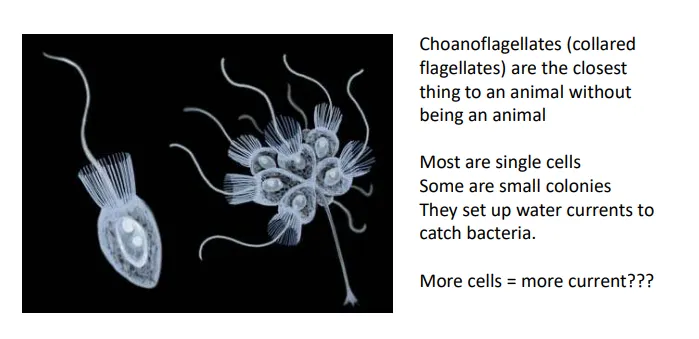
what are choanoflagellates?
choanoflagellates are the closest living single-celled relatives to animals
they are marine/freshwater protists that feed on bacteria
they have a long flagellum surrounded by a collar of actin-supported tentacles, which is a similar structure to sponge choanocytes (feeding cells) inside chambers
under certain conditions (eg. specific bacteria supplied), choanocytes can switch from a single-celled to a colony lifestyle, but are not multicellular
what makes animals true multicellular organisms?
they have many cells, and many different types of cells
they have specialised haploid sperm and egg cells of very different sizes
this allows for different investment of resources
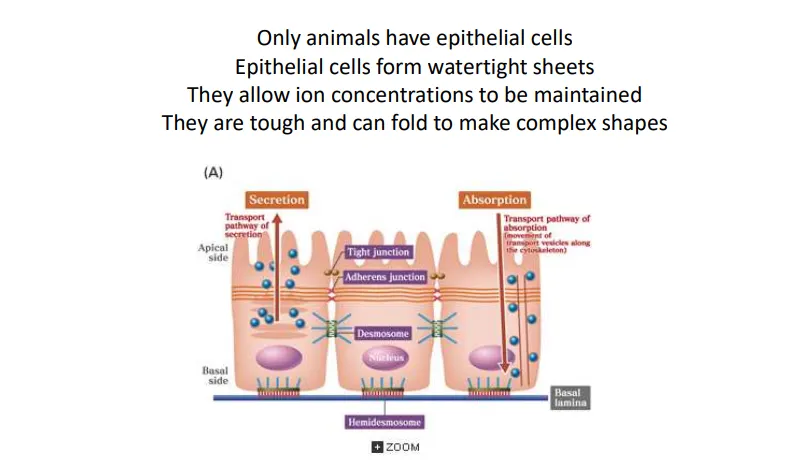
epithelial cells are very unique and only found in animals:
they can form watertight sheets with tight junctions that solutes can’t pass, so solutes have to pass through the cells
this means ion concentrations can be tightly controlled and biochemical reactions can be compartmentalised
this transition to produce multicellular organisms potentially required a thousand new genes