Elbow Joint Special Tests

0.0(0)
Studied by 0 people
call kaiCall Kai
learnLearn
examPractice Test
spaced repetitionSpaced Repetition
heart puzzleMatch
flashcardsFlashcards
GameKnowt Play
Card Sorting

1/7

encourage image

There's no tags or description

Looks like no tags are added yet.

Last updated 10:30 PM on 5/26/26
Name
Mastery
Learn
Test
Matching
Spaced
Call with Kai

No analytics yet

Send a link to your students to track their progress

8 Terms

1
New cards

Ligament Instability Test

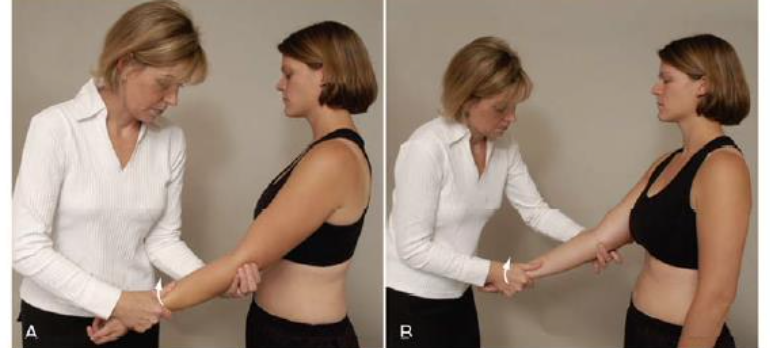
  • PURPOSE- To identify ligament laxity or restriction

  • DESCRIPTION- Patient sitting or supine, elbow placed in 20 to 0 degree of flexion. Valgus force placed through elbow tests ulnar collateral ligament. Varus force tests radial collateral ligament.

  • RESULT-Primary finding is laxity but pain may be present.
<ul><li><p><span>PURPOSE- To identify ligament laxity or restriction</span></p></li><li><p><span>DESCRIPTION- Patient sitting or supine, elbow placed in 20 to 0 degree of flexion. Valgus force placed through elbow tests ulnar collateral ligament. Varus force tests radial collateral ligament.</span></p></li><li><p><span>RESULT-Primary finding is laxity but pain may be present.</span></p></li></ul><p></p>
2
New cards

Lateral epicondylitis Test

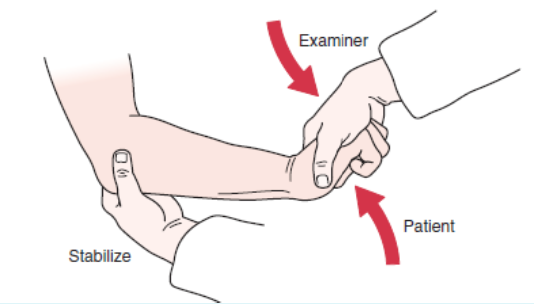
  • Also known as Tennis elbow test/ Cozen’s test

  • PURPOSE- Identify lateral epicondylopathy

  • DESCRIPTION- The patient is sitting with elbow 90 degree flexion then asked to actively make a fist, pronate the forearm, and radially deviate and extend the wrist while the examiner resists the motion.

  • RESULT- Sudden severe pain in the area of the lateral epicondyle of the humerus is a positive sign
<ul><li><p><span>Also known as Tennis elbow test/ Cozen’s test</span></p></li><li><p><span>PURPOSE- Identify lateral epicondylopathy</span></p></li><li><p><span>DESCRIPTION- The patient is sitting with elbow 90 degree flexion then asked to actively make a fist, pronate the forearm, and radially deviate and extend the wrist while the examiner resists the motion.</span></p></li><li><p><span>RESULT- Sudden severe pain in the area of the lateral epicondyle of the humerus is a positive sign</span></p></li></ul><p></p>
3
New cards

Mills Test

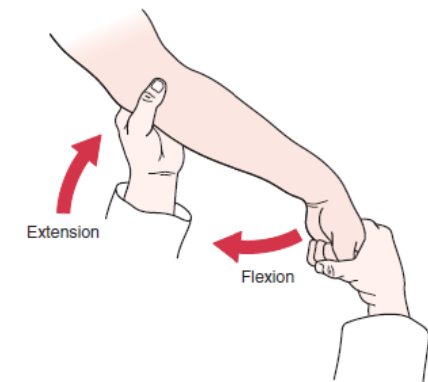
  • PURPOSE- Identify lateral epicondylopathy

  • DESCRIPTION- While palpating the lateral epicondyle, the examiner passively pronates the patient’s forearm, flexes the wrist fully, and extends the elbow

  • RESULT- Pain over the lateral epicondyle of the humerus indicates a positive test.
<ul><li><p><span>PURPOSE- Identify lateral epicondylopathy</span></p></li><li><p><span>DESCRIPTION- While palpating the lateral epicondyle, the examiner passively pronates the patient’s forearm, flexes the wrist fully, and extends the elbow</span></p></li><li><p><span>RESULT- Pain over the lateral epicondyle of the humerus indicates a positive test.</span></p></li></ul><p></p>
4
New cards

Maudsley Test

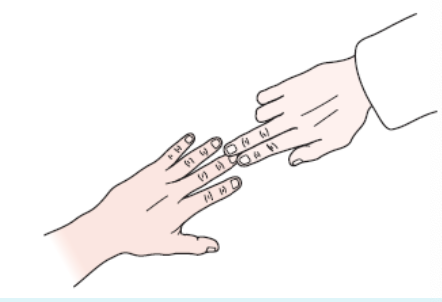
  • PURPOSE- Identify lateral epicondylopathy

  • DESCRIPTION- The examiner resists extension of the third digit of the hand distal to the proximal interphalangeal joint, stressing the extensor digitorum muscle and tendon

  • RESULT- Positive test is indicated by pain over the lateral epicondyle of the humerus

<ul><li><p><span>PURPOSE- Identify lateral epicondylopathy</span></p></li><li><p><span>DESCRIPTION- The examiner resists extension of the third digit of the hand distal to the proximal interphalangeal joint, stressing the extensor digitorum muscle and tendon</span></p></li><li><p><span>RESULT- Positive test is indicated by pain over the lateral epicondyle of the humerus</span></p></li></ul><p></p>
5
New cards

Elbow Flexion Test

  • PURPOSE- Identify cubital tunnel syndrome

  • DESCRIPTION- The patient is asked to fully flex the elbow with extension of the wrist and shoulder girdle abduction (90°) and depression and to hold this position for 3 to 5 minutes. Symptoms should develop in less than 5 seconds

  • RESULT- Tingling or paresthesia in the ulnar nerve distribution of the forearm and hand indicates a positive test. The test helps to determine whether a cubital tunnel (ulnar nerve) syndrome is present.

<ul><li><p><span>PURPOSE- Identify cubital tunnel syndrome</span></p></li><li><p><span>DESCRIPTION- The patient is asked to fully flex the elbow with extension of the wrist and shoulder girdle abduction (90°) and depression and to hold this position for 3 to 5 minutes. Symptoms should develop in less than 5 seconds</span></p></li><li><p><span>RESULT- Tingling or paresthesia in the ulnar nerve distribution of the forearm and hand indicates a positive test. The test helps to determine whether a cubital tunnel (ulnar nerve) syndrome is present.</span></p></li></ul><p></p>
6
New cards

Medial Epicondylitis Test

  • PURPOSE- Identify medial epicondylopathy (Golfer’s elbow test)

  • DESCRIPTION- While the examiner palpates the patient’s medial epicondyle, the patient’s forearm is passively supinated and the examiner extends the elbow and wrist.

  • RESULT- A positive sign is indicated by pain over the medial epicondyle of the humerus
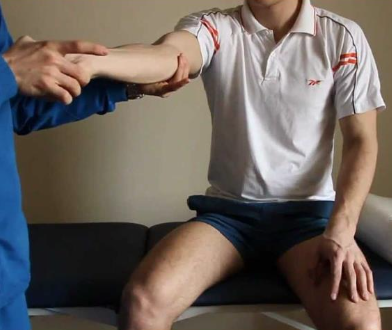
<ul><li><p><span>PURPOSE- Identify medial epicondylopathy (Golfer’s elbow test)</span></p></li><li><p><span>DESCRIPTION- While the examiner palpates the patient’s medial epicondyle, the patient’s forearm is passively supinated and the examiner extends the elbow and wrist.</span></p></li><li><p><span>RESULT- A positive sign is indicated by pain over the medial epicondyle of the humerus</span></p></li></ul><p></p>
7
New cards

Tinel Sign

  • PURPOSE- Identifies dysfunction of ulnar nerve at olecranon

  • DESCRIPTION- The area of the ulnar nerve in the groove is tapped.

  • RESULT- A positive sign is indicated by a tingling sensation in the ulnar distribution of the forearm and hand distal to the point of compression of the nerve. The test indicates the point of regeneration of the sensory fibers of a nerve. The most distal point at which the patient feels the abnormal

    sensation represents the limit of nerve regeneration
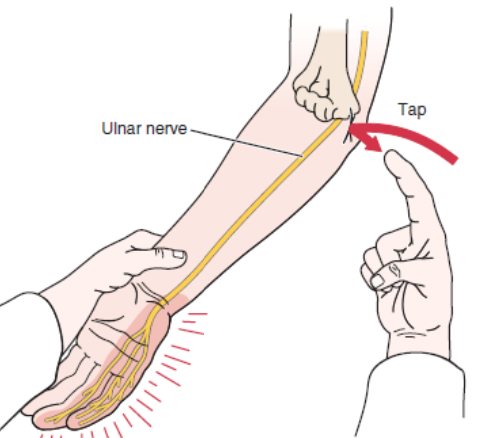
<ul><li><p><span>PURPOSE- Identifies dysfunction of ulnar nerve at olecranon</span></p></li><li><p><span>DESCRIPTION- The area of the ulnar nerve in the groove is tapped.</span></p></li><li><p><span>RESULT- A positive sign is indicated by a tingling sensation in the ulnar distribution of the forearm and hand distal to the point of compression of the nerve. The test indicates the point of regeneration of the sensory fibers of a nerve. The most distal point at which the patient feels the abnormal</span></p><p><span>sensation represents the limit of nerve regeneration</span></p></li></ul><p></p>
8
New cards

Pronator Teres Syndrome Test

  • PURPOSE- Identify median nerve entrapment within pronator teres

  • DESCRIPTION- The patient sits with the elbow flexed to 90°. The examiner strongly resists pronation as the elbow is extended

  • RESULT- Tingling or paresthesia in the median nerve distribution in the forearm and hand indicates a positive test.

<ul><li><p><span>PURPOSE- Identify median nerve entrapment within pronator teres</span></p></li><li><p><span>DESCRIPTION- The patient sits with the elbow flexed to 90°. The examiner strongly resists pronation as the elbow is extended</span></p></li><li><p><span>RESULT- Tingling or paresthesia in the median nerve distribution in the forearm and hand indicates a positive test.</span></p></li></ul><p></p>



