Plant-like Protist Diversity
 Call Kai
 Learn
Learn Practice Test
 Spaced Repetition
 Match
Match Flashcards
 Knowt Play
1/17

There's no tags or description
Looks like no tags are added yet.
Name | Mastery | Learn | Test | Matching | Spaced | Call with Kai |
|---|
No analytics yet
Send a link to your students to track their progress
18 Terms
Protist
Eukaryotes — diverse structurally and functionally
Have organelles
Most are unicellular
Some live in groups and multicellular species
SAR clade
Protist
Diverse
Defined by DNA similarities — evolutionary relationship
Consists of:
Stramenopiles
Alveolates
Rhizarians
Stramenopiles
SAR clade
Diatoms
Unicellular algae with a unique two-part glass-like wall of silicon dioxide (glass)
Major component of phytoplankton
Fossilized walls compose of diatomaceous earth (sediment)
Golden Algae
Yellow and brown carotenoids
Simple structure
Mostly groups of unicellular organisms
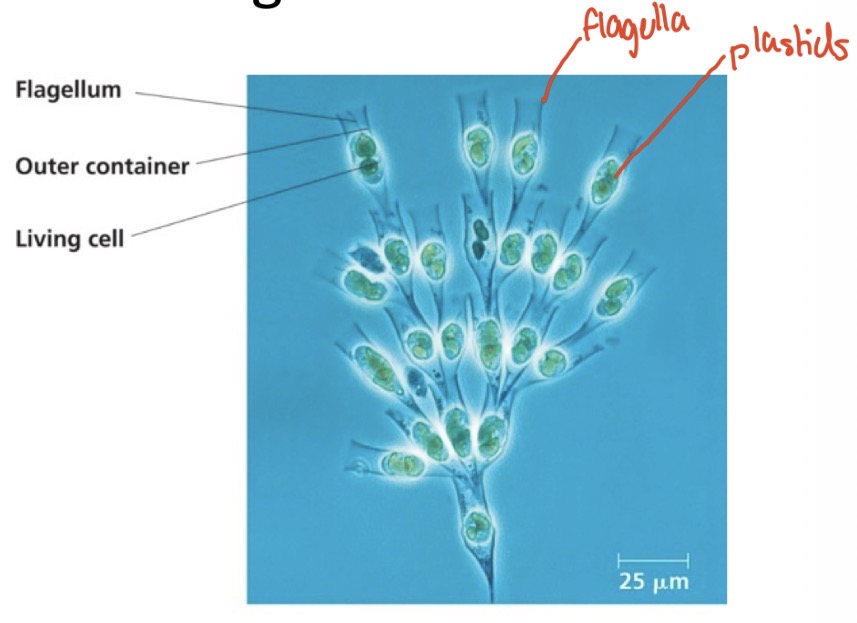
Brown Algae
Large complex multicellular structures
Kelps, giant seaweed
Close to surface to capture more sunlight
Plant-like Structures
Holdfast
Anchors the algae to a substrate — like roots
Stipe
Supports upper structures — like stem
Blade
Structures for photosynthesis — like leaves
Analogous structures to plants
Alternation of Generations
Most complex lifestyle
Alternation of multicellular haploid and diploid forms
Heteromorphic generations
Structurally different
Isomorphic generations
Look similar
Dinoflagellates
Made of cellulose — polymer of simple sugars, tough
Phytoplankton
Blooms (explosive growth) results in ‘red tide’
Red Tide
Occurs in shallow water (easier to photosynthesize)
Warm
Toxins produced by dinoflagellates causes massive kills of invertebrates and fishes
Archaeplastida
Red algae and Green algae
Diverse habitats
Freshwater, marine, terrestial
Unicellular
Generally grouped together
Multicellular
Closest relatives of land plants
Red Algae
Reddish in colour due to phycoeythrin
Mostly multicellular
No flagellate structures in the life cycles
Paper thin glossy sheets of nori — for sushi
Algal cell structure
Cell wall — similar to plants
Cellulose, some carbohydrates, proteins
Rigid when mature
Permeable to water, gases, minerals (nutrition)
Vacuole
Regulate the water content of the cell
Water moving in exerts outward pressure — turgor pressure
Pyrenoids — only in algae
Within chlorplasts
Site of starch synthesis — source of energy
Isogamy
Gametes of different mating types (+/-) are morphologically identical
Mature cells of algae develop into gametes
Due to environmental stress (nitrogen stress)
Haplontic life cycle
Main form is haploid