Fluvial Landforms - Upper
 Call Kai
 Learn
Learn Practice Test
 Spaced Repetition
 Match
Match Flashcards
 Knowt Play
1/9

There's no tags or description
Looks like no tags are added yet.
Name | Mastery | Learn | Test | Matching | Spaced | Call with Kai | Chat |
|---|
No analytics yet
Send a link to your students to track their progress
10 Terms
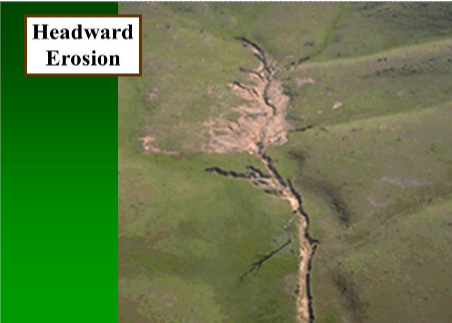
Headward Erosion
A river lengthens its course by cutting BACKWARDS (upstream) above its original source. The river erodes upslope over time.
Waterfall
Forms where a river flows over a band of hard rock overlying softer rock. The softer rock is eroded faster, creating a step. A plunge pool forms at the base. The hard rock overhangs and eventually collapses, causing the waterfall to retreat upstream.
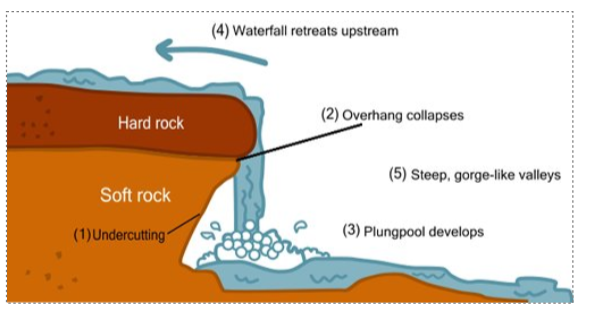
Plunge Pool
A deep pool at the base of a waterfall, formed by hydraulic action and abrasion as water plunges into it.
Rapids
Occur where a river flows over alternating bands of hard and soft rock, creating a series of small steps and fast-moving water.
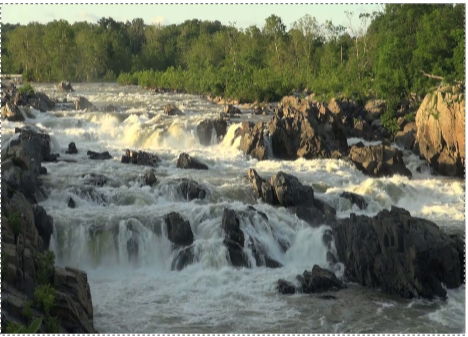
How a waterfall forms (step by step)
Hard rock overlies softer rock.
Softer rock is eroded faster by hydraulic action and abrasion.
Hard rock overhangs.
Plunge pool forms at the base.
Hard rock collapses.
Waterfall retreats upstream (headward retreat).
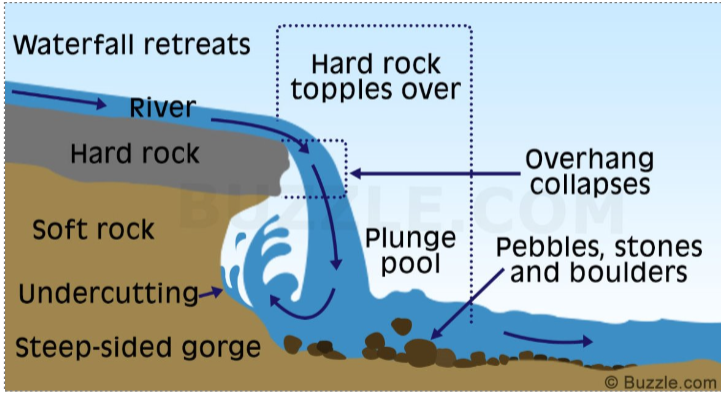
Hydraulic Action in waterfall formation
The force of the water crashes into the softer rock at the base, loosening and removing material, deepening the plunge pool.
Abrasion in waterfall formation
Rocks and sediment carried by the water scrape and wear away the softer rock at the base of the waterfall.
Upper Course characteristics
Steep gradient, fast flow, narrow V-shaped valley, vertical (downward) erosion, waterfalls, rapids, headward erosion. River loads large boulders.
V-shaped valley formation
In the upper course, vertical erosion cuts downward rapidly. Mass movement and weathering on valley sides also occur, creating steep V-shaped valleys.
Deposition (when does it occur?)
Occurs when the river LOSES ENERGY and can no longer carry its load. Heavier particles are deposited first.