Psychology- obedience: situational variables
 Call Kai
 Learn
Learn Practice Test
 Spaced Repetition
 Match
Match Flashcards
 Knowt Play
1/18

There's no tags or description
Looks like no tags are added yet.
Name | Mastery | Learn | Test | Matching | Spaced | Call with Kai |
|---|
No analytics yet
Send a link to your students to track their progress
19 Terms
% obedience when teacher and learner are in the same room
40%
% when experimenter gave orders by phone
20.5%
Why did obedience fall to 47.5% in run down office?
experimenter had less authority there than they did at Yale.
Bickman (1974)
Three confederates, dressed as a milkman, security guard, and jacket and tie asked public to do things and found people were twice as likely to obey the security guard than the jacket and tie.
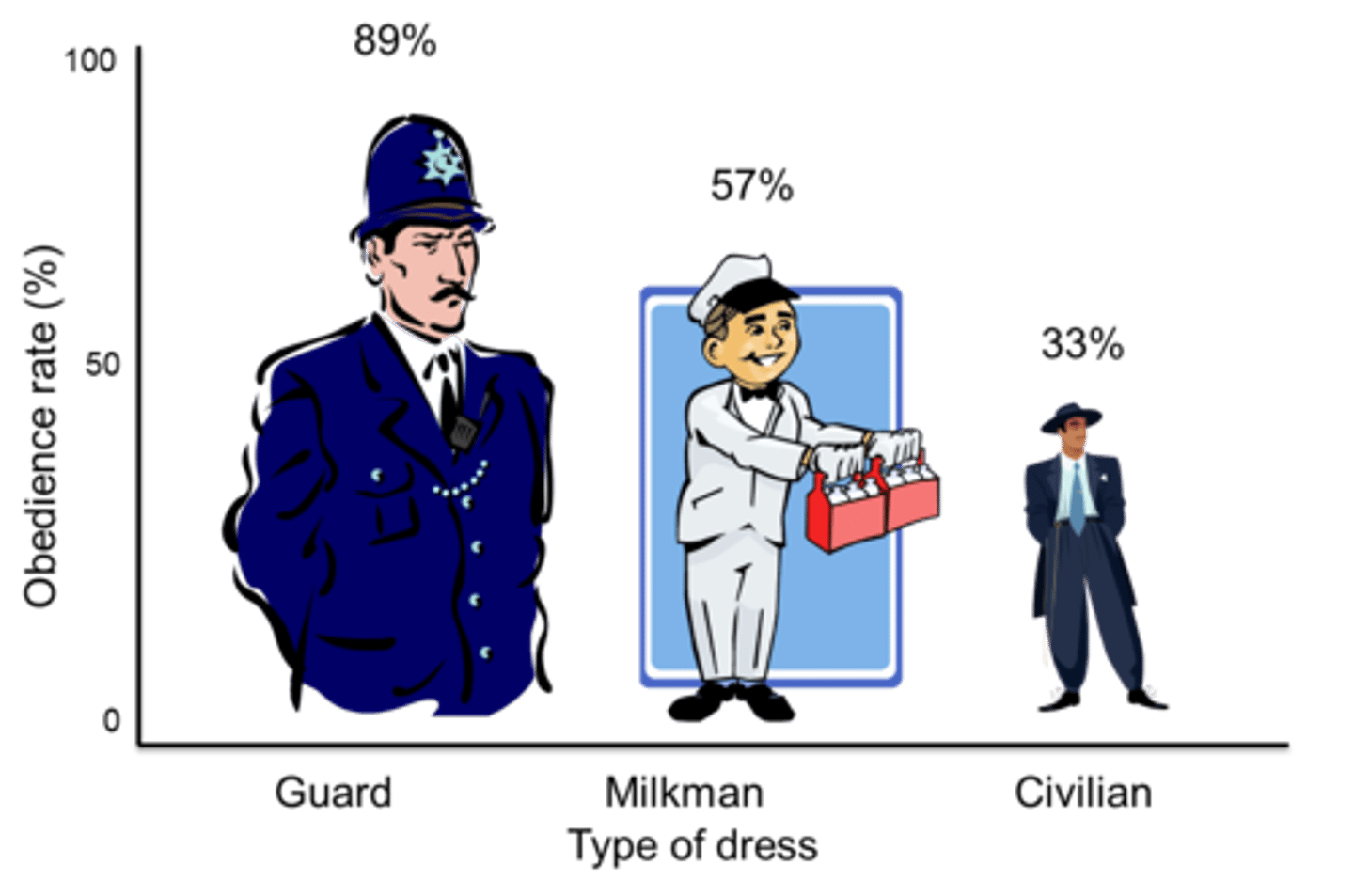
Miranda et al (1981)
Obedience rate of over 90% amongst Spanish students
Smith and Bond (1998)
Explain how most research has been carried out in Western developed societies, so it is too early to conclude that proximity, location and uniform apply universally.
Milgram carried out a large number of variations in order to consider what?
Situational variables
Three types of variables used in Milgram's experiment
Proximity, location and uniform
Percentage of obedience in run down office
47.5%
percentage of obedience at Yale
65%
% when teacher forces learners hand onto plate
30%
% when experimenter played by member of public
20%
Uniform affecting obedience
ordinary member of public in everyday clothes replaced experimenter in lab coat, obedience dropped to 20% (lowest %)
baseline study ao3 evaluation.
strengths, strong external validity, nurse experimeny (21/22). weaknesses lacks internal validity and is unethical.
strengths, nurse experiment.
Hofling et al. (1966), who conducted a field study using a naive sample of 22 nurses
Each nurse was telephoned by a doctor they did not know
The doctor told the nurse to administer an excessive dose of an unfamiliar drug
20 mg of 'Astroten' (the drug was fake and was simply a glucose tablet)
The Astroten box clearly stated that the maximum daily dose was 10mg
21 out of the 22 nurses obeyed the unethical order, which broke hospital guidelines
The findings support the idea that harmful acts can be committed by seemingly caring people
Thus, Milgram's study has good external validity as similar effects as were observed in his study can be seen in the real world
ao3 baseline. how does milgrams experiment lack internal validity.
perry, only 50% believed shocks were real. Ps may have been responding to demand characteristics, ‘play acting’.
ao3 baseline. how is milgrams OG study unethical?
Ps were deceived to true nature of study, not properly given right to withdraw (experimenter’s prods when Ps asked to leave), caused excessive stress in Ps. could not be replicated today.
ao3 baseline. counterpoint to low internal validity.
experiment carried out with real shocks on a puppy. 100% of women gave what they thought was a fatal amount, 54% of men. obedience in study may be genuine
VARIATIONS AO3.