Modules 6-7
 Call Kai
 Learn
Learn Practice Test
 Spaced Repetition
 Match
Match Flashcards
 Knowt Play
1/297

Earn XP
Description and Tags
Orgo Chem
Name | Mastery | Learn | Test | Matching | Spaced | Call with Kai |
|---|
No analytics yet
Send a link to your students to track their progress
298 Terms
What is Organic Chemistry
The study of carbon and hydrogen based compounds.
What is a hydrocarbon?
A compound composed entirely of hydrogen and carbon atoms.
How can hydrocarbons be structured?
Chains, branches, and cyclic structures.
What kind of bonds does carbon form with other atoms?
strong covalent bonds
What can organic compounds also exist in?
isomers
What is an isomer?
the same chemical formula, but different connectivity and arrangement in 3D space.
What geometry do organic compounds mainly exist in?
tetrahedral geometry
What are the two parts to an organic molecule?
carbon backbone
one or more functional groups
What is a functional group?
a set of atoms bonded together in a specific way.
What do functional groups largely define?
the chemical and physical properties of the compound.
What do molecules with similar functional groups have?
similar chemical and physical properties.
What are alkanes?
Compounds made entirely of carbon and hydrogen atoms connected by single bonds
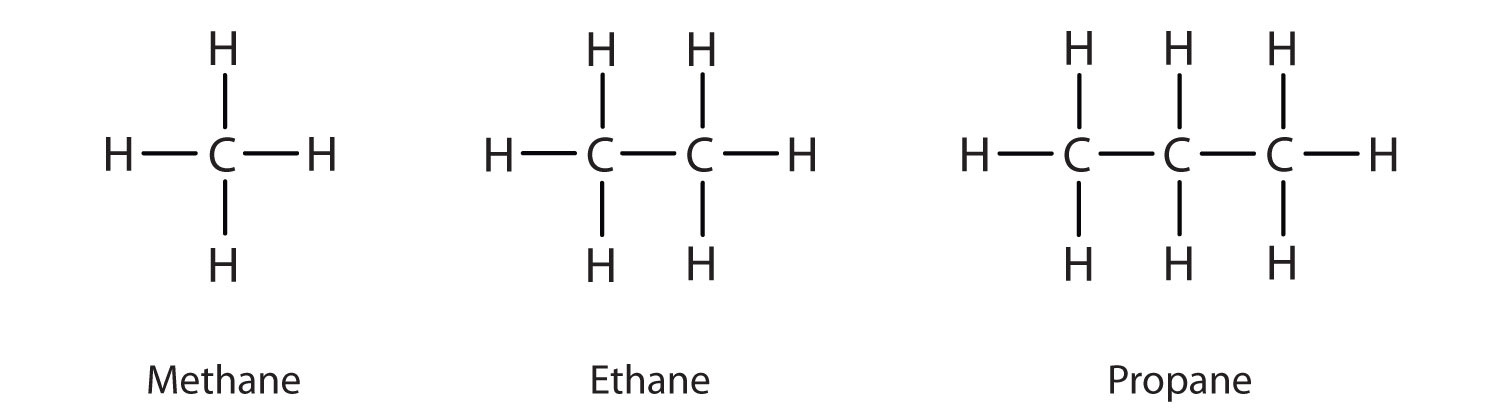
What is the simplest organic compound?
alkanes
What kind of bonds do alkanes form?
carbon-carbon single bonds
What are alkanes also known as?
paraffins
What is the simplest alkane?
methane
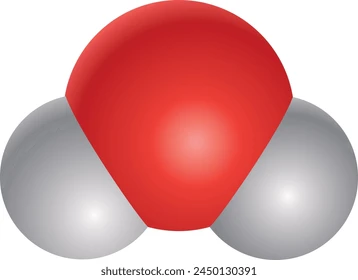
What is a “ball and stick” model?
spheres of different colors representing different types of atoms using tetrahedral geometry.
What is a “space filling model”?
3D visual representation of a molecule where atoms are shown as solid spheres
What is an alkyl group?
basically an alkane missing one hydrogen atom

What is an alkyl group generally symbolized by?
an “R”
As the R group becomes larger and bulkier, what happens?
it has an impact on the chemical and physical properties of the functional groups present.
What does R mean when attached to the line structure of a molecule?
That there is a carbon based functional group present.
What is special nomenclature?
Not all carbon chains and R groups are in a straight line; a way to name compounds because they are not in a straight line
What does the special nomenclature “n” mean?
normal configuration
What does the special nomenclature “iso” mean?
all of the carbons except for one are in a single chain; specifically means a methyl group branches off the second to last carbon
What does the special nomenclature “sec” mean?
the functional group is attached to a secondary carbon - a carbon bonded to two other carbons
What does the special nomenclature “tert” mean?
where a carbon atom is directly bonded to three other carbon atoms
The group attaches at a tertiary carbon
What can ISO, SEC, and TERT tell us?
the location of the functional groups on a compound
What are cyclic alkanes?
saturated, cyclic hydrocarbons; can omit locant number
What order do you name the constituents on a cycloalkane?
alphabetical
What are saturated compounds?
molecules that contain the maximum number of hydrogen atoms for a given number of carbon atoms
What are unsaturated compounds?
molecules that contain double bonds or rings
What are alkenes?
have at least one carbon-carbon double bond functional group
What is the simplest alkene?
ethene (ethylene)
What is the geometry of alkenes?
trigonal planar geometry
True or false. The smaller the alkene the higher the boiling and melting point.
false
What are isomers?
Compounds with the same formula but a different arrangement of bonds/atoms.
What are the two categories of isomerism?
Structural isomerism and stereoisomerism
What are the 3 categories of structural isomerism?
chain
position
functional
What are the 2 categories of stereoisomerism?
geometric
optical
What is cis/trans isomerism?
a kind of stereoisomerism exhibited by alkenes
What is a cis isomer?
both of the hydrogens are on the same side of the double bond
What is a trans isomer?
each hydrogen is on opposite sides of the double bond
What are the 4 addition reactions of alkenes?
halogenation
hydration
hydrogenation
polymerization
What is hydrogenation?
A Chemical reaction where hydrogen gas is added across a carbon-carbon double bond
unsaturated alkene → saturated alkane
What is polymerization?
The process of joining many reactive alkenes together to form a giant chain like molecule.
Alkene → alkane
True or false. The length of the polymerization chain is not dependent on the reaction conditions.
false
What is an alkyne?
An unsaturated hydrocarbon containing at least one carbon-carbon triple bond.
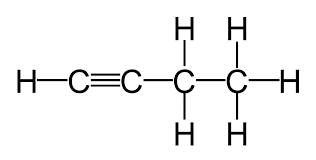
What are alkynes also known as?
acetylenes
Are alkynes common in medical settings?
no.
What is the simplest alkyne?
ethyne
What are aromatics?
molecules that contain a benzene ring and is especially stable
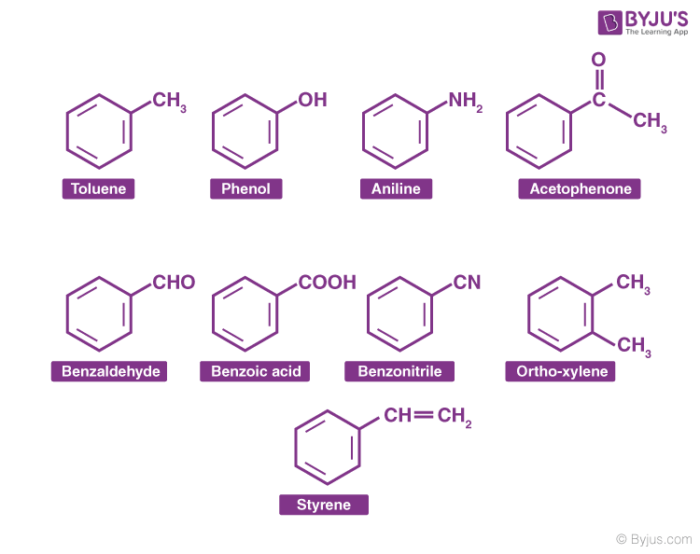
Are benzene rings common in nature?
yes
True or false. Aromatics are frequently used in medications.
true
What are aromatics also called?
arenes
What is the simplest aromatic compound?
benzene
When a benzene ring is a stick-on group, what is it called?
a phenyl group
What is a common anesthetic that contains a benzene ring?
propofol
What makes an aromatic compound so stable?
the resonance electrons form a shared cloud spread freely across the entire molecule - lowering the energy; not reactive
What are organohalogen compounds?
Organic compound that contain one or more halogen atoms.
What is an example of organohalogen name?
“haloalkane” - the parent compound is alkane
Ex. Chloromethane
What are haloalkanes also called?
alkyl halides
What is an organohalogen called if the parent group is a benzene?
aryl halides
What is the generic formula of an alkyl halide?
R-X, where R is an alkyl and X is a halide/halogen
What are alcohols?
molecules that have a hydrogen atom directly bonded to an oxygen atom.
What is the generic formula for alcohols?
R-O-H
What kind of bonds can alcohols form?
hydrogen bonds
If the R group contains less than 3 carbon atoms, the alcohol is ….
perfectly soluble in water
For alcohols, as the R group becomes larger the…
solubility in water decreases
What are aromatic alcohols called?
phenols
What is the alcohol for drinking?
Ethanol
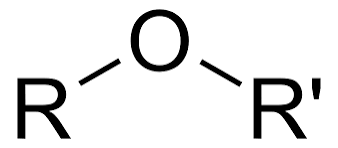
What are ethers?
a compound where oxygen is connected to two alkyl groups.
What organic compounds are anesthetic gases?
halogenated ethers
What are amines?
a compound that has an ammonia group on it
What is the most important chemical reaction of amines?
basicity of amines
If there is a nitrogen in an organic compound what will it probably be?
an amine
What is a carbonyl group?
a carbon double bonded to an oxygen
Do carbonyl bonds form frequently in the chemical world?
yes
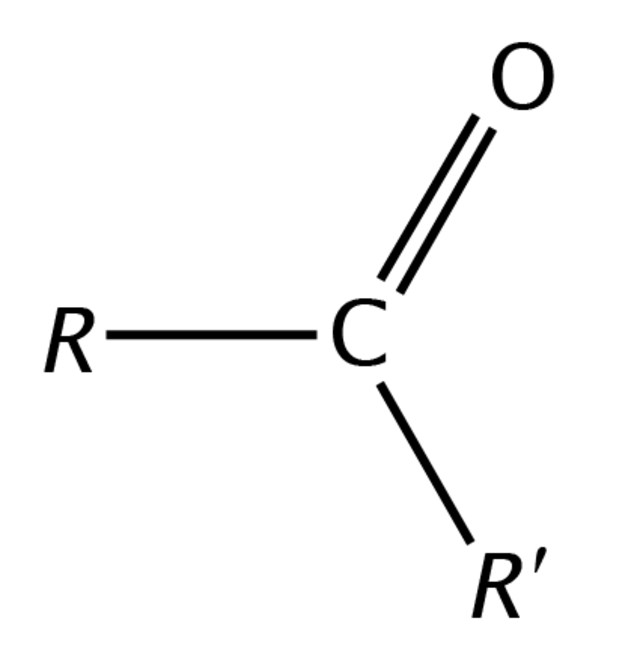
What are ketones?
molecules that two alkyl groups bonded to a carbonyl group
True or false. Ketones are not common in nature.
false
True or false. Ketones are represented in a large variety of natural compounds and medicines.
true
What is the simplest ketone?
propanone
What is propanone commonly known as?
acetone
What are some biological and medically important ketones?
progesterone, oxycodone, and methadone
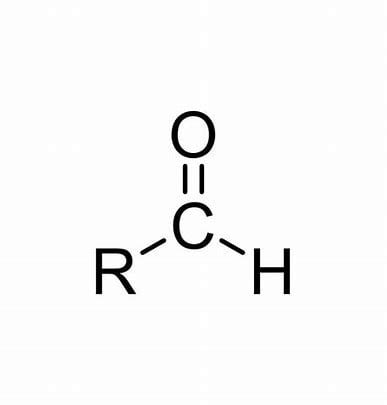
What are aldehydes?
molecules that have an alkyl group and a hydrogen atom bonded to a carbonyl group.
Are aldehydes common in nature?
no
Why are aldehydes rare in nature?
they easily oxidize to carboxylic acids, with just oxygen
What is the simplest aldehyde?
methanal
What is methanal commonly known as?
formaldehyde
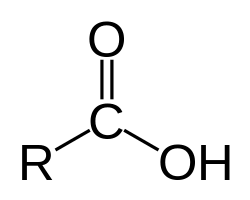
What is the carboxylic acid group?
a molecule with a carbonyl group and hydroxyl group double bonded to the carbon atom
What is an important property of carboxylic acid?
its ability to act as an acid
What do unsaturated fatty acids have?
at least one double bond
What are esters?
condensation products between acids and alcohols.
What feature may esters have?
a pleasant, fruity odor
What reacts together to form esters?
carboxylic acid (or any acid) a and alcohol
What is a phosphate ester?
condensation product of phosphoric acid and alcohol
Why are phosphate esters important?
they form the backbone of DNA and RNA
What are amides?
Nitrogen atom directly attached to a carbonyl group
condensation products between carboxylic acid and amines
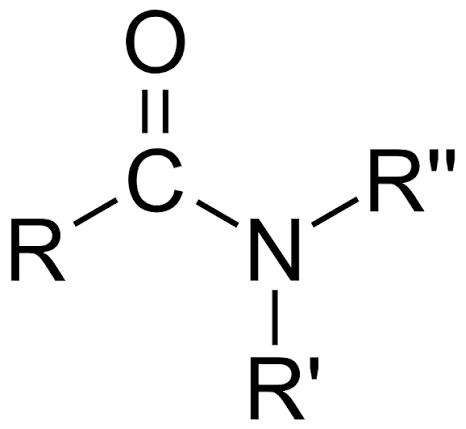
What is an important example of amides?
proteins