MAR 3203 Chapter 3: Project Management
 Call Kai
 Learn
Learn Practice Test
 Spaced Repetition
 Match
Match Flashcards
 Knowt Play
1/28

There's no tags or description
Looks like no tags are added yet.
Name | Mastery | Learn | Test | Matching | Spaced | Call with Kai |
|---|
No analytics yet
Send a link to your students to track their progress
29 Terms
3 phases of project management
Planning — Goal setting, defining the project, and team organization
Scheduling — Relates people, money, and supplies to specific activities and relates activities to each other
Controlling — The firm monitors resources, costs, quality, and budgets; also revises or changes plans and shifts resources to meet time and cost demands
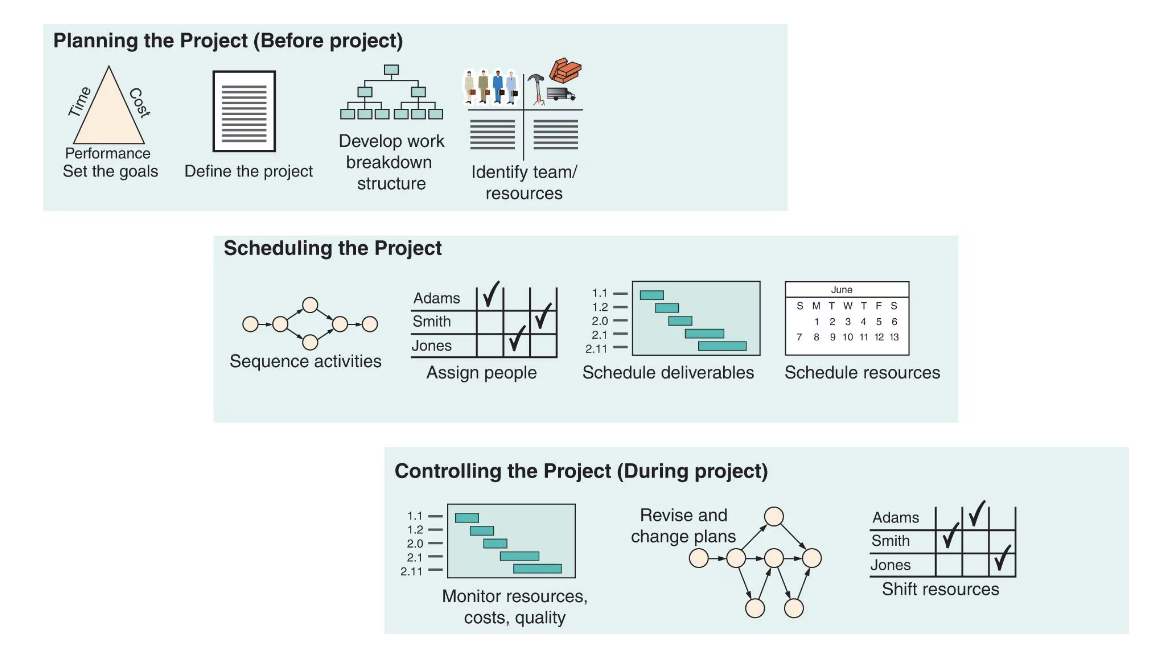
Project planning
Projects can be defined as a series of related tasks directed toward a major output
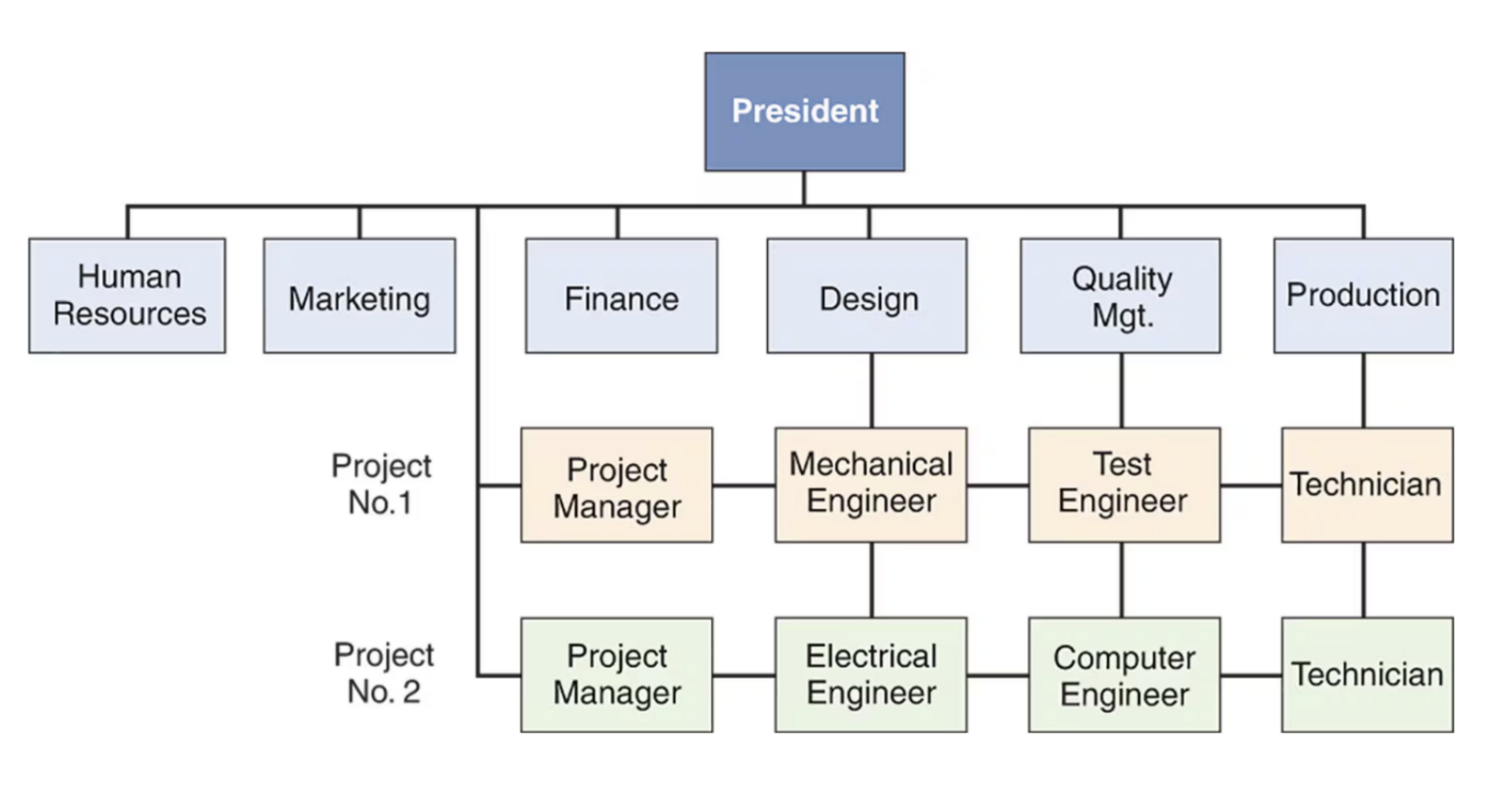
Project organization
Work breakdown structure (WBS)
Project organization
An organization formed to ensure that programs (projects) receive the proper management and attention
Can be temporary or permanent (matrix organization)
Ethical issues project managers face
Offers of gifts from contractors
Pressure to alter status reports to mask delays
False reports for charges of time and expenses
Pressures to compromise quality to meet bonuses or avoid scheduling penalties
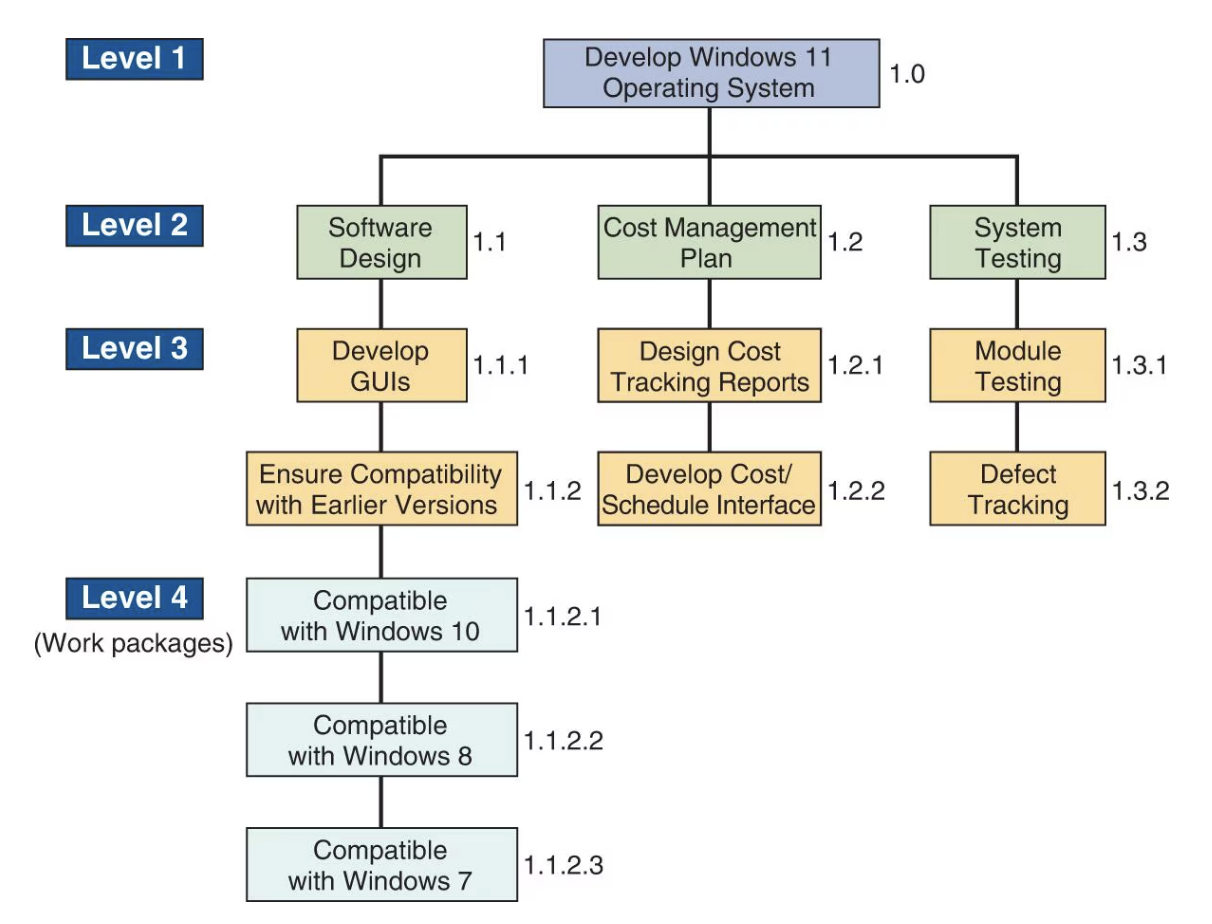
Work breakdown structure (WBS)
Defines a project by dividing it into more and more detailed components
Levels of hierarchy:
Project
Major tasks in project
Subtasks in major tasks
Activities (or “work packages”) to be completed
Project scheduling
The sequencing and allotment of time to all project activities
Shows the relationship of each activity to others and the whole project
Identifies the precedence relationships among activities
Encourages the setting of realistic time and cost estimates for each activity
Helps make better use of people, money, and material resources by identifying critical project bottlenecks
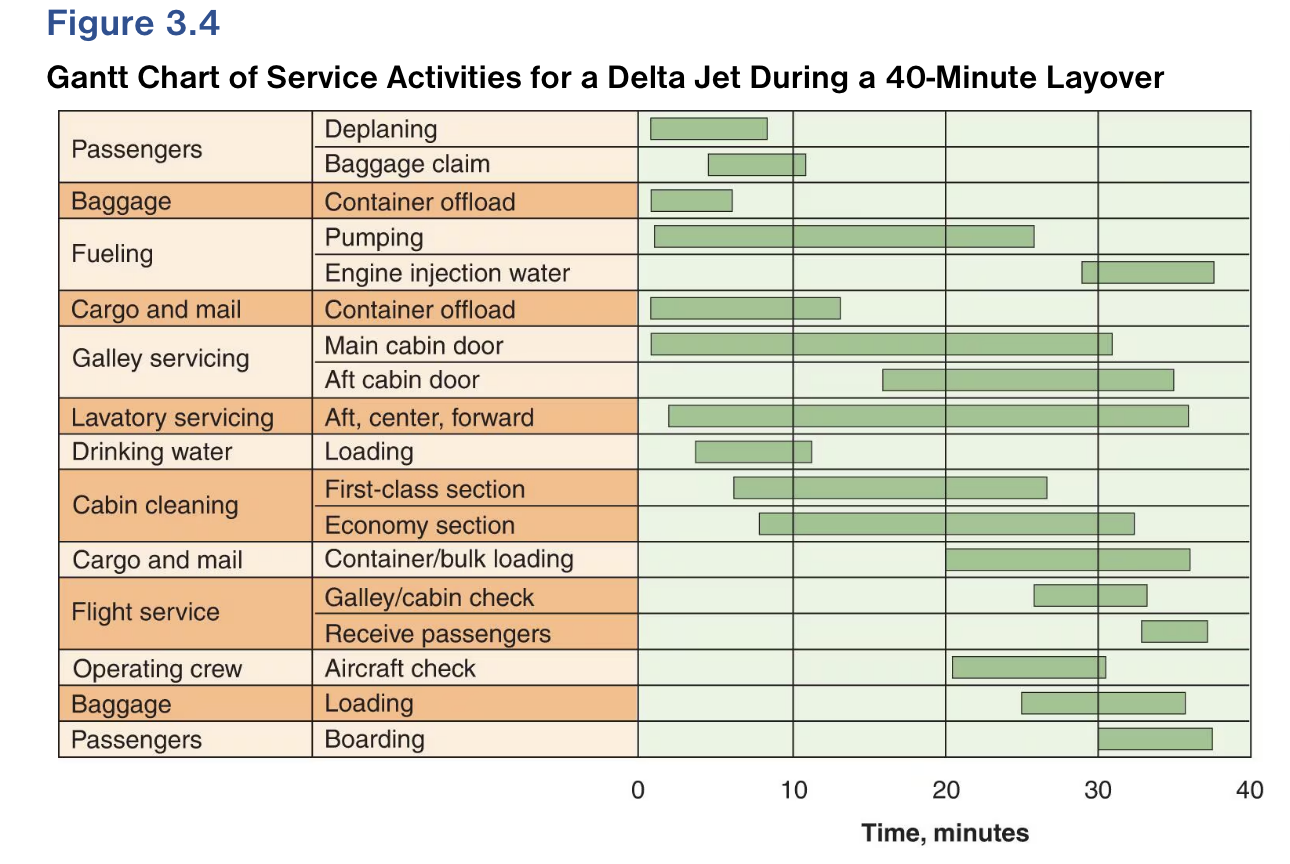
Gantt chart
Used during project scheduling; planning charts used to schedule resources and allocate time
Ensures that
Activities are planned
Order of performance is documented
Activity time estimates are recorded
Overall project time is developed
Project controlling
Computerized programs produce a broad variety of PERT/CPM reports including
Detailed cost breakdowns for each task
Total program labor curves
Cost distribution tables
Functional cost and hour summaries
Raw material and expenditure forecasts
Variance reports
Time analysis reports
Work status reports
Projects may be managed using the waterfall or agile approaches
Waterfall projects
Projects that progress smoothly in a step-by-step manner until completed
Agile projects
Ill-defined projects requiring collaboration and constant feedback to adjust to project unknowns
Program evaluation and review technique (PERT)
A project management technique that employees three time estimates for each activity
Critical path method (CPM)
A project management technique that uses only one estimate per activity—makes the assumption that activity times are known with certainty
Critical path
The computed longest time path(s) through a network
Represents tasks that will delay the entire project if they are not completed on time zero slack time
6 steps of PERT/CPM
Define the project and prepare the work breakdown structure (WBS)
Develop the relationships among the activities; decide precedents
Draw the network connecting all the activities
Assign time and/or cost estimates to each activity
Compute the longest time path through the network aka the critical path
Use the network to help plan, schedule, monitor, and control the project
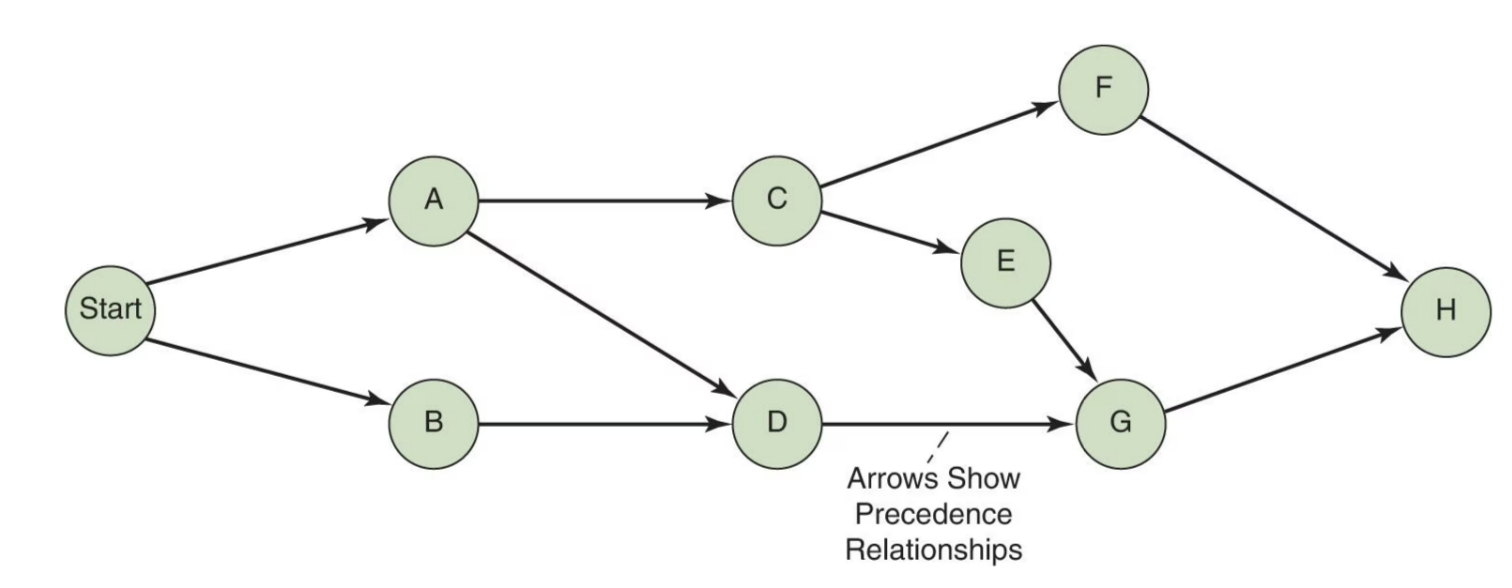
Activity-on-node (AON)
A network diagram in which nodes designate activities
Activity-on-arrow (AOA)
A network diagram in which arrows designate activities
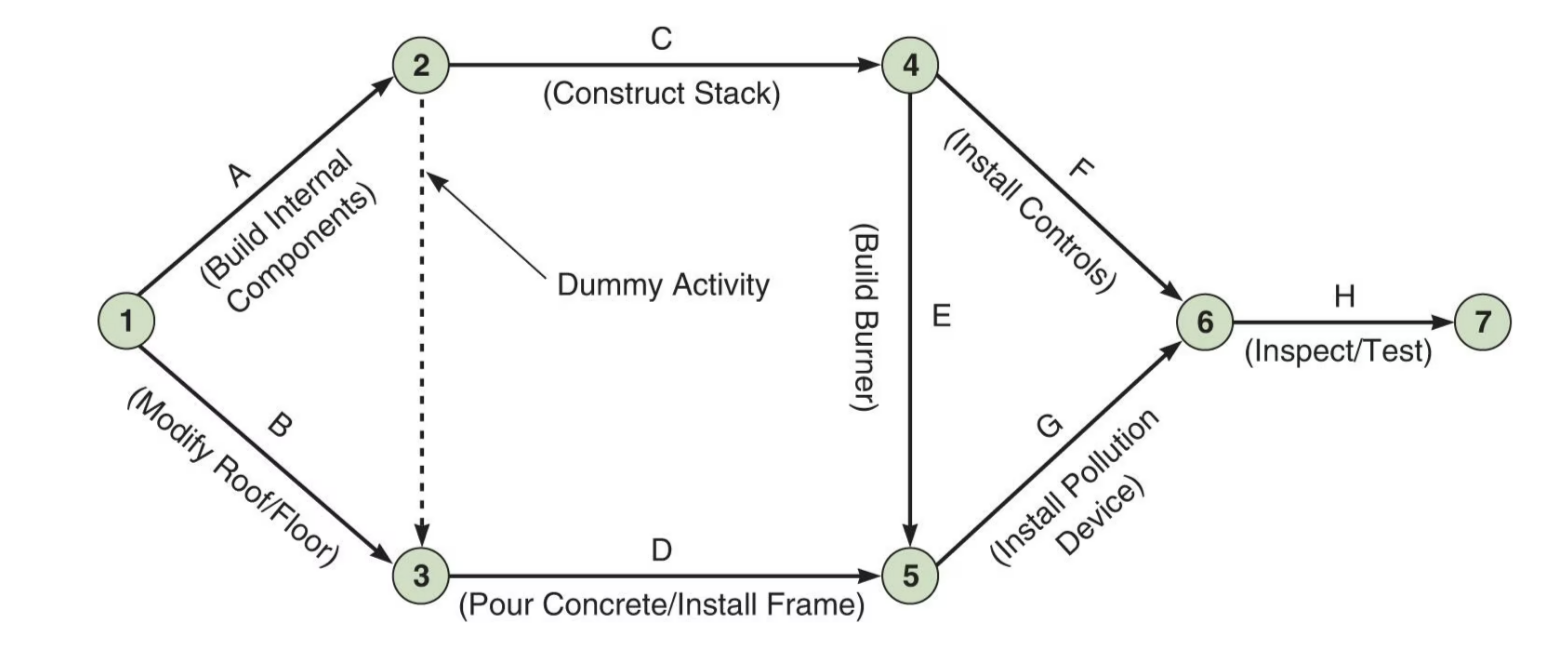
Dummy activity
Common activity in AOA networks that does not exist and has no time and is inserted into a network to maintain the logic of the network
Critical path analysis
A process that helps determine a project schedule
Two distinct starting and ending times for each activity are calculated:
Earliest start (ES)
Earliest finish (EF)
Latest start (LS)
Latest finish (LF)
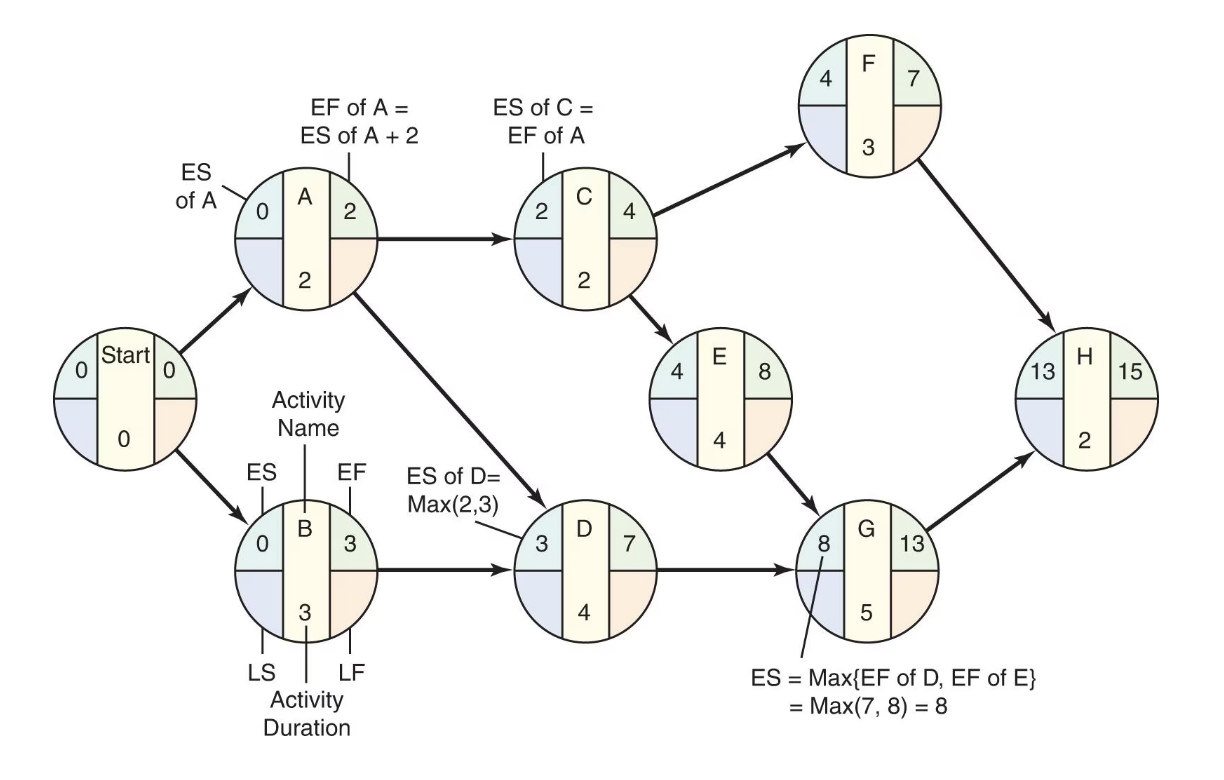
Forward pass
A process that identifies all the early start and early finish times
Earliest start:
Before an activity can start, all its immediate predecessors must be finished
1 immediate predecessor, ES = EFpredecessor
Multiple immediate predecessors, ES = maximum EFpredecessor
Earliest finish:
Sum of its earliest start time (ES) and its activity time
Backward pass
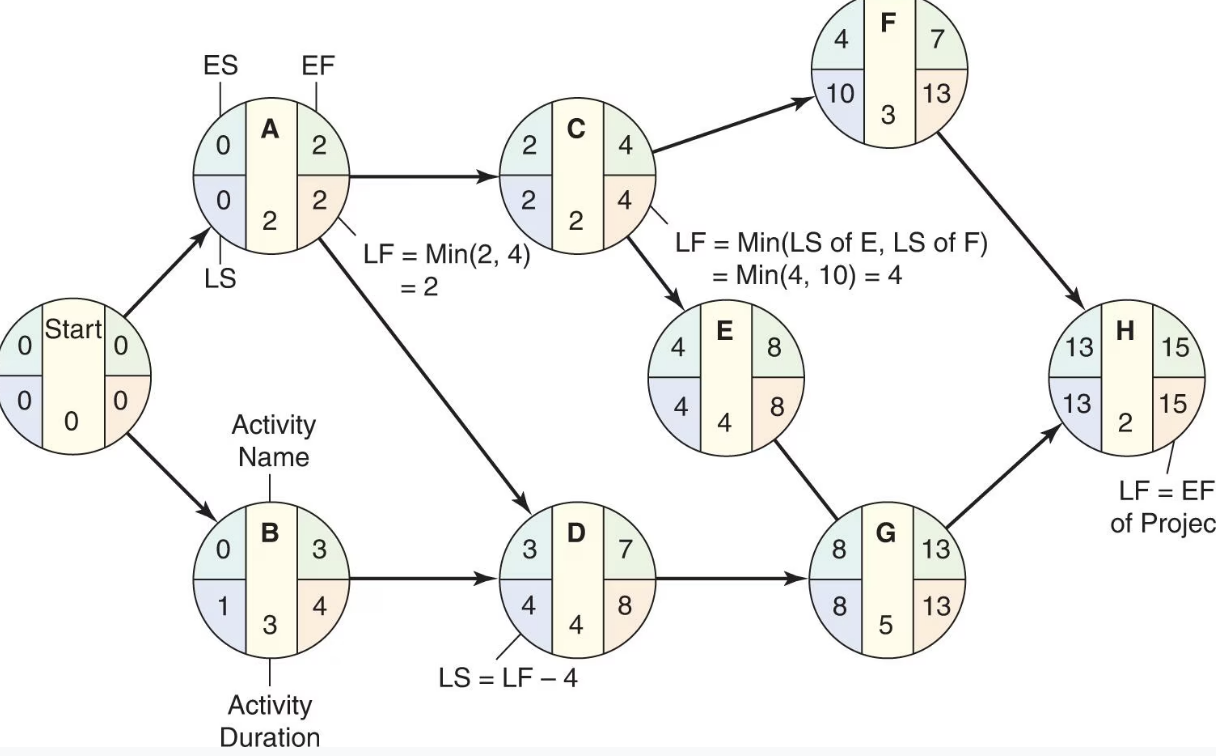
A process that identifies all the late start and late finish times and begins with the last activity in the project
Latest finish:
If an activity is an immediate predecessor for 1 activity, its LF = LS of the activity that immediately follows it
If an activity is an immediate predecessor of >1 activities, its LF is the minimum of all LS values of the activities that immediately follow it
Latest start:
The difference of its latest finish time (LF) and its activity time
Slack time
Free time for an activity—the length of time an activity can be delayed without delaying the entire project
Critical activities
Activities with zero slack are on the critical path
Critical path
A continuous path through the project network that
Starts at the first activity in the project
Terminates at the last activity in the project
Includes only critical activities
Total slack
When two of more noncritical activities appear successively in a path, they share total slack—delaying either activity by 1 week causes not only that activity, but also the other activity, to lose its slack
Crashing
Shortening activity time in a network in the cheapest manner possible to reduce time on the critical path so total completion time is reduced

Crash time
The shortest duration required to complete an activity
4 steps of crashing a project
Compute the crash cost per week/time period for each activity in the network: Crash cost per period = (Crash cost - Normal cost) / (Normal time - Crash time)
Using the current activity times, find the critical path(s) in the network and identify the critical activities
If single critical path, select the activity that can still be crashed and has the smallest crash cost per period; if multiple critical paths, select one activity from each path
Update all activity times and stop crashing if desired due date has been reached
Advantages of PERT and CPM
Especially useful when scheduling and controlling large projects
Straightforward concept and not mathematically complex
Graphic networks help highlight relationships among project activities
Critical path and slack time analyses help pinpoint activities that need to be closely watched
Project documentation and graphs point out who is responsible for various activities
Applicable to a wide variety of projects
Useful in monitoring not only schedules but costs too
Limitations of PERT and CPM
Project activities have to be clearly defined, independent, and stable in their relationships
Precedence relationships must be specified and networked together
Time estimates tend to be subjective and are subject to fudging by managers who fear being overly optimistic
Inherent danger of placing too much emphasis on the longest aka critical path. Near-critical paths need to be monitored as well