T3: Integumentary System
0.0(0)
Studied by 1 person Call Kai
 Learn
Learn Practice Test
 Spaced Repetition
 Match
Match Flashcards
 Knowt Play
Card Sorting
1/31

Earn XP
Description and Tags
Last updated 12:22 AM on 9/23/22
Name | Mastery | Learn | Test | Matching | Spaced | Call with Kai |
|---|
No analytics yet
Send a link to your students to track their progress
32 Terms
1
New cards
What are the 6 functions of the skin?
protection, thermoregulation, excretion, provide sensory info, synthesis of vitamin D3 and lipid reserves, and coordinate immune response in the skin
2
New cards
Accessory structures of the skin are located in the __ and include __ __, __ __, and __.
dermis; hair follicles, sweat glands, and nails
3
New cards
What are the 4 elements of the skin?
sebaceous glands, sweat glands/ducts, adipose tissue, and blood vessels
4
New cards
Define keratinocyte
main cell type in the integumentary system (specifically, epidermis); composed of stratified squamous epithelium
5
New cards
Define melanocyte
cell that produces melanin, which presents skin damage by absorbing UV radiation
6
New cards
Skin as you imagine is the __ and __
epidermis and dermis
7
New cards
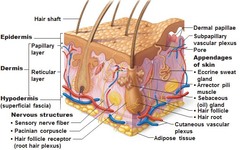
What are the 3 layers of the integumentary system, in order from most superficial to least?
epidermis, dermis, hypodermis
8
New cards
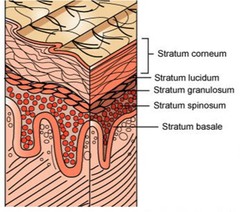
The 5 layers of the epidermis (specific to the palms and soles) are the stratum __, __, __, __, and __ from most superficial to least
corneum, lucidum, granulosum, spinosum, germinativum
9
New cards
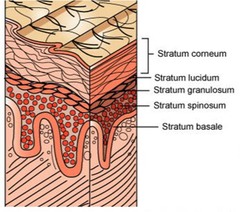
Callouses form in the __ layer of the epidermis
stratum spinosum
10
New cards
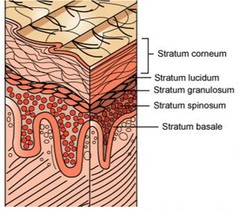
The stratum __ is the keratin layer
granulosum
11
New cards
What are the 3 types of epidermis skin?
thick, thin, keratinized
12
New cards
Thick skin is __ layers and found on the __ and __
5 layers and found on the palms and soles
13
New cards
Thin skin is __ layers and covers most of your body
4
14
New cards
Define the dermal papilla
ridges and bumps from the dermis that extend into the epidermis; produces prints on your soles and palms
15
New cards
Define dermis
layer of blood vessels and nerves; consists of 2 layers: the papillary and reticular layer
16
New cards
Define papillary layer (part of dermis)
most superficial, made of loose CT proper, contains capillaries and nerve endings
17
New cards
Define reticular layer (part of dermis)
made of sense irregular CT proper, contains accessory structures and collagen fibers
18
New cards
Define hypodermis
subcutaneous fat; innermost layer that separates the skin from the internal organs made from loose CT proper
19
New cards
What layer of the skin contains adipose tissue?
hypodermis
20
New cards
Define superficial fascia
superficial adipose layers (in the hypodermis)
21
New cards
The root hair plexus is a __ __ that senses movement of the hair
nerve ending
22
New cards
Horripilation is--
goosebumps; contraction of the Arrector Pili muscle in response to fear or cold
23
New cards
Hair follicles extend into the __, sometimes into the __
dermis, sometimes into the hypodermis
24
New cards
Sweat glands are controlled by the __ __ __
autonomic nervous system
25
New cards
True/False: sweat glands are activated selectively
false; activated all at once
26
New cards
Sweat release is predominately __, but __ sweat glands do exist in the armpit and groin area
merocrine; apocrine
27
New cards
Sebaceous glands secrete __, an oil secretion that feeds into where hair follicles are
sebum
28
New cards
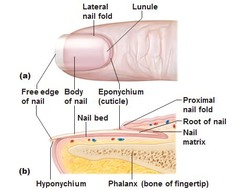
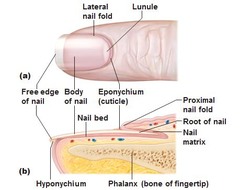
Define nail body
covers the top of fingers and toes along with the nail bed

29
New cards
Define nail root
where nail production occurs
30
New cards
Define lunula
right where the nail contacts the skin; where blood vessels are obscured
31
New cards
__ cancer does not get worse (curable) while __ cancer gets progressively worse
Benign; malignant
32
New cards
Basal cell carcinoma (malignant) results from--
UV exposure