W10: Substance Use Policy Issues
 Call Kai
 Learn
Learn Practice Test
 Spaced Repetition
 Match
Match Flashcards
 Knowt Play
1/14

Earn XP
Description and Tags
Gomes et al Reading: Safer supply (SOS)
Name | Mastery | Learn | Test | Matching | Spaced | Call with Kai |
|---|
No analytics yet
Send a link to your students to track their progress
15 Terms
what are some common classifications of drugs?
· Cannabinoids: e.g., cannabis, hash oil
· Depressants: e.g., alcohol, benzodiazepines, GNB, xylazine, “tranq”
· Dissociative: e.g., nitrous oxide, ketamine, PCP, “angel dust”
· Psychedelics: e.g., LSD or “acid,” psilocybin or “magic mushrooms,” DMT, peyote, ayahuasca
· Empathogens: e.g., MDMA, “molly,” “ecstasy”
· Stimulants, excluding nicotine and caffeine: e.g., amphetamines, cocaine, “uppers,” “speed” methamphetamines, khat
· Opioids, including synthetics: e.g., heroin, fentanyl, methadone, oxycodone
· Solvents or aerosols
what did the historical “mental health system” for addictions look like? (PROGRESS FROM 1800S TO 1950S)
“mutual aid, institutional care”
· Peer-based
o As early as 1750, sobriety circles grounded in Indigenous healing practices
o Alcoholic Anonymous (1935)
· Early 1800s specialized addiction treatment institutions emerged; closed due to stigma, abuses, and poorly evaluated treatment
· “Narcotics farms” — drug prisons and rehab (1930s)
· 1950s: addictions gained recognition as a medical issue
· Private residential addiction services
· Criminalization, fragmentation
what does contemporary mental health system for addiction look like?
· “Evidence-based and patient-centered”
· Peer-based
o Alcoholic Anonymous, Narcotics Anonymous
· Rapid Access Addiction Medicine Clinics
· Concurrent disorders treatment
o Inpatient
o Community-based
· Public and private residential addiction services
· Public health approaches to harm reduction
· Patient-centered and progress towards integration (only lasts 15 years)
what are things to consider in relation to policy options related to overdose?
· Location of services
· Continuity of support rather than just crises
· Supportive housing
· Harm reduction strategies
whaat did research by Rammohan and colleagues look at?
overdose mortality incidence and supervised consumption services
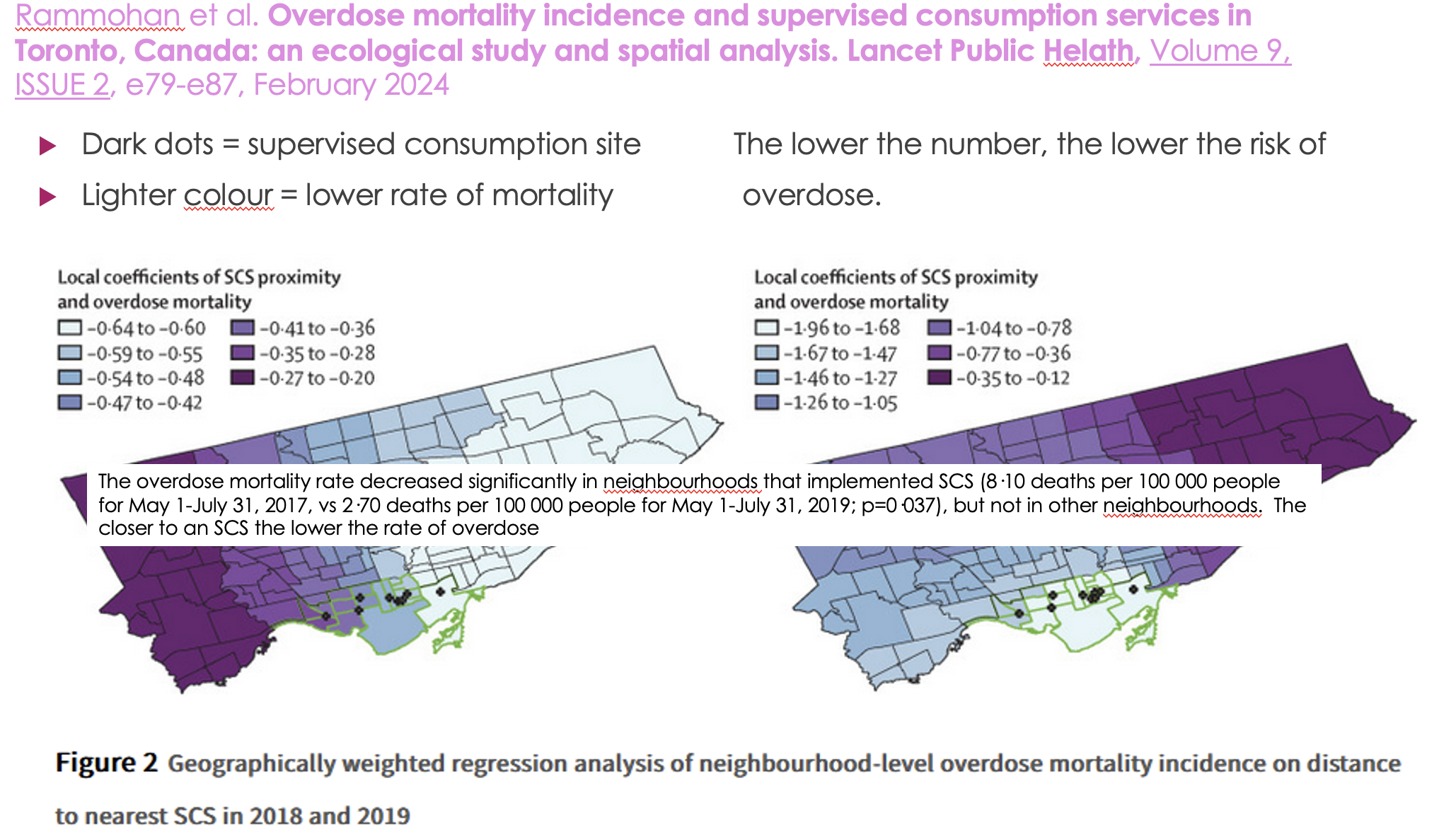
· Spatial analysis: risk of OD happening depending on far it is from the supervised consumption site; overdose mortality risk decreased significantly in neighbourhoods that implemented SCS, but not in other neighbourhoods
· 2018: west end was still associated with an greater risk; odds were lowered but not that much
· 2019: complete shift; showing effectiveness in reducing mortality rates
elaborate on HART Hubs
· Shifted focus from safe consumption sites to these hubs that provide housing and mental health support too
· Do not offer safer supply, supervised drug consumption, or needle exchange programs
what did the Gomes and colleagues study look at/ its purpose?
safer opioid supply (SOS) program
provide prescribed pharmaceutical opioids (usually daily‑dispensed hydromorphone) to people at high risk of overdose as an alternative to the dangerous, unpredictable street drug supply.
· Key features:
o Prescribed opioids replace toxic street fentanyl products; slow-release oral morphine
o Delivered through health centres that also provide wrap-around supports
Purpose: Reduce overdose deaths and improve health by offering a controlled, safer alternative to the unregulated drug supply.
what were the results of the Gomes and colleageus study?
o Small sample (within one year)
o ER visits reduced by 31%
o Didn’t look at changes to addiction or dependence, social factors like relationship/employment (just looked at cost, next step would be to look at the social factors that might be influenced)
ALSO:
•Hospital admissions ↓ 54%
•Hospitalizations for new infections ↓ 49%
•Health‑care costs (hosp/emerg) ↓ sharply (from $15,635 to $7,310 per person‑year)
No Increase in Major Harms:
•No opioid‑related deaths
•No significant rise in infections
what is decriminalization?
· Rules and exemptions of the CC
o Requires a requested exemption
· Police-based approaches to dealing with drug use
· Controls over how much and where drugs can be carried or used
o Cutt-offs on quantities that can be carried without arrest
o Public spaces vs private residences
what did the scoping review of the drugs look at?
o Evaluating discrimination policies by substances
o Most studies focused on cannabis
o What percentage of studies looked at these outcomes of policies?
§ Only 4 studies looked at justice involvement
§ Most studies just looked at the frequency of drug use
o So that means our evidence base is still low
true or false, the most common drugs of abuse are not already legl
FALSE
Most common drugs of abuse are those already legal: alcohol, cannabis, tobacco, cannabis
· Principle investigator of survey is a psychiatrist in Ibiza so maybe that’s why MDMA numbers are so high…
what did the study by Hulme and colleagues look at?
· Mortality risk for alcohol in Ontario (Hulme et al., 2020)
o Survival analysis, looking at probability of some event happening over time by some group
o Data at baseline based on the number of times someone showed up at ER due to alcohol
o The time from their most recent ER visit, with 5, your likelihood of survival one year after is 3.5%
o So ER is an important point of intervention, and those who use alcohol are at risk of mortality for a number of different reasons (mental health or behavioral disorders, suicide, GI issues, accidents)
· So what? Evidence base for understanding risk of substance, conveys magnitude of issue to policy makers
what did mcgukin and colleagues look at in regards to cannabis?
trends in cannabis use in inpatient psychiatry in ON PRIOR to legalization
Percentage of people using within 30 days off admission: increases by age
· Prior to legalizing, there was already an increasing proportion of people using cannabis – a population shift already under way
· Health Canada on medical cannabis – exploited around 2012, when a lot of storefronts opened; grey area
· The trend continued to increase after legalization except in older people
what did Myran and colleagues look at in regards to cannabis and psychosis?
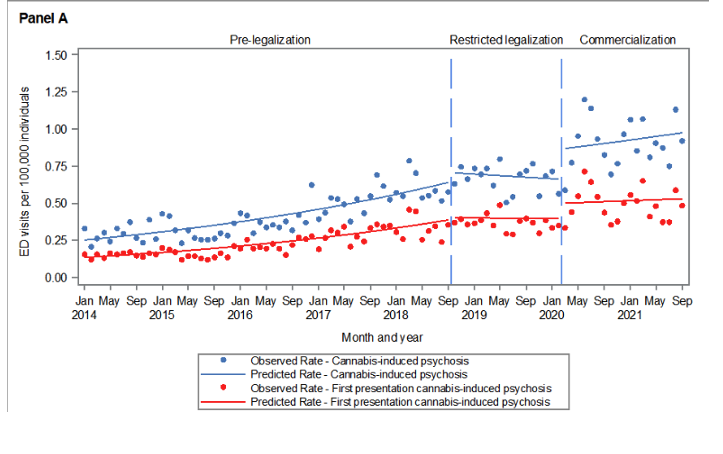
rate of cannabis induced psychosis in ON ER
· ER data
· Interrupted time series
o Discontinuity with legalization; if sig, the policy had an impact
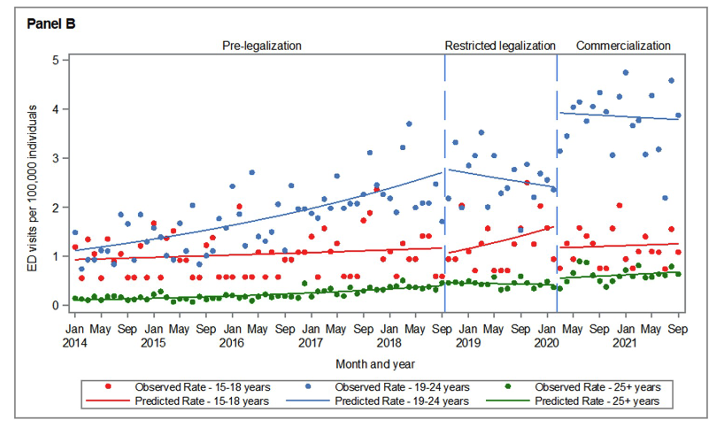
· Rate of cannabis-induced psychosis in Ontario emergency departments
o Increased a little but then decreased for cannabis-induced psychosis
o With commercialization, the rate jumped substantially (policy had a negative impact)
· By age, the under 18 group, it started to have an impact in late legislation
what is a whole systems approach?
· A horizontal integration of strategy- esp when thinking of a system related to substance use
o Prevention: preventing problematic drug and substance use
o Treatment: supporting innovative approaches to treatment and rehabilitation
o Harm reduction: supporting measures that reduce the negative consequences of drug and substance use
o Enforcement: addressing illicit drug production, supply and distribution