Ch. 10 bio ess
 Call Kai
 Learn
Learn Practice Test
 Spaced Repetition
 Match
Match Flashcards
 Knowt Play
1/19

There's no tags or description
Looks like no tags are added yet.
Name | Mastery | Learn | Test | Matching | Spaced | Call with Kai |
|---|
No analytics yet
Send a link to your students to track their progress
20 Terms
photochemical smog
Concentrations are elevated by hot, sunny days
A reaction between pollutants and atmospheric compounds that creates over 100 different chemicals
Most pronounced in cities prone to inversion events:
Stratospheric ozone depletion
Increases exposure of organisms to ultraviolet light
Caused by halocarbons, such as chlorofluorocarbons (CFCs)
Montreal Protocol aimed to reduce emissions that cause this
acid deposition
Leaches plant nutrients from soils
Forms from emissions of sulfur dioxide
lead
Before the 1980s, gasoline combustion was a major source of this pollutant.
tropospheric ozone
This pollutant's chemical structure is three bonded oxygen atoms. Its concentration is strongly influenced by sunlight levels and air temperature.
particulate matter
Pollutants in this category are classified according to diameter.
carbon monoxide
This pollutant deprives organisms of oxygen by binding to the hemoglobin in red blood cells
nitrogen dioxide
This pollutant contributes to the formation of photochemical smog and acid deposition
sulfur dioxide
A very high percentage of the emissions of this pollutant comes from coal combustion
(Based on the video in the chapter)
Which of the following has contributed to longer life spans in the United States?
decreased air pollution
improved health care
improved diet
(Based on the video in the chapter)
On average, it appears that over the past 25 years, improved air quality in the United States has resulted in __________ in the lifespan of the average individual.
an increase of about five months
(Based on the video in the chapter)
Based strictly on increases in air pollution over the past few decades, where would we expect to see the greatest decrease in life spans? We would expect to see a decrease in life span in __________.
Beijing, China
(Based on the video in the chapter)
Which of the following describes the greatest health risk posed by air pollution? Air pollutants __________.
damage blood vessels in human lungs
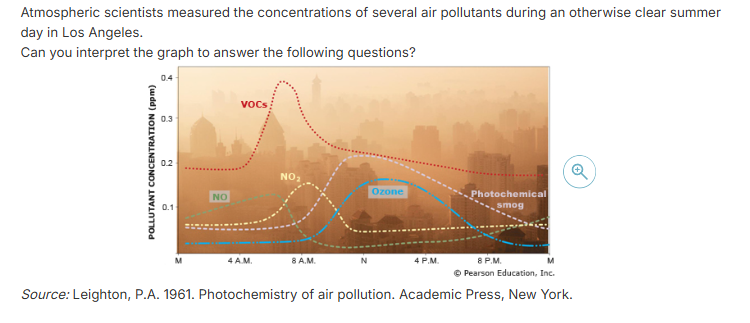
What does the y-axis show?
concentration of pollutants, in parts per million
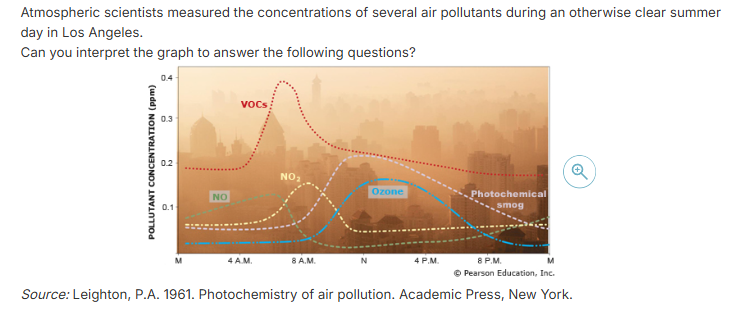
What was the concentration of volatile organic compounds (VOCs) at 8:00 A.M.?
0.35 ppm
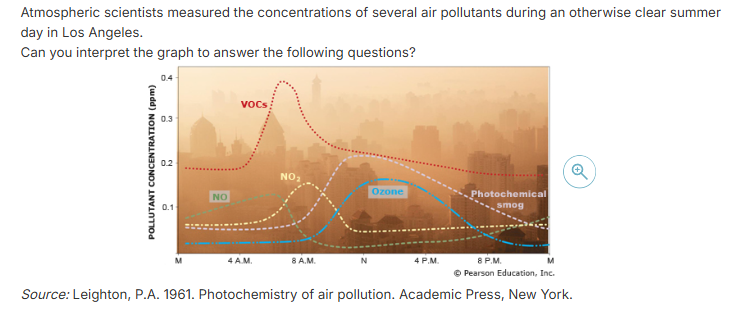
What is most likely to have caused the increase in atmospheric nitrogen oxide (NO) between 4 A.M. and 7 A.M.?
exhaust from vehicles during morning rush hour
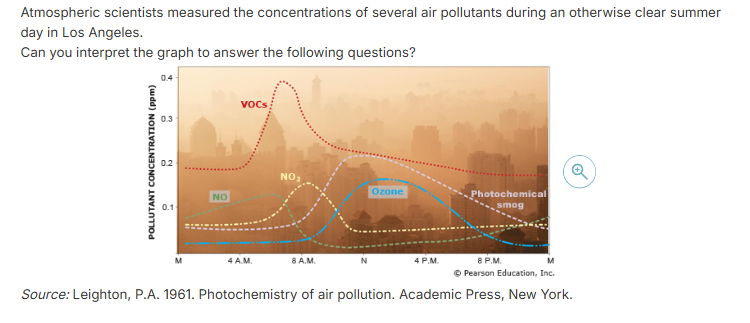
In which period was the concentration of photochemical smog highest?
11:00 A.M. to 3:00 P.M.
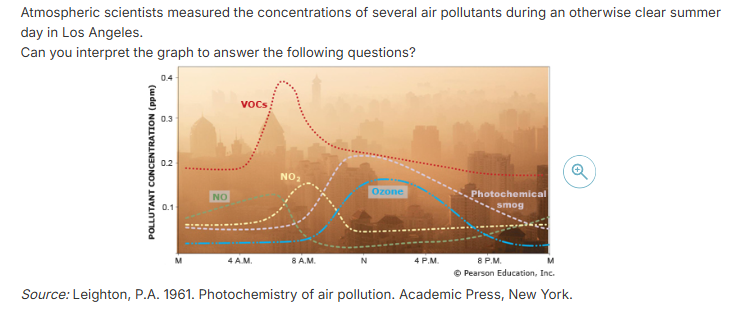
What is most likely to have caused the rapid increase in photochemical smog between 8 A.M. and 11 A.M.?
reactions of nitrous oxides (NOx) and VOCs with oxygen in sunlight
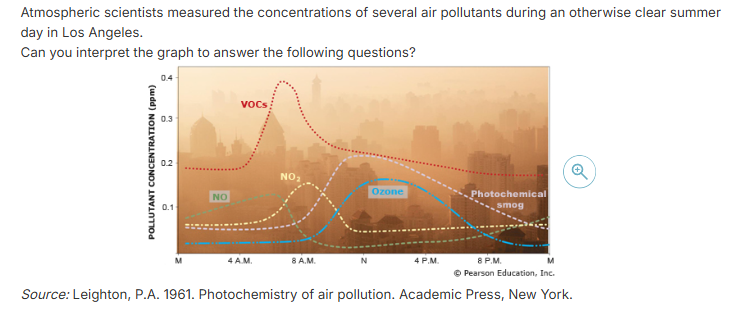
What is most likely to have caused the levels of ozone and photochemical smog to decline after 4:00 P.M.?
The production of smog declined as the amount of sunlight decreased.
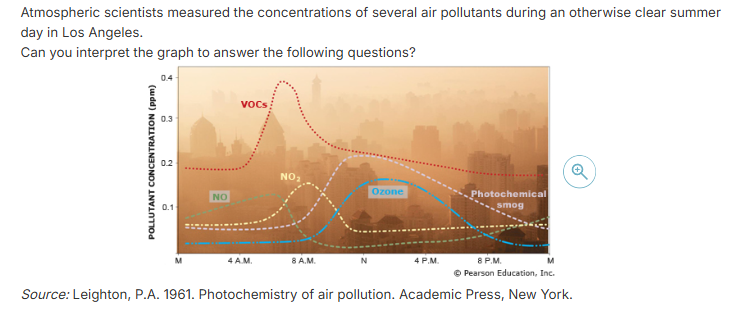
Which of the following factors would be most likely to lead to an overall increase in the level of photochemical smog?
a temperature inversion