HON IM1 2nd Sem Review
 Call Kai
 Learn
Learn Practice Test
 Spaced Repetition
 Match
Match Flashcards
 Knowt Play
1/28

There's no tags or description
Looks like no tags are added yet.
Name | Mastery | Learn | Test | Matching | Spaced | Call with Kai |
|---|
No analytics yet
Send a link to your students to track their progress
29 Terms
Matrices(1 dot)
.
Rule for if it is able to be a matrix:
if the 2nd number for the 1st matrix and the 1st number for the 2nd matrix dimensions match, they can. It would be the 1st number for the 1st matrix times the second number for the second matrix dimensions.
Ex: 2 × 3 by 3 × 5
=2 × 5 Matrix
4 × 2 by 2 × 7
=4 × 7 Matrix
Multiplying Matrices
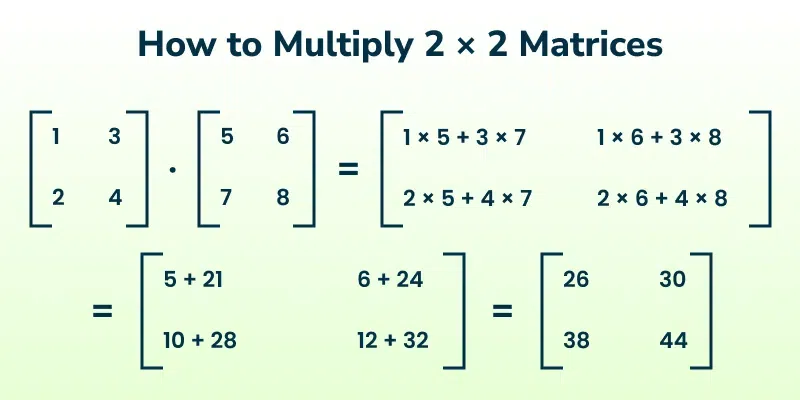
To multiply two 2×2 matrices, multiply the rows of the first matrix by the columns of the second matrix, adding the products together.
Ex:
Determining Functions through Vertical Line Test
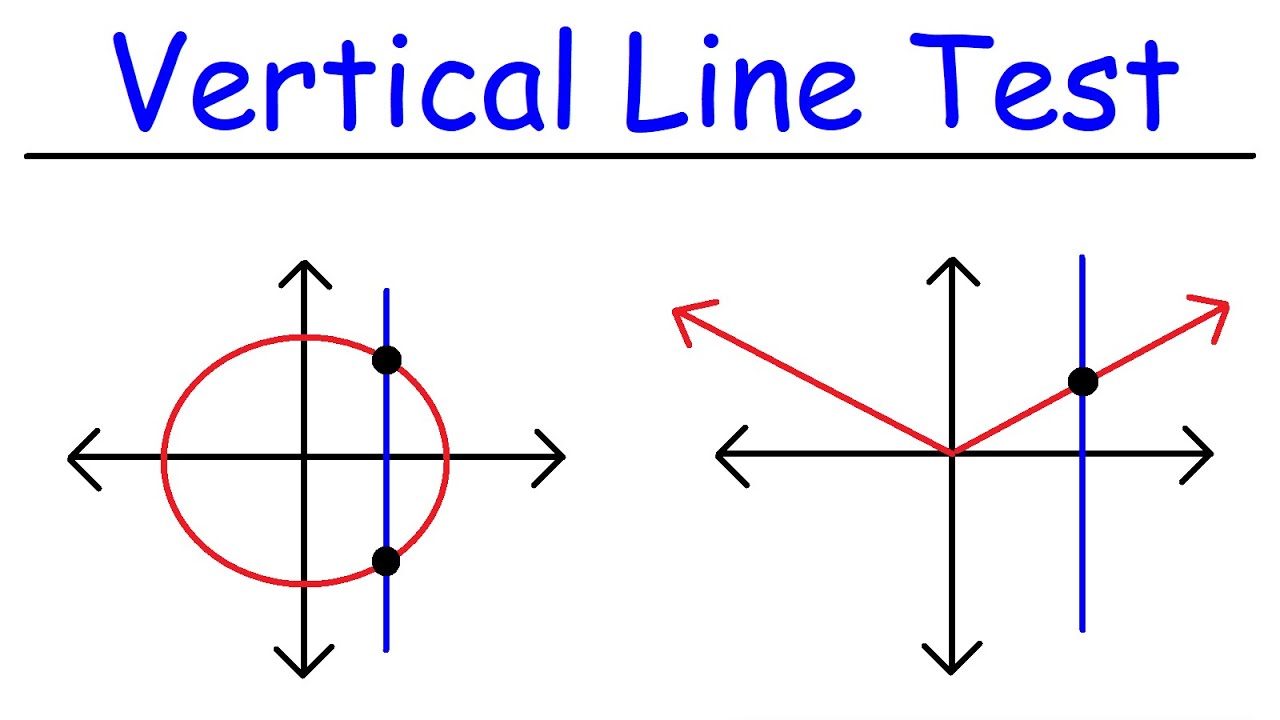
The vertical line test determines if a graph represents a function. If you can draw any vertical line that intersects the graph more than once, it is not a function. If every vertical line intersects the graph at exactly one point (or zero points), it is a function.
Ex: So based on the image, the one on the left would not be a function because it has two points on the same line, while the one on the right would be a function because it has one point on it’s line.
(It isn’t the fact that the function has many points that it is not a function, functions can have many points, but they just CANNOT be on the same line.)
Vertical Line Test trick(must pay attention)
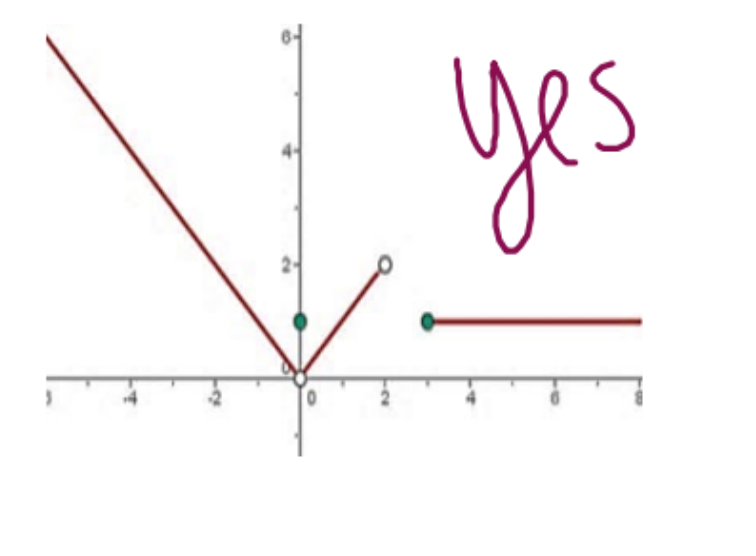
Even though for this function, there were two points on the same line, it was still counted as a function by the math teacher. Why? Because one point is shaded while the other is not shaded.
POINT OF NOTE: *If there is a shaded point and a not shaded point on the same line, and the rest of the function is valid with the vertical line test, it will not be disqualified as a function because those two points aren’t the same input. It is still a function.*
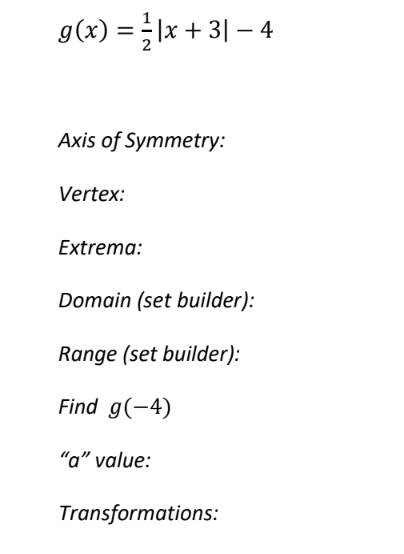
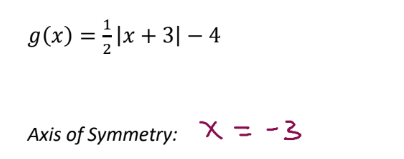
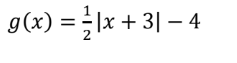
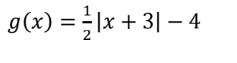
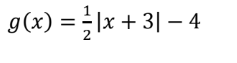
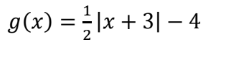
Finding these terms with example g(x)=1/2|x+3|-4 (2 dots)
..
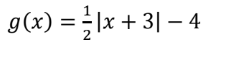
Axis of Symmetry:
Axis of Symmetry = The x value, which is always flipped.
So in this case it is -3, because it was 3 in the problem.
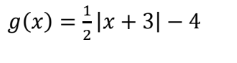
Vertex
Vertex = x and y coordinate. X remains the opposite, while y is what it shows outside the absolute value.
So in this case it is (-3,-4)

Extrema
Extrema = Either the minimum or maximum y value that shows on the outside of the absolute value.
So in this case, it is min at -4, when x=-3 because -4 is the y value shown outside -3(the x value). The extrema will only be the y value, and it is minimum because y is a negative number(-4). If y was positive, it would be maximum instead.

Domain(set builder)
ALL Real numbers

Range(set builder)
Range = The motion of y after extrema(either minimum or maximum).
Finding extrema is important, because it helps to find the RANGE. In this case, the range is y>=-4, because the extrema was minimum. Because it is minimum at -4, the y value, it goes up. If it were maximum at a y value, it would go down.

“a” value
The number all the way to the left outside the left bar of the absolute value.
In this case, it is 1/2.

Transformations(3 dots)
…
Vertical Stretch
When a is greater than 1, graph becomes taller
Ex: a=3
Vertical Compression
When a is less than 1, graph becomes shorter
Ex: a=1/2
Vertical Reflection
negative in front of the a value, flips graph upside down.
Ex: -3
Horizontal Stretch
Reciprocal of value in front of x
Ex: In the function h(x)=1/6 × 5^1/2x +1
1/2x = 2, so it would be a horizontal stretch. Horizontal stretch is ALWAYS THE Reciprocal
Horizontal Compression
Reciprocal of value in front of x
Ex: In the function g(x)=1/5 × 7^3x+4
3x=1/3x, so it would be horizontal compression. Horizontal Compression is ALWAYS THE Reciprocal.
Horizontal Reflection
Negative in front of x value
Ex: h(x)=1/6 × 5^-1/2x +1
(Bolded is the reflection)
Horizontal Shift
left/right
Vertical Shift
up/down
Sequences(4 dots)
….
Arithmetic Sequence
An Arithmetic sequence is a sequence with a constant d value in the equation. D is only for adding or subtracting
Ex: 6, 3, 0, -3, -6( minus 3)
7, 14, 21, 28, 35(add 7)
Arithmetic Sequence Rule
The d value must be continuous. It doesn’t depend on pattern, it depends on continuity. Although for example: 6, 11, 17, 24 follows a pattern of adding 1 to the value before, it is NOT arithmetic. It goes from 5, to 6 to 7, which isn’t continuous. This is NOT arithmetic, Arithmetic must be continuous.
Geometric Sequence
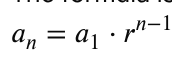
A Geometric sequence is a sequence with a constant r value in the equation. R is for multiplying and dividing
Ex: 5, 10, 20, 40(times 2)
Ex: 100, 10, 1(divide by 10)
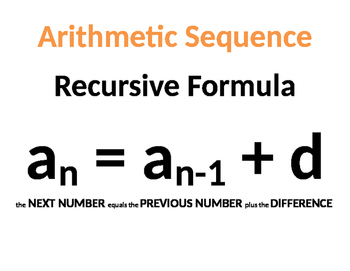
Recursive Formula Arithmetic
an=an-1+(common difference)
a1=(1st term)
Ex: -10,-4,2,8,14
an=an-1+6
a1=-10
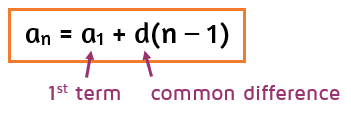
Explicit Formula Arithmetic
an=(first term) +/-(common difference) n-1
Ex: -10,-4,2,8,14
an=-10+6(n-1)
an=-6n-16(simplified)
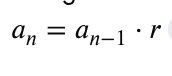
Recursive Formula Geometric
an=an-1(common difference)
a1=1st term
Ex: 1,3,9,27
an=an-1(3)
a1=1
Explicit Formula Geometric
Ex: 12,6,3,1.5
an=12(1/2)^n-1