Literary Technqiues from LitCharts
 Call Kai
 Learn
Learn Practice Test
 Spaced Repetition
 Match
Match Flashcards
 Knowt Play
1/33

There's no tags or description
Looks like no tags are added yet.
Name | Mastery | Learn | Test | Matching | Spaced | Call with Kai |
|---|
No analytics yet
Send a link to your students to track their progress
34 Terms
Diction
Definition: Diction means "word choice": the specific words that a writer deliberately chooses to use in a piece of writing.
Analysis Advice:
The rules of diction 1. Never analyse boring words. 2. Always analyse interesting words.
Diction itself is not what’s important.
Every word has a denotation (i.e., a boring, literal meaning found in the dictionary) and connotations. A word is interesting if it has interesting connotations.
Take the word "gold" as an example.
Denotation: "a yellow precious metal, the chemical element of atomic number 79" Yawn. The word “gold” obviously means a lot more to us than just its boring denotation. The word “gold” instantly makes us think of: wealth, money, luxury, prestige, royalty, quality, beauty, perfection, big fat Rolexes.
These ideas, feelings, and impressions that we naturally associate with certain words are called connotations. Denotation is what the thing literally means; connotation is what we think and feel about that thing.
connotations are often linked to the culture, for example dark is culturally always been associated with evil, in another world light might be associated with evil, but that's not this world.
to refer to it (adjective of noun) diction. The same rule applies to tone, atmosphere and mood.
The author characterises “the town” to be “infested” with criminals. Here, the deliberate use of animalistic diction in “infested” serves to dehumanise the “thieves and smugglers” as creatures comparable to cockroaches or rats, which evokes a sense of disgust in readers. The animalistic diction thus captures the squalid, corrupted state of this “town” and builds an unsettling atmosphere.
Modality
Modality is a measure of certainty, and it's expressed through words like these.
→ Differences in Modality.
High Modality
must
should
need to
have to
certainly
Low Modality
might
could
perhaps
maybe
if
Effect of Modality
High modality creates an authoritative and certain tone, which makes a person seem superior, arrogant and/or decisive. Low modality creates an uncertain tone, which makes the person seem inferior, considered, and/or indecisive.
When do we normally analyse modality?
1. In relation to the narrator or speaker.
2. In relation to a character.
3. When people are trying to persuade you (e.g. advertisements, posters, infographics, speeches)
For literary works:
we often analyse modality in the dialogue between characters, but also in the inner thoughts (fancy term: internal monologue) of characters. a low modality is also used to show internal conflict, when the character can't decide between different choices.
Analysis Advice
always add the adjective "high" or "low" in front of "modality". Never use "modality" by itself, as a 'naked' modality makes absolutely no sense...
Connect the use of modality to a tone. Your teacher will love this.
High and low modality are often used in themes related to superiority / inferiority, authority / oppression, and in the purpose of characterisation. We explain more about characterisation in a later lesson.
Imperative language
Definition: Imperative language is simply an authoritative command.
Details:
It's very closely related to high modality. In many cases you will see the combined use of high modality and imperative language in the same quote--especially when a character is being very bossy.
Analysis Advice:
In literary works, the writer uses imperative language in a character's thoughts and dialogue to construct tone, which in turn is used to characterise that person. → Characterisation is a key purpose--a core part of the Diamond Analysis Formula (previous lesson).
Tone of individual, anyway, also layered analysis - from tone to characterization
In non-literary works, look for 'Call-to-Actions'. Typically, these are buttons on websites, or highly noticeable commands in the footer on advertisements. Imperative language is almost always used here to propel viewers to take action.
Voice
There is a voice talking to you. And that voice can be in different 'modes':
• "first person"
• "second person"
• "third person"
→ The voice can also shift back-and-forth between the three voices throughout a single text
Voice is about narrator and reader relationship, not necessarily when characters WITHIN the novel are interacting
First person
Definition: The narrator or speaker refers to himself/herself using first person pronouns “I”, “us”, and “we”. It's important to notice when the writer uses “us” or “we”, because they are called inclusive language.
Analysis Advice:
Inclusive language has two distinct effects on the reader
To create a closer relationship between the reader and the narrator or speaker.
→ For example, Obama refers to his audience as "we" in his speech on the Oregon shooting, one of the practice papers, in order to show that he is empathizing and suffering with his audience, making him appear more trustworthy and likeable.
Inclusive language brings the reader into the immediate situation and emotions operating within the scene. For example, first person voice works really well with imagery to create a vivid impression of a physical scene.
→ again layers of analysis - voice AND imagery
Second person
Definition: When the narrator or speaker directly addresses you, the reader/audience, through the second person pronoun “you.” This technique is also called “direct address”.
→ Detail of Tone.
About 50% of the time, especially in literary works, the second person voice is used to create a confronting or accusatory tone
Because it singles out the reader and points a finger at them, making them feel like they did something wrong.
Analysis Advice:
Talk about how second person voice influences the tone of a piece of writing.
So don't spend too much time on second person voice in your analysis. It should be the 'cherry on top' that bolsters and strengthens another stronger technique.
Direct address often creates the emotional effect of guilt and discomfort in the reader.
The visual equivalent of second person voice is the gaze of a person!
→ Detail of Persuasion.
Now, for the other 50%, the second person voice is leveraged in the realm of persuasion
The use of "you" GRABS PEOPLE'S ATTENTION, since people care about themselves a lot
Analysis Advice:
The use of direct address sucks attention from the viewer--this is the key effect of this technique. Remember to analyse the effect as taught in the Analysis Formula lesson.
For Language & Literature students: if you want to appear smart in your analysis, you can use the noun "copy" to refer to advertising and marketing language.
Third person
Definition: Third person voice is the ‘normal' voice that writers use for their omniscient, god-like narrator who can casually jump into any character's mind at any time.
Effect: detached, all-knowing, neutral, trusting nature - opposite of unreliable narrator
When the voice changes... :O
the mode of voice is not stagnant, they can change all the time and that in itself is a literary technique - it has an effect
Voice gets really interesting when the writer suddenly transitions between first and third person.
outline of an example:
1. The text starts off with one type of voice such as first person. The use of “us” and “we” includes the reader and makes them feel a sense of belonging.
2. Then the writer sprinkles in “they” here and there--that's called 'exclusive language'. The third person pronoun “they” often refers to other characters who might be enemies or belong to different social groups.
3. The ultimate result of transitioning from first to third person voice is to create an ‘us versus them' mentality, thus building themes such as conflict and disagreement (aka rich ideas).
→ Builds a contrast or juxtaposition, and deepens the message and effect for readers
Analysis Advice:
Look for voice changes! They are a goldmine, and give you lots of hints about the authorial intent. It's an open window into the mind of the writer.
Voice changes are extremely potent ingredients for analysis. It's rocket fuel for reaching the Land of the 7. When you find something like this in a text, please analyse it.
Allusion
Definition:
When a writer allude
s to something, the writer makes a passing reference to a historical event, a work of literature, a religion, or a cultural tradition. Basically, an allusion is a bit of information that:
1. is external to the current text, and
2. contains rich meaning to those who are familiar with the reference.
Effect!
adds deeper layers of meaning that otherwise couldn't be easily achieved.
The allusion plants richer connotations and meaning into the story because it's taking all the notions and associations that we have.
The allusion plants richer connotations and meaning into the story because it's taking all the notions and associations that we have.
Analysis Advice:
First, explain the meaning, connotations, ideas and feelings associated with the alluded concept, event, person or culture.
Next, relate these meanings and associations to the current situation in the text. → this is basically the link to relevancy.
→ In the ice skating example, we would analyse the use of allusion by saying that the allusion amplifies the fearful tone of the narrator. The allusion also highlights the apprehension and guilt of the narrator, to the point that he physically, and psychologically, becomes a stone that cannot move as a result of shock, shame and fear of his consequences. → the allusion is about medusa
Figurative Language
Definition: Figurative language shouldn't be taken literally. It's supposed to give the reader an abstract idea of something: a mental image, a feeling or an emotion.
Metaphor
Definition: Metaphor is the technique we talk about when a writer directly compares any one thing to any other thing in an attempt to bring out a common characteristic.
For example, we might have a very calculating character, and we want to emphasise this quality. We can use metaphor!
What non-human thing, animal or object gives the impression of always being alert?
→ An owl comes to mind, specifically an owl's eyes, which are watching even in the stillness of the night. → “His owl eyes scanned from left to right and back, searching, scanning, seeing.”
extended metaphor
Definition: What if a metaphor continues longer, perhaps over a whole stanza or even an entire poem or short story?
In Bruce Dawe's poem Happiness is the Art of Being Broken, the image of a fragile bottle floating in a wild sea is an extended metaphor for life and the difficulties we face. I have to say that ocean metaphor is pretty deep…
Analysis Advice:
When you find a simile or metaphor in a text, you'll generally be able to analyze diction and imagery as well.
Similes and metaphors have interesting diction because the metaphor must have interesting connotations, otherwise the writer wouldn't use the metaphor in the first place!
→ For example, in the metaphor "His owl eyes", the "owl eyes" is the metaphor itself, but the animalistic diction in "owl" also has a lot of interesting connotations (alertness, a large size, etc.).
So don't forget about connotations!.
→ One simple way you can weave it all together is something like this: The writer's use of the metaphor "owl eyes" suggests / connotes / implies the alertness, thus...
Notice how you don't actually need to mention 'diction' to analyze diction. It can be subtle.
If the simile or metaphor is particularly detailed, then imagery is also likely to be present.
Simile
Definition: A simile is also used to highlight a certain characteristic of an object by comparing it with something else. A simile must use “like” or “as” to compare two things, so a simile is an indirect comparison between two things, whereas a metaphor is a direct comparison: the warrior is a mountain.
Analysis Advice:
When you find a simile or metaphor in a text, you'll generally be able to analyze diction and imagery as well.
Similes and metaphors have interesting diction because the metaphor must have interesting connotations, otherwise the writer wouldn't use the metaphor in the first place!
→ For example, in the metaphor "His owl eyes", the "owl eyes" is the metaphor itself, but the animalistic diction in "owl" also has a lot of interesting connotations (alertness, a large size, etc.).
So don't forget about connotations!.
→ One simple way you can weave it all together is something like this: The writer's use of the metaphor "owl eyes" suggests / connotes / implies the alertness, thus...
Notice how you don't actually need to mention 'diction' to analyze diction. It can be subtle.
If the simile or metaphor is particularly detailed, then imagery is also likely to be present.
Personification
Definition: personification gives human characteristics to non-human organisms or objects.
Analysis Advice:
When you analyze, keep this in mind. Personification is most commonly used to:
1. make the setting come to life, and hence create an atmosphere
2. evoke emotion from the reader, and hence create a mood
Pathetic fallacy
definition:
Pathetic fallacy is the embodiment of a human emotion in a natural element like the weather, or the seasons, or the environment.
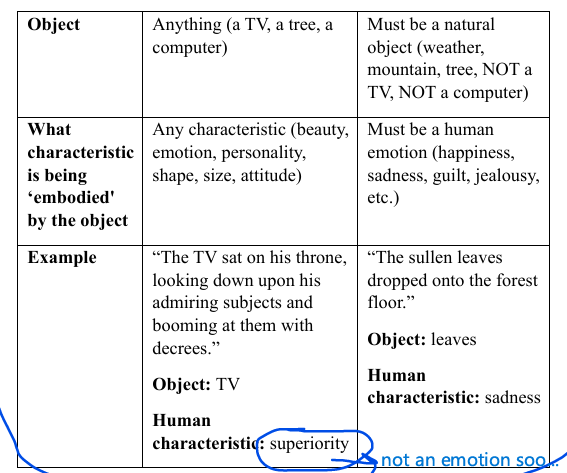
Distinction between Pathetic Fallacy and Personification
Personification
• When you personify an object, the object can be anything: natural or man-made. Also, the personified object can have any human characteristic: beauty, emotion, personality, attitude, appearance, etc.
Pathetic fallacy
• When you use pathetic fallacy, the object can only be a natural object: weather, a mountain, a tree, but not a computer and certainly not a TV.
• The object can only embody a human emotion like happiness, sadness, guilt, jealousy, etc.
The moment you give the object a characteristic unrelated to emotion, it's no longer pathetic fallacy.
so it would just be personification.
Imagery
The 7 types of imagery:
1. Auditory imagery for sound
2. Olfactory imagery for smell
3. Gustatory imagery for taste
4. Tactile imagery for touch
5. Thermal imagery for temperature
6. Kinaesthetic imagery for movement
7. And of course visual imagery for vision
Purpose and effect
To create a vivid, clear mental image in the reader's mind about a particular scene, character or object.
Imagery is about using the senses to make the words come to life. It's like dropping the reader directly into the physical scene that is being described, and this allows the reader to experience everything that the narrator sees, hears and experiences as well.
In general, the purpose of imagery is to amplify the reader's experience of sensations and emotions.
Analysis Advice:
Silence counts as auditory imagery.
Imagery is often used to establish the physical setting of a prose extract or poem and, by extension, the atmosphere of the text. → layers of analysis.
When you analyse imagery, try to imagine the physical scene in your mind, and think about why the writer has constructed the scene in this way, linking the use of imagery to the authorial intent. LIVE IT, BREATHE IT, FEEL IT.
Symbol
Definition:
A symbol is an object or character that represents an abstract idea.
→ linked to connotations, meanings created due to culture.
examples of symbols!!!
In Star Wars, light and darkness represent good and evil, respectively.
In The Great Gatsby, the iconic green light represents the American Dream.
In Macbeth, King Duncan represents goodness. → characters can also be symbols
In Eveline, a prose extract that we will analyse, we see the symbol of the "iron railing." Stay tuned for that lesson!
Analysis Advice
The purpose of symbolism is to add deeper layers of meaning to a text, which means symbolism will almost always give you deep analysis.
So if you find symbolism in a text, make sure you analyse it. It's one of those rare catches that will instantly level up your analysis.
Analysing symbols is also linked to analysing diction and connotations.
MOTIF
Definition: A motif is a recurring object that an author uses to develop a central theme or idea.
Distinction between Symbol and Motif. A motif is essentially an object that keeps being repeated and brought up again and is linked to a central theme.
A symbol is also an object, but:
It doesn't need to be repeated throughout a literary work. A symbol can appear once and never show up again in the rest of the text.
It doesn't need to contribute to a central theme. A symbol can represent any abstract idea or theme, no matter how significant or insignificant that theme is to the whole text. This seems like a really weird difference, but that's how people before us have chosen to define things!
Common motifs to look for include:
nature (e.g., trees, stars, the sky)
animals (e.g., the rabbits in Steinbeck's 'Of Mice and Men', which represent the American Dream)
quirky objects (e.g., the green light in 'The Great Gatsby', also representing the American Dream; cars to represent social status)
Analysis Advice
identify the motif and provide a quote
relate the motif to a core theme
explain why the recurring nature of this object effectively communicates this theme to the reader
as always, analyse the effect on the reader.
For the motif of blood in 'Macbeth', we could write: "In order to create a continuous source of eerie tension in the play, Shakespeare constantly dangles the notion of murder in the audience's mind through the recurring nature of the blood."
Colour
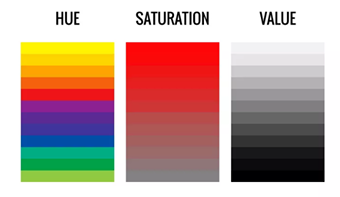
An analysis of colour can be multi-dimensional—covering not only the choice in colour, but also its appearance and effect. Within this visual technique, you can discuss features including:
Hue: refers to the colour itself (e.g. red, green, blue etc.).
Saturation: refers to the intensity of the colour.
Value/contrast: describes the difference between light and dark.
→ Firstly, the symbolic use of hues—red, white and blue—allows the author to pinpoint the intended audience, being Americans, forcing them to individually confront the dangers of consumerism within their own society.
What's more, the author's varied use of value within the subject's red coat creates a sense of filth and grime which not only repulses, but, to a certain extent, frightens audiences from the idea of consumerism within the context of the holidays.
Warm vs cool colours: reds/yellows vs. blues/greens
Headings
Headings are often used in a variety of text types—not only in written texts, but also in visual stimuli. Headings are great to analyse, and don't worry: You'll never miss them. (That's the point of headings.)
When analysing headings, you can discuss a lot of features surrounding it, including:
Type face
Font size
Colour
Weight
Analysis Advice.
The main purpose of headings is to capture the audience's attention.
Make sure you analyse the appearance of the heading and specifically why the heading is appropriate to the particular audience of the text (taking the audience into account is important for analysing any technique, actually).
For example, an advertisement targeted at children would use bright letters and interestingly-shaped font for the heading, as this choice of visual presentation is most suitable for the target audience.
With that said, don't just analyse the appearance! Every heading contains words, and all words contain meaning, so you should definitely use the literary techniques you learned in the previous section to analyse the meaning conveyed by the language in the heading. → diction, connotations, alliteration etc
Composition, Angle & Framing