WHB Final Exam v23: World Between the Wars
 Call Kai
 Learn
Learn Practice Test
 Spaced Repetition
 Match
Match Flashcards
1/43

There's no tags or description
Looks like no tags are added yet.
Name | Mastery | Learn | Test | Matching | Spaced | Call with Kai | Chat |
|---|
No analytics yet
Send a link to your students to track their progress
44 Terms
"If you woke up one morning and found that somebody had come to your house, and had declared that house belonged to him, you would naturally be surprised, and you would like to know by what arrangement." - Jomo Kenyatta
The attitude expressed in the above quotation most closely aligns with the goals of
African Nationalism.
The Mexican Constitution of 1917 Provisions:
1. Provided labor protections.
2. promoted land reform for peasants.
3. made Church land "the property of the nation."
4. allowed for stronger government control over the economy
The purpose of apartheid in South Africa was to
ensure white economic, political, and social supremacy.
Why was the protest showing image of Gandhi's Salt March an example of civil disobedience?
Marchers deliberately defied laws passed by the colonial government.
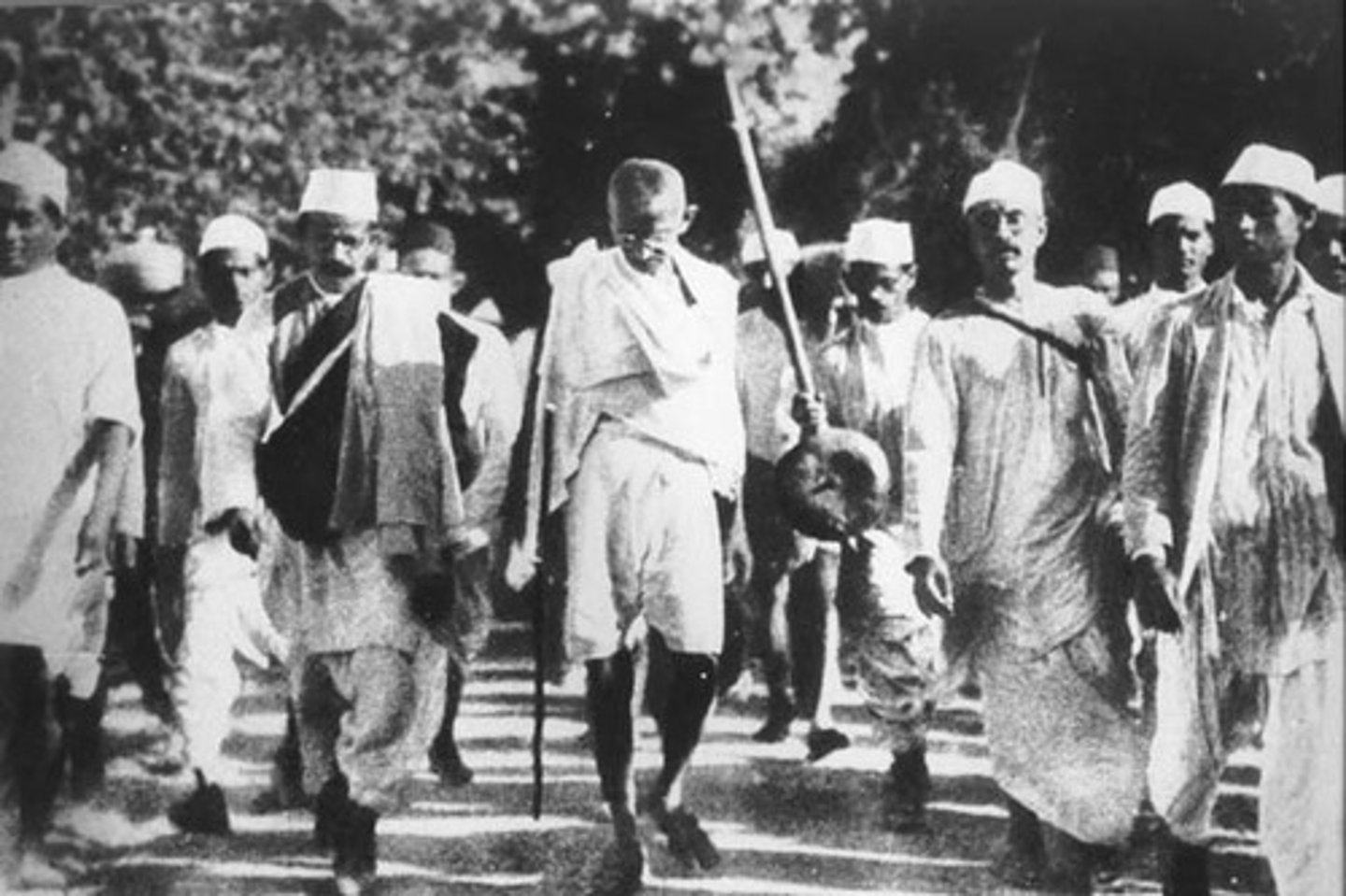
What did Turkish nationalists, led by Atatürk accomplish?
overthrew the Ottoman sultan and declared Turkey a republic.
Identify map of British and French Mandates in Middle East, including Palestine. What does this show impact of?
the Balfour Declaration.
In the long term, who benefited the most from the journey depicted by the red arrows traveling from South to North during Chinese Civil War in 1927-36?
the Communists under Mao Zedong
How did Mao Zedong differ from earlier Chinese and other Communists?
He believed that the Communists should seek support among the large peasant masses.
Based provided on map showing expansion of Japanese Empire, how did the growth of the Japanese Empire affect China?
China lost control of many of its eastern seaports.
Japan began an aggressive policy of imperialism in the late 19th and early 20th centuries because Japan. Shown with map
needed raw materials for its factories
Stalin's idea to create collective farms and later control industrial production is part of his
Five-Year Plans
Why would it make sense for Joseph Stalin to want to double the production of industry, especially coal, oil, and steel?
Stalin wanted his country to be able to produce more materials on their own, especially things that could be used in the military so Russia could catch up with the rest of the world.
Which of the following is the best example of a command economy?
Stalin's five-year plans in the Soviet Union
What was a key characteristic of fascism in the 1920s and 1930s?
supremacy of the state
What was the chief appeal of fascism to Italians after World War I?
It promised a strong and stable government.
"Either the government will be given to us or we shall seize it by marching on Rome." —Mussolini
What was the result of the action Mussolini describes here?
Mussolini was legally appointed to head the government by the king and became prime minister.
Why were Benito Mussolini and Adolf Hitler wanted as leaders in Italy and Germany
Mussolini and Hitler both offered a way out of the depression in their countries.
Adolf Hitler, Benito Mussolini, and Joseph Stalin were all totalitarian leaders. What is totalitarianism?
A government which all power is centralized and people are subservient to the state
Which time period in German history is most accurately represented in this map showing terroritorial losses at its borders?
Between World War I and World War II
This image of stacked German currency duirng the Great Depression illustrates the impact on Germany of
hyperinflation.
Which of the following best explains how the end of World War I affected Germany in the 1920s and 1930s?
Reparation payments led to the total collapse of Germany's economy.
"The National Socialist movement must strive to eliminate the disproportion between our population and our area." —Adolph Hitler, Mein Kampf
The above passage is most closely connected with which of Hitler's goals?
territorial expansion
What measure did the Nazis take that was a rejection of the Versailles treaty?
They rearmed Germany.
In a show of appeasement by Prime Minister Neville Chamberlain, the Munich Agreement promised a hollow peace in exchange for
Allowing Germany's capture of the Sudetenland in Czechoslovakia.
Once the Nazi-Soviet Non-Aggression Pact was signed, Nazi Germany and the Soviet Union invaded and conquered...
Poland
Adolf Hitler and the Nazi Party's despicable anti-Semitism meant that they had a personal hatred for which minority group? He blamed this group for Germany's problems.
Jews
Adolf Hitler in his book Mein Kampf describes his vision for the future of Europe, in which he wanted as a "living space" for a pure Aryan race. This was called
The Final Solution
In 1935, the Nazis passed the Nuremberg Laws which
took away rights from Jews, including depriving them of German citizenship.
Ex: Jews cannot legally acquire real-estate and mortgages. Identify based on provisions. These Nuremberg laws indicate a government policy of....
discrimination
The Kristallnacht was
a destructive Nazi rampage against the Jews.
"They broke our windowpanes, and the house became very cold. . . . We were standing there, outside in the cold, still in our night clothes, with only a coat thrown over . . . Then they made everyone lie face down on the ground . . . 'Now, they will shoot us,' we thought. We were very afraid." —Sophie Nussbaum
The incident described here was a key moment in Hitler's
campaign of anti-Semitism.
"The important lesson wasn't so much the Nazis' extraordinary evil but that it could happen with the participation of so many, the indifference of many more, that humanity has no guarantees against its vicious streaks except its own conscience, for which each individual is responsible...the effort for decency and justice must go on every day, everywhere."
In this passage, the term "extrordinary evil" refers to the
Holocaust
Which of the following best describes the Holocaust that took place in Europe?
The mass murder of 6 million European Jews, Romanies, homosexuals, and other persecuted groups by Nazi Germany.
Which are things Germans did to prisoners arriving in Auschwitz to keep them feeling less than human?
1. They made them strip naked and run to their new barracks.
2. They shaved off all of the hair on their bodies.
3. They gave them clothes that did not fit.
Heinrich Himmler and Reinhard Heydrich, two high ranking members of Adolf Hitler's evil inner circle, planned and orchestrated the "Final Solution." What is this?
The systematic murder of 6 million+ Jews and other Nazi "undesirables" in secret concentration camps and death camps.
What did the "selection process" determine?
Who would live and who would be sent to the gas chamber.
In Night, Why did Elie Wiesel & his father lie about their ages to Dr. Mengele?
So they wouldn't be killed.
The privilege of opening the first trial in history for crimes against the peace of the world imposes a grave responsibility. The wrongs which we seek to condemn and punish have been so calculated, so malignant, and so devastating, that civilization cannot tolerate their being ignored, because it cannot survive their being repeated. That four great nations, flushed with victory and stung with injury stay [stop] the hand of vengeance and voluntarily submit their captive enemies to the judgment of the law is one of the most significant tributes that Power has ever paid to Reason...
The wrongs referred to in this passage include
mass murder of Jews and others in concentration camps
Why was Germany hit particularly hard during the Great Depression?
Germany was forced to pay war reparations after World War I
What was one reason that the Great Depression spread quickly from the United States to other nations?
The United States tried to collect on debts owed by Germany, Great Britain and France.
The Versailles Treaty explained which of the following?
The Nazis rise in Germany

Why were the leaders of Western Europe surprised by the event addressed in this cartoon?
The ideologies of these two nations were at opposite ends of the political spectrum.

Which policy is associated with the historical episode described in the passage?
appeasement

What does this passage suggest about Neville Chamberlain’s action?
Judgments about events can shift with time.