Calculations(DO NIGHT BEFORE GUARANTEED)
 Call Kai
 Learn
Learn Practice Test
 Spaced Repetition
 Match
Match Flashcards
 Knowt Play
1/23

There's no tags or description
Looks like no tags are added yet.
Name | Mastery | Learn | Test | Matching | Spaced | Call with Kai |
|---|
No analytics yet
Send a link to your students to track their progress
24 Terms
What is RFM?
Relative formula mass is the sum of the relative atomic masses of all the atoms in the compound.
For example- Al2O3
(2x27)- there are 2 aluminiums + (16x3)- 3 oxygen= 102
What is a mole
A mole is a chemical amount, the symbol is mol.
THIS IS NOT A MOLECULE!!!
What is Avogadro's constant?
The number of particles in one mol
The number of particles are:
6.02 x 10^23
1 mol of a substance = The RAM of the substance in g.
For example 1 mol of helium = 4g( just its RAM).
What is the formula for a mole?
Mass = Mr x Mole
What is Mr
Mr is the mass of one mole of a substance.
How do you calculate percentage composition?
(Total number of atoms in element)/ (Total RAM of compound) x 100
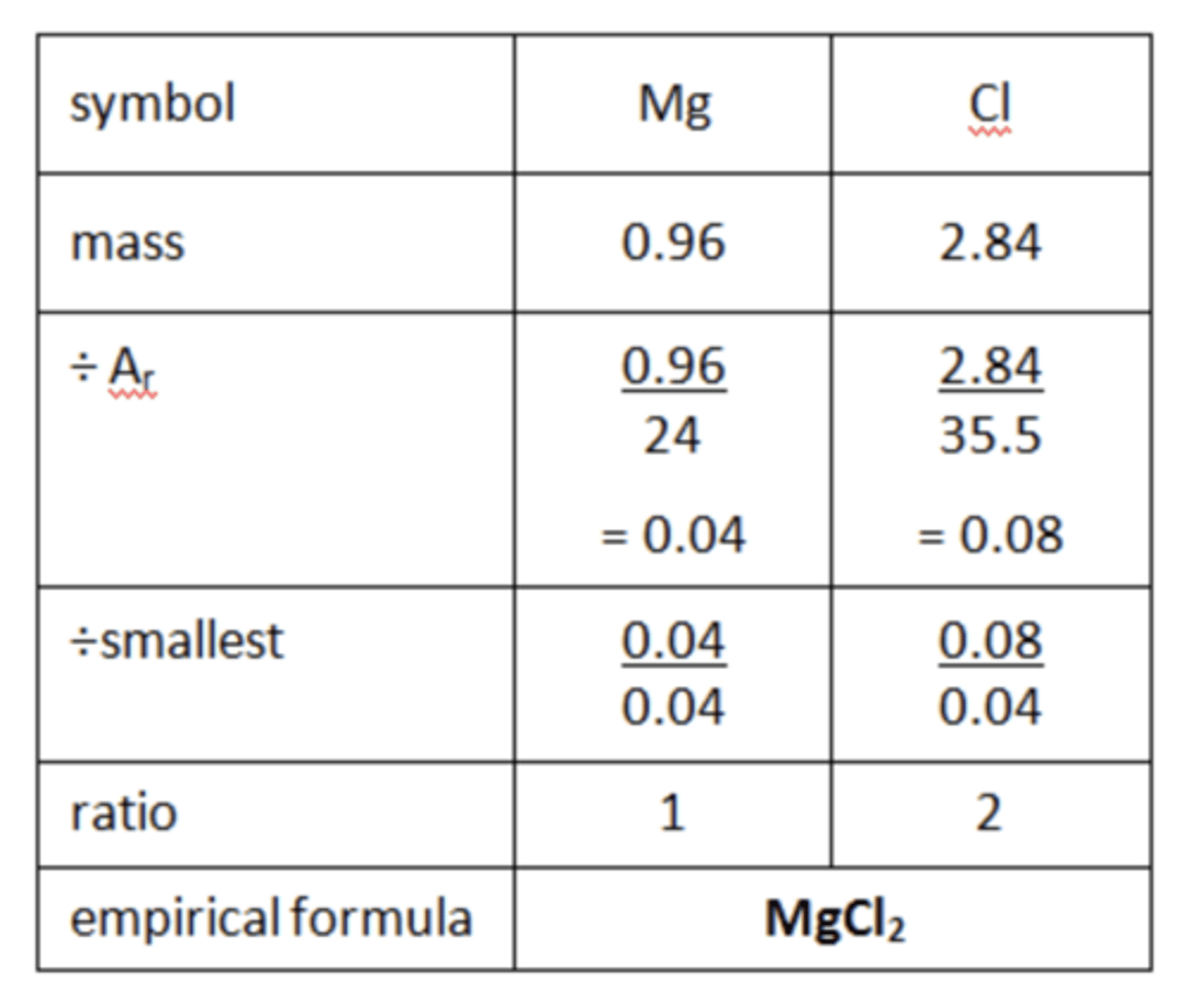
How do you calculate empirical formulae?
1. First, calculate the RAM of each element.
2. Then divide the individual g( mass) numbers by each RAM value you attain.
g(mass) number/ RAM
3. The smallest number that you get between the 2, divide that by both numbers again.
4. You will get the molar ratio, write down the answer.
Steps to find the Mass of Reactants.
1. Balance the equation if not balanced.
2. Calculate the RAM of the 2 elements.
3. Divide the RAM of the element you need to find/ the RAM of the element of the given measurement *mass of y
4. Write a sentence for your answer
Example:
107 is the RAM-->x 150 is the RAM--> y. y is 50g
107/150 * 50 = 35.7
50g of element y makes 35.7g of element x
What is theoretical yield?
Theoretical yield is the amount of product that should be formed in the experiment, through mathematical calculation.
What is actual yield?
Actual yield is the amount of product formed in the experiment
How do you calculate percentage yield?
Actual yield/ theoretical yield *100
What is an exothermic reaction?
A reaction in which energy is released.
What is an endothermic reaction?
A reaction in which energy is absorbed.
What do bond-enthalpy calculations provide us?
Whether a reaction is exothermic or endothermic.
If the answer obtained is negative, the reaction is exothermic
If the answer obtained is positive, the reaction is endothermic.
Steps for bond enthalpy calculations.
1. Write out the equation, and balance is needed.
2. Draw a line down from the products and reactants.
3. Draw the individual bonds of each compound.
4. Calculate the value of the bonds using the table provided.
5. Add together the total of the products and the total of the reactants.
6. Subtract the value of the reactants from the products, and write your answer in kJ/mol.
What is the formula linking concentration, volume, and number of moles?
n( number of moles) = concentration x volume.
What is concentration measured in?
mol/dm3
What is volume measured in?
dm3
How do we move from cm3 to dm3?
Divide the cm3 value by 1000.
What are the steps for the titration calculations?
1. First, balance the equation( if needed).
2. Find the ratio between the 2 elements.
3. Draw a table for the given measurements.
4. Use the formula n = c x v
5. Calculate the missing value, and add that to the table for the element that has missing measurements. This is based on the ratio.
What is the formula for volume in cm3 and dm3?
24000 x mole = volume( cm3)
24 x mole = volume ( dm3)
What is the formula for the number of particles in a molecule?
Avagadro's constant( 6.02 X 10^23) x mole
What is the formula for the atom economy?
Mass of the useful products// mass of reactants/products(choose simpler option) * 100