Corporate Finance
 Call Kai
 Learn
Learn Practice Test
 Spaced Repetition
 Match
Match Flashcards
 Knowt Play
1/110

There's no tags or description
Looks like no tags are added yet.
Name | Mastery | Learn | Test | Matching | Spaced | Call with Kai |
|---|
No analytics yet
Send a link to your students to track their progress
111 Terms
Sole Trader/Proprietorship:
No separate legal identity
Owner operated
Owner has unlimited liability
Profits taxed as personal income (pass-through)
Financed by owner’s access to capital
General Partnership:
No separate legal identity
Partners operated
Partners have unlimited liability
Profits taxed as personal income (pass-through)
Financed by partner’s access to capital
Limited Partnership:
No separate legal entity
General partner operated
GP has unlimited liability LPs have limited liability
Profits taxed as personal income (pass-through)
Financed by partners’ access to capital
Limited Liability Company:
Separate legal entity
Board and Management operated
Owners (shareholders) have limited liability
Profits taxed as personal income (pass-through)
Unbounded access to capital, unlimited business potential
There may be legal limits on number of owners, require a vote for transfer of ownership
Public Limited Company: coporation
Separate legal entity
Board and Management operated
Owners (shareholders) have limited liability
Profits taxed at corporate level (dividends taxed as
personal income)
No restrictions on ownership/transfer
Corporate Issuers
Corporations that raise capital in the financial markets are known as Corporate Issuers
Return on Equity
Net Income / Equity
Private Company:
Private Placements: Company raises capital from accredited investors
risks/terms outlined in private placement memorandum
Go Public : Initial Public Offering (IPO)
company raises capital from public
(private ➞ public) or direct listing : no new shares (no capital raised)
or SPAC : shell company raises capital via IPO then make an acquisition
[special purpose acquisition company]
or via acquisition
secondary offerings (secondaries) : Company raises capital from public
[secondary market: issued shares trade between market participants]
Public v. Private trends
many emerging economics have growing number of public
- high growth
- transition to open market structures
- foreign capital inflows
many developed economies have declining number of public
- mergers & acquisitions
- growing number of private capital sources
- preservation of ownership and control
limited parternership
2 level
one or more GP general partners operating the usiness and have unlimited liability.
but limited partners - only liable to the amount they invest(limited liability) dont invlove in appointing or removing GP.
GP have more profit distribution, taxed as personal income.
Free float
shares actively traded by investors
Shareholder Theory of Governance
- stakeholders only considered to the extent that they affect shareholder value
Stakeholder Theory of Governance
corporate governance should consider all
stakeholder interests
- ESG should be an explicit objective of the board
Primary Stakeholder Groups
Investors : shareholders , debtholders, Board of Directors
Board of Directors
Elected by shareholders to advance their interests
Independent Directors, Inside Directors
Inside Directors links to the company (includes founders and current, former manager.
Independent Directors - no material relationship with the company
- may better represent the interests of minority shareholders
Two-Tier Structure and Staggered Boards
Two-Tier Structure - separate supervisory board oversees board of directors
Independent Directors
Staggered Boards - groups elected separately in consecutive years
Limits the ability of shareholders to effect a major change of control
But, allows for continuity
Managers:
Led by CEO, determine and implement strategy and day-to-day operations
Stock based incentive plans align interests with shareholders
Employees:
Corporations rely on human capital of employees
May have equity via compensation, form unions to negotiate pay
Transition risk
Transition risks are losses related to the transition to a lower-carbon economy. An oil well may become a stranded asset due to government regulations or changes in consumer preferences that affect the price of oil or otherwise impair an issuer’s ability to fully realize the asset value. Physical risks include damage to property stemming from extreme weather, which is expected to increase in both frequency and severity due to climate change.`
Principal agent relationship
one part hires another to perform a task or service, can be present with or without a contract
conflicts - Shareholder v. Directors, Management
Information asymmetry reduces ability of shareholders to assess performance
increases with lower levels of institutional ownership, free float
Principal tool to align interests: compensation
But, interest may still diverge due to:
Insufficient Effort - Unable, unwilling to make investments, manage costs, make hard decisions
Too little monitoring of employees/controls ➞ Risks and Litigation
Too little time due to outside interests
Inappropriate Risk Appetite - Stock grants, options ➞ excessive risk taking
No stock grants, options ➞ risk-averse decision making
(Stockholder’s diversified portfolios increase risk tolerance)
Empire Building - Compensation tied to business size ➞ too many acquisitions
Entrenchment - Play it safe ➞ copy competitors, avoid risks, avoid speaking out
Self Dealing - Exploit firm resources ➞ perquisites (private planes, memberships etc.)
Smaller stakes, less cost to bear for management
Conflicts
Controlling v. Minority Shareholders
Dispersed Ownership: Many shareholders, none with control
Concentrated Ownership: Individual shareholder or group who can exercise control
= Controlling shareholders - can be a family, other companies,
Example Conflicts: Controlling shareholder: Founding family seeking diversification
Minority shareholders: Hold diversified portfolios - focus on max s/h value
Controlling shareholder: Long-term shareholder - multi-decade perspective
Minority shareholders: Seeking quicks gains via asset sales, cost cutting
Voting Schemes
Dual-Class Structure:
Class A: one vote per share, publicly held and traded
Class B: several votes per share, held by company insiders/founders
Corporate Reporting and Transparency
External stakeholders rely on corporate reporting for information on performance and
position investors rely on corporate reports to:
Assess company performance and that of its directors/management
Make valuation and investment decisions
Vote on key corporate matters or changes
Ensure compliance with legal commitments in debt contracts (via trustee)
Shareholder Meetings : Annual General Meeting (AGM)
discuss board elections, auditor appt., approval of F/S,
dividends, director and auditor compensation, equity based
compensation plans, “say-on-pay” non-binding votes on
compensation plans
Extraordinary General Meetings (EGMs)
called when resolutions requiring shareholder approval
proposed or by request by a specified minimum number/%
shareholders
special election, mergers, voluntary liquidation
Shareholder Activism:
Investor strategies to compel a company to act in a desired manner
Aim is to rapidly increase shareholder value
or - Social, Political, Environmental Considerations
Hedge Funds are among the predominant shareholder activists
Fees are based on Returns, able to fund large positions with
leverage (unlike ‘Regulated’ investment entities)
e.g. Encourage corporation to focus on what it does well
Encourage restructuring, replacement of management
Shareholder Litigation:
Activists may pursue ‘shareholder derivative lawsuits’
s/h acting on behalf of Co. in place of directors/management
who have failed to adequately act for the benefit of the company
Laws restrict s/h taking legal action in some countries
minimum thresholds or prohibition
Corporate Takeovers:
Proxy Contest/Fight: Group seeking controlling position persuades
other shareholders to vote for group
Tender Offers: Invitation to existing s/h to sell to group
gain control of board, and hence mgmt.
Hostile Takeover: Attempt to acquire a company without the
consent of its management
Contests for control attract arbitrageurs and takeover specialists
Purchase shares from existing s/h, sell to highest bidder
Bond Indenture
Legal contract that describes the structure of the bond, the
obligations of the company, the rights of the bondholders
Terms and Conditions may - Require certain actions
- Prohibit certain actions
- Require assets to be pledged
Board of Directors
[Specific functions delegated to committees, responsibility is not delegated]
audit committee - f financial/ac expertise
monitors financial reporiting process
supervises internal audit
recommends external auditor
proposes remedial actions based on reports
may oversee IT security
Nominating/Governance commitee
Typically independent members
appraises director and manger candidates
oversees board election process
set nomination procedures
oversees theestablishment of coporate polices
Compensation commitee
100% independent.
dev remuration policies
Which protects creditor’s interests?
Tender offer
ad hoc commitee
poison pill
Corporate Governance Risks and Benefits
Risks
Weak control systems can benefit one stakeholder group at the expense of others, increasing the perception of a company's riskiness.
Insufficient information can lead to ineffective decision-making.
Poor corporate governance can increase a company's cost of capital as well as its exposure to default risk.
Benefits
Robust corporate governance practices allow risks to be identified earlier when they are easier to manage.
The clear reporting lines and delegation of responsibilities needed to implement strong corporate governance have the additional benefit of improving operational efficiency.
A commitment to corporate governance can reduce a company's exposure to legal, regulatory, and reputational risks.
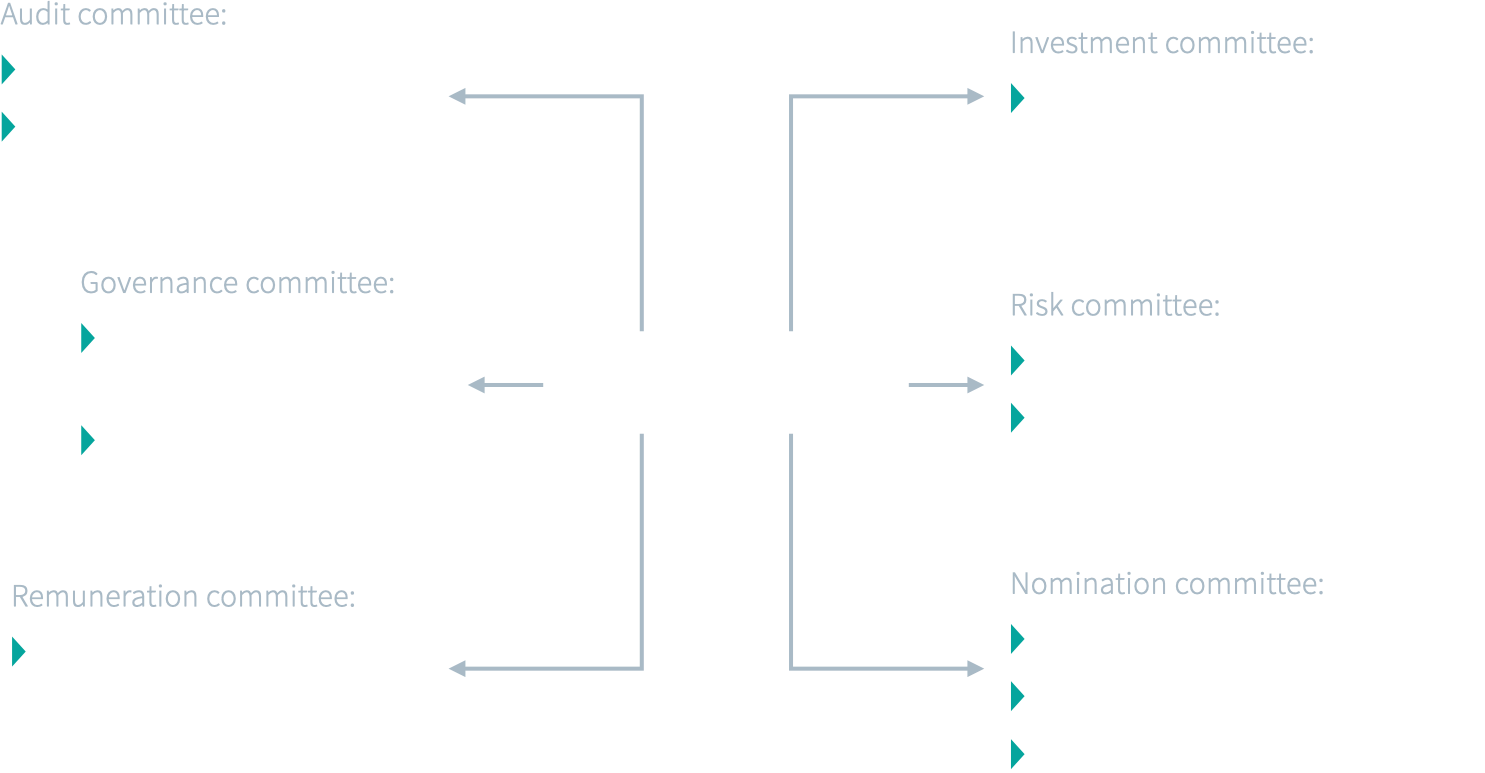
Board and Management Mechanisms
Creditor committees
Creditor committees are formed by bondholders to represent the interests of lenders during a bankruptcy proceding. They may also be created on an ad-hoc basis when a company is struggling to meet its debt obligations but has not yet filed for bankruptcy protection.
Corporate takeovers
can be executed in several ways, including proxy contests, tender offers, and hostile takeovers. Incumbent managers and directors may adopt anti-takeover provisions (e.g., poison pills, staggered board elections) to prevent acquisitions that might make them redundant.
Corporate Reporting and Transparency
Transparency is critical to reducing the asymmetrical information advantage enjoyed by managers over shareholders. High-quality, timely reporting benefits all of a company's stakeholders, but particularly its capital providers.
who enjoy the advantage of information asymmetry,
Managers enjoy the advantage of information asymmetry,
Shareholders and managers have a classic agency relationship, with shareholders being principals who have hired managers as agents to act in their interests. Managers enjoy the advantage of information asymmetry, which makes it difficult for shareholders to assess their performance. Shareholders also have an agency relationship with the directors who they elect to represent their interests on the board. Corporate governance structures are part of the agency costs that are incurred to reduce the potential for exploitation in these agency relationships.
dual-class share systems,
A dual-class share system is a structure in which a company issues two or more classes of shares, each with different voting rights. Typically, one class of shares is offered to the general public and carries limited or no voting rights, while another class is held by company founders, executives, or insiders and has enhanced voting rights.
CCC - Cash conversion cycle
shows the time it takes for a company to convert its investments in inventory and other resources into cash inflows from sales.
how quickly can company converts investments into cash
CCC = DOH + DSO - DPO
a company reduces its cash conversion cycle in the following ways:
Increase DPO by obtaining longer payment terms from its suppliers.
Reduce DOH by using data analytics to improve demand forecasts or switching to "just in time" inventory management.
Reduce DSO by charging fees for late payments, tightening credit standards, and requiring up-front deposits. Additionally, a company can offer a price reduction for cash settlement within a discount period. The effective annual rate for trade credit is calculated using the following formula:
EAR of supplier financing
[(1 + discount/1-discount) ^ 365/PP-DP]-1
where PP and DP are the number of days in the payment period and discount period, respectively.
Total working captial
current assets - current liabilities
Net working capital
= current assets(excluding cash and marketable securites)- current liabilities(excluding short term and current debt)
Primary Sources of Liquidity
Primary sources of liquidity are readily accessible at a low cost, including:
Cash and marketable securities
Borrowings
Cash flow from operations (CFO)
FCFE
he amount of free cash flow available to a company's shareholders (FCFE) is calculated by subtracting capital investments from CFO
CFF equity = cfo - investments in long term assets
Secondary Sources of Liquidity
Suspending or reducing dividend payments to shareholders
Delaying or reducing capital expenditures.
Issuing new equity.
Renegotiating the terms of contracts with lenders, lessors, customers, and suppliers.
Selling assets.
Filing for bankruptcy protection.
Factors Affecting Liquidity: Drags and Pulls
drag on liquidity: A drag on liquidity is a lag on cash inflows resulting in a shortage of available funds. Major drags include uncollectable receivables, obsolete inventory, and tight credit terms from lenders
A pull on liquidity occurs when disbursements are made before cash can be generated from sales. Major pulls on payments include making payments early, low liquidity positions, and reduced credit limits from lenders and suppliers.
current ration
ca/cl
quick ratio
cash+mark sec + rec/cl
Cash ratio
cash + mark sec / cl
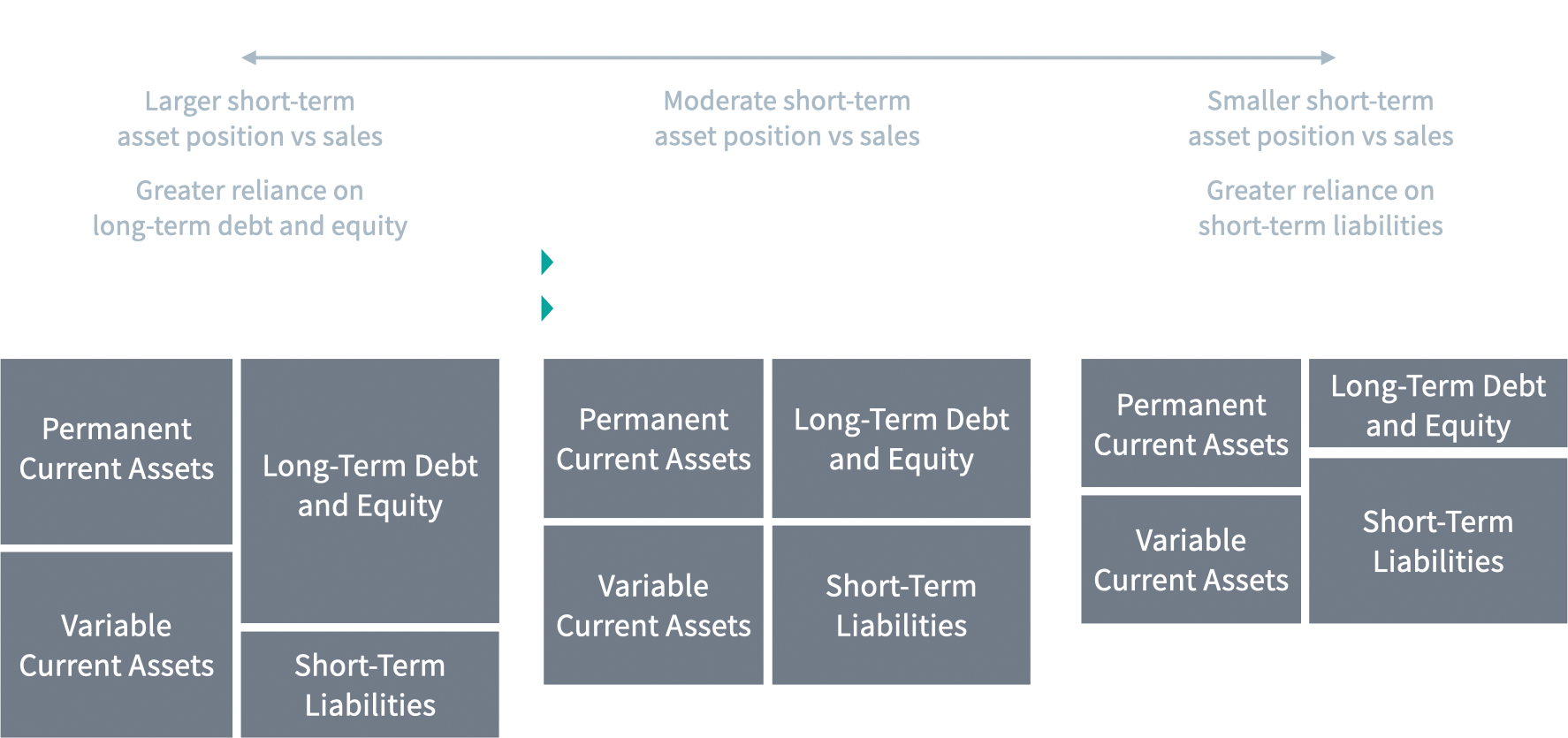
Wokring capital management
conservative - la
Lower working capital = more efficient operations
Conservative: working capital
Largest current assets, most long-term finance = greater certainty at higher cost
Typical for firms in early-growth phase (access to short-term debt limited)
More established companies may be able to pass on higher financing costs to customers
Suitable if expectation is for flat to rising interest rates
Working Capital and Liquidity Management
Aggressive:
Aggressive: Smallest level of current assets, more short-term finance = least flexibility, higher
May be considered for firms with lower profit margins
More suitable when future sales and cash needs can be forecasted with a high degree of
Suitable given an expectation of stable or falling interest rates
May be adopted for firms that expect to shorten CCC, can quickly liquidate inventory,
Pros: Lower financing cost
Flexibility to borrow only as needed (reduces total interest expense)
Short-term debt typically places fewer restrictions on operations
Flexibility to refinance if rates fall
Cons: Variable interest costs
Higher short-term cash needs to service debt
Rollover risk increases bankruptcy risk
More reliance on trade credit, collecting AR (may use 3rd party collection/AR sale)
debt service
returns
precision
collect AR
Capital Investments
Types , Going concern projects, regulatory/compliance, expansion projects
Going Concern Projects
Undertaken for a company to continue operating at its current size.
Relatively easy to evaluate because existing assets are being replaced.
Term of financing typically aligns closely with asset's expected useful life to avoid asset-liability mismatches.
A company's reported depreciation expense can be used as a proxy for its capital spending requirement for these types of projects.
Regulatory Compliance Projects
Pursued to comply with relevant laws, regulations, or contractual requirements.
Not meant to increase revenues or profitability, but may increase barriers to entry for potential competitors.
If the required costs are sufficiently high and cannot be passed along to customers, companies may abandon assets or cease operations.
Business Growth Projects
Investment in growth projects can be estimated as total capital spending less depreciation.
Expansion of Existing Business
Investments required to expand existing operations.
Riskier than going concern projects due to greater uncertainty.
Often developed internally through R&D projects.
External expansion through acquisition creates exposure to the risks of integration and overpaying.
New Lines of Business and Other Projects
Typically high-risk, high (potential) reward projects.
Unconventional projects (e.g., pet projects) are often excluded from normal project analysis process that is used for traditional capital investment
steps in capital allocation process
Capital Allocation
Steps in the Capital Allocation Process
Idea Generation: This can originate from within the company or from outside the company.
Investment Analysis: Collect information to forecast the investment's expected cash flows and profitability.
Planning and Prioritization: Select and prioritize profitable investment opportunities that together best fit the company's strategy.
Monitoring and Post-Investment Review
Net Present Value
A project's NPV is the amount of value that will be added to the company by making this investment. If the project has a conventional cash flow pattern, its NPV can be calculated using the following formula:
= CF0 + cf/(1+k)^1 + ct/(1+k)^t
Decision rule: Invest if NPV≥0. Do not invest if NPV<0.
IRR
Internal Rate of Return
The IRR is the discount rate that makes a project's NPV equal to zero:
Decision rule: Invest if IRR≥𝑟. Do not invest if IRR<𝑟.The required rate of return, 𝑟, is also known as the hurdle rate.
In the event of a conflict between NPV and IRR for mutually exclusive projects, decisions should be based on
In the event of a conflict between NPV and IRR for mutually exclusive projects, decisions should be based on NPV because 1) NPV represents the project's value to the firm, and 2) the IRR measure unrealistically assumes that all cash flows can be reinvested at this rate, while NPV only assumes that they will be reinvested at the required rate of return.
Conventional cash flow pattern
if the sign on the cf changes only once, with one ore more cash outflows followed by one or more cash inflow
unConventional cash flow pattern
has more than one sign change.
Adv & dis of NPV and IRR Methods
adv of npv - diret measure of the expected increase in the value of the firm
adv irr - measures profitablity as a percentage showing the return on each dollar invested.
dis irr - projects cf are reinvested at the irr while npv assumes those cf are reinvested aat the projects rrr
ROCI
ROIC reflects the effectiveness of a company's management in converting capital into profits, regardless of what type of capital is used (e.g., debt, equity). Companies create value for investors by generating an ROIC in excess of their cost of capital.
roci = NOPA/avg book value of total cap
Advantages of ROIC
Calculated using easily-accessible data
Can be broken into components for after-tax operating profitability and asset turnover
Allows aggregate level analysis of a company's ability to create value from capital budgeting decisions
Limitations of ROIC
Accounting-based inputs can be manipulated
Highly volatile, backward-looking measure
Mask differences in profitability among individual projects
Capital Allocation Principles
Capital Allocation Principles
The capital allocation process is based on the following key principles:
Decisions are based on after-tax cash flows, not accounting concepts.
Adjustments must be made for non-cash items (e.g., depreciation).
Include incremental cash flows, net of what would have occurred without the decision.
Only count current and future cash flows, not sunk costs.
Capital Allocation Pitfalls: Cognitive Errors in Capital Allocation
Internal forecasting errors:
Including sunk costs in a project's valuation
Incorrectly estimating a project's overhead costs
Using a discount rate that does not accurately reflect a project's true risk
Failing to account for opportunity costs or the anticipated responses of competitors
Ignoring costs of internal financing: Failing to recognize that all capital has an opportunity cost and treating internally generated funds as "free" capital with a 0% required return.
Inconsistent treatment of inflation: Nominal cash flows should be discounted at a nominal discount rate, and real cash flows should be discounted at a real discount rate. Inflation does not affect all revenues and costs uniformly.
Capital Allocation Pitfalls: Behavioral Biases in Capital Allocation
Inertia: The tendency to reuse their most recent capital budget with only minor adjustments.
Basing decisions on earnings metrics: The focus should be on cash flow-based NPV, not accounting measures.
Pet projects bias: Approving managerial pet projects based on overly optimistic projections or without being subject to a proper capital budgeting analysis.
Failing to consider alternatives: Getting fixated on specific projects and failing to consider other potentially better uses of funds.
Real Options
Real options are opportunities for a firm to delay a decision about a capital project or to amend the project after deciding to pursue it. Like financial options, real options are valuable because they grant the right to defer the timing of a decision until more information has been accumulated.
Types of Real OptionsTypes of Real Options
Types of Real Options
Real options can be classified based on the type of decision-making flexibility that they offer.
Timing options allow a company to delay its initial decision about whether to pursue a investment.
Sizing options allow the company to walk away from a project if the financial results are poor (abandonment option) or make additional investments if the results are positive (growth option).
Flexibility options provide the ability to make adjustments based on subsequent market conditions (e.g., price-setting options, production-flexibility options).
Fundamental options treat an entire investment as an option.
weighted average cost of capital
WACC = [weight of debt x pretax cost of debt (1-tax)] + (weights of equity x cost of equity)
wacc = wd rc (1-t) + we re
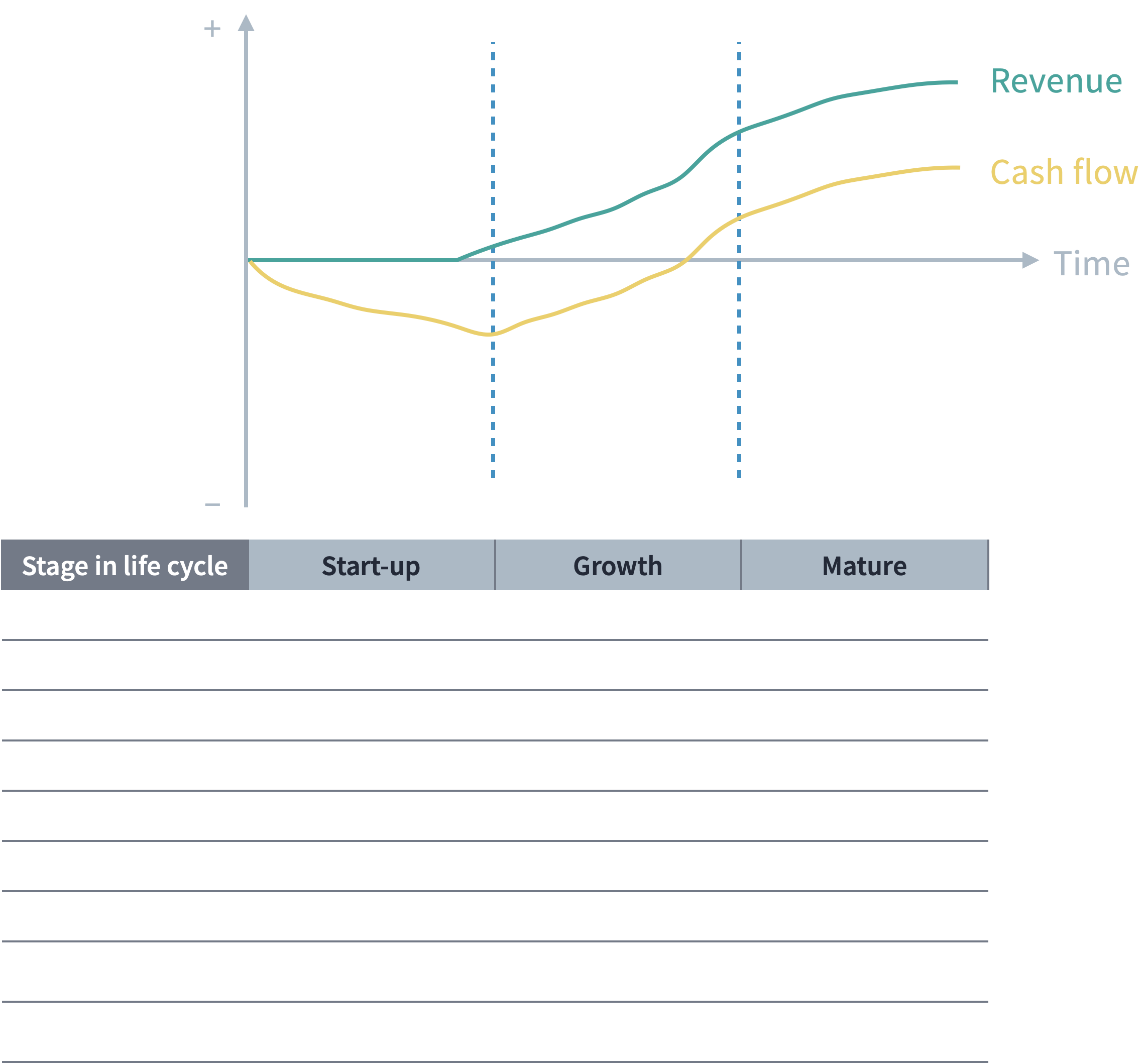
Corporate Life Cycle:
Modigliani–Miller Propositions without Taxes
Proposition I Without Taxes: Capital Structure Irrelevance
The value of an unlevered firm is equal to its levered value (𝑉𝑈=𝑉𝐿) if the following assumptions hold:
Investors have homogeneous expectations.
Capital markets are perfectly efficient.
Investors can borrow and lend at the risk-free rate.
There are no agency costs.
Financing and investment decisions are independent.
Under these theoretical conditions, the present value of a company's future cash flows will be unaffected its capital structure.
Proposition II Without Taxes: Higher Financial Leverage Raises the Cost of Equity
If the five assumptions hold, a company's WACC remains constant because any increase in the use of low-cost debt will be offset by a corresponding increase in the cost of equity to reflect the risk of higher leverage. A levered firm's cost of equity is a linear function of its debt-to-equity ratio:
𝑟𝑒=𝑟0+(𝑟0−𝑟𝑑)(𝐷/𝐸)
Modigliani–Miller Propositions with Taxes
Proposition I With Taxes: Firm Value
If debt payments can be deducted from taxable income, firm value can be increased by the amount of the debt tax shield.
Proposition II With Taxes: Cost of Capital
If all other assumptions hold, introducing taxes (and deductible interest) will reduce WACC at higher debt-to-equity ratios. The cost of equity will rise, but not at the same rate as in a no-tax scenario. Rearranging the updated WACC formula allows us to determine the cost of equity under this revised set of assumptions:
𝑟𝑒=𝑟0+(𝑟0−𝑟𝑑)(1−𝑡)(𝐷/𝐸)
Pricing and Revenue Models
Price Discrimination Strategies:
Tiered pricing
Dynamic pricing
Value-based pricing
Auction/reverse auction models
Tiered pricing
Tiered pricing is a strategy that charges different prices for different levels of service or quantities of products.
dynamic pricing
the practice of varying the price for a product or service to reflect changing market conditions, in particular the charging of a higher price at a time of greater demand.
Value-based pricing
Value-based pricing is a strategy of setting prices primarily based on a consumer's perceived value of a product or service.
Pricing Strategies for Multiple Products:
Bundling: Selling multiple products or services together as a single combined package at a reduced price.
Razors-and-blades pricing: Selling a core product at a low price or at a loss (the razor) while charging higher prices for consumable accessories or components (the blades).
Add-on pricing: Charging extra fees for additional features, services, or products that are optional and not included in the base price.
Pricing Strategies for Rapid Growth:
Penetration pricing - exp jio, gives products at low margin in beginning after growing maket share it will charege
Freemium pricing - offer with basic functionality at no cost but sell or unlock other function for a fee
Hidden revenue business model - ads
value chain
A company's value chain is the answer to the question of how it executes its value proposition. In order to deliver value to its customers, a firm requires relevant assets and capabilities.
supply chain
A supply chain includes all of the steps and processes involved in the physical transformation of a product up to the point that it is purchased by the end consumer.
Unit economics
Unit economics is the quantitative analysis of a company's revenues and costs on a per unit basis.
A company's contribution margin is the difference between the unit price and its variable costs per unit.
The break-even point is the quantity of units sold that allows a company to cover its fixed costs.
Business Model Types
Conventional Business Models
One of the most important determinants of a company's business model is whether it offers products or services. The business models of companies that operate in goods-producing industries have long been understood in terms of their position in a linear supply chain.
banks, manugactures, distributors, retailers, baks, software
Private label manufacturers
producing items that are marketed by other firms under outsourcing arrangements.
Licensing arrangements
allow a firm to sell products that use another firm's brand or intellectual property in exchange for royalty payments.
Produce under a recognized brand name, pay royalty
Value added reseller
provide key follow-up services for the products that they sell.
Franchise models
Franchisor earns a royalty and is responsible for advertising and product
Network effects
Network Effects
The increase in value of a network to its users as more users join
e.g. messaging platforms, payment platforms, social media, payment systems, stock
One sided : there is one type of user that is valuable to other users e.g. Venmo
Two sided : two (or more) types of users e.g. credit card networks
Crowdsourcing : users contribute to the product, the business facilities ‘communities’
Crowdsourcing
allows users to generate a product or service, typically voluntarily and often with little or no oversight. wikipedia