7.20 - Coordination & payoff irrelevant cues
 Call Kai
 Learn
Learn Practice Test
 Spaced Repetition
 Match
Match Flashcards
 Knowt Play
1/10

There's no tags or description
Looks like no tags are added yet.
Name | Mastery | Learn | Test | Matching | Spaced | Call with Kai |
|---|
No analytics yet
Send a link to your students to track their progress
11 Terms
Claims of Schelling
In pure coordination games, payoff-irrelevant cues make some strategies “salient” / some ways to coordinate “focal”
PICs help coordination in mixed-motive (opposite interests) coordination games of real importance
e.g. military strategy,
help agreement in bargaining/resource division
especially when there is a common interest in reaching some agreement.
Isoni et al. (2013) - OV
Studies if payoff-irrelevant cues help make some ways of coordinating “salient” or “focal” in bargaining over division of resources
1-shot coordination games in lab with mixed motives
common interest in reaching some agreement
BUT opposed interests over which agreement.
Bargaining table game - both see same
games differ in no. disks + value of disks + location
Coordination success measures:
Focus on agreement rate (% of pairings with agreement)
OR earnings efficiency index (avg across all pairings of: combined payoffs achieved / total of disk values on table
Isoni et al. (2013) - Bargaining table
2 player game with fixed pairs + 24 rds
no feedback between games
Each has a base
Disks of monetary value across board - players can claim any disk
bargaining is tacit - independent claims with no comms
If disk only claimed by 1 player then they get the value otherwise no one does
2 potential sources of inefficiency:
Failure to agree: If any disk is claimed by both players, they both get zero (in total).
Failure to claim all disks: Disks not claimed by either player are “wasted”
Disk locations - PIC controlled by experimenter
observable to both + doesnt change value
Incentives - For each pair, one game selected at random; players get outcome of that game
So, each game is, in effect, a one-shot game.
Isoni et al. (2013) - Schelling hypothesis
Both claiming none OR all is weakly dominated strategy so coordination needed to decide who picks what
Players will use payoff-irrelevant cue from Rule of Proximity which says:
If a disk is nearer to your base than to the other base then subject claims it
Both players see (and know the other sees) game via bargaining table display and note cues it provides
When PIC less obvious (equidistant from both) → less coordination → lower payoffs
If locations only salient guide, then both players have interest in following it
Even less favoured player if no other way to increase prob of achieving agreement
“Beggars cannot be choosers about the source of their signal, or about its attractiveness” - Schelling
Isoni et al. (2013) - Example
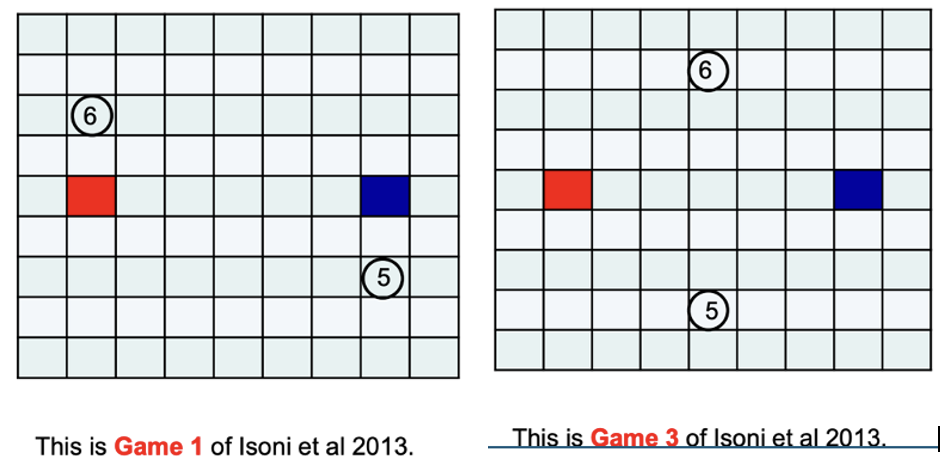
Equal design apart from proximity
Red favoured - earns 13% more on avg
Earnings efficiency index higher for game 1 (65% vs 48%)
In line with Schelling hypotheses
when proximity rule doesnt apply EEI & agreement rate drop a lot
EEI 18.5% & AR = 27%
Bargaining table pros
Simple representation of games
Clear distinction between payoff-relevant and payoff-irrelevant factors
Controlled manipulation of whether Rule of Proximity does or does not give advice on which disks to claim
Shows any bargaining may have PICs which can aid agreements
Not necessarily Rule of Proximity but PICS in general
PICs and communication
Fear influence of payoff-irrelevant cues wont survive if players could communicate
Is PICs role just an artefact of ‘tacit’ coms
Communication allows bargaining that is more than tacit
If cues seem arbitrary to player not favoured by them, that player might use communication to challenge their authority
Now player can appeal to fairness
Isoni et al. (2014) - OV
Adds limited communication to 2013 game (comms player-player)
Either player can provisionally claim (and cancel any claim) any disk at any time
All current claims of both players visible to both players,
with highlight for disks currently claimed by both;
Each player can explicitly “accept” the current claims (but can cancel acceptance)
Game ends if both players are “accepting” at same time or time runs out.
Payoffs determined as in previous design using the final claims, whether explicitly agreed or not.
Different set of bargaining tables used
Very flexible comms as communication emerges spontaneously
Isoni et al. (2014) - possible effects of comms
May weaken impact of disk location on final division
Strengthen role of fairness considerations;
Make it less likely that any disks will be unclaimed OR disks claimed by both players.
Isoni et al. (2014) - RESULTS
Strong tendency for bargains to emerge that are efficient (all disks claimed, none by both players)
Either yield equal payoffs or as close to equal as is possible if efficiency achieved
Comms enhance use of fairness considerations, relative to payoff-irrelevant cues.
RoP not often followed when would conflict equal payoff (even extreme RoP)
BUT very common when can mediate equal payoffs
PICs still relevant and easy option to choose out of all possibilities
Coordination summary
Disequilibrium payoffs matter as well as equilibrium payoffs
Available actions and the possible payoffs from them matter
BUT are not the only factors affecting behaviour
Player’s expectations of the play of others matters critically
Shaping expectations can be important:
contextual PICs + history + belief-shifting events + communication.
All these may align expectations in helpful or unhelpful ways