Global campaigns — AdPeople Worldwide.
 Call Kai
 Learn
Learn Practice Test
 Spaced Repetition
 Match
Match Flashcards
 Knowt Play
1/16

There's no tags or description
Looks like no tags are added yet.
Name | Mastery | Learn | Test | Matching | Spaced | Call with Kai |
|---|
No analytics yet
Send a link to your students to track their progress
17 Terms
Main exam idea (what’s the formula)
The key idea: global brands need consistency, but global communication cannot usually be fully standardized because consumers still live locally: local values, language, media, culture, habits, needs, and dreams.
Small example:
Nike can have one global brand idea like “achievement,” but the way it shows achievement in Japan, Spain, and Brazil may need different visuals, athletes, language, and emotional tone.
Exam logic:
Do not say: “Global campaign = same ad everywhere.”
Correct: global campaign = consistent brand idea + local execution where needed.
[to read] Globalization creates opportunity, but also execution complexity
The article says global campaigns are harder because communication channels have grown to more than 30, and media standards differ by country. Example: China has more than 30 different standard banner sizes, while the US has only a few.
Small example:
A banner ad made for the US cannot simply be sent to China. The formats, sizes, platforms, and technical requirements may be different.
Exam logic:
Standardization saves time and money, but implementation across markets is operationally difficult.
“Consumers are local” (global products and …)
The reading rejects the simple “global village” idea. Some products can be standardized, but communication is harder because consumer behavior remains complex and diverse. The article says the truly global consumer does not really exist: people may know global brands, but they usually buy and interpret brands through a local frame of reference.
Small example:
Two people may both use Apple, but one may see it as status, another as creativity, another as practical work equipment.
Exam trap:
Access to global media does not mean consumers think the same way.
Glocal strategy
The article’s best word is glocal: a brand must have global consistency and local power. HSBC’s “The world’s local bank” is used as the example: global brand identity, but local relevance.
Small example:
McDonald’s keeps global brand recognition, but adapts menu, pricing, communication, and promotions by country.
Exam logic:
The goal is not “global OR local.”
The goal is global brand platform + local adaptation.
Emotional vs. product-specific rational messages
The reading says global brands should often use emotional and universal messages, because these can be adapted more easily. Product-specific and rational messages often require more localization and can create inconsistency when translated into many markets.
Small example:
A global message like “helping entrepreneurs grow” travels better than a very technical product message about exact laptop specifications, because specs, prices, and needs change by market.
Exam trap:
A global campaign should not be overloaded with detailed product claims if those claims do not fit every country.
Culture vs. ads response
Culture shapes how people understand brands and communication. The reading uses Hofstede’s dimensions: power distance, individualism, masculinity, uncertainty avoidance, and long-term orientation. The important point is not to memorize definitions mechanically; it is to understand that cultural values change how ads are received.
Small example:
A very aggressive “be the best, dominate the market” ad may work better in a masculine culture, but feel too pushy in a more feminine culture where softer values are preferred.
Exam logic:
Same message can produce different reactions depending on culture.
[to read] Buying motives differ by culture
The luxury-brand example is important. In collectivist / high power-distance cultures, luxury brands often communicate social status, group belonging, and face-saving. In individualistic cultures, luxury may communicate uniqueness or self-expression.
Small example:
A luxury watch campaign in China may emphasize respect, success, and social status. In the US, it may emphasize personal identity and standing out.
Exam trap:
The same luxury product is not bought for the same psychological reason everywhere.
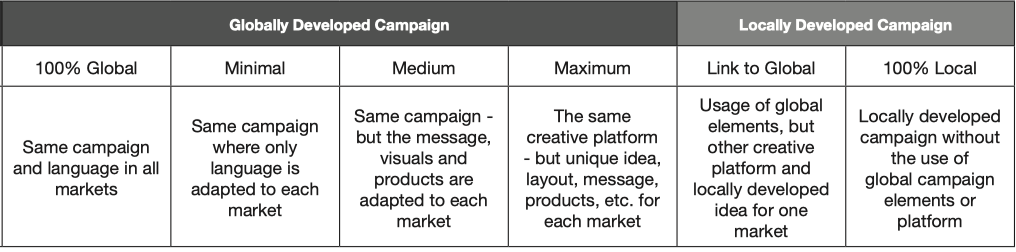
Standardization vs localization is not either/or (levels)
The article says companies often want standardization to sell more and reduce costs, but local adaptation can create stronger relevance. The decision is not binary. The reading gives several levels:
100% global: same campaign and language everywhere.
Minimal localization: same campaign, only language changes.
Medium localization: same campaign, but message, visuals, or products adapted.
Maximum localization: same creative platform, but local idea/layout/message/product.
Link to global: uses some global elements but mostly local creative platform.
100% local: local campaign without global campaign elements.
Small example:
Coca-Cola can keep one global happiness idea, but use local celebrities, local festivals, local language, and local media channels.
Exam logic:
You must be able to explain degrees of adaptation, not just “standardized or adapted.”
The 10 factors that decide whether to centralize or localize
The article gives 10 local-market factors. These are exam-relevant because they explain when localization is necessary:
Political, legal, and religious basis.
Practical and logistical constraints.
Socio-economic factors.
Physical needs.
Local tastes, preferences, customs, culture.
Competitors.
Media, communication, and distribution access.
Category and brand development stage.
Language.
Consumption patterns.
Small example:
A cosmetics campaign may need different models, claims, media, language, and even legal wording in Saudi Arabia, India, and France.
Exam trap:
Localization is not only translation. It can involve legal rules, religion, media, competitors, product maturity, and buying habits.
—
4. It is extremely hot, so people say: “Actually, we need cold products.”
= Physical needs
1. First, a policeman stops the truck.
They ask: “Is this product legal, politically okay, and religiously acceptable?”
= Political, legal, religious basis
2. Then the truck gets stuck because the roads are bad and there are no freezers.
= Practical and logistical constraints
3. The company reaches the city, but people open their wallets and say: “Too expensive.”
= Socio-economic factors
5. But when they taste the ice cream, they say: “We don’t like this flavor. We prefer local flavor.”
= Local tastes, preferences, customs, culture
6. Suddenly, another ice cream seller appears and says: “This is my market.”
= Competitors
7. The company tries to advertise, but there is no good TV, internet, or supermarket access.
= Media, communication, and distribution access
8. Then they realize people barely know this type of ice cream, so the category is still young.
= Category and brand development stage
9. They print the package, but nobody understands the language on it.
= Language
10. Finally, they see people eat ice cream only after dinner, not during the day.
= Consumption patterns
[to read] Benefits and risks of standardized communication
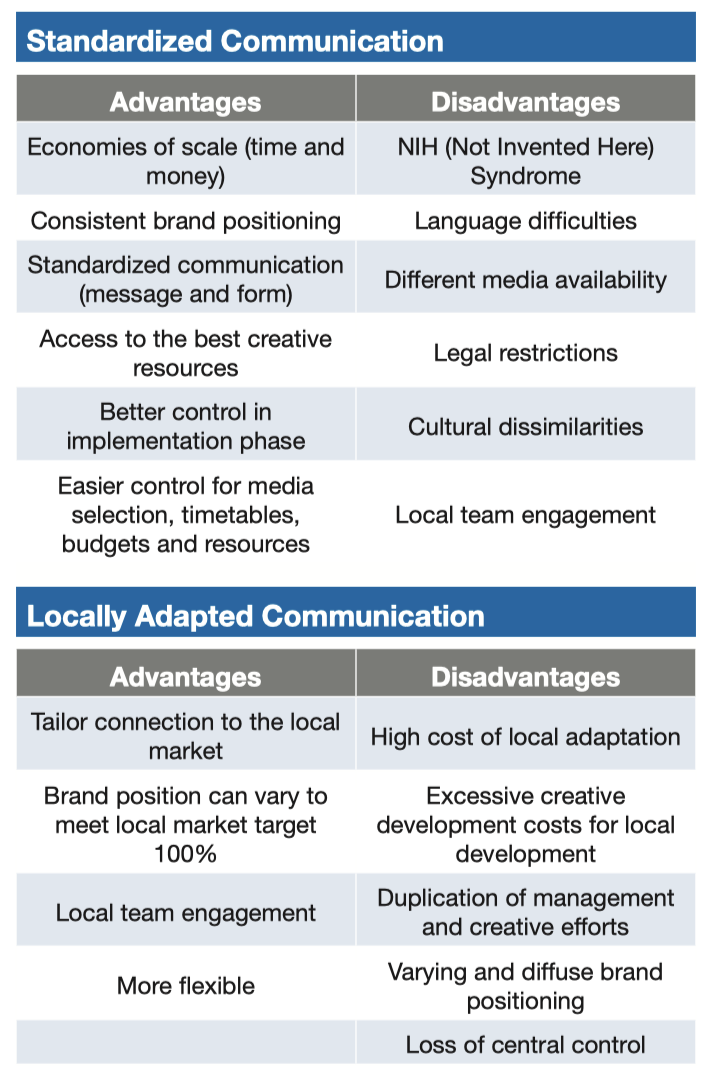
Standardized communication gives economies of scale, consistent brand positioning, better control, and access to strong creative resources. But it can fail because of language problems, legal restrictions, media differences, cultural distance, and weak local team engagement.
Small example:
A global perfume ad may look beautiful and consistent, but fail locally if the slogan translates badly or the visuals violate cultural norms.
Exam logic:
Standardization is efficient, but risky when local meaning changes.
Standardized vs localized communication
Small example:
A global campaign slogan may be cheap and consistent if used everywhere, but it may sound strange or even offensive in another language. A local version may work better, but if every country changes the brand too much, the global brand becomes unclear.
Exam logic:
It is one trade-off:
standardization = efficiency and consistency, but lower local fit.
localization = relevance and flexibility, but higher cost and weaker global control.
Global campaign development: 2 things matter most
Two things matter most:
Involve local markets early to collect real consumer insight.
Create brand guidelines that are broader than logo rules: strategy, visual identity, message, brand promise, approval process, creative assets, performance measurement, and scorecard.
Small example:
A headquarters team should not finish a campaign in London and then ask local markets to “translate it.” Local teams should help before the campaign is finalized.
Exam trap:
Brand guidelines are not just “use the logo correctly.” They must define what can change and what must stay consistent.
[to read] Execution often decides success or failure
The article says global campaigns often fail in execution and implementation, not only in strategy. Success needs shared vision, clear responsibilities, common language, documentation, best-practice sharing, scorecards, and local involvement. Global teams must also manage language barriers and cultural communication styles.
Small example:
In some cultures, people may avoid asking questions in a public call because they do not want to lose face. So managers need extra local dialogue, not only global conference calls.
Exam logic:
A good global idea can fail if the implementation process is weak.
Transcreation
Transcreation is more than translation. It adapts the campaign to another language and culture while keeping the intended meaning. It can include pictures, tone, style, cultural references, jokes, analogies, product information, prices, legal text, formats, and calls to action.
Small example:
A slogan based on a wordplay in English cannot be directly translated into Spanish or Chinese. The local version needs a new phrase that creates the same feeling.
Exam trap:
Translation changes words.
Transcreation preserves effect and meaning.
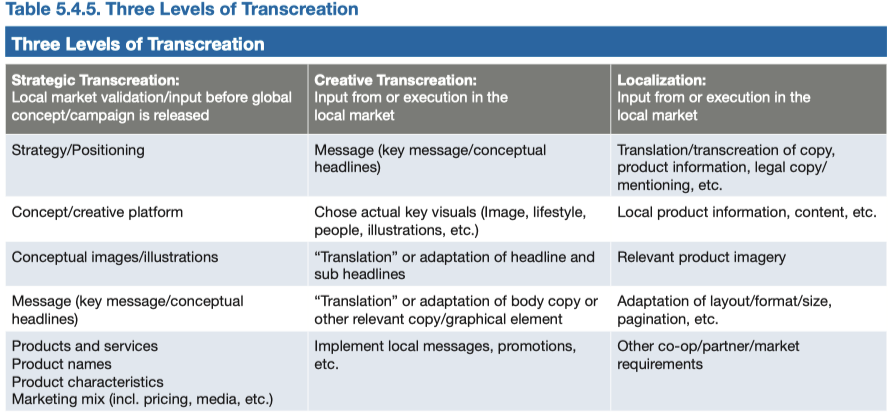
3 levels of transcreation
The article gives 3 levels:
Strategic transcreation: local input before the global concept is released; decides positioning, message, product portfolio, and whether one or several versions are needed.
Creative transcreation: adapts the creative idea, key visuals, headlines, message, people, style, and local creative elements.
Localization: adapts language, local products, legal copy, prices, URLs, media formats, layout size, and local promotions.
Small example:
For a global car campaign:
Strategic = decide if “freedom” or “safety” is the right promise.
Creative = choose local roads, families, or celebrities.
Localization = translate text, add local price, local website, and legal disclaimer.
Exam logic:
Transcreation happens before and during execution, not only at the final translation stage.
[to read] Dell “Take Your Own Path” case
This case is the best practical example. Dell used a global strategy and idea, but adapted execution locally. The consistent global idea was Dell as a trusted technology advisor for small and medium businesses. The campaign used inspirational “business heroes.” Execution varied by country, and many markets used local heroes for stronger impact. The campaign launched in 9 countries representing over 50% of Dell’s market opportunity, used more than 200 creative templates, released over 3,000 local assets, and improved awareness, consideration, and engagement.
Small example:
The same campaign idea can work globally: “entrepreneurs succeed with Dell.”
But the entrepreneur shown in Spain, Japan, or Brazil should often be local, so the audience believes and feels the story.
Exam logic:
This case proves the article’s main argument: global idea, local execution.
[to read] Final
The reading’s core message is that global campaigns should balance standardization and localization. A brand needs a consistent global idea, but consumers interpret messages through local culture, language, media, values, competitors, and consumption habits. The strongest exam concepts are glocal strategy, degrees of localization, standardization vs localization trade-offs, and transcreation. The Dell case shows the ideal model: one global campaign platform, but local heroes, local assets, local formats, and local execution. The exam answer should be: global consistency is useful, but global campaigns win only when they are locally meaningful and well executed.