Biology- Topic 1 Enzymes + Food (Year 9 Spring Term )
 Call Kai
 Learn
Learn Practice Test
 Spaced Repetition
 Match
Match Flashcards
 Knowt Play
1/21

There's no tags or description
Looks like no tags are added yet.
Name | Mastery | Learn | Test | Matching | Spaced | Call with Kai | Chat |
|---|
No analytics yet
Send a link to your students to track their progress
22 Terms
enzyme
a biological catalyst that increases the rate of reaction in living organisms
Active site
specific region of an enzyme where the substrate binds and the reaction takes place
2 types of chemical reaction
Breakdown 00 -> 0 + 0 Synthesis 0 + 0 -> 00
Lock and Key Model
Substrate collides with active site of enzyme -> enzyme - substrate complex
Enzyme catalyses breakdown of substrate -> enzyme - product complex
Products released from active site
Substrate and active site have to be…
Complementary in shape
Protein: Enzyme, where, smaller molecules
Enzyme: Protease
Where: Stomach+ small intestine
Smaller molecules: amino acids
Starch: Enzyme, where, smaller molecules
Enzyme: amylase
where: mouth+ small intestine
smaller molecules: sugars (glucose)
Lipids: Enzyme, where, smaller molecules
enzyme: lipase
where: small intestine
smaller molecules: fatty acids + glycerol
Denaturing enzymes
if enzymes are exposed to extremes of pH or temperature the shape of their active site may change and the substrate will no longer be able to fit in.
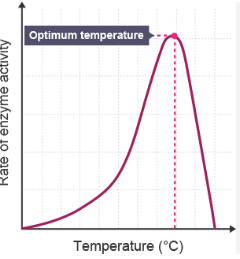
Effect of TEMPERATURE of Enzyme Activity
-Enzyme activity is HIGHEST at Optimum Temperature -below optimum temp there are fewer collisions (activity decreases) -above optimum temp the enzyme denatures (activity decreases)
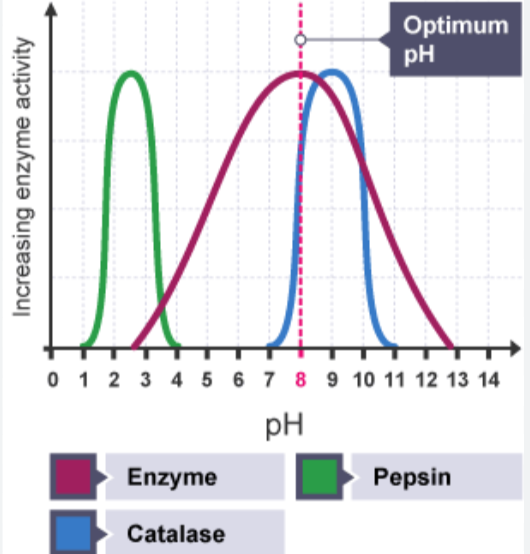
Effect of pH on Enzyme activity
-Highest at optimum pH, this depends on where the enzyme is found in the body -Below or Above optimum pH the enzyme denatures (activity decreases)
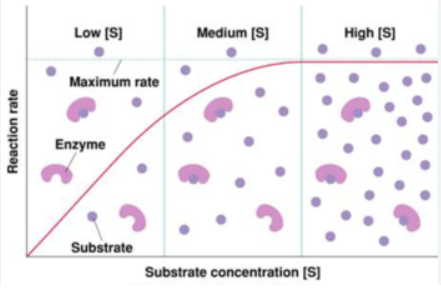
Effect of SUBSTRATE CONCENTRATION on Enzyme activity
As substrate concentration increases so does rate of reaction -low concen= limiting factor: (active sites are empty) -medium: more substrates than enzymes -high: limiting factor = enzyme concentration(active sites are full)
CORE PRACTICAL: Investigating the effect of pH on amylase VARIABLES
Independent: pH buffer solution value (ph3,5,7,9)
Dependent: time taken
Control: temp, volume of solutions
CORE PRACTICAL: Investigating the effect of pH on amylase METHOD
-place iodine into spotting tile
put test tubes containing amylase+pH buffer and starch solution in a water bath at 40°C. -pour starch solution into amylase+pH buffer and start stopwatch -every 20 seconds add a drop of mixture to the iodine until it remains yellow
repeat for other pH buffers
CORE PRACTICAL: Investigating the effect of pH on amylase RESULT
Amylase breaks down starch into glucose. At pH 7 this took the shortest time for the iodine to remain yellow. This shows starch is broken down quickest at this pH. This is because amylase is found in the mouth where the pH is 7.
Rate of reaction
1/ seconds
Test for STARCH
-add iodine to test solution Positive Result: turns BLACK
Test for PROTEIN
-add Biuret solution Positive Result : turns PURPLE
Test for REDUCING SUGAR
-add Benedict's solution and black in water bath at 80°C Positive Result: turns RED
Test for Lipids
-add ethanol to solution and pour into a test tube of eater Positive Result: WHITE EMULSION
Calorimeter
measures the energy in our food
Calorimetry method (simple)
-as food burns water in the test tube is heated up -the change in temp of the water can calculate the ENERGY CONTENT