Reliability week 17 and 18
 Call Kai
 Learn
Learn Practice Test
 Spaced Repetition
 Match
Match Flashcards
 Knowt Play
1/67

There's no tags or description
Looks like no tags are added yet.
Name | Mastery | Learn | Test | Matching | Spaced | Call with Kai |
|---|
No analytics yet
Send a link to your students to track their progress
68 Terms
Define reliability
The probaiility that a [sub assembly/component/system] will meet its required function under stated conditions for a specified period of time.
Define a repairable system
A system that can be fixed/restored to working order after a failure through repair/maintenance like part replacements or adjustments (include major components like gearboxes, generators, pitch systems, assemblies of sub assemblies)
Define a non repairable system
one that cannot be repaired once it fails and must be replaced entirely after a single failure (often at component level, like batteries, bearings, power electronics etc.)
What is the failure rate?
THe rate at which failures occur within a specific period (per unit time). Measures as the number of failures per turbine per operating period, (usually a yea) or failures per MWh
What does failure rate indicate?
How often critical components within a wind turbine are likely to fail and need repair or replacementWh
What is failure intensity?
Related to the severity and impact of the failures, such as downtime and costs assocaited with failures, uncluding repair costs and lost revenue. describes the reliability or failure rate over time
What is wind turbine?
the total amount of time that a wind turbine does not operate due to a failure
What is the failure intesnity visualised as?
A bathtub curve
What is the bathtub curve?
A graphical representation of reliability showing failure rate over time. Failure rate is in the middle of the graph when failure intensity is constant
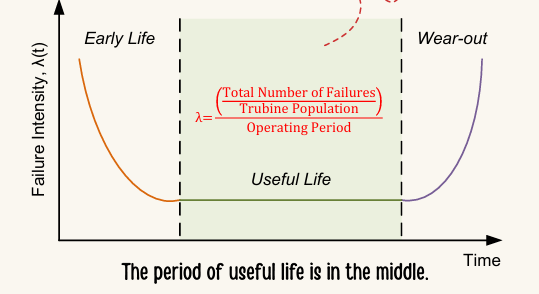
What is the equation for the failure rate ?
λ=MTBF1 MTBF is mean time between failures
What is the equation for the repair rate?
μ=MTTR1 MTTR is mean time to repair
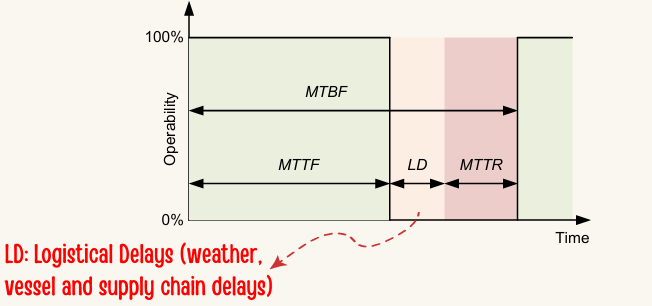
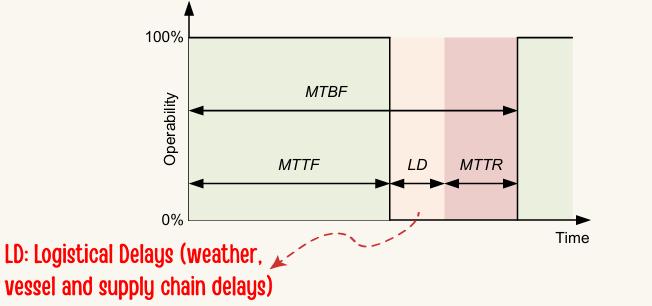
What does the operability time graph look like?
MTBF is between start and the end of the first failure when its operable again
MTTF is from start to the beginning of first failure
LD is between start of failure to the MTTR start
MTTR is from somewhere between the start and end of the failure where LD ends , to the end of the failure
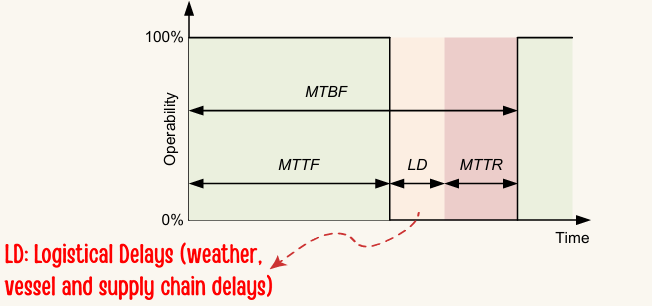
What is LD
That is logistial delays
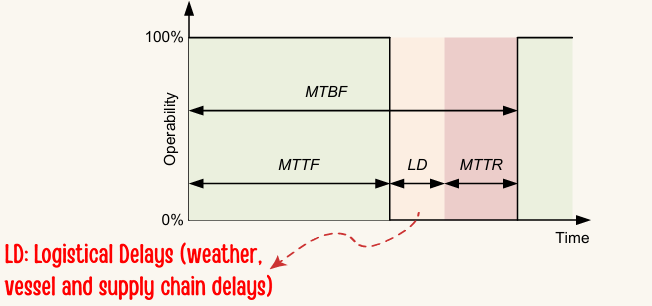
What is MTBF
Mean time before failure
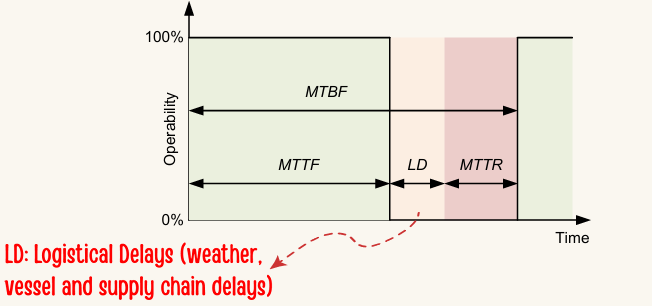
What is MTTF
Mean time to failure
What is LD
Logistical delays
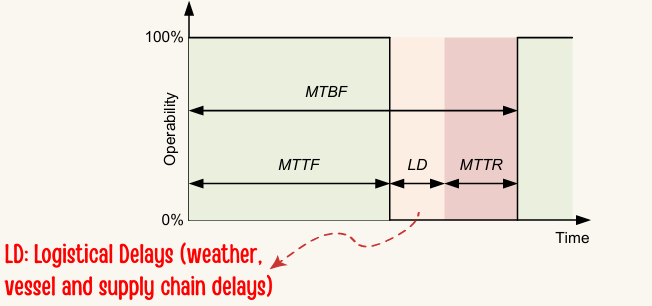
What is MTTR
Mean time to repair
What is the availability?
The fraction of the time ina year that the wind turbine can generator electricity
What is the usual availability of an onshore WT?
95-97%
What is the usual lifetime of an onshore WT?
20 - 30 years
What is the operational availability (technical)
Aop=MTBFMTTF=MTBFMTBF−MTTR−LD=1−μλ−LD.λ
What is the manufacturers availability? (commercial)
Am=MTBFMTBF−MTTR=1−λ1μ1=1−μλ
Which is larger, the operational availability or the manufactueres availabilty?
The manufacturers because the logistical delays arent considered in the manufacturers
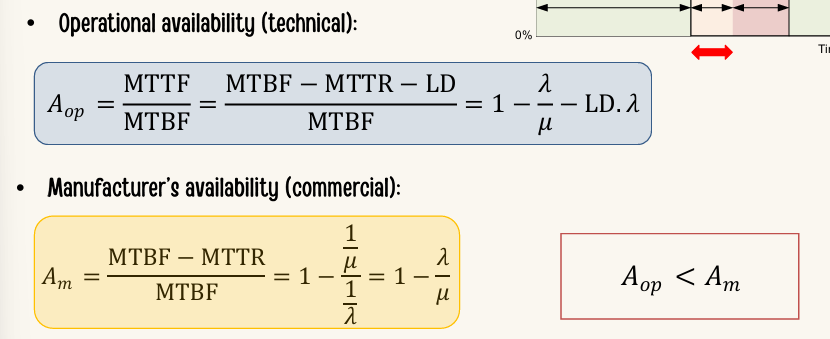
What are examples of logistical delays?
response time, if the turbine is offshore the maintenance team will take time to assess and respond to the failure
Spare parts availability - if a part failed, obtaining the replacement may take time, could be from specialised manufacturers
Weather conditions - adverse weather can delay repair actions as repair crews and equipment need to reach the wind turbine
What is the capacity factor?
This is the annual energy production as a percentage of the theoretical maximum for the turbine/farm C=100×8760×PAEP AEP is annual energy production
What is the cost of energy CoE
The current price of a unit of electricity at a specific point in time
What is the LCOE?
The levelized cost of energy LCOE represents the average cost of producing a unit of electricity over the entire lifespan of a power generation project.
What is the difference between the CoE and the LCOE?
The CoE is the current price, while the LCOE considers the total cost spread across a power plant’s entire lifespan
What are the factors for the CoE?
Wind regime
Energy capture efficiency of the wind turbine generators
availability of the wind turbine
lifetime of the wind turbine
capital costs (CapEx)
financing cost
operation and maintenance cost (OpEx
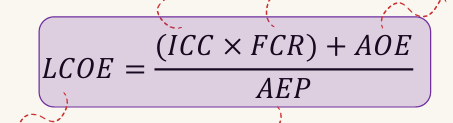
How do you calculate LCOE?
ICC - initial capital cost
FCR - fixed charge rate
AOE annual operating expenses
AEP annual net energy production
What is the LLC?
The land lease cost
What is the O and M?
The levelised oepration and maintenance cost
What is the LRC
The levelised replacement/renovation cost
What is teh equation for the OpEx?
The LLC + O&M +LRC
Land lease cost + operation and maintenance cost + levelised replacement cost
What is the trade off when trying to reduce the LCOE?
To reduce the LCOE, installing the WT in deep waters increases their power capacity, but increases their failure rate
What % of costs are O and M for offshore and onshore?
23% of their total investment costs for offshore
5% of costs for onshore
What will cause cost reductions for WT?
Bigger and more efficient turbines, lower capital and operating costs and other tech and economic advancements
How does reliability change with size?
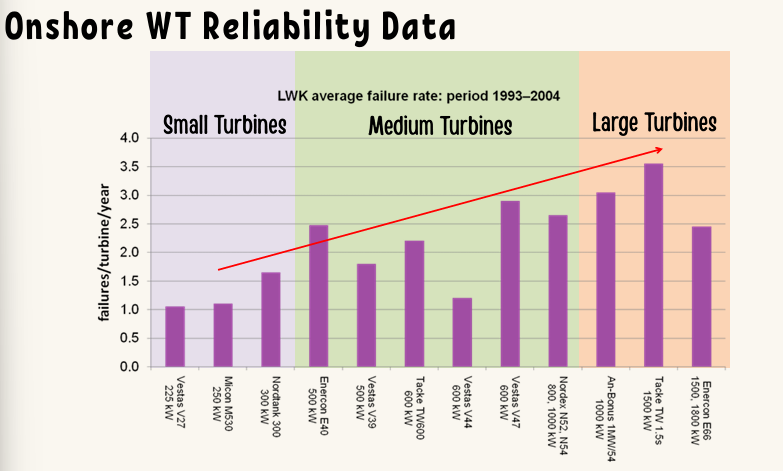
Which components cause the highest failure rate?
Pitch systems 18.7%, 1.18 (failures per unit time or MWh)
protection units 12.1%, 1.17 (failures per unit time or MWh)
Overall lubrication system 11.2%, 1.08 (failures per unit time or MWh)
yaw system 9.1%, 0.88 (failures per unit time or MWh)
Which components of WT have the higher portion of the total dowbtime?
Yaw systems (698h, 23.9%)
pitch system (503h, 17.2%)
power generation system (306h, 10.5%)
electrical grid (265h, 9.1%)
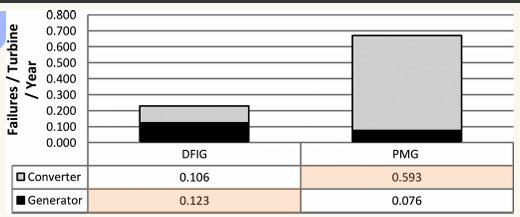
failure rates of generators and converters DFIG vs PMG
In DFIG more failures per year for generator,
In PMG more failures per year in converter
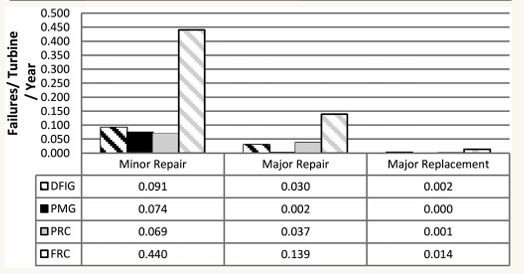
Failure rate by severity for DFIG, PMG, PRC, FRC
What is a FOWF
Floating Ofshore Wind Farm
What is a SCSG type FOWF?
Squirrel cage synchronous generator
this is a wound field synchronous generator or an electrically excited sycnhronous machine where the rotor field is created by the current
requries a field excitation system andused with a gearbox or a medium speed drive train
can control reactive power via excitation
Advantes of a SCSG
No rare earth magnets
good voltage and reactive power contol
mature technology
Challenges of SCSG
More components from excitation system and slip rings/burshes
more maintenance if offshore
gearbox often present which is a major failure risk
What is a PMSP type FOWF?
A permanent magnet synchronous generator, rotor magnetic field comes from permanent magnets. Used in direct drive systems (no gearbox) and requires a fully rated power converter
Advantages of a PMSG?
No gearbox - good for reliability
no excitation system - fewer components
higher efficiency
(best for offshore wind)
Challenges of PMSG
Large and heavey geneartor
depends heavily on power electronics reliability because needs fully rate converter
uses rare earth materials
what are the key components which fail in WTs?
Blade, gearbox, pitch system, yaw system
Causes of failure by fracture and crackings?
Design defects
poor quality
change in process
lack of production eceprience
What is the simple payback period analysis?
THis determines the relative economic benefits compres revenue with consts to determine the time in years required to recoup an initial investment SP=Ea∗PeICC #
E_a is annual electricity production and Pe is the price for electricity
Benefits of an induction machine with no converter at a fixed speed
simple robust design
no brushes of excitation system
low failure rate of the machine itself
What are the risks of an induction machine with no converter at a fixed speed?
Requires a gearbox
no control over speed (higher mech stress)
poor grid support capabilit
What are the benefits of an induction machine with a fully rated converter?
enables variable speed → reduced mechanical loads
removes need for stric grid synchronisation
better control → smoother operation
Risks of an inuction machine with a fully rated converter?
Fully rated convverter has a high failure rate
more electrical complexity
still may require a gearbox
What is the reliability trade off of an induction machine with a fully rated converter?
Decreased mechnaical stress by increased electrical failure risk
benefits of a DFIG?
partially rated converter - 30%
lower converter losses
lower cost
widely used so mature tech
What are the risks of the DFIG?
Slip rings and brushes
wear and require maintenance
major offshore reliability issues
gearbox required
sensitive to grid faultsWh
What is the realiability trade off for DFIG?
Lower converter losses and more mature tech, but multiple vulnerable conponents, gearbox, slip rings, converter
Benfits of a wound rotor synchronous machine WRSM
Controlled excitation → good voltage / reactive power contorl
no permanent magnets which improves costsWha
What are the risks of a wound rotor synchornous machine?
Excitation system - slip rings and burshes
more components mean more failure points
often used with a gearboxWh
What is the reliability trade off of a wound rotor synchronous machine?
Controllable excitation and no magnets but added electrical complexity reduces offshore reliability
Benefits of a permanent magnet synchronous machine?
No gearbox
no excitation system
fewer moving parts
high efficiency
Risks of a permanent magnet synchrnous machine
fully rated converter required
large heavy generator
thermal and structural stresses
rare earth material dependency
what is the main failure point for a permanent magnet synchronous generator?
The fully rated power converter
Why is the gearbox a big reliability problem?
Low failure rate but very high repair time, offshore means this is extremely costly
What is the power electronics reliability trade off?
high failure rate
easier to replace
modular