Physiology of the Respiratory System
 Call Kai
 Learn
Learn Practice Test
 Spaced Repetition
 Match
Match Flashcards
 Knowt Play
1/45

There's no tags or description
Looks like no tags are added yet.
Name | Mastery | Learn | Test | Matching | Spaced | Call with Kai |
|---|
No analytics yet
Send a link to your students to track their progress
46 Terms
Pleural linkage at rest
Lungs = somewhat expanded
Thorax = somewhat compressed
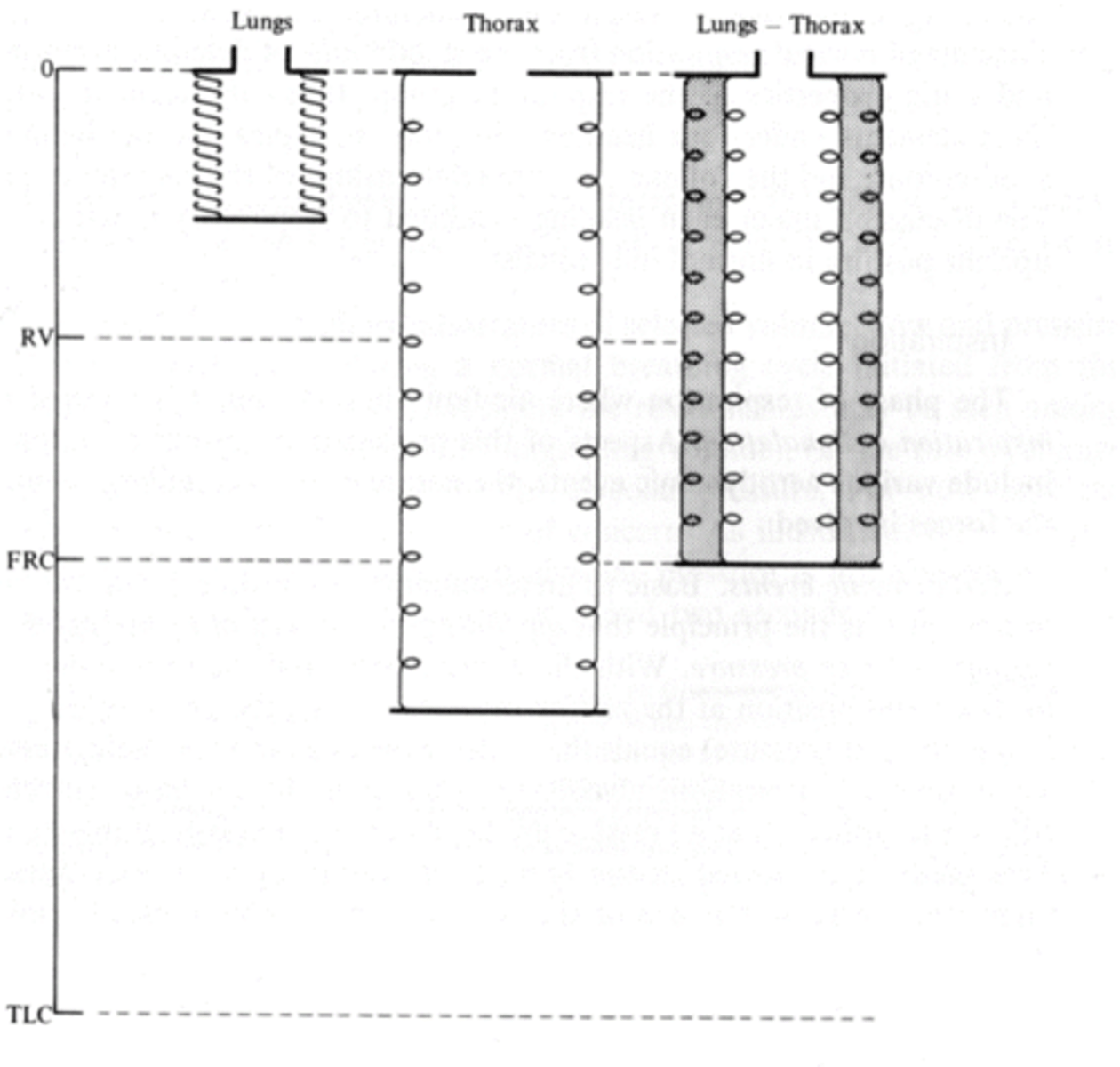
resting lung volume
the amount of air in the lungs at rest position
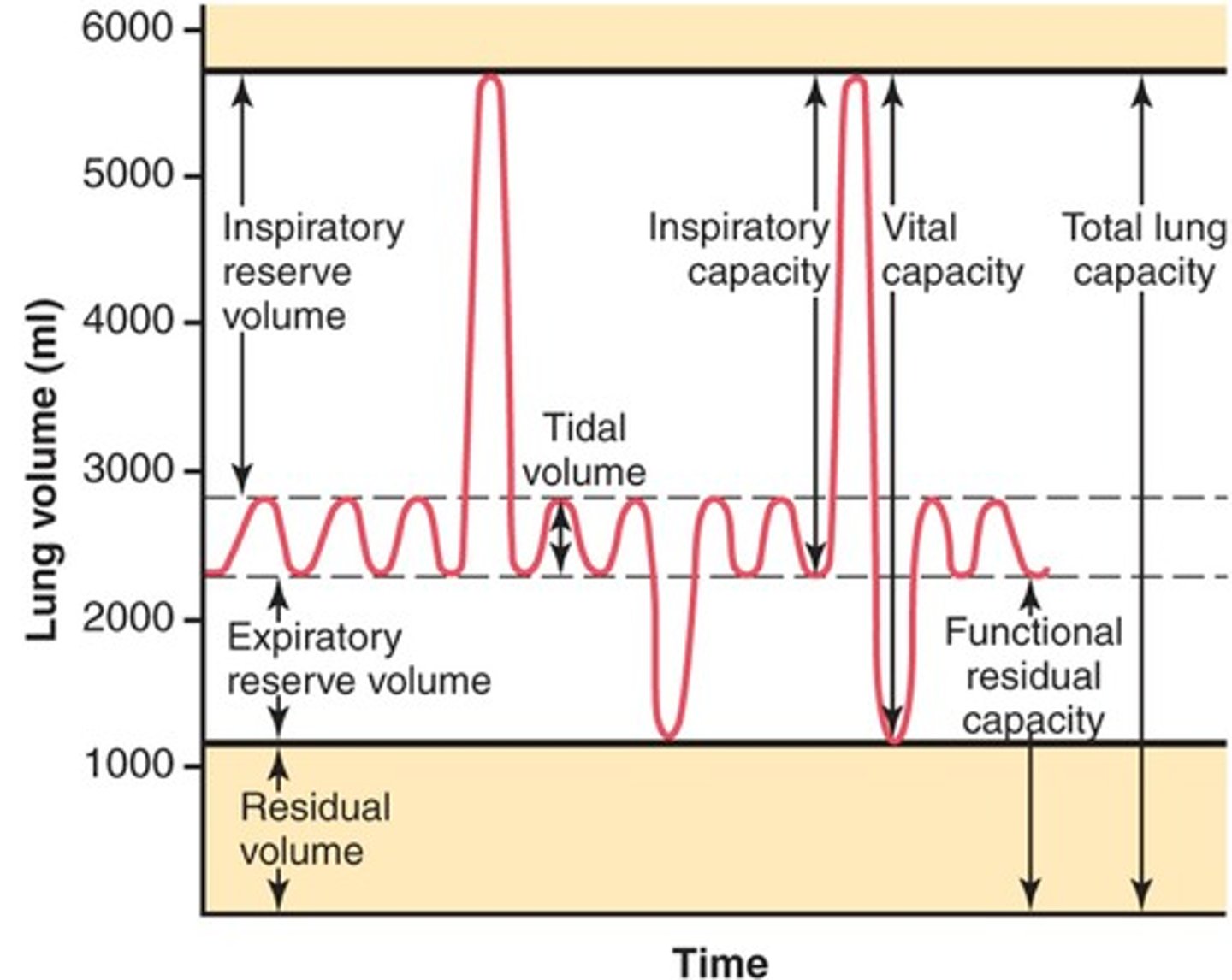
Lung Volumes
tidal volume, inspiratory reserve volume, expiratory reserve volume, residual volume
how to measure lung volume
spirometry
what is tidal volume and its normal volume
volume of air moved during quiet inhalation or exhalation. M 600mL, F 450mL
what percent of tidal volume is in anatomical dead space and alveoli respectively?
30% in anatomical dead space
70% in alveoli
what is anatomical dead space?
conducting portion of the lung that does not take part in exchanging gas
what is inspiratory reserved volume and its normal value?
amount of air that can be inhaled above tidal volume, about 2500ml
what is expiratory reserved volume and its normal value?
amount of air that can be exhaled below tidal volume, about 1000ml
what is residual volume and its normal value?
amount of air left in the lung after forceful exhalation, about 1100ml
list the lung capacities
Inspiratory capacity
Functional residual capacity
Vital capacity
Total lung capacity
what is inspiratory capacity and its normal value?
tidal volume + inspiratory reserved volume
500ml + 2500ml = 3000ml
what is functional residual capacity and its normal value?
expiratory reserved volume + residual volume
1000ml + 1200ml = 2200ml
what is vital capacity and its normal value?
IRV + ERV + tidal volume
2500+1000+500= about 4000ml
what is total lung capacity and its normal value?
total amount of air in the lung after maximal inspiration
about 6000ml in man, slightly less in woman
what are the main muscle for inhalation and exhalation?
Inhalation: diaphragm, external intercostal muscle
Exhalation: abdominal muscle, internal intercostal muscle
what is the difference between activity of inhalation and exhalation?
Inhalation is an active process and exhalation is passive process due to elastic recoil of the lung and thoracic cage
list the respiratory cycle
Rest → Inhalation → Exhalation → Rest
Specific Pressures for Speech and nonspeech Functions
Alveolar pressure
Intrapleural pressure
Subglottal pressure
Intraoral pressure
How to measure lung pressure?
Manometery
atmospheric pressure
the pressure exerted by atoms and molecules in the atmosphere surrounding Earth (760 mm Hg/ or 1,033 cm H2O)
alveolar pressure
pressure within the individual alveolus
intrapleural pressure
pressure within the pleural cavity
subglottal pressure
pressure below the vocal folds
intraoral pressure
the air pressure within the oral cavity
Boyle's Law
inverse relationship between volume and pressure.
P = 1/V
describe the resting phase of breathing cycle
Atmospheric = intraoral = alveolar when at rest
Atmospheric pressure = 760 mm HG or 1,033 cm H20
Intrapleural pressure is -3 to -5 cm H20 at rest
All respiratory muscle at rest
describe the lung during inhalation
Space between pleurae increases
Intrapleural pressure becomes a larger "negative" (pressure "increases" up to -10 cm H20)
uThis expands each alveolus
Alveolar, subglottal, intraoral pressures becomes negative re: atmospheric (~-2 cm H20)
Air enters the lungs
describe the lung during exhalation
Intrapleural pressure becomes less negative
Alveolar pressure becomes positive relative to atmosphere
Subglottal & intraoral pressure become positive re: atmosphere
Air leaves the lungs
what is pleural pressure and what causes it?
It is the pressure between parietal and visceral pleura. It is always negative and less than intrapulmonary pressure. It is formed by the lung and chest wall. The lung wants to collapse and the chest wall wants to expand
what are the 4 components of the control system for breathing?
1. chemoreceptor
2. mechanoreceptor
3. control center in medulla and pons
4. respiratory muscles
list the control center for breathing and their location
*Brain Stem
Cerebral cortex
describe cerebral cortex's voluntary control on breathing
Can temporarily over ride brain stem. We can hyper or hypoventilate. Hyperventilation decrease PaCO2 and increase pH, can induce unconsiousness. Hypoventilation increase PaCO2 and decrease pH. Both are strong drive for ventilation.
Relaxation pressure
The pressure produced entirely by nonmuscular forces of the respiratory apparatus
Relaxation Pressure Diagram
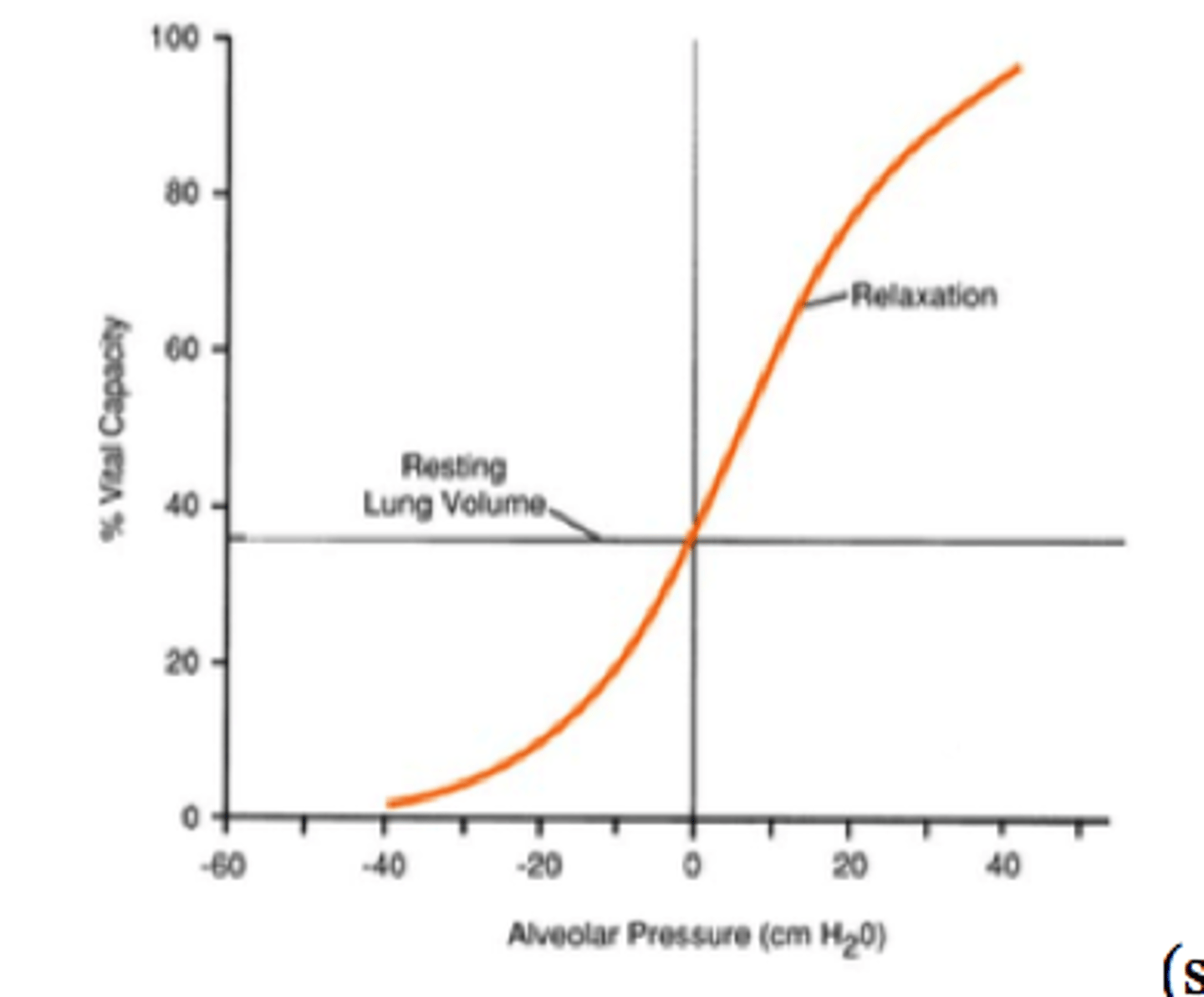
Relationship between breathing and pressure
The more you have inspired, greater is the positive pressure generated
The more you have expired, the greater is the negative pressure generated
At relaxation of the muscles of inspiration and expiration, this proportion remains in the lungs.
38% of VC
Above 38% VC
Inspiratory process is active, exp. is passive
Chest wall recoil generates a positive pressure (are attempting to make thorax smaller)
Below 38% VC
Expiratory process is active, insp. is passive
Restoring forces generates a negative pressure (are attempting to make thorax larger)
For non-speech respiration
40% of the respiratory cycle is inhalation, 60% is exhalation
For speech respiration
10% of cycle is inhalation and 90% is exhalation
Tidal breathing rate
12 cycles per minute
Minimum subglottal pressure required to drive vocal folds
3-5 cm H20
Subglottal pressure required for quiet conversational speech
7-10 cm H20
Checking action
using the muscles of inspiration to impede the outflow of air during expiration
What does happen when the subglottal pressure drop below 50% of VC?
Muscles of expiration will be enlisted