4.6 Price Stability
 Call Kai
 Learn
Learn Practice Test
 Spaced Repetition
 Match
Match Flashcards
 Knowt Play
1/37

There's no tags or description
Looks like no tags are added yet.
Name | Mastery | Learn | Test | Matching | Spaced | Call with Kai |
|---|
No analytics yet
Send a link to your students to track their progress
38 Terms
What is price stability
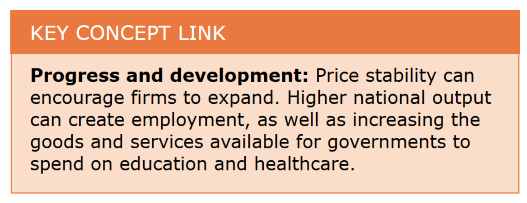
A low and stable inflation rate (to avoid uncertainty)
- Occurs when prices only rise by only a small percentage and there is an avoidance of fluctuations in price level
- Governments usually aim for 2+-2%
Key concept link - progress & development
What is inflation
A sustained rise/increase in the economy's/general price level of goods and services over a period of time.
- Means that on average prices are rising at a particular rate e.g. an inflation rate of 6% means that, on average, prices are 6% higher than they were in the last quarter
What does the price level (aka the general price level) refer to
The average of all prices in an economy
What happens when the price level increases
Price level increases -> Value of the money falls -> purchasing power declines -> each unit of the currency will buy less
What is a creeping inflation
A low rate of inflation -> may encourage firms to produce more
What is hyperinflation
A very high rate of inflation, which may result in people losing confidence in the currency
- Generally consider to be a rate that exceeds 50% a month
E.g. in 2008, Zimbabwe had created ten billion Zimbabwean dollar notes
What is deflation
A sustained fall in the general price level of goods and services over time.
- Results in a rise in the value of money with each currency unit having greater purchasing power
- It involves a negative inflation rate
What is disinflation
A reduction/fall in the rate of inflation but is still positive; prices are still rising but at a slower rate .
What does the inflation rate refer to
The percentage rise in an economy's price level over a period of time (from one period to another - either month to month or quarter to quarter)
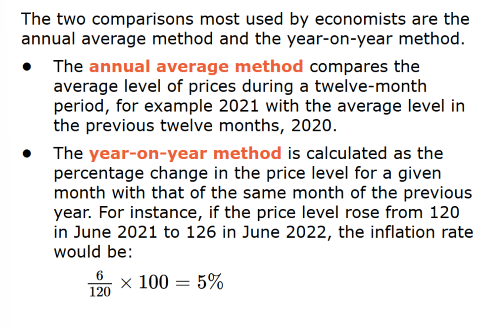
What are the two comparisons of inflation rate most used by economists
What is the consumer price index (CPI)
A measure that shows the average change in the prices of a representative basket of products purchased by households
How is the Consumer Price Index (CPI) used
It measures changes in the cost of a basket of goods and services purchased by the average household to calculate the inflation rate.
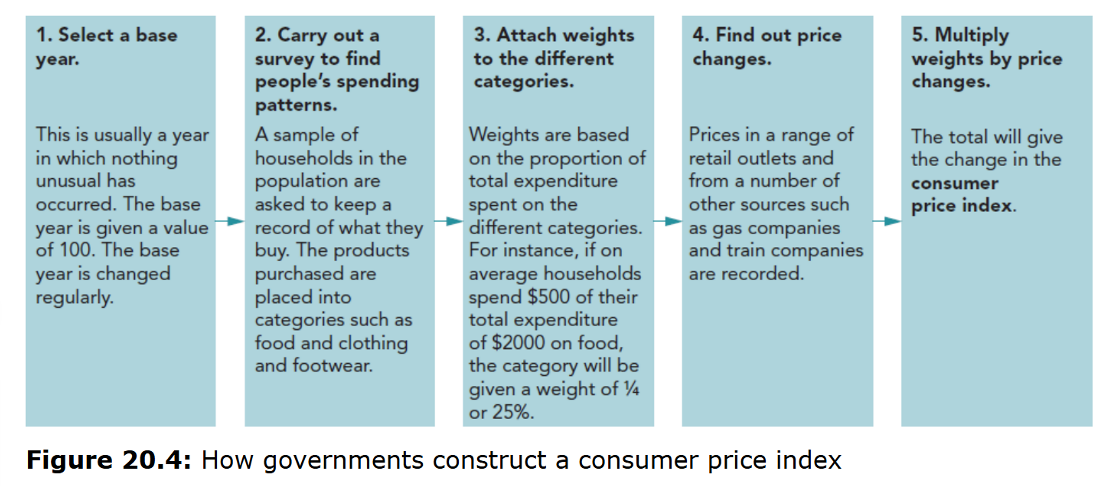
How do governments construct a consumer price index (CPI) (5 steps)
How is the inflation rate calculated using CPI
Inflation rate (%) = (CPI this year – CPI last year) ÷ CPI last year × 100
What are some difficulties in measuring inflation using CPI
• Choosing an appropriate base year – unusual years distort comparisons.
• Survey issues – sample may not represent the population; people may record spending inaccurately; different groups face different inflation rates.
• Basket problems – weights can become outdated; slow to include new products or remove old ones.
• Substitution bias – CPI doesn’t fully reflect consumers switching to cheaper alternatives.
• Quality bias – difficult to adjust for improvements or reductions in product quality (including shrinkflation).
What is the difference between nominal and real values
Nominal values (also known as money values) are measured in current prices operating at the time (include inflation); real values are adjusted for inflation to show true purchasing power.
How do you convert money values into real data
The figures are multiplied by the price index in the base year and divided by the price index in the current year
- Nominal wage rises 5%, inflation 3% → real wage increase = 2%.
What are the two main causes of inflation
Cost-push inflation and demand pull inflation
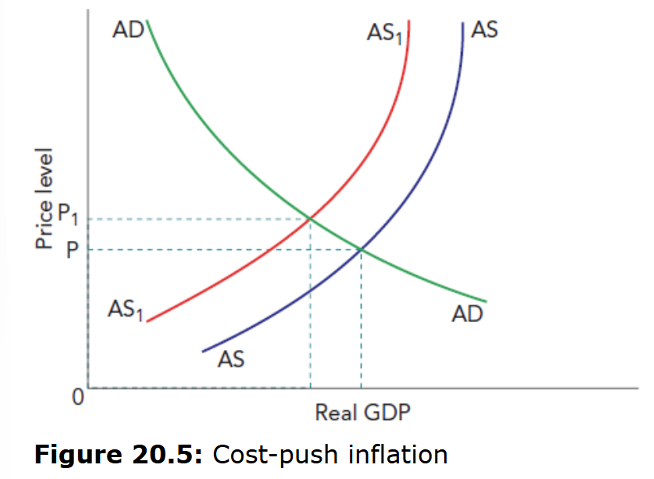
What is cost-push inflation + diagram
Inflation caused by rising production costs, shifting SRAS left.
Price level rises -> causes a contraction in AD -> reduces real GDP
What causes cost-push inflation (5)
• Rising wages (especially if wage growth > productivity), possibly leading to a wage–price spiral.
• Higher raw material and fuel prices.
• Depreciation of the exchange rate, making imports more expensive.
• Higher transport/production costs and firms raising prices to maintain profit margins.
• Supply shocks such as bad weather, resource depletion or damage reducing supply.
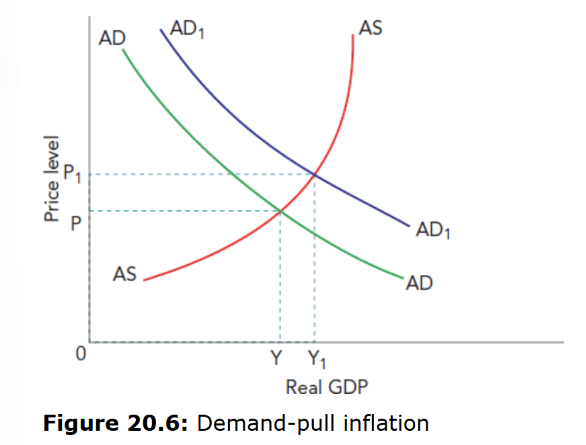
What is demand-pull inflation + diagram
Inflation caused by total demand (AD) exceeding the productive capacity of the economy.
- Inflation caused by increases in AD not matched by equivalent increases in AS
- Any of the components of AD may increase (C, I, G, X-M) although an increase in some forms of gov spending and investment may not be inflationary in the long term
Increase in AD -> Increase in price level
- Will have a greater impact the closer the economy is to full capacity
What causes demand-pull inflation
Higher consumption, investment, government spending, or exports → AD shifts right → price level rises.
What do monetarists argue is the key cause of higher AD vs Keynesians opposing view
Monetarists argue is the key cause of demand-pull inflation is increases in the money supply.
- They suggest that if the money supply grows more rapidly than output , the greater supply of money will drive up the price level
Keynesians argue that it is inflation that causes an increase in the money supply and not the other way round as if costs rise, firms may borrow more from banks -> this will
What is the link between demand‑pull inflation and cost‑push inflation
Some changes can cause both demand‑pull and cost‑push inflation at the same time. For example, a fall in the exchange rate can increase import prices (cost‑push) while boosting export demand (demand‑pull).
Once inflation starts, the two types can reinforce each other, creating an inflationary spiral. Higher prices may lead workers to demand higher wages, raising production costs (cost‑push) while also increasing spending (demand‑pull), causing further upward pressure on prices.
What is stagflation
A situation where output falls and prices rise, often caused by cost-push inflation.
What are the possible costs of inflation (8)
Reduced international competitiveness → reduction in net exports -> BoP probelms
Redistribution of income → borrowers/lenders and savers gain or lose in real terms.
Menu costs → costs involved in changing prices -> firms must update prices, labels, catalogues.
Shoe‑leather costs → time spent moving money between financial institutions to find best interest rates.
Fiscal drag → people pushed into higher tax brackets.
Lower investment → uncertainty makes firms less willing to invest.
Inflationary noise → prices give misleading signals, causing inefficient decisions.
Inflation expectations → workers demand higher wages, potentially fuelling a wage–price spiral.
What are menu costs
Costs to firms of having to change prices due to inflation
What are shoe leather costs
Costs of moving money around in search of the highest interest rate
What is fiscal drag
The income of people and firms being pushed into higher tax brackets as a result of inflation
What is inflationary noise
Confusion over relative prices caused by inflation
What are the possible benefits of inflation (3)
• Stimulates output: Low, stable inflation can boost confidence, raise profits and encourage investment; higher nominal incomes may increase spending.
• Reduces the real burden of debt: Real interest rates may fall, lowering repayments and encouraging consumption and investment.
• Prevents some unemployment: Firms can reduce real labour costs more easily (e.g., by holding wages steady in nominal terms), helping them avoid layoffs.
What factors affecting the consequences of inflation (5)
• Cause of inflation: Demand‑pull (rising output) tends to be less harmful than cost‑push (falling output).
• Rate of inflation: High or hyperinflation causes greater damage than low rate
• Whether inflation is accelerating or stable: Rising or unstable inflation increases uncertainty and discourages investment.
• Whether inflation is anticipated: Unanticipated inflation is more harmful because households/firms cannot plan for it.
• Comparison with other countries: A country with lower inflation than competitors may gain international competitiveness.
What has caused recent reductions in global inflation
Recent global inflation has fallen due to advances in technology, which lower production costs and increase aggregate supply; greater international competition, which discourages firms from raising prices; and labour market changes, such as declining trade union membership and more casual employment, reducing workers’ ability to demand wage rises.
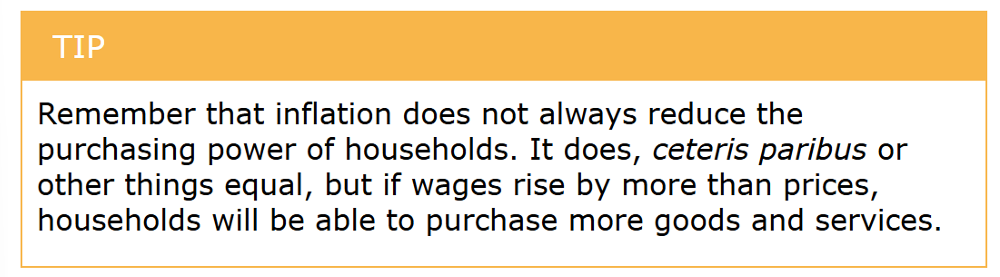
Tip -inflation does not always reduce the purchasing power of households
What are policy responses to inflation
Monetary policy (increase interest rates), fiscal policy (reduce government spending), and supply-side measures to increase productive capacity.
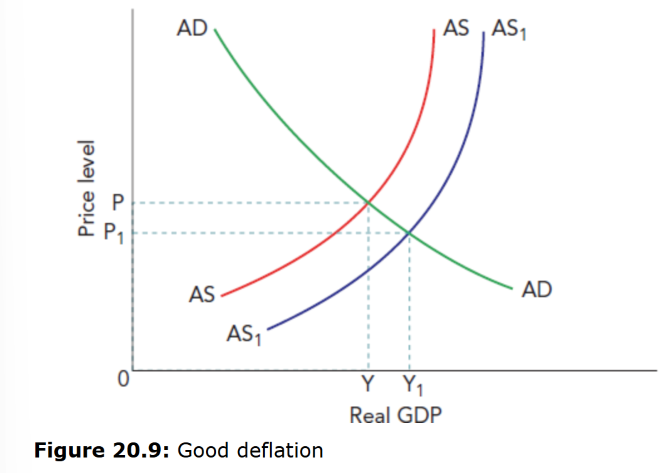
What is good deflation + diagram
Good deflation occurs as a result of an increase in AS -> fall in price level & rise in GDP
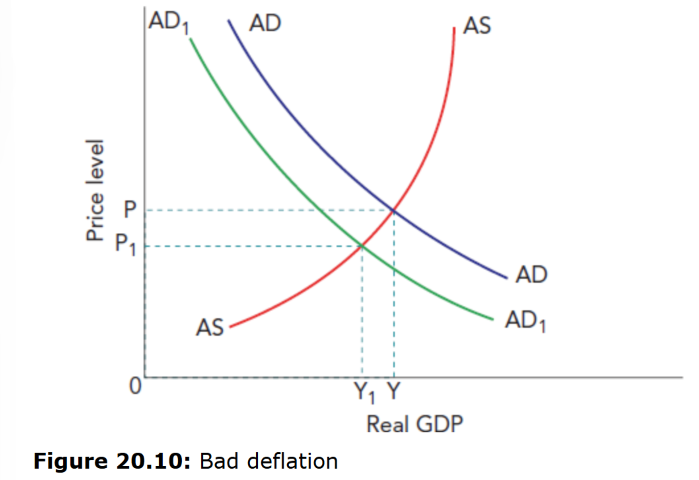
What is bad deflation + diagram
Bad deflation occurs when price level is driven down by a fall in AD
Output falls -> potentially rise in unemployment
- Risk of developing into a deflationary spiral
- Consumers may delay their purchases, expecting prices to fall further in the future