Protein Folding kinetics
 Call Kai
 Learn
Learn Practice Test
 Spaced Repetition
 Match
Match Flashcards
 Knowt Play
1/6

There's no tags or description
Looks like no tags are added yet.
Name | Mastery | Learn | Test | Matching | Spaced | Call with Kai |
|---|
No analytics yet
Send a link to your students to track their progress
7 Terms
Rate constants
kf → rate constant for folding
ku → rate constant for unfolding
How do we measure folding rates?
Folding (U → N): Start with unfolded protein in high denaturant → dilute into buffer → fit the signal to y = Ae-kft
Unfolding (N → U): Start with folded protein → add denaturant → fit to y = Aekut
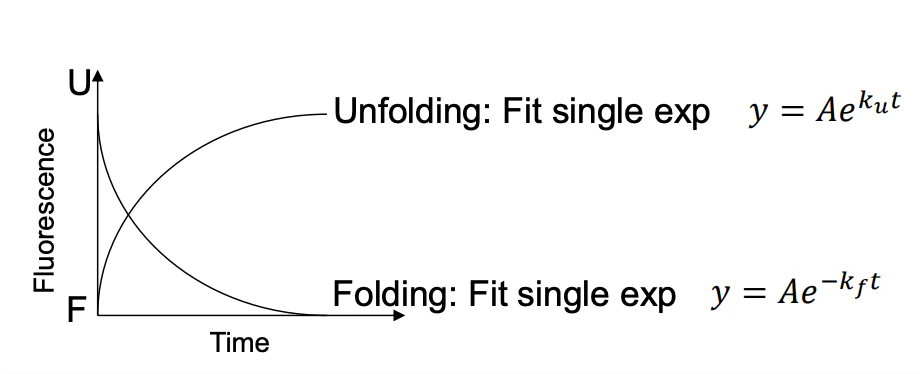
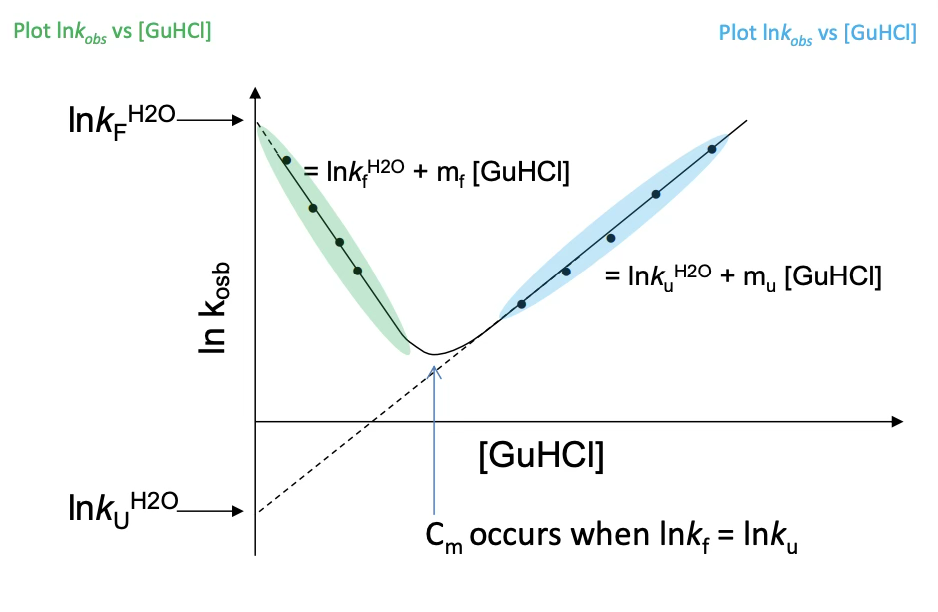
Chevron plot
Because we usually cannot measure folding rates directly in pure water (it happens too fast or the protein is too unstable), we measure kobs at various denaturant concentrations and extrapolate.
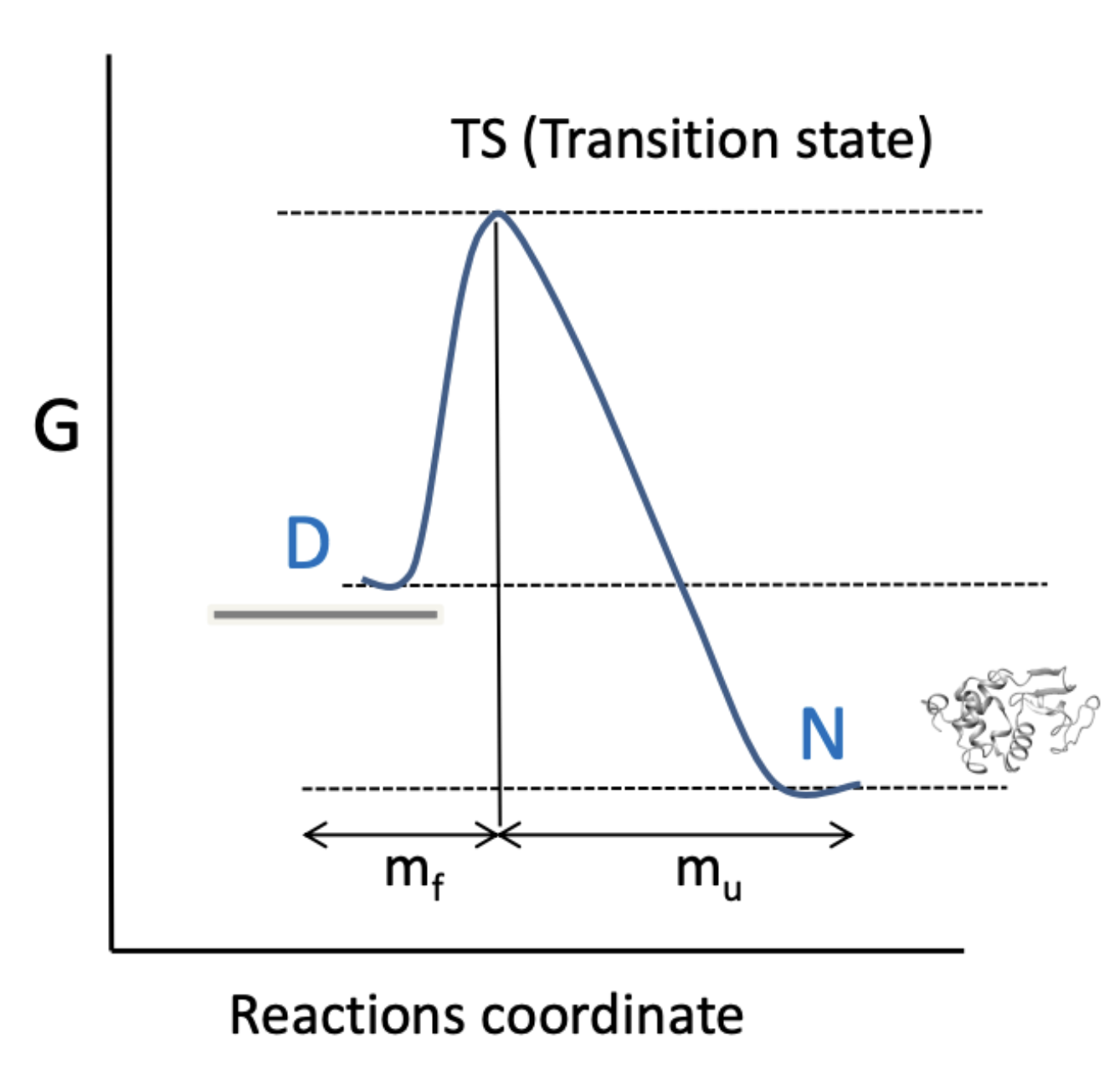
Transition state and βT value
TS is the “mountain peak” the protein must cross to fold or unfold
We can calculate βT (a value between 0-1) to see what the TS looks like using the formula
βT measures how much surface area is buried in the transition state compared to the fully folded state
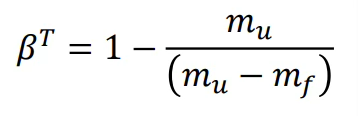
What does it mean if mf >> mu —> βT is around 1?
TS is compact and looks like the native state!
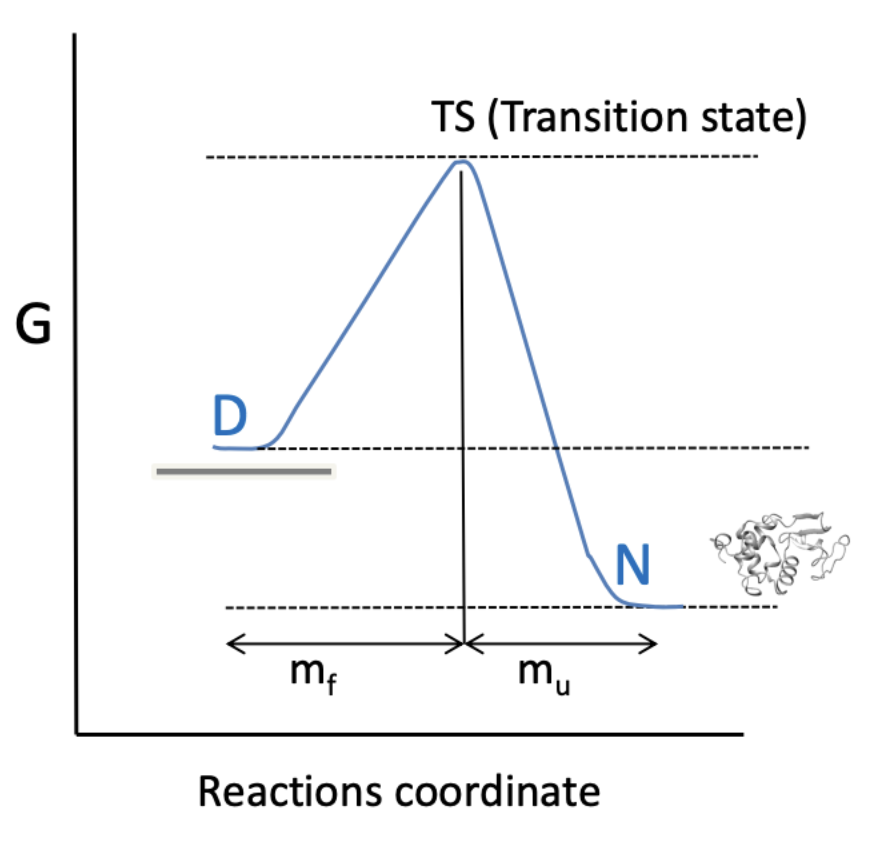
What does it mean if mf << mu —> βT is around 0?
TS is unstructured and looks like the unfolded state!
How can we see which amino acids have formed their native contacts in the TS?
Through a Φ-value analysis!
Φ = 0: mutated residue is largely unfolded and does not contribute to stabilising the transition state
Φ = 1: mutated residue and its local environment are fully structured and native-like in the transition state
Φ = 0-1: the residue has partially formed contacts in the TS