Genetics Ch. 6-7 Lab
 Call Kai
 Learn
Learn Practice Test
 Spaced Repetition
 Match
Match Flashcards
 Knowt Play
1/33

There's no tags or description
Looks like no tags are added yet.
Name | Mastery | Learn | Test | Matching | Spaced | Call with Kai |
|---|
No analytics yet
Send a link to your students to track their progress
34 Terms
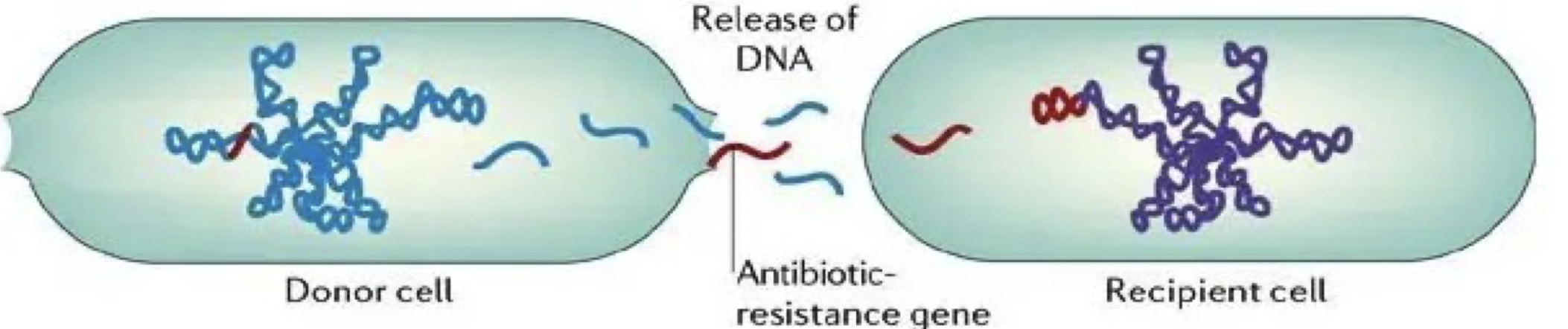
Gene Transfer Mechanism in Bacteria: Transformation
Transfer of cell-free or “naked” DNA from one cell to another
Transfers fragments of chromosomal DNA after lysis and partial degradation of donor chromosomal DNA
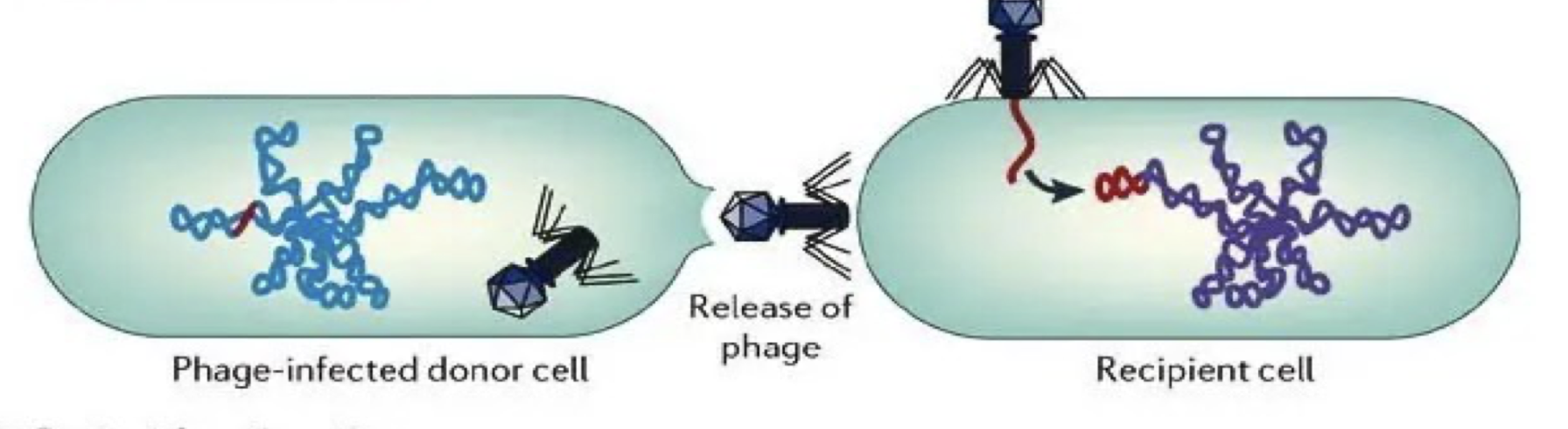
Gene Transfer Mechanism in Bacteria: Transduction
Transfer of genes from one cell to another by a bacteriophage
Transfers fragments of donor DNA by incorporation into defective phage particles
Transfers smallest amount of chromosomal DNA since fragments have to fit into the transducing particle
A form of recombination in bacteria
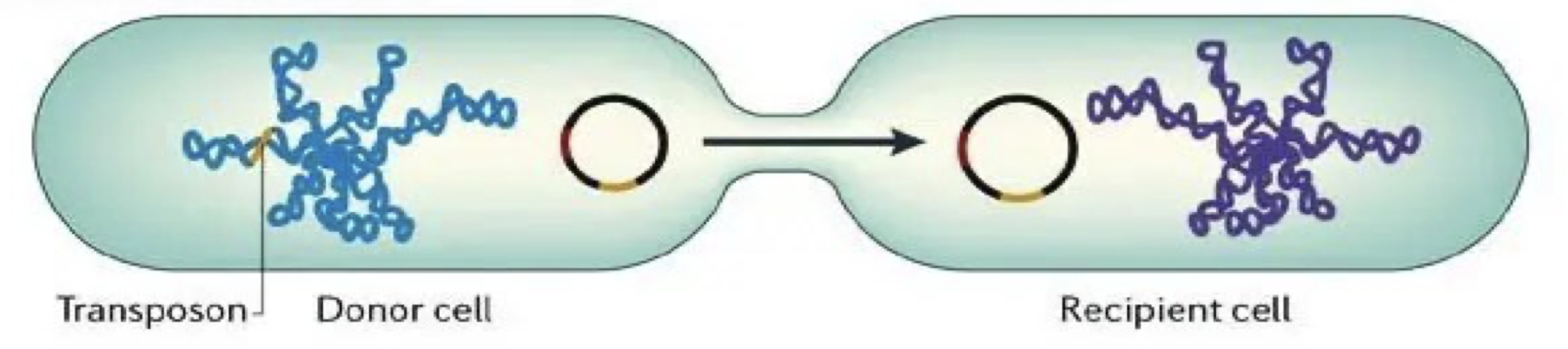
Gene Transfer Mechanism in Bacteria: Conjugation
Transfer of genes between cells that are in physical contact w/ one another
Transfers chromosomal DNA from Hfr and F’ donor to F- recipients
Transforms the largest amount of donor chromosomal DNA
the donor retains a copy of the transferred gene
Transfers DNA horizontally to cells in the same generation
A form of recombination in bacteria
Transfers genes for drug resistance
Transfers genes for enzymes and adherence molecules
F- strains are conjugated by …
By F+ to F+
A donor is effectively F+ if …
It initiates F factor mediated conjugation because only cells that have the F factor are able to do that
An F+ cell (containing the F factor) conjugates w/ an F- cell to make it into F+ while the F+ donor stays F+
Hfr strain
A bacterium w/ a conjugative plasmid integrated into the chromosomal DNA
Can act as donors b/c have F factor integrated into chromosome, so when initiating conjugation, attempts to transfer its entire chromosome/host chromosome
In mapping experiments, are conjugated to F- strains → F factor is excised imprecisely, carrying some adjacent chromosomal DNA w/ it
distance between 2 genes is determined by comparing their times of entry during a conjugation experiment
genetic distance in minutes = difference in entry times
Cotransduction frequency
Fraction of transductants where both genes were transferred together
Large value = closer together
Small value = farther apart
If two genes are very close together on chromosome, are more likely to fit into the same phage head
Meaning of + and -
+ means can synthesize it (i.e. met+ = can synthesize methionine)
- means cannot synthesize it (i.e. met- = cannot synthesize methionine
Complete media vs Minimal media
Complete: Medium contains all the required compounds for bacterial growth and reproduction
Minimal: contains only carbon and nitrogen source
Phototrophic bacteria
Only grow on minimal media
Can produce all necessary compounds required for their growth and reproduction utilizing the carbon source provided on the minimal media (i.e. ala+ pro+ lac+)
Auxotrophic Bacteria
Can’t grow on minimal media b/c have mutation on some amino acid biosynthetic pathway gene → only grows in complete media or on right supplemented minimal media
i.e. ala+ pro- lac+ can only grow on complete media or minimal media supplemented w/ amino acid proline
Purines
Adenine and Guanine (have 2 bonds between)
2 rings
Pyrimidines
Cytosine and Thymine (have 3 bonds between)
1 ring
The melting temp of DNA increases as the …
G+C content increases
Phosphodiester bond
The bond that joins one nucleotide to another in the DNA strand
Covalent
Formation between alpha phosphate of incoming nucleotide triphosphate and 3’ hydroxyl group of the last nucleotide added to strand → catalyzed by DNA polymerase
Hydrogen bonds
The bond that joins one strand of DNA duplex to the other strand
Non covalent
Complementary
Is used to describe the pattern of base pairing between one DNA strand and its partner in a duplex
Antiparallel
Is used to describe the polarity of two DNA strands in a duplex
Means DNA strands run in opposite direction (i.e. one strand of DNA goes from 5’ to 3’ and the other strand is opposite in direction going 3’ to 5’)
Topoisomerase
Works at the region ahead of the replication fork to prevent supercoiling
Helicase
Opens up the DNA at the replication fork
Single-strand binding protein
Coats the DNA around the replication fork to prevent rewinding of the DNA
RNA Primase
Synthesizes RNA primers complementary to the DNA strand
Creates Okazaki fragment primers
Note: RNA has no T, has U instead, but % A doesn’t equal % U
DNA Polymerase
Can proofread replicating DNA, delete incorrect bases, excise them, and correctly replace them
DNA Polymerase III
Extends the primers, adding on to the 3’ end to make the bulk of the new DNA
Polymerase activity
5’ → 3’
Replication, proofreading, editing
Exonuclease activity
3’ → 5’
If it could add bases in the 3’ → 5’ direction in E.coli, there would be no need for Okazaki fragments
Most important enzyme/main enzyme for DNA replication
DNA Polymerase I
Removes RNA primers and replace them w/ DNA
aka does primer removal and gap filling in the completion of an Okazaki fragment
Polymerase activity
5’ → 3’
Filling in gap after removal RNA primer, DNA repair, removal of RNA primers
Exonuclease activity
5’ → 3’, 3’ → 5’
DNA Polymerase II
Polymerase Activity
5’ → 3’
DNA repair
Exonuclease activity
3’ → 5’
Ligase
Seal gaps between DNA fragments
Okazaki fragments (which are formed on lagging strand) are joined by this
Okazaki fragments: short DNA segments formed on the discontinuously replicated strand that contains both DNA and RNA nucleotides
The final covalent bond made in the completion of an Okazaki fragment, including primer removal and gap filling
Prokaryotic chromosomes vs Eukaryotic chromosomes
Prokaryotic chromosomes have a single origin of replication
Eukaryotic chromosomes have multiple origins of replication
Why do leading and lagging strands exist?
Because there is no known enzyme that replicates in the 3' - 5’ direction
The Hershey and Chase experiment with P32 and S35 demonstrated that …
Phage DNA enters the host cell
When genes are found on different chromosomes or far apart on the same chromosome …
They assort independently and are said to be unlinked
Common types of gametes = parental configuration
Rare types of gametes = recombinant configurations
When genes are closer together on the same chromosome …
They are linked
alleles/gene versions will be inherited as a unit more frequently
Gene interference
A measure of the independence of crossovers from each other
If they aren’t independent → crossover in one region does affect the likelihood of there being a crossover in an adjacent region
If a crossover in one region does affect a crossover in another region, but interaction is called interference
Interference value explained
If I = 0.49, that means only 0.49 of expected double-crossover progeny were not observed