Energy Expidenture
 Call Kai
 Learn
Learn Practice Test
 Spaced Repetition
 Match
Match Flashcards
 Knowt Play
1/39

There's no tags or description
Looks like no tags are added yet.
Name | Mastery | Learn | Test | Matching | Spaced | Call with Kai |
|---|
No analytics yet
Send a link to your students to track their progress
40 Terms
What is energy expenditure?
rate of energy use
How are energy requirements estimated?
can be estimated based on energy expidenture assuming that energy expended/day = energy required/day
What is energy balance?
energy intake = energy expended
body stores are stable
What happens when one’s energy intake < energy requirement?
reduction in physical activity
reduced growth rate in children
mobilization of tissue energy reserves (primarily adipose tissue)
What happens when one’s energy intake > energy requirement?
weight gain may occur
increased risk of chronic disease
What are the different components of total energy expidenture (TEE) in individuals?
TEE = Basal Metabolic Rate (BMR) + Physical Activity (PA) + Thermic Effect of Food (TEF)
BMR = 60-70% (directly correlated with FFM as the bigger the body, the more energy needed to function and vice versa)
PA = 20 - 30%
TEF = 10%
What is the difference between resting metabolic rate (RMR) vs Basal Metabolic Rate (BMR)?
BMR: the minimum rate of energy expenditure necessary to maintain basic physiologic functions, and this is typically measured during deep sleep, typically during the night or early morning hours
RMR: the rate of energy expenditure when at rest, and this is measured after an 8-12 hour fast and after a 30 minute rest, this can be ~3-10% higher than BMR
What are BMR and RMR closely related to?
body size, especially FFM
the amount of FFM explains ~70-80% of variance in RMR among individuals
What is the most variable component of TEE between individuals?
physical activity
Describe how different levels of activity contribute differently to TEE of individuals?
sedentary people = ~20-30% of TEE
very active people = 50% of TEE
athletes and heavy laborers = > 50% of TEE
Describe energy costs during and after an activity.
there is an immediate rise in energy expended during the activity
see a small increase in energy expenditure after the activity (but this is dependent on intensity of activity and can contribute ~15% of expenditure that occurred during the activity overall)
What is the thermic effect of food (TEF)?
energy expended to digest, transport, metabolize, and store nutrients
differs depending on what type of food is eaten
How do different macromolecules contribute differently to our TEF?
carbs = ~ 5-10%
fats = ~ 0-5%
proteins = ~ 20-30% (high metabolic cost in processing amino acids)
mixed diets = 10%
What is thermoregulation?
process by which mammals regulate their body temperature within narrow limits
How does thermoregulation influence our TEE?
2-5% increase in TEE in low normal environmental temps (68-82ºF vs 82-86ºF)
under cold stress that triggers shivering, RMR may increase by 2.5%
in most conditions people can regulate their clothing and environment to maintain a comfortable body temp therefore temperature variations contribute very little to TEE
Describe energy requirements for growth during infancy and childhood.
infancy: energy requirement for growth is low except for the first few months
1 month = 35% of energy
12 month = 3%
puberty = 4%
What is the difference between what the BMR is mostly dedicated for in infants (0-2) versus in adults?
in infants, a larger % (~60-70%) of BMR is dedicated to support brain function and growth compared to adults
What more than BMR, PA, and TEF can module TEE?
pregnancy, lactation, age, and injuries
How does age impact TEE? Why?
TEE declines to age
due to loss of FFM (lowers metabolism), decline in physical activity, and decline in organ-level metabolic rates (BMR)
How does pregnancy impact TEE?
BMR increases due to increased metabolism of the uterus, fetus, heart, and lungs, and by the end of pregnancy this increase in BMR is due to the fetus
physical activity tends to decline but as weight gain continues, activities tend to require more energy
What are the different additional energy requirements during the different trimesters of pregnancy?
1st = 0 kcal/day
2nd = 340 kcal/day
3rd = 452 kcal/day
How does lactation impact TEE?
BMR tends to increase 4-5% in order to support milk production
milk energy output ~400-500kcal/day
energy mobilization from tissues can support some of the energy required for milk production (this supports postpartum weight loss)
in general physical activity levels tend to decline so any changes aren’t due to this
physical activity may return to normal by 2-3 months
What are four factors that decrease energy expenditure?
hypothermia
hypothyroidism
prolonged fasting
decreased FFM (muscle atrophy)
What are five factors that increase energy expenditure?
fever (13% increase per ºC)
hyperthyroidism
burns (can double injury needs)
recovery from major surgery
sepsis
How do you measure kcal needs during injury or illness?
kcal need = BMR x activity factor x injury factor
activity factor: confined to bed OR seated/little movement
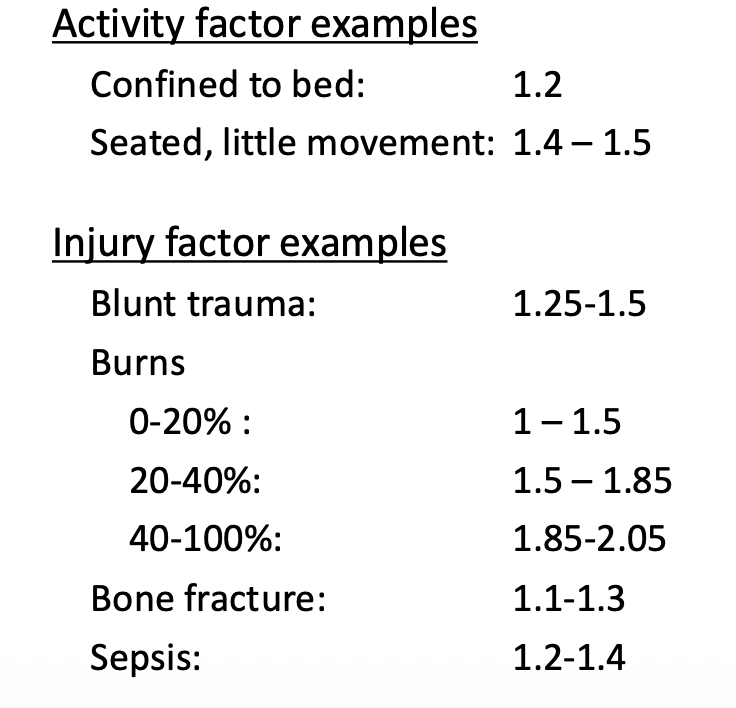
How you measure energy expenditure from estimation?
make use of prediction equations
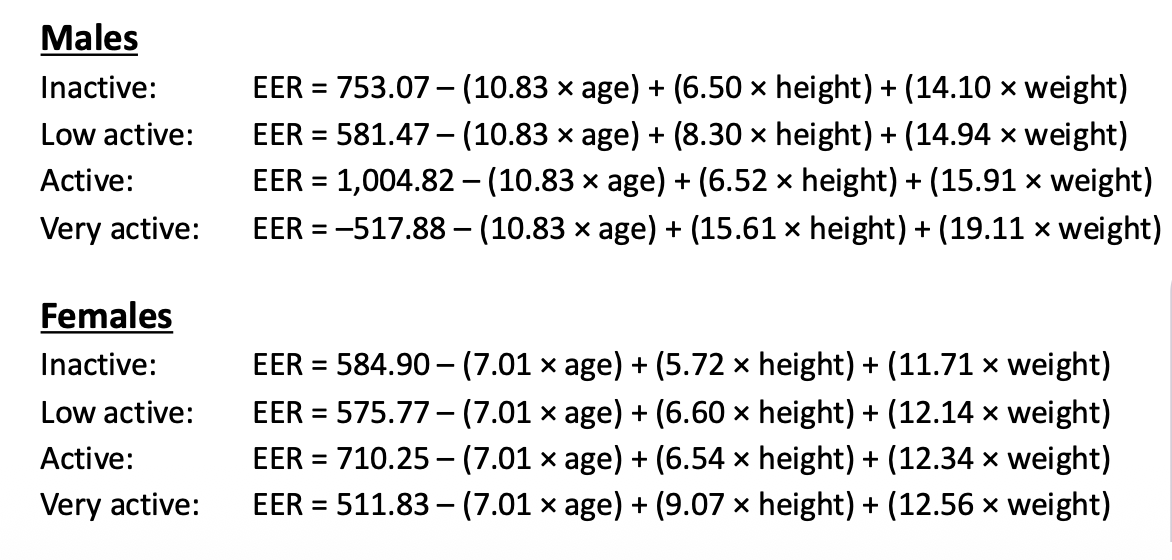
What are the different physical activity levels found in prediction equations?
inactive
low active
active
very active
What is considered an inactive physical activity level?
activities of daily living
ex: 30 minutes walking + ~90 minutes of light-moderate activity (household task, dishes, raking the lawn, etc)
What is considered a low active physical activity level?
activities of daily living +
60-80 min of moderate activity (ex: walking 3-4 mph)
What is considered an active physical activity level?
activities of daily living +
30-50 min of moderate activity + 85 minutes of vigorous activity (ex: jogging/cycling)
What is considered a very active physical activity level?
activities of daily living +
> 2 hours of vigorous physical activity
Energy expidenture requirement equation for children
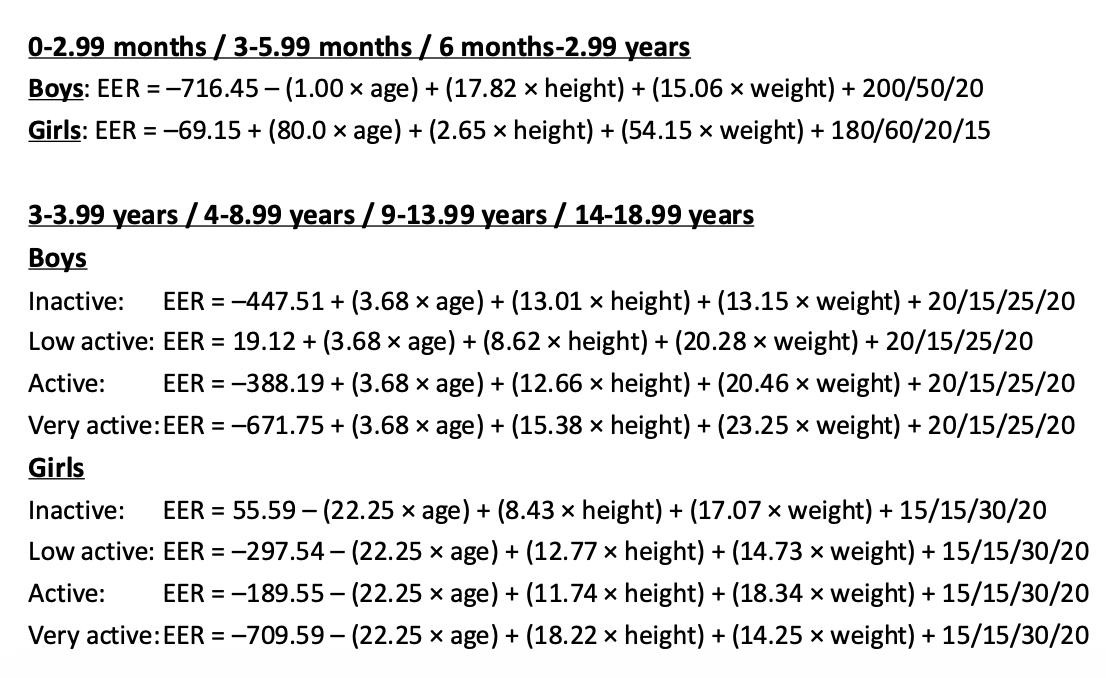
younger ages dont have physical activity accounted for bc it is assumed that they are active or that their activity levels are negligible
Energy expidenture requirement equations for those who are pregnant.
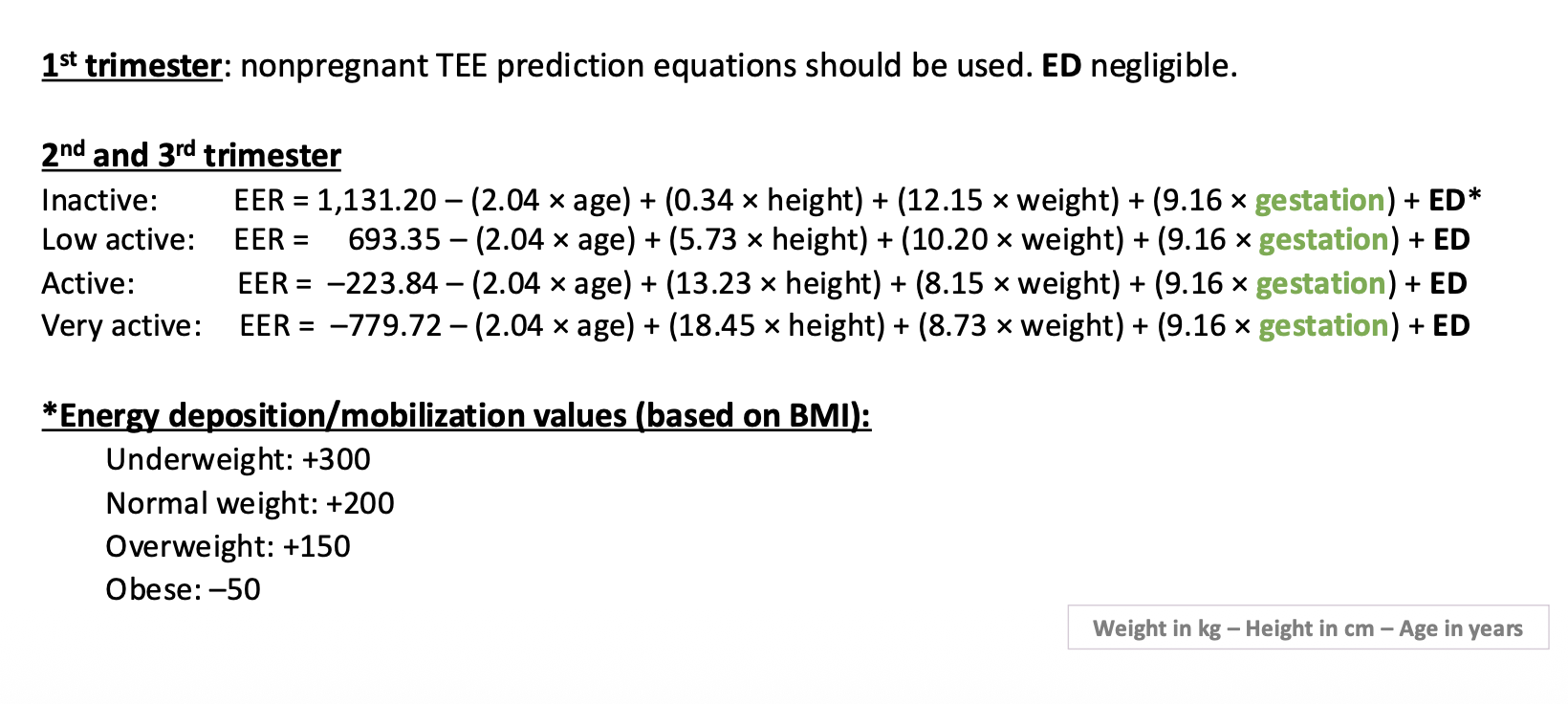
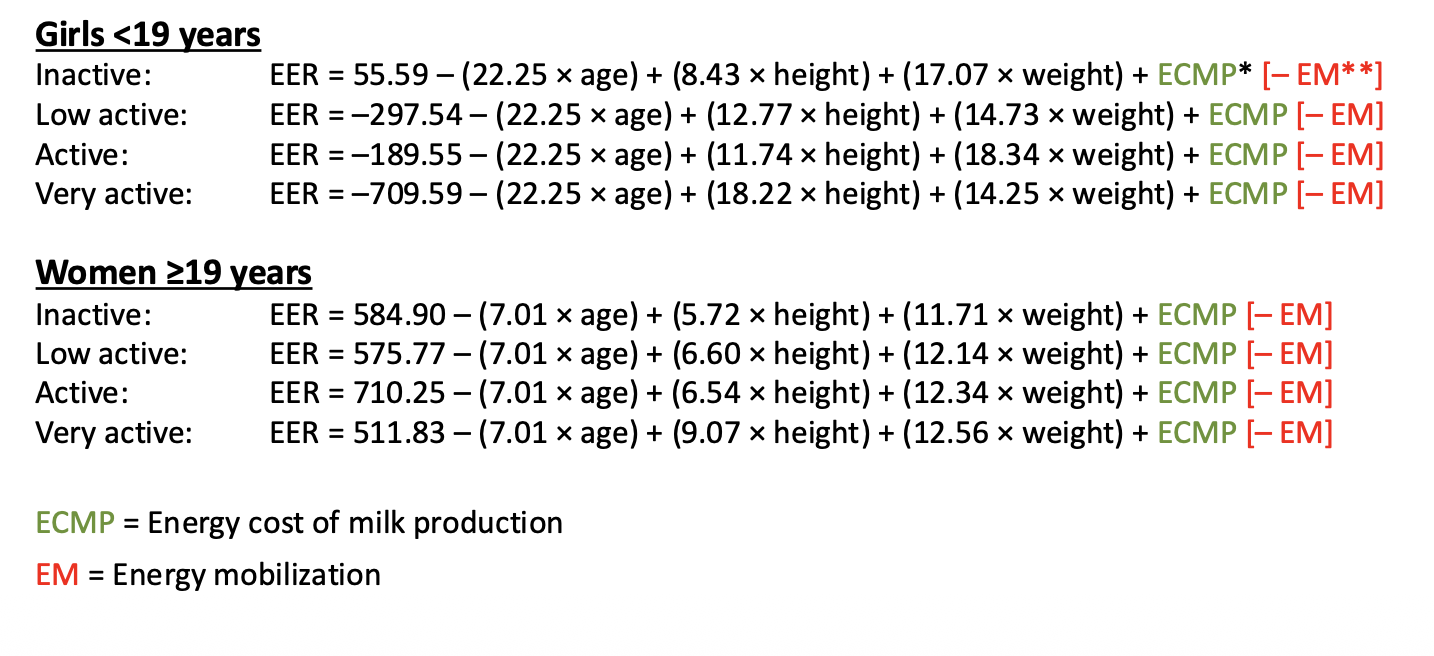
Energy expidenture requirement equations for those who are lactating.
What is RMR positively correlated with?
positively correlated with FFM
this is what mostly causes the inter-individual variation amongst RMR (FFM differences)
What are two ways that RMR can be estimated/measured?
prediction equations (make use of weight, height, age, and sex)
can be measured using indirect calorimetry
What are two prediction equations used for estimating resting metabolic rate?
Mifflin-St Jeor (1990s)
Harris-Benedict Equations (1910s and revised 1980s)
What are characteristics associated with the Mifflin-St Jeor equation?

developed from normal weight, overweight, and obese individuals in 1990
is the overall equation that is recommended
found to predict RMR ±10% in 82% normal weight individuals and 70% of obese individuals
formula does not work well for elderly (> 80 years)
What are three different ways to assess energy expidenture?
estimation
direct measurement
factorial method
Why can’t TEE be calculated from a single sample taken over a few hours after a dose of doubly labelled water?
because measuring TEe requires observing isootpic