Hellenistic World: Term 1 Week 2: The formation of the Kingdoms
 Call Kai
 Learn
Learn Practice Test
 Spaced Repetition
 Match
Match Flashcards
 Knowt Play
1/122

There's no tags or description
Looks like no tags are added yet.
Name | Mastery | Learn | Test | Matching | Spaced | Call with Kai | Chat |
|---|
No analytics yet
Send a link to your students to track their progress
123 Terms
Who were the Diadochi?
The Diadochi were the rival generals, families, and friends of Alexander the Great who fought for control over his empire after his death in 323 BC.
What was Alexander the Great not successful in?
Not successful in the afterthought of what the empire would look like
What did Alexander become after his death?
He becomes a kind of mythical figure
He was a ruler that many sought to emulate
How was Alexander lucky/successful?
He was also quite lucky- he attacked a much larger empire and successfully defeated the Persians (then took over their empire)
How did this success end?
When he went beyond the band of the Persian empire it didn’t go so well
Had difficulty controlling his armies, they became more rebellious till they demanded they wanted to go home and they had to retreat
Died in 323 BC
Who was he interested in uniting?
Interested in uniting Persians, macedonians and Greeks (had a Persian wife- Roxanne, and forced commanders to also take Persian wives)
When did Alexander the Great die?
323 BC
What were issues that arose from his death?
No obvious heir
The Kings authority had not been fully established over the empire
The most experienced commanders were not in Babylon (Antipater, Antigonus)
His wife was preganant when he died but they did not know the gender
What is the period of successors characterised by?
The period of the Successors is characterised by wars, alliances and peace treaties
How did rulers often attempt to make alliances?
Each ruler tried to secure alliances through marriage, would often mean repudiating a wife and offending another ruler
What was the general trend when an individual would become the most powerful successor?
Whoever was the most prominent and powerful of the Successors would be regarded as a threat by his rivals, so they would form an alliance against him
If the most powerful Successor was defeated, another became the most powerful, and an alliance would be made against him …
Explain the symbolic importance of Alexander to the successors after his death
The successors sought to shore up authority by creating connections to Alexander, no successors had hereditary kingship so conencteions with Alexander were very much so desired
How would they create these connections with Alexander?
The physical presence of members of his family (having members of his family at court)
His corpse (having access to his crospe for some reason?)
Portraitos on coins of certain successors
Who were they ‘key players’ after Alexanders death?
Perdicass
Antipater and his son Cassander
Antigonus Monopthalmus and his son Demetrius Poliorcetes
Seleucus I
Lysimachus
Ptolemy
Who is Perdicass?
Perdiccas, one of Alexander’s closest confidants (he had been Chiliarch after Hephaistion’s (Alexanders lover) death - effectively vizier) Not the most experienced commander at this point
Who is Antipater and his son Cassander
Antipater and his son Cassander (Antipater was regent of Macedonian on Alexanders behalf)
Who is Antigonous Monopthalmus and his son Demetrius Poliorcetes?
Antigonus Monopthalmus (one eye- tells us about the nature of these kings, we assume this is a physical feature of his) and his son Demetrius Poliorcetes (means sacker of cities) (founders of the Antigonid dynasty)
Who is Seleucus I?
Seleucus I (founder of the Seleucid dynasty)
Who is Lysimachus?
Lysimachus was a Thessalian officer and successor of Alexander the Great who became king of Thrace in 306 BC, western Asia Minor in 301 BC and Macedon in 288 BC.
Who is Ptolemy?
Founder of the Ptolemaic dynasty
What did the army want after Alexanders death?
The army wanted a full blooded Macedonian ruler (they didn’t want Roxannes child who was half Persian)- they insisted a half bother of Alexander Phillip III Arrhidaeus became king (possibly was mentally disabled- a very minor figure who failed to establish authority in any way)
What did Perdicass want?
Perdicass pressed for Roxannes child to become king (this suited his interests as he was made regent and this meant he would continue to be regent for a long time until the baby was of age)
What did the other commanders receive?
Other commanders received regional commands:
Ptolemy received Egypt
Antigonous received Phrygia
Lysimachus received Tharce
Who had the upper hand and was resented for this?
Perdicas seemed to gain the upper hand, he was resented for this
How did they try to reduce Perdicass power and how did he retaliate?
In 321 Ptolemy hijacked the corpse of Alexander, which was on its way to Macedonia, taking it from Perdiccas’ soldiers
Perdiccas retaliated by attacking Ptolemy in Egypt, but was assassinated (320) by his own officers
What happened in Greece, between 323-322?
In Greece, between 323-322 there was an unsuccessful attempt by the Greek cities, led by Athens, to destroy Macedonian hegemony (the Lamian War)- they were trying to throw off Macedonian rule. Antipater forced Athens to give up its navy (end of Athens as a powerful force, not the end of them as a cultural force) Antipater installed a garrison and an oligarchic government in place of democracy
What was the meeting at Triparadeisos (320 BC)?
Located in Lebanon
The key players assembled to decide on who would replace Perdiccas as regent
What did they decide in this meeting at Triparadeisos?
Redistribution of the satrapies (Satrapies were the administrative provinces of the ancient Median and Achaemenid Persian Empire)
What are did Seleucus receive?
Seleucus received Babylonia (Selecus was involved in the assantiation of Perdicas)
What did Antipater receive?
Antipater received the two kings and took them to Macedonia (he effectively became the regent, he essentially replaced Perdicass) Antipater was confirmed as the supreme regent (epimeletes) of the Macedonian Empire. This appointment granted him full authority over Alexander the Great's empire following the death of Perdicass
What did Antigonous receive?
Antigonus made commander of the royal armies in Asia, essentially everything not in Greece or madenoia. This made him very powerful, and he is the key figure for the next two decades. Naturally the others resented him
Draw a map of the areas people received
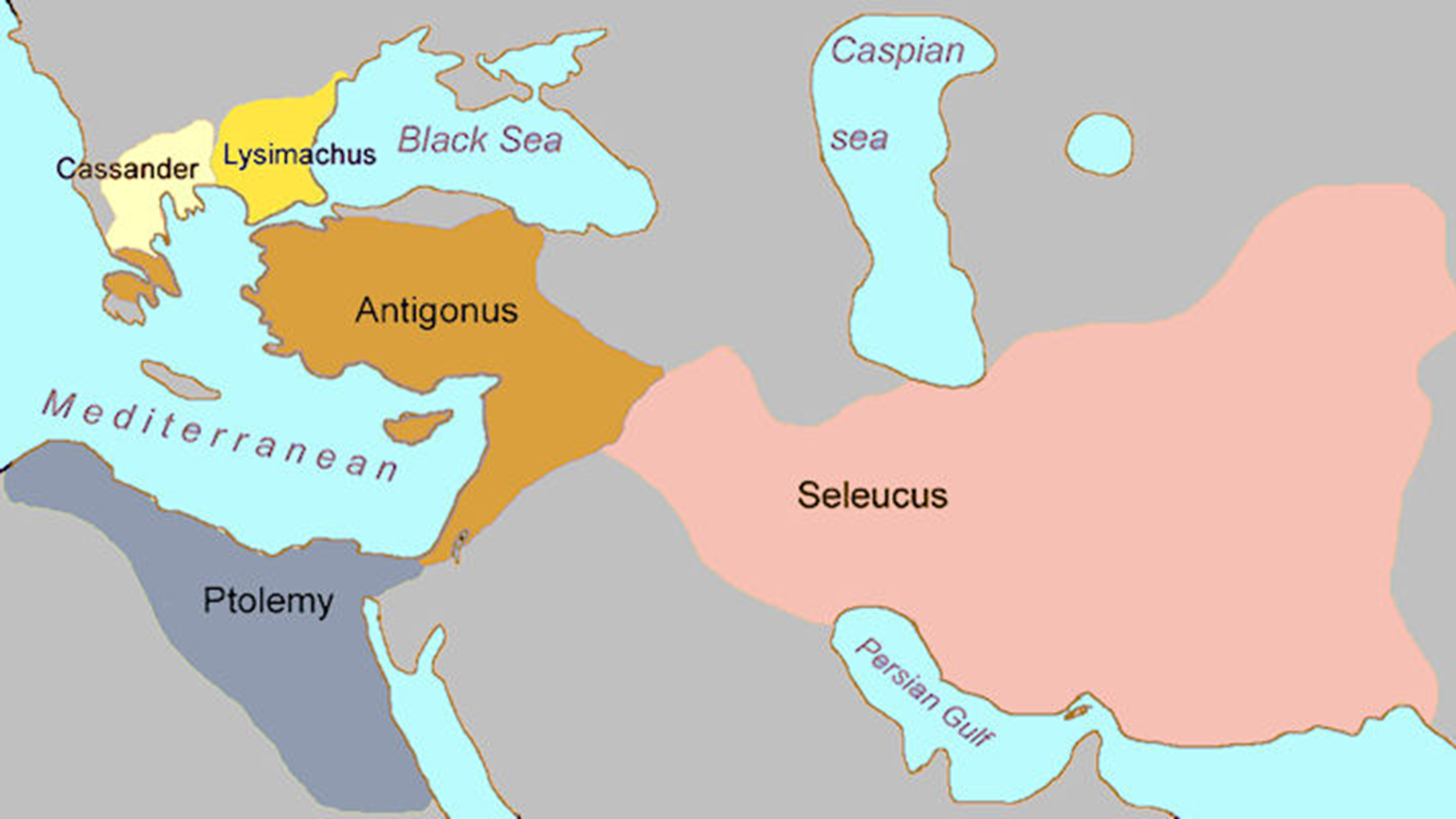
What developments occurred in Macedonia?
Antipater died in 319- creating conflict and instability in Macedonia
Philip III was killed in conflict
Antipater’s son, Cassander, emerged as the effective ruler of Macedonia, holding king Alexander IV, effectively making him regent
What did Cassander do?
Cassander did some rather kingly things that shocked the others: he founded a city named after himself (Cassandreia), and refounded the city of Thebes, which Alexander had destroyed- seemed to be going against the wishes of Alexander
What did nobody dare do at this point?
However, at this point nobody dared to call himself king.
What did Antigonous claim and what did this mean for the other Satraps?
Antigonus claimed the title Lord of Asia (a title also used by Alexander), and declared he was subject only to the authority of the Kings – or King after Philip III’s death
This meant the other satraps (Satraps were provincial governors in the ancient Median, Achaemenid, and later Persian empires) were regarded by him as subordinates
What did Antigonous do to Seleucus?
He forced Seleucus out of his satrapy in Babylonia; Seleucus fled to the protection of his supporter Ptolemy, gave him control of all the Asian part of alexanders empire
What alliance was formed against Antigonous?
An anti-Antigonus alliance: Ptolemy, Seleucus, Lysimachus and Cassander (they were loosely allied against him)
What demands did the alliance make?
They made various territorial demands that were refused, leading to war
What was the proclamation of Tyre?
The Proclamation of Tyre, issued by Antigonus I Monophthalmus in 315 BC, was a key diplomatic act during the Third War of the Diadochi (Successor Wars) declaring that all Greek city-states should be free, autonomous, and ungarrisoned
Who issued the proclamation of Tyre?
Issued by Antigonus while he was besieging Ptolemy’s forces at the city of Tyre
Why were copies of the proclamation dispersed?
Copies of the Proclamation were dispersed widely, so Greeks became generally aware of its content
What did the proclamation help to define?
Helped to define Hellenistic royal rule
What did the proclamation denounce and declare?
Apart from denouncing the ‘royal’ actions of Cassander and his holding the King hostage, it declared that all Greek cities were to be ‘free’
What did Diodorus write on this proclamation?
Diodorus Siculus 19.61-2: ‘the Greeks’ hopes for freedom would make them willing allies in the war’. The Greek cities would support that they should be free, granted some kind of autonomy
When was the proclamation made?
312 BC
What is the kings power a pretence of?
The kings power is pretence of a mutual agreement, the king will reward cities and individuals and those individuals could accept the honour or refuse it (which would be a rebellious act), the king can make all kinds of awards and honours but they are really bound to accept this
What did Antigonous do in denouncing Cassander?
In denouncing Cassander, Antigonus demanded he give up King Alexander IV and obey Antigonus (demolish Cassandreia and Thebes). In the proclamation, Antigonus seems to lay claim to supreme authority over the whole of Alexander’s empire
What did Ptolemy also declare?
Ptolemy also declared that Greek cities would be ‘free’
What did Diodorus write in reaction to all of this?
Diodorus Siculus 19.62: ‘Each side saw that to gain the goodwill of the Greeks would carry no little weight, and so they vied with each other in conferring favours on them’.
What happened in 312 BCE?
In 312 BCE Seleucus recaptured Babylonia, depriving Antigonus of access to the eastern half of Alexander’s empire
What happened in 311 BCE?
In 311 there was a peace treaty between Antigonus, Ptolemy, Lysimachus and Cassander (but not with Seleucus): Antigonus was recognized as ruler in Asia
This peace treaty did not last very long
Write out Antigonous’ letter to Skepsis (a Greek city in north Asia minor)
…We have written a clause into the agreement that all the Greeks should join together in protecting their mutual freedom and autonomy, in the belief that in our lifetime they would in all human expectation be preserved, but that in future with all the Greeks and the men in power bound by oath, the freedom of the Greeks would be much more securely guaranteed. To join in the oath to protect what we agreed with each other did not seem to us inglorious or without advantage to the Greeks. It therefore seems to me right that you should swear the oath which we have sent to you. We shall endeavour in future to achieve whatever is in your interest and that of the other Greeks. Concerning these matters I resolved to write to you and to send Akis to discuss them with you; he brings you copies of the agreement we have made and of the oath. Farewell. (RC 1; OGIS 5; Austin 2006 No. 38)
Analyse this letter
He emphasises the freedom of the Greeks
In so doing he calls upson them to swear support (he will only protect them if they swear to support him)
Immediately indicates the severe limitations upon that freedom
What did Skepsis do to honour Antigonous?
Skepsis developed its festivals in his honour into a cult, with precinct, altar and cult-statue (semi-divine Antigonous)
Explain the Alexander time bomb
By now Alexander IV was about 12 and destined to become supreme rulers of others
Cassander was under pressure to release the hostage and school him to be king
In 310 cassander killed Alexander and the male line of Alexander the great came to an end
With the legitimate king dead there was a question fo what should be done next
What did Plutarch write about them doing in response to this?
“Antigonus and Demetrius were filled with a remarkable eagerness to free Greece, which was all under the sway of Cassander and Ptolemy … As soon as they were decided to sail against Athens, one of their friends remarked to Antigonus that, should they capture the city, they must keep it for themselves, as it was the stepping-stone to Greece. But Antigonus would have none of it, and declared that goodwill was a fair and unshakeable stepping-stone and that Athens, the watch-tower of the inhabited world … would quickly flash to all mankind the message of their glorious achievements.’
Plutarch, Life of Demetrius 8
Plutardch wrote about Antigonous and Demeritorious presented themselves as champions of the Greeks, they attacked Cassander in Greece and sort of liberated Athens.
Prioritising image and legacy over
What problem arose with he death of Alexander IV?
A new problem arose: was the empire to have a single ruler?
What do Antigonous’ actions suggest?
Antigonus’ actions suggest he might have seen himself as sole ruler, but this is contested
Who did they all maintain a fictional loyalty to?
They maintained a fictional loyalty to ‘the King’, even though there wasn’t one. The concept of the empire is there but none of them have the capacity to rule all of it, whether they have the ambition to rule the whole empire may have been the case for Antigonous but not Ptolemy (their aims were different)
What happened in 306 BC?
In 306 Antigonous and his son Demetrius took the next step:
They both took the royal title, basileus (and thus Antigonus showed he had an heir, unlike Alexander the Great) (they declared themselves king)
Who else followed in declaring themselves king?
The other main players, Ptolemy, Seleucus, Lysimachus and (eventually) Cassander all followed in declaring themselves king
What was this move important for?
This move was important for the concept of Hellenistic kingship
Why?
Antigonus was not descended from kings, so by what right did he claim kingship? (before in the Hellenistic rule it was all royalty by descent)
Royal power could henceforth be claimed through personal charisma and military victory (this was now a valid way to define power)
Through these a king claimed absolute power: military; administrative; judicial
What does it mean that in the period of successors there were kings rather than kingdoms?
The king was the kingdom
Demonstrated by Demetrius as he kept losing his land and would have to go make a new kingdom someone else, his land was not permanent but he remained to be king
Draw a map of the kingdoms in 305 BC
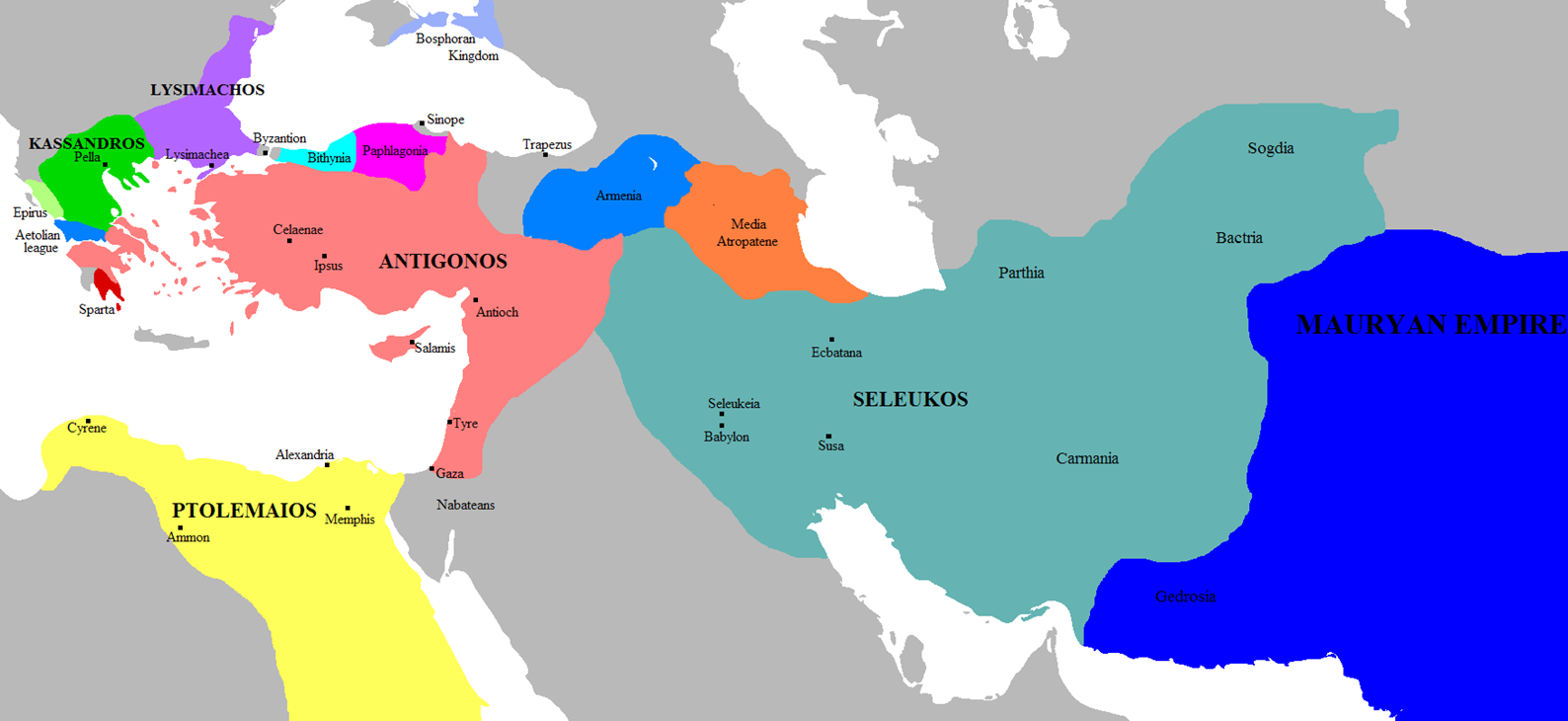
Explain the career of Antigonous from 306-301 BCE
Antigonus seems to have regarded his authority as superior to the other kings, and he may not have regarded the others as legitimate kings at all
The others were forced into an alliance in order to check his power, they had to recognise each other as king
In 306 Antigonus tried to eject Ptolemy from Egypt, but failed (this shows that Antigonous was dangerous for others)
In 302 Antigonous’ son, Demetrius, almost overthrew Cassander
Cassander made a coalition with the others
Lysimachus and Seleucus attacked Antigonus and Demetrius in Asia Minor
When was the battle of Ipsus?
301 BCE
Who fought in the battle of Ipsus?
Antigonus I Monophthalmus and his son Demetrius I (Antigonid dynasty) were defeated by a coalition of Alexander's other successors: Seleucus I Nicator (Babylonia/Persia), Lysimachus (Thrace), and Cassander (Macedon)
Describe the battle of Ipsus and its aftermath
Both sides had infantry, cavalry, elephants and even scythed chariots, but the sheer number of Seleucus’ elephants seems to have carried the day (both sides were fairly evenly matched)
Antigonus died on the battlefield, and Demetrius fled with part of his army. His kingdom evaporated with his death
He (demetrius) tried to sail to Athens, but the Greek cities rejected him; he then established a foothold on the edge of Lysimachus’ kingdom
The end of Indigenous empire but not the end of his dynasty
Draw the Hellenistic Kingdoms after the battle of Ipsus
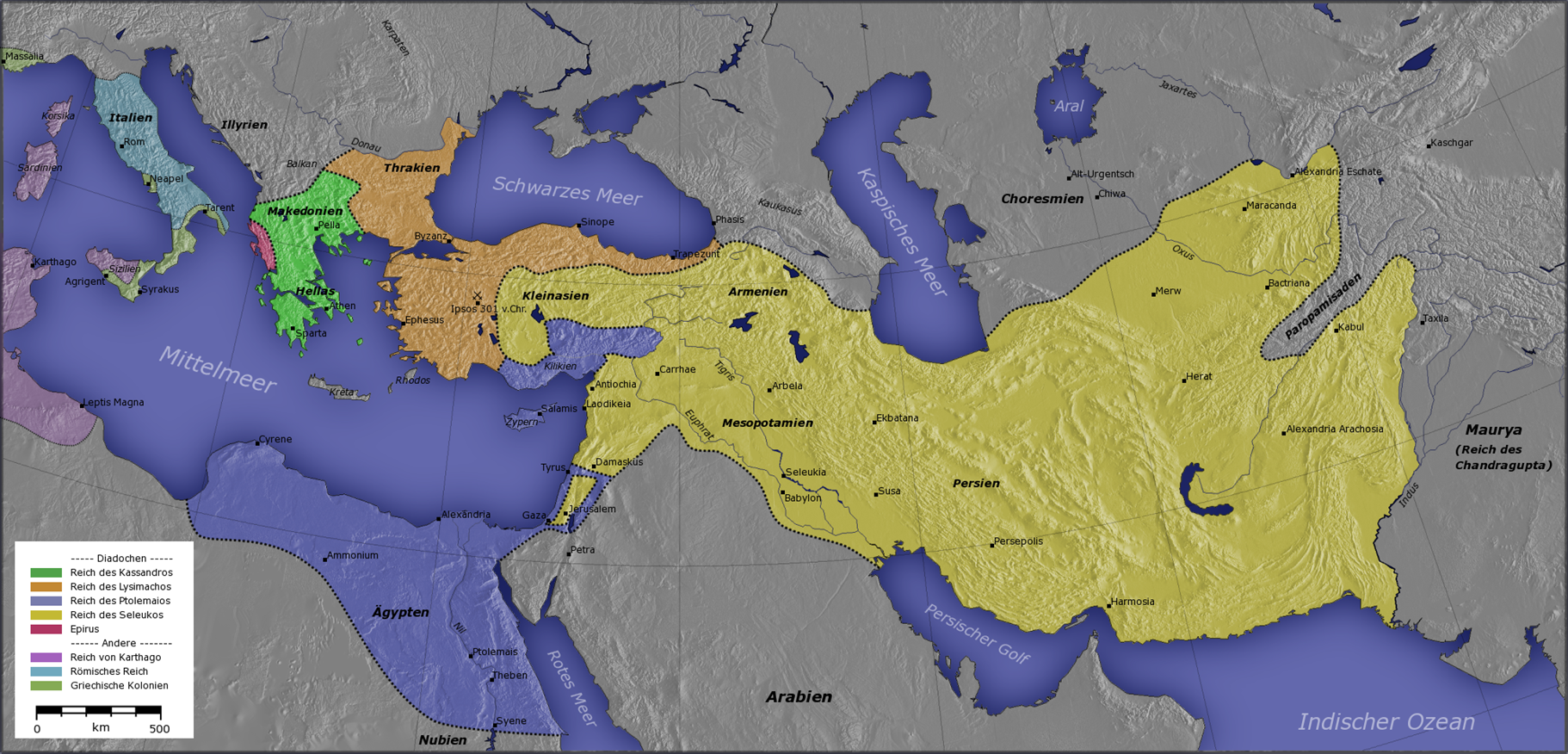
Explain the career of Demetrius (298-283 BCE)
Cassander died in 298 and Demetrius managed to take over the kingdom and establish himself as king by 294, but his position was precarious
In 287 the Macedonians ejected him
He attacked Lysimachus, but the following year (286) he fell into the hands of Seleucus, who held him captive in Syria
After 3 years of captivity he died, but left a son, Antigonus II Gonatas, in Greece. He drank himself to death out of boredom
What was Demetrius the archetype of?
Demetrius is the archetypal Hellenistic king (apart from Alexander)- boundless energy and charisma, turning set backs into success (turns him into a dangerous king for the others)
What was Demetrius’ death the end of?
This was the end of Antigonous dynasty
What were the now three great successor kingdoms?
Seleucus in the east; Lysimachus in Thrace and part of Asia Minor; and Ptolemy in Egypt, Cyprus, southern Asia Minor and the southern Levant
What happened after Ptoelmeies death in 286 BCE?
In 286 Ptolemy died, succeeded by his son Ptolemy II, who, like his father, did not seem to have the territorial ambitions of Seleucus and Lysimachus
The showdown was to be between Seleucus and Lysimachus
Who died in The battle of Corupedium 281 BC
Lysimachus
What happened after Lysimachus’ death?
Seleucus was now free to absorb Lysimahcus kingdom of thrace and perhaps Macedonia, almost completely reuniting Alexanders empire
He crossed into Thrace, but was assassinated by one of his aides, a son of Ptolemy, called Ptolemy Keraunos (the Thunderbolt)
Ptolemy Keraunos established an ephemeral kingdom in part of Thrace, but was killed by invading Gauls who overran Macedonia and Thrace
Draw a map of the Hellenistic Kingdoms after the Battle of Corupdeium:
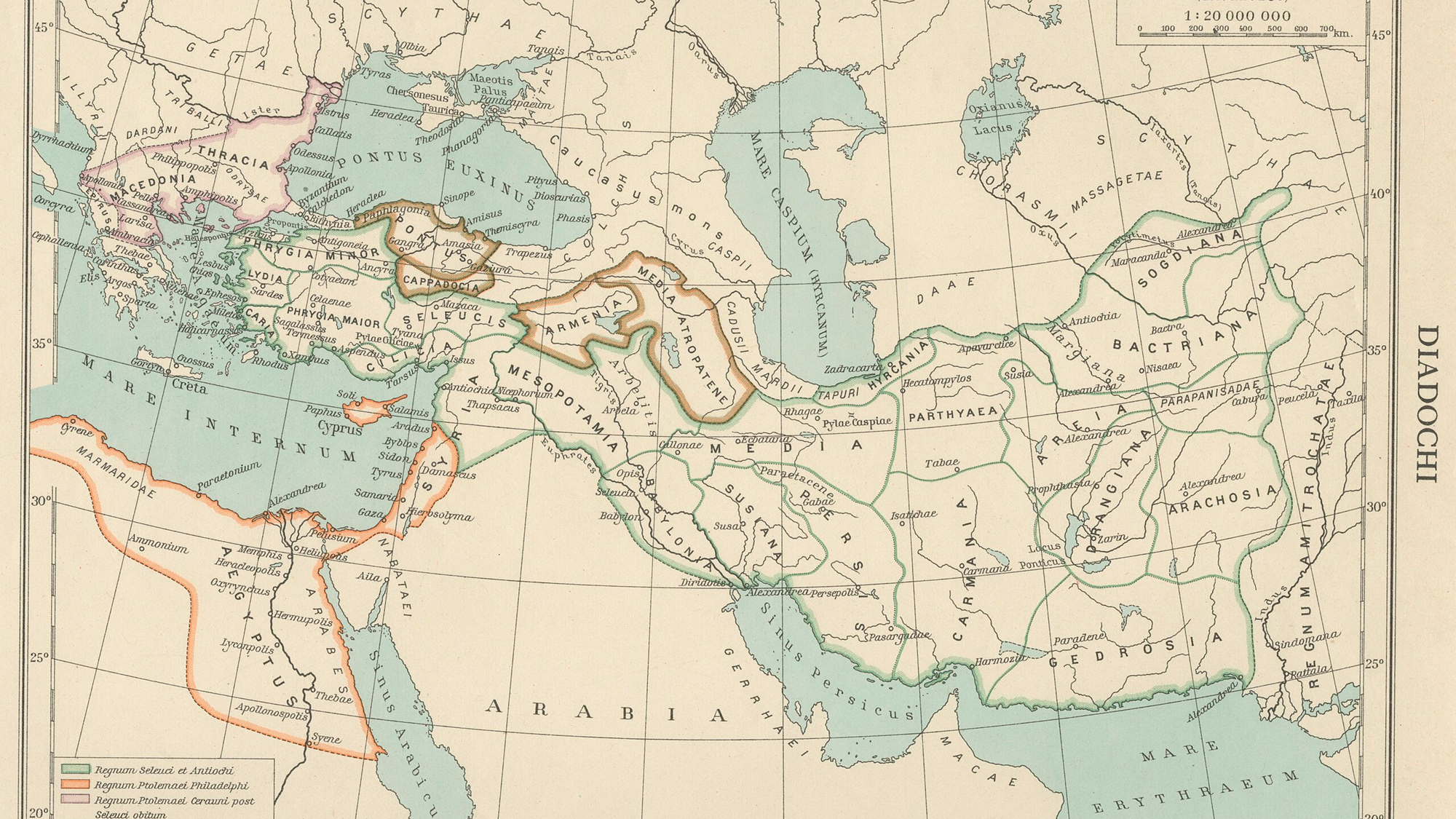
Explain the establishment of the Hellenistic dynasties at this point
Seleucus had been the last of Alexanders generals
His son Antiochus I had been joint ruler with him for many years
He now succeeded as sole king, but he was unable to continue his father’s attempt to conquer Thrace and Macedonia
In 277-276, Macedonia was taken by Antigonus Gonatas, the son of Demetrius, who established the Antigonid dynasty (named after his grandfather, Antigonus Monopthalmus)
List the remaining kingdoms and where they are now
Antigonids in Macedonia
Seleucids in Asia minor, Syria and the east
Ptolemies in Egypt, Cyprus, southern asia minor
Where was most of the Antigonids military interests aimed at?
Most of their military interests were aimed at Greece and the islands
Who were the main rulers of the Antigonids?
Antigonus II Gonatas (276-239 BCE)
Philip V (221-179 BCE)
Perseus (179-168 BCE)
What were the Antigonids struggling to get control of?
Initially locked in a struggle with their rivals for the control of Greece and the Aegean
What did Macedonian society impose constraints on the Antigonids?
Macedonian society may have imposed constraints on the behaviour of Antigonid monarchs (no ruler cult, for example)
Resources
Access to fewer resources than the Seleucids or Ptolemies, but maintained a powerful fleet and a network of fortresses
What did the Macedonians expect from the Antigonids?
Macedonians expected their king to lead their army into battle
Macedonians also frowned on the idea of a ruler cult, these expectations may have imposed limits on Antigonist autonomy
Who were the main rulers of the Seleucid kingdom?
Antiochus I Soter (281-261 BCE)
Antiochus III the Great (223-187 BCE)
Antiochus IV Epiphanes (175-163 BCE)
What did the size of the Seleucid kingdom mean?
A huge kingdom which was very difficult for its rulers to exercise control over effectively- (Multiple rulers due to such a large space)
What were the people like in the Seleucid kingdom?
Unlike the Antigonids, the peoples they ruled over were ethnically and culturally diverse – most were not Greek or Macedonian- It was very heterogenous, ruled over lots of different peoples. They couldn’t do it in the same way the antagonists and macedonians could.
What did the Seleucid rulers make an effort to do?
They made an effort to behave as traditional rulers to these peoples: as a Babylonian king to Babylonians, for example
What was the seleucid army composed of?
The seleucid army was composed of Greeks and non-greeks
What did thre seleucid empire conform more towards?
This empire may have conformed more towards Alexanders vision of empire compared to the others
Give three facts about the Seleucid empire
They founded dozens of cities
They had access to vast resources due to how large it was
They had large armies as well, they needed these armies to maintain control of their own empire
How long did the Ptolemaic dynasty last?
The Ptolemaic dynasty outlived its rivals ending in 30 BCE with he death of Cleopatra VII
List the main rulers of the Ptolemaic kingdom
Ptolemy II Philadelphus (285-246 BCE)
Ptolemy III Euergetes (246-221 BCE)
Ptolemy VI Philometor (181-164, then 163-145 BCE)
Ptolemy VIII Physcon (170-163, then 145-116 BCE)
Ptolemy XII Neos Dionysos (Auletes) (80-51 BCE)
Cleopatra VII (51-30 BCE)
What rivalries did the Ptolemies have?
Rivalry between them and Seleucids for control of Syria
Rivalry with the Antigonids in Greece and the Aegean
What of the Ptolemies was attacked and how did they respond to this?
Egypt was difficult for rivals to attack, but they could attack the Ptolemies’ overseas possessions
The Ptolemies developed a powerful navy to protect their overseas interests
What were the Ptolemaic armies composed of?
Ptolemaic armies were composed of Graeco-Macedonians from Egypt or mercenaries
Did they often participate in war?
Ptolemaic kings rarely participated in war (although Ptolemy VI did) unlike the Macedonian tradition