Urinary Physiology Asynchronous Questions
 Call Kai
 Learn
Learn Practice Test
 Spaced Repetition
 Match
Match Flashcards
 Knowt Play
1/21

There's no tags or description
Looks like no tags are added yet.
Name | Mastery | Learn | Test | Matching | Spaced | Call with Kai |
|---|
No analytics yet
Send a link to your students to track their progress
22 Terms
A decrease in plasma ____ will cause an increase in the anion gap.
A. albumin
B. glucose
C. chloride
D. bicarbonate
E. lactate
D. Bicarbonate
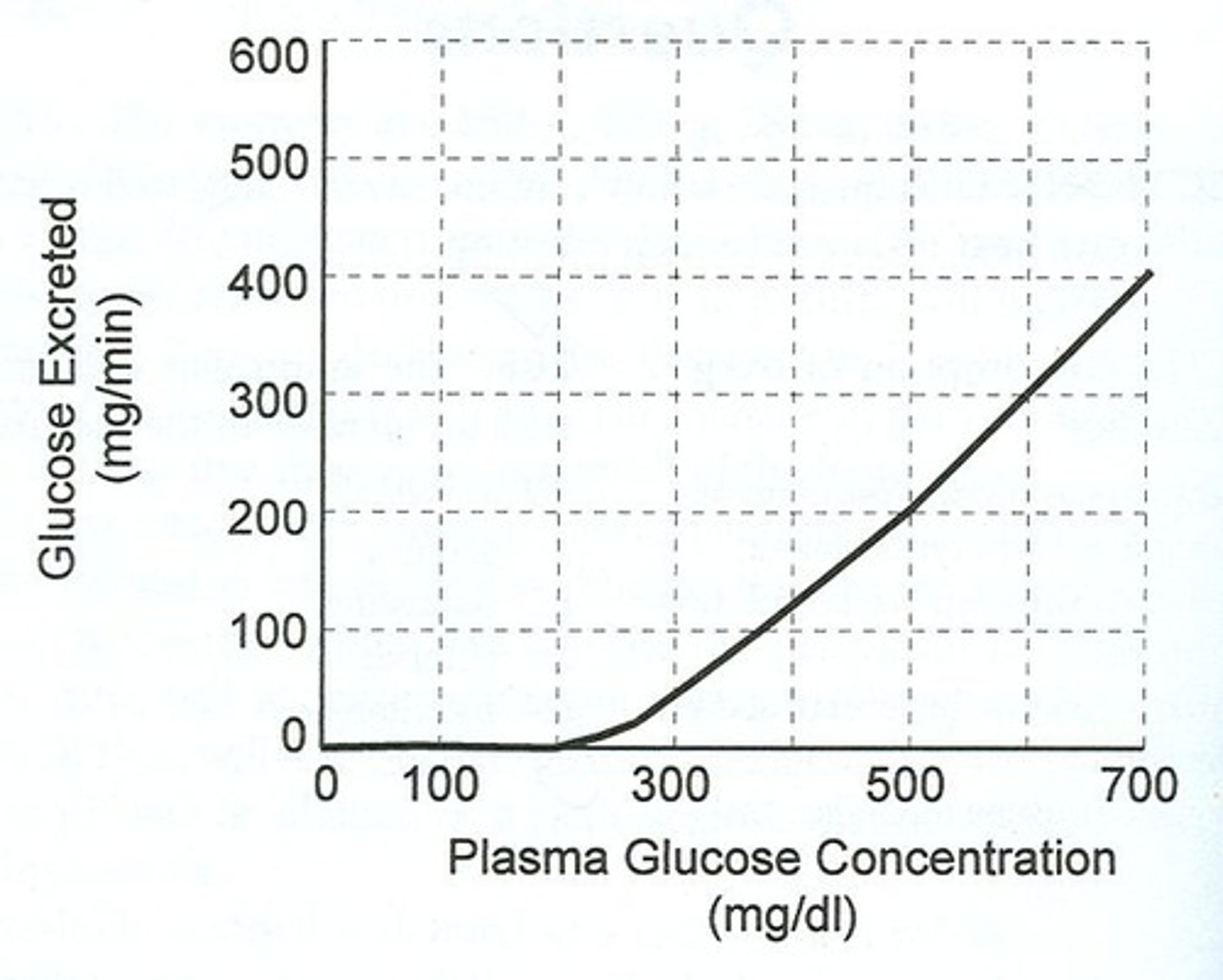
The graph to the right, the relationship between plasma glucose concentration and glucose reabsorption by the kidney. To determine the filtered load of glucose from the graph, we need to know the
A. the clearance of PAH.
B. the clearance of glucose.
C. the RPF.
D. the GFR.
E. the RBF
D. the GFR
From the graph above Tmax for glucose in mg/dl is closest to?
A. 100
B. 150
C. 225
D. 300
E. 350
C. 225
What does the color of urine indicate?
A. The hydration status.
B. The osmolarity of the urine.
C. The output of urine.
D. Free water clearance.
E. Each of the above.
B. The osmolarity of the urine.
Bill drinks 200 ml normal saline quickly. Give the distribution of the saline.
A. 100 ml goes to the ECF and 100 ml goes to the ICF
B. 150 ml goes to the ECF and 50 ml goes to the ICF
C. 100 ml goes to plasma the rest goes to the ICF
D. All 200 ml goes to the ECF.
D. All 200 ml goes to the ECF.
Which of the following defines renal excretion load of a filtered substance?
A. GFR x plasma concentration of that substance.
B. Urine concentration of that substance x urine flow rate.
C. Clearance of creatinine.
D. Clearance of inulin.
E. Urine concentration of the substance x GFR.
B. Urine concentration of that substance x urine flow rate.
What will cause an increase in the glomerular filtration rate?
A. Secretion of renin from juxtaglomerular cells
B. Volume depletion
C. Blockage of a ureter
D. Dilation of afferent arterioles
E. Contraction of mesangial cells
D. Dilation of afferent arterioles
Functions of the kidney include
A. filtration of plasma.
B. production of erythropoietin.
C. regulation of plasma pH.
D. regulation of urine volume and concentration.
E. each of the above.
E. each of the above.
Renal plasma flow is estimated by determining renal clearance of
A. glucose.
B. creatinine.
C. PAH.
D. oligopeptides.
E. water
C. PAH.
What does an increase in free water clearance indicate?
A. Glucosuria.
B. Reduced renal blood flow.
C. Dehydration.
D. The effect of AVP.
E. Formation of a dilute urine.
E. Formation of a dilute urine.
If substance X is present in the renal artery but missing in the renal vein what has happened to X?
A. It was secreted into peritubular capillary blood.
b. It was metabolized by renal tubular cells.
C. It was synthesized by tubular cells.
D. It was cleared completely from the blood.
E. It was not filtered by the glomeruli.
D. It was cleared completely from the blood.
Which of the following is not part of the juxtaglomerular apparatus?
A. Granular cells
B. Macula densa cells.
C. Distal tubular cells.
D. Podocytes.
E. Afferent arteriolar endothelial cells.
D. Podocytes.
Certain foods are rich in K+. To avoid hyperkalemia K+ is removed by
A. total clearance from the renal filtrate.
B. reabsorption of filtered K+.
C. actions of insulin and aldosterone.
D. storage in the liver.
E. increased sweating.
C. actions of insulin and aldosterone.
Which substance is readily filtered across glomerular capillaries but normally absent in the urine?
A. Glucose
B. PAH
C. Hemoglobin
D. Inulin
E. Creatinine
A. Glucose
Glomerular tubular balance primarily relates to
A. secretion of H+ by the TAL.
B. secretion of HCO3- by the TAL.
C. tubular reabsorption of glucose.
D. alterations in the tubular reabsorption of NaCl.
E. permeability of glomerular capillaries.
D. alterations in the tubular reabsorption of NaCl.
Most filtered solutes are primarily reabsorbed by proximal tubular cells. Which of the following is the exception?
A. Cl-
B. Na+
C. Ca2+
D. Mg2+
E. Glucose
D. Mg2+
Which of the following is correctly matched with the information given?
A. Macula densa cells monitor the glucose concentration in the filtrate.
B. α-intercalated cells secrete HCO3- into tubular fluid.
C. β-intercalated cells secrete HCO3- into tubular fluid.
D. Granular cells reabsorb filtered glucose.
E. Granular cells secrete ADH.
C. β-intercalated cells secrete HCO3- into tubular fluid.
Which of the following correctly characterizes the loops of Henle?
A. They are limited to cortical nephrons.
B. Long loops are linked to formation of dilute urine.
C. The ascending and descending limbs have equal permeabilities.
D. Countercurrent flow of the filtrate.
E. Secretion of glucose.
D. Countercurrent flow of the filtrate.
The glomerular filtration barrier does not include
A. fenestrated capillary endothelium.
B. pedicels of podocytes.
C. basement membranes.
D. podocyte processes.
E. macula densa cells.
E. macula densa cells.
PTH and vitamin D3 play a prominent role in the renal reabsorption of filtered
A. ferrous iron.
B. glucose.
C. amino acids.
D. Ca2+.
E. Mg2+.
D. Ca2+.
From the above data, what is the most likely acid-base disorder in this patient?
A. Metabolic acidosis
B. Metabolic alkalosis
C. Respiratory acidosis
D. Respiratory alkalosis
E. Mixed metabolic alkalosis and respiratory alkalosis
B. Metabolic alkalosis
The cause of the condition in question 21 is
A. loss of gastric acid.
B. hyperkalmia.
C. increased anion gap.
D. hypernatremia.
E. hyponatremia.
A. loss of gastric acid.