Particles and Radiation
 Call Kai
 Learn
Learn Practice Test
 Spaced Repetition
 Match
Match Flashcards
 Knowt Play
1/42

There's no tags or description
Looks like no tags are added yet.
Name | Mastery | Learn | Test | Matching | Spaced | Call with Kai |
|---|
No analytics yet
Send a link to your students to track their progress
43 Terms
State the mass and charge of the proton, neutron and electron
Proton: 1.67⋅10−27 kg, 1.6⋅10−19 C
Neutron: 1.67⋅10−27 kg, 0 C
Electron: 9.11⋅10−31 kg, −1.6⋅10−19 C
Describe nuclide notation of AzX
A is the mass/nucleon number, Z is the atomic/proton number.
Define Isotope
Atoms of the same element (same number of protons) but a different number of neutrons
Define specific charge and its units
The amount of charge an object has per unit mass, charge per unit mass
(Ckg−1 )
How do some isotopes become more stable
The isotopes undergo radioactive decay
Define Carbon Dating
Looking at the amount of isotopes in a material to estimate its age
Define specific charge including the equation and units
The amount of charge an object has per unit mass
Specific charge = charge/mass
Units = Ckg−1
State what contributes to the charge and mass of a nucleus
Only protons contribute to the charge of a nucleus
Protons and neutrons contributes to the mass of a nucleus
State the four fundamental forces
Gravity, electromagnetism, strong nuclear force, weak nuclear force
State the properties of the strong nuclear force
Repulsive less than 0.5fm
Attractive between 0.5fm and 3fm
No effect beyond 3fm
When does a nucleus become unstable
Too much energy
An imbalance between protons and neutrons contributes
Too much mass
State what occurs in alpha decay
A nucleus emits an alpha particle consisting of 2 protons and 2 neutrons (Helium nucleus)
State what occurs in beta minus decay
A neutron turns into a proton through the weak nuclear force, releasing a beta particle (electron) and an electron antineutrino
State the force for beta decay
Weak nuclear force
State 2 things photons do not have
Mass
Electric Charge
Define annihilation
When a particle meets its anti-particle collide and release energy in the form of two photos moving in opposite directions to conserve momentum
Define rest energy
The energy stored in an objects mass
State the equation used for annihilation
2mc2=2hf
Define pair production
When a photon turns into a particle and its antiparticle, if the photon has more than the minimum energy required for pair production, the excess becomes kinetic energy or enables the production of more massive particles
State the equation for pair production
hf=2mc2
State how to convert from eV to Joules
multiply by 1.6×10⁻¹⁹
An anti-particle has the ___ but opposite ___ of the particle
The same mass
Opposite charge
State an equation relating and objects rest energy and mass
E=mc2
State the differences between hadrons and leptons
Hadrons can feel the strong nuclear force, leptons cannot
Hadrons are made up of smaller particles called quarks, leptons are fundamental particles
State the 2 types of hadron
Baryons and mesons
Describe baryons and mesons and examples
Baryons
Made up of 3 quarks
The most stable baryon is the proton which all other baryons eventually decay into
Examples: Protons, neutrons and sigmas
Mesons
Made up of a quark and anti-quark
Examples: Pions, Kaons
State which forces leptons and hadrons feel
The strong nuclear force, gravity and electromagnetic force if charged
State some examples of leptons
Electron, muon, electron neutrino, muon neutrino
State all quantum numbers
baryon number, lepton electron number, lepton muon number
State which leptons are stable
Electrons and neutrinos are stable
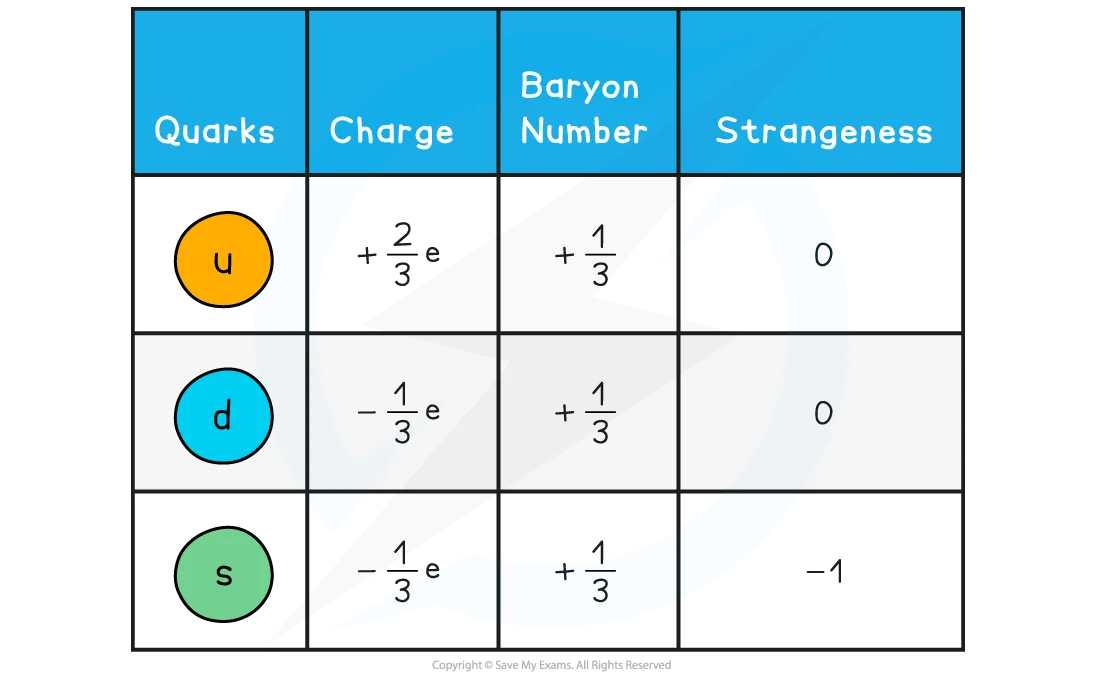
State all pion and kaon quark combinations
Pions (no strange quarks)
π+=ud
π−=du
π0=uu anddd
Kaons (contain strange quarks)
K+=us
K−=su
K0=ds
K0=sd
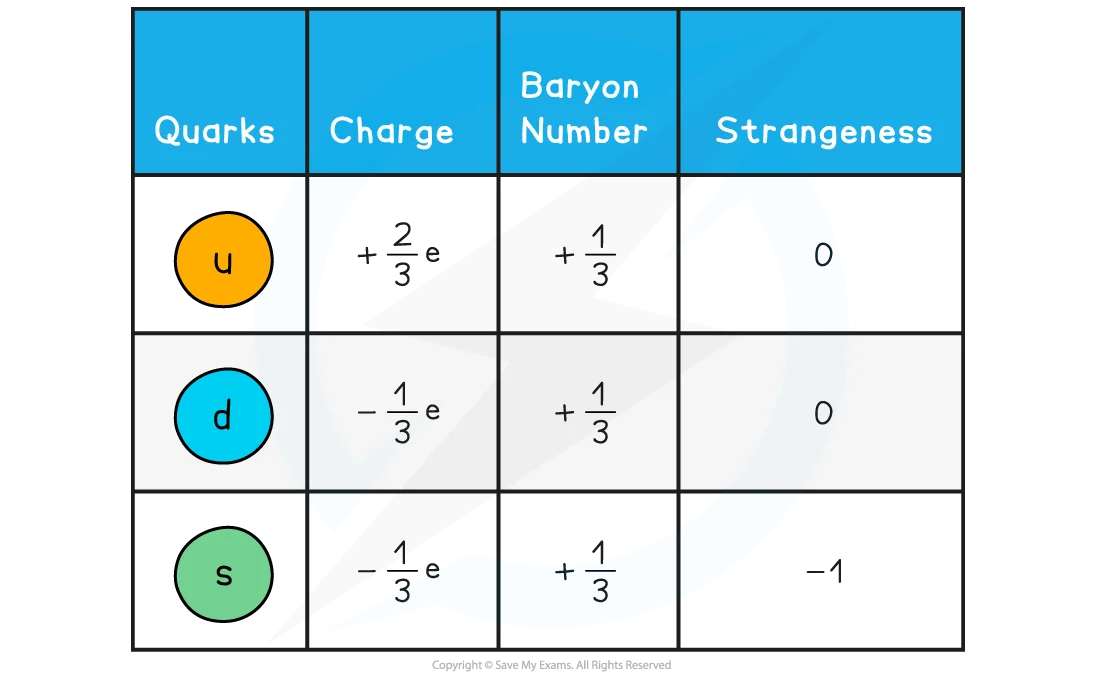
State the quark compositions of protons and neutrons
Proton = uud
Neutron = udd
Why can quarks not exist on their own
Due to quark confinement → The energy required to pull them apart creates a new quark-antiquark pair (pair production)
State what must be conserved in particle interactions, include strangeness
Charge
Baryon Number
Lepton electron number
Lepton muon number
Strangeness is sometimes conserved
Strangeness always conserved in strong interactions
Strangeness is not always conserved in a weak interaction (can change by +1, -1 or 0)
What causes strong and weak particle interaction
Strong interaction is cause by the strong nuclear force (SNF)
Weak interaction is caused by the weak nuclear force (WNF)
State how to identify strong and weak particle interactions
Strong
Only involves hadrons, no leptons
Strangeness conserved
Weak
Likely involves leptons
Strangeness may not be conserved
Often 1 particle decaying into 2 or 3
If quark flavour changes/changes letter e.g. u→d
Describe all 4 fundamental forces in nature
Gravity = Force acting between matter with mass, always attractive
Electromagnetic force = acts between charged objects
Strong nuclear force = holds atomic nuclei/protons and neutrons together
Weak Nuclear Force = responsible for some radioactive decay and particle transformations
For each of electromagnetic, WNF, SNF and gravity, give their exchange particle and its properties and range
Electromagnetic Force = Virtual Photon, 0 mass and 0 charge, infinite range
Gravity = Graviton, 0 mass and 0 charge, infinite range
Weak Nuclear Force = W+and W− bosons, Has mass and charge, very short range
Strong Nuclear Force = Pions (between nucleons) and gluons (between quarks), has charge and mass, very short range
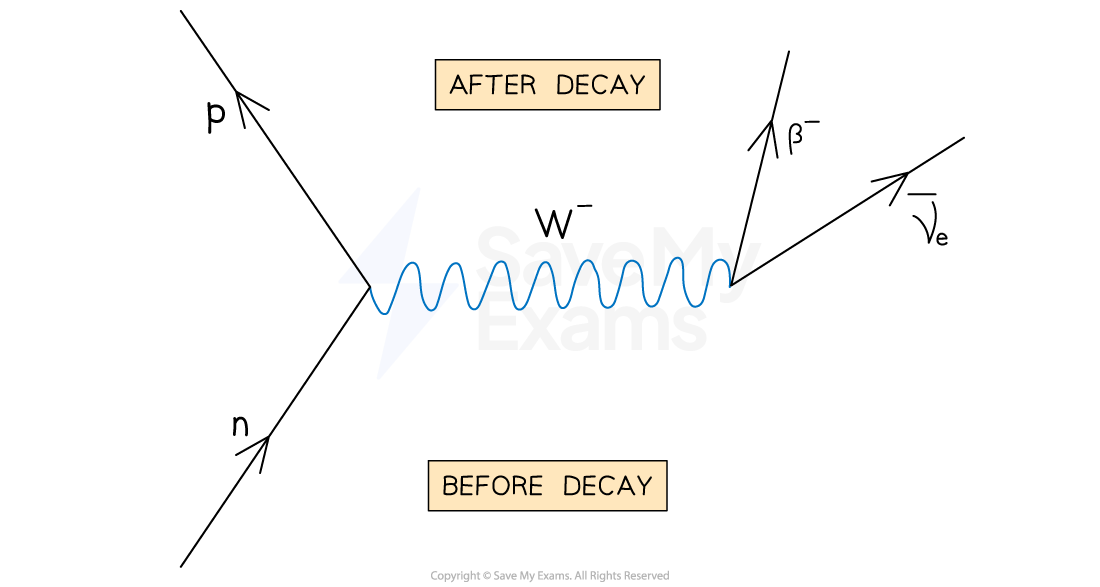
State which particle interaction is given by the image
Beta Minus Decay

State which particle interaction is given by the image
Beta plus decay
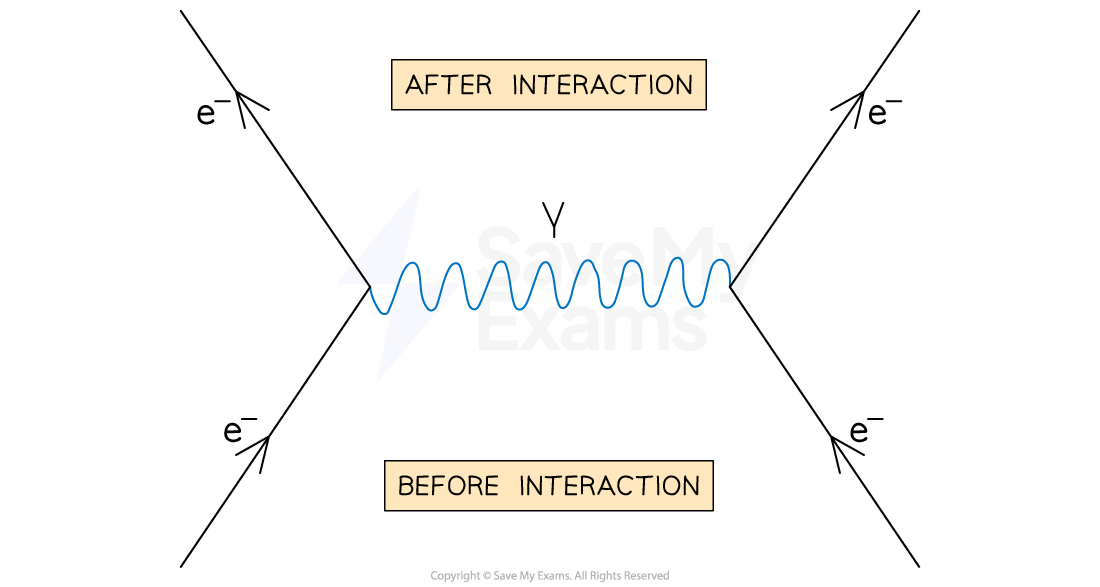
State which particle interaction is given by the image
Electromagnetic/electrostatic repulsion (between electrons)
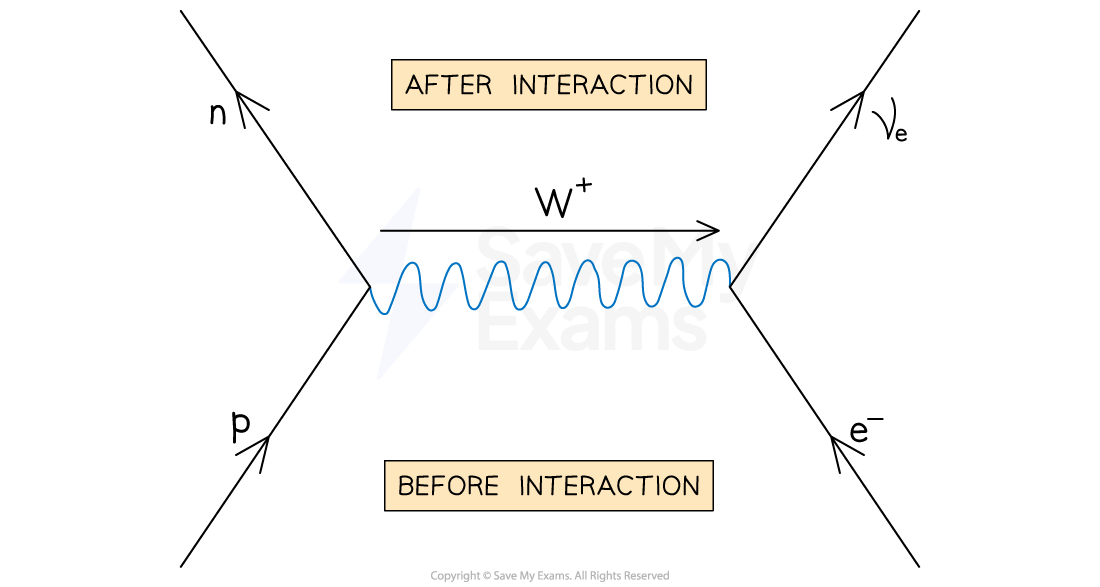
State which particle interaction is given by the image
Electron capture (←Think of it has +ve capturing -ve)
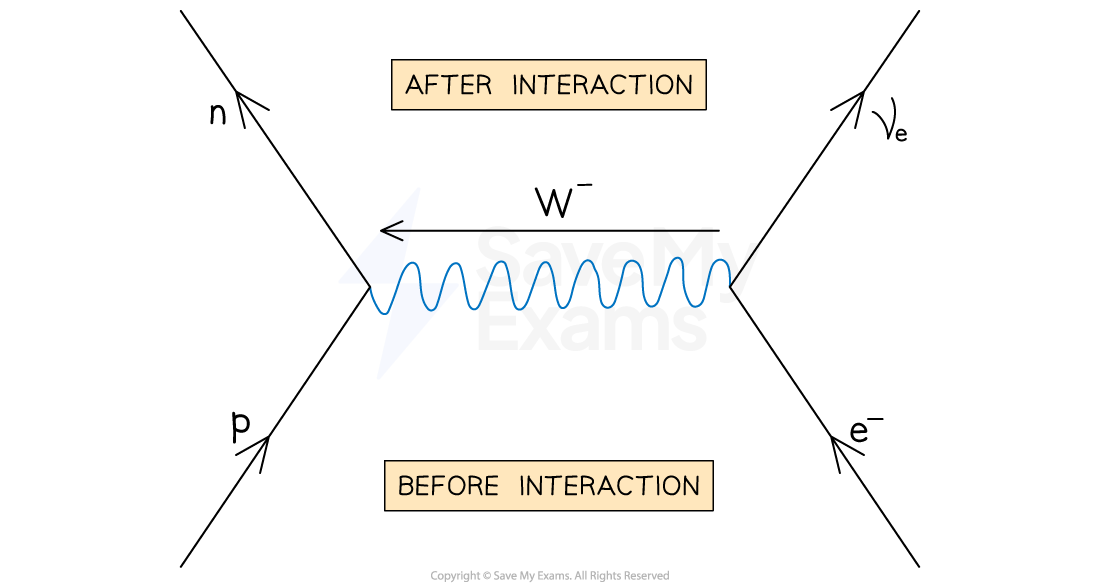
Electron-proton collision